
Killed by Mosby’s Guerillas
By Carl L. Sell Jr. · Originally published April 2018 · pp. 6–7
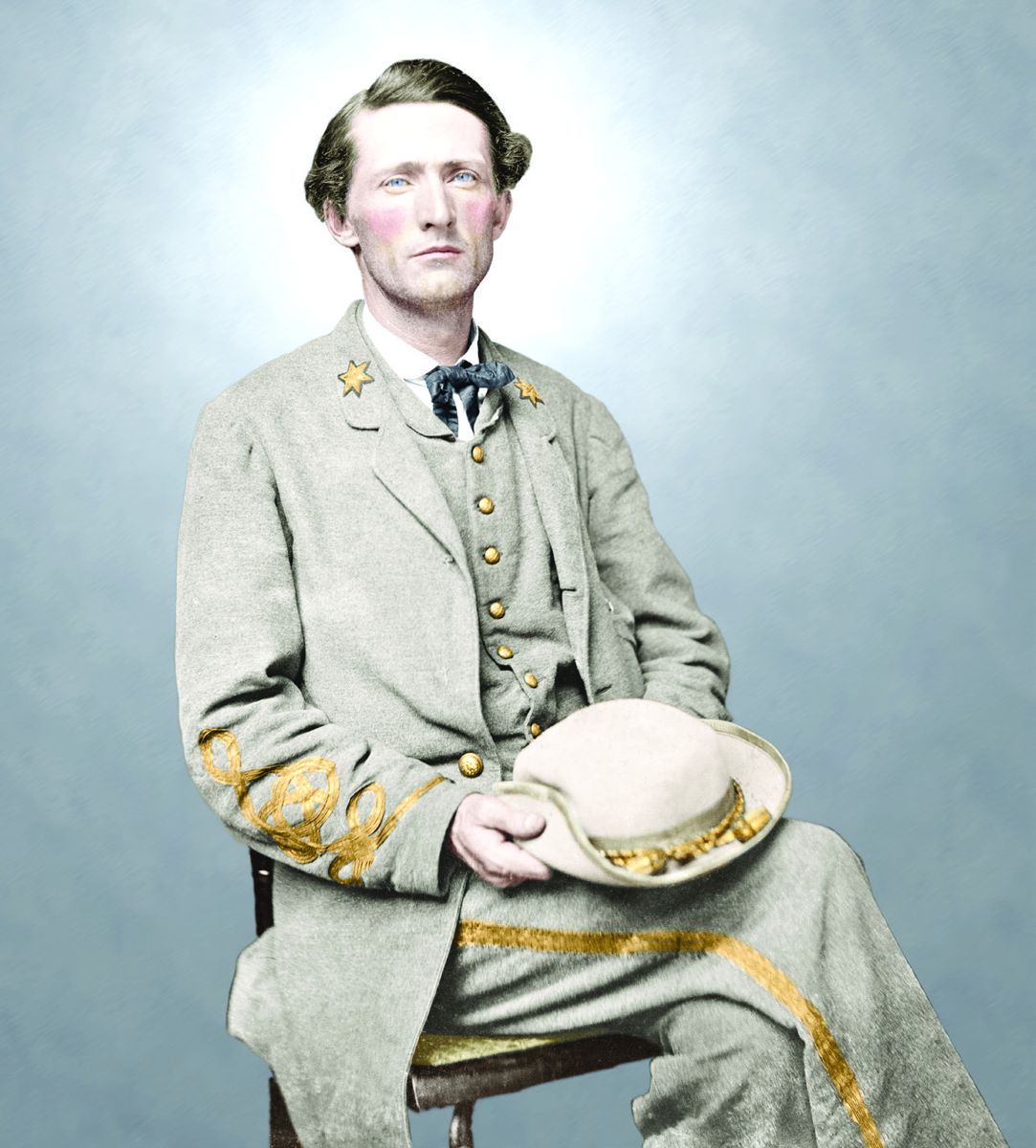
The inscription on the young Union cavalryman’s grave reads “Killed by Mosby’s Guerillas.” He is buried near his home town of Littlestown, Penn., just a few miles from Gettysburg. The town and surrounding farms served as hospitals after the famous battle. Edmund Sell was too young to fight at Gettysburg, but he joined the army on Aug. 26, 1864. He died in Virginia less than three months later. Edmund had volunteered at age eighteen as a substitute and joined Co. E, 17th Penn. Cav., one of three Penn. cavalry units raised after President Abraham Lincoln’s call for additional troops on July 2, 1862. Although famed Confederate guerilla John Singleton Mosby wasn’t present, his 43rd Va. Bn. surprised the 17th Penn. Cav. at Stephenson’s Station near Winchester, killing four and wounding three. Private Edmund Sell and three comrades were killed Nov. 16, 1864. Their deaths came during a period of extreme passion among Union and Confederate forces that was triggered by a reign of terror in the Shenandoah Valley. After victories in midSept. at Winchester and Fisher’s
Hill, Sheridan started what became known as “The Burning of the Shenandoah Valley” that destroyed crops, barns, mills, and livestock in order to starve the Confederates. The devastation went on for almost two weeks while Sheridan went to Washington City for a meeting. During Sheridan’s absence, Confederate Gen. Jubal Early launched a surprise attack at Cedar Creek and overwhelmed the Federals. As Sheridan rode back toward Middletown, he was puzzled by the sounds of battle. After reorganizing his forces, Sheridan counterattacked and drove Early off. This put the Valley firmly under Union control or, so the northern general thought. In late Sept., Union forces led by Brig. Gen. Alfred T. Torbert and Brig. Gen. George A. Custer hanged and shot six of John Singleton Mosby’s 43rd Va. Bn. Cav. at Front Royal. Another was hanged later at Chester Gap. Mosby then captured fourteen members of Custer’s Division and promised to execute seven. He had three hanged, three shot and the seventh escaped. On Nov. 11, Mosby sent a message to Sheridan that he would continue to execute Union soldiers if any more of his men suffered a similar fate. The human barbarity was over, but the Federals continued to burn the Shenandoah and Loudoun Valleys. Sheridan no doubt had heard of John Singleton Mosby, but he had little direct knowledge of the strength of the Confederate partisan and his men. None the less, Union camps were heavily guarded and the numbers on patrol were increased because Mosby’s successful hit and run tactics bedeviled Union commanders on both sides of the Blue Ridge and the Potomac River for more than two years. The 17th Penn. Cav. had not been involved in any heavy fighting since arriving in the Valley. The unit participated in several skirmishes, mostly involving the delivery of messages from the command center in Winchester to scattered outlying units. Such was the case early on Nov. 16, 1864. Little did they know that Rangers under Capt. Richard Montjoy had ridden all night from the Blue Ridge, crossed the Shenandoah River and were waiting on the Valley Pike above Winchester for unsuspecting Yankees.
Family tragedy and war already had scarred Edmund Sell’s young life. He was not quite fifteen when his father, David Sell, died at age forty nine on Feb. 8, 1861, leaving behind a wife and ten children. On March 3, 1863, his mother, Lydia, moved into Littlestown. She would remarry a little over a year later. A half-brother, David, was drafted in 1862, went away to war and was never heard from again. In June 1863, the war came to Adams County, Penn., as Union and Confederate cavalry sparred with each other in a prelude to Gettysburg. On August 26, 1864, Edmund volunteered with the Union Army at age eighteen as a substitute and joined Company E of the Seventeenth Pennsylvania Cavalry. Three months later he was dead, killed in a skirmish with Mosby’s cavalrymen, at Stephenson’s Winchester and Potomac Railroad Depot, just north of Winchester, Va. His mother went from Littlestown to Winchester, reclaimed his body from a grave there and brought it home. Edmund is buried with his father and other family members in the United Church of Christ cemetery just outside Littlestown on the road to Hanover, the same road where Union and Confederate cavalry battled each other July 2 and 3. The following account of the engagement written by a New York Times correspondent appeared in both the Times and the Philadelphia Press several days later. The headline in the Philadelphia Press read “Guerrilla Attack on a Detachment of the Seventeenth Pennsylvania Cavalry—the Casualties—Recapture of Prisoners by Michigan Cavalry.” “A correspondent of the New York Times with Sheridan’s Army, writing last Thursday, gives the annexed account of an attack upon a detachment of the Seventeenth Pennsylvania Cavalry, between the army and the Opequon: [identifications and corrections are in brackets] “Sergeant [Martin] Schaffner [Shaffner], with fifteen men of Company E, Seventeenth Pennsylvania, accompanied by Corporal William Amwake, clerk at Colonel (Julian) Kellogg’s headquarters, started for the Opequon, by order of Colonel [Oliver] Edwards, commandant at Winchester, to take dispatches to the railroad station on the Opequon. The party succeeded in reaching the point designated without interruption, but when on their return, after having crossed the Opequon, and passing through a piece of woods, they encountered one company of Moseby’s [Mosby’s] men, one hundred and nine strong, commanded by Captain Montgomery [Montjoy] and Lieut. Smith* a son of Extra Billy Smith, of Warrenton. They [the enemy] had just returned from Martinsburg and Winchester Pike, and had captured a newsboy’s wagon, the driver of which was still in their custody. “The enemy was concealed behind a barn, and only exposed a squad of the advance of Sergeant Schaffner’s [Shaffner’s] party. The advance guard was not halted, but as soon as the main body came into sight they were ordered to surrender, which order the commander refused to obey, when instantly the whole of the enemy’s force charged, surrounded the party, and an indiscriminate slaughter commenced. Of the seventeen men, seven were killed or wounded. One man escaped, who was on the rear guard, and, returning to camp, gave information of what occurred. The balance of the party (nine men) were taken prisoner. “Col. Kellogg, with 250 men of the Seventeenth Pennsylvania Cavalry, immediately, started out in pursuit, but only succeeded in recapturing two men belonging to the Second Massachusetts Cavalry, who had been previously captured by the enemy while on picket. But it seems that the enemy was not to escape so easily. The Fifth Michigan Cavalry met them near the ford of the Shenandoah [River] at Ashby’s Gap when all but one of the prisoners were recaptured, and at last accounts one rebel sergeant and a private had been killed, and the Fifth Michigan were fighting them five miles east of the river. As the regiment had fourteen men murdered by Moseby’s [Mosby’s] men in August last, it is not supposed that they will escape through any fault of theirs. “The death of Sergeant Schaffner [Shaffner] is particularly regretted, because he was a superior soldier. Only two weeks ago he was captured, and made his escape at the peril of his life from the guard of two men. He had frequently said that he would never be taken to Richmond; indeed, when ordered to surrender, he positively refused until wounded, and then the dastardly cowards shot him a second time, inflicting the wounds from the effects of which he died last night. “The casualties in the detachment were as follows: Sergt. Schaffner [Shaffner], commanding, died of wounds; R.W. Moll, wounded, shot after he had surrendered; Adam Fox, wounded; Henry Fredericks, killed; Martin Morgan Tyler, rear guard, escaped uninjured; Jos. Sheffler, wounded; Henry Glebe, wounded; Edward [Edmund] Sell, killed; W. F. Williams, missing—was a prisoner as well when last seen; Jacob Shell, recaptured; Norman Garletz, recaptured; William A. Poltz, recaptured; E.E. Taylor, recaptured; John Shinn, recaptured; John Petus, recaptured; Adam Wertz, recaptured; J. [Joseph] Tobias, recaptured. “In Montgomery’s [Montjoy’s] company there were ten or twelve men in citizen’s clothing, and one of them talked openly about having work to do on his farm today. One member of this company belongs in Easton, Pennsylvania, he refused to give his name. “Moseby’s [Mosby’s] headquarters, for several days past, have been in Warrenton, but he is about locating at Culpeper.” Mosby expert Don Hakenson says Mosby probably was staying at Brookside, outside Delaplane in Fauquier County. He had made Brookside his temporary headquarters after Heartland, the nearby home of Joseph Blackwell, was burned by the Yankees. Two days after the attack, the Philadelphia Inquirer printed a dispatch that said that skirmish occurred at the intersection of the Martinsburg and Charleston [Charles Town] Roads. The Inquirer said “some twenty five of the Seventeenth Pennsylvania were attacked by one hundred and fifty of Mosby’s men,” when the Union unit was on its way from Harper’s Ferry to Winchester. It listed four killed, two dead outright and two more succumbed to their wounds. Later on November 16, Montjoy’s command was attacked by Union scouts led by Captain Richard Blazer. At first, the Confederates were routed but reinforcements were gathered and Mosby’s 43rd Va. Cav. Bn. eventually defeated the Union force and captured Blazer in ongoing fights over the next few days ranging from Castleman’s Ferry on the Shenandoah River to Kabletown, north of Winchester. Like the Union commanders after the November 16 shooting, Mosby decided he had to answer or curtail his activities. Sheridan’s report of the engagements revealed that the Union suffered sixteen killed, six wounded and the rest scattered. Mosby would remain a burr under his saddle. On November 27, Mosby sent Montjoy and Company D of the Rangers to northern Loudoun County to counter Federal activity that was terrorizing pro-Confederate residents. Montjoy headed for Waterford, where the Union troopers, along with the pro-Union Loudoun Rangers, usually gathered. Finding no activity, Mosby’s men headed north on the Point of Rocks Road. At Paxton’s Store at Goresville, just south of Lucketts, they ran into two companies of the Loudoun Rangers. Mosby’s men immediately attacked and the pro union forces split into groups and fled. Some headed for the Potomac River, another ran toward Leesburg and some ran across open fields with Montjoy and others in hot pursuit. Mahlon Best, a Loudoun Ranger, fired his pistol, hitting Montjoy in the head, killing the Confederate partisan. There are two eye-witness accounts of the incident. Loudoun Ranger Bruce Goodhart wrote that “M.H. Best turned in his saddle, took deliberate aim, fired, and killed Montjoy, the ball entering his brain.” Mosby Ranger John Munson’s account was a tad different. “Montjoy….. was close on his heels when the man threw his six-shooter over his shoulder, pointed it backwards without aim and pulled the trigger. The bullet went straight into Montjoy’s head.” *Frederick Waugh Smith was the son of William (Extra Billy) Smith, who was governor of Virginia at the time. He previously had served with the Forty-Ninth Virginia Infantry and on his father’s staff. The elder Smith earned his nickname for adding extra routes (and extra fees) while serving as a contractor to deliver mail during the administration of President Andrew Jackson. He twice was governor of Virginia, during the Mexican War and again from January 1, 1864, until the end of the Civil War. He also served five terms in the United States House of Representatives before the Civil War. Extra Billy was sixty four years old when the Civil War started and was a brigadier general during the conflict, serving at Gettysburg as governor-elect. He had been wounded at Sharpsburg. His son, Frederick, joined Mosby’s staff sometime in mid-1864. After the war, Fredrick moved to South Africa, where he married Elizabeth Bell. He died in 1926 and is buried in Cape Town, South Africa. The author is a very distant cousin of the subject of this story. Carl Sell’s direct descendants on his father’s side arrived in
Pennsylvania from Germany in 1862 during the Civil War. They settled in Schuylkill County. Edmund Sell’s ancestors had arrived from Germany beginning in the mid 1600s. They settled in what is now Adams County. The family connection goes back to the Old Country, as Carl Sell’s grandfather, William J. Sell, often remarked. Carl Sell has a Confederate ancestor on his mother’s side and has written a book titled Thank God He Survived Pickett’s Charge about the service of Private James Farthing of the 38th and 53rd Va. Inf. Regts. Farthing was wounded at Gettysburg but survived the war despite also being wounded again the following year at Chester Station. Carl Sell can be reached online at [email protected] or by phone at 703-971-4716.