
Bronze Soldier Still Stands to Honor Local Heroes
By Bob Ruegsegger · Originally published April 2018 · p. 40
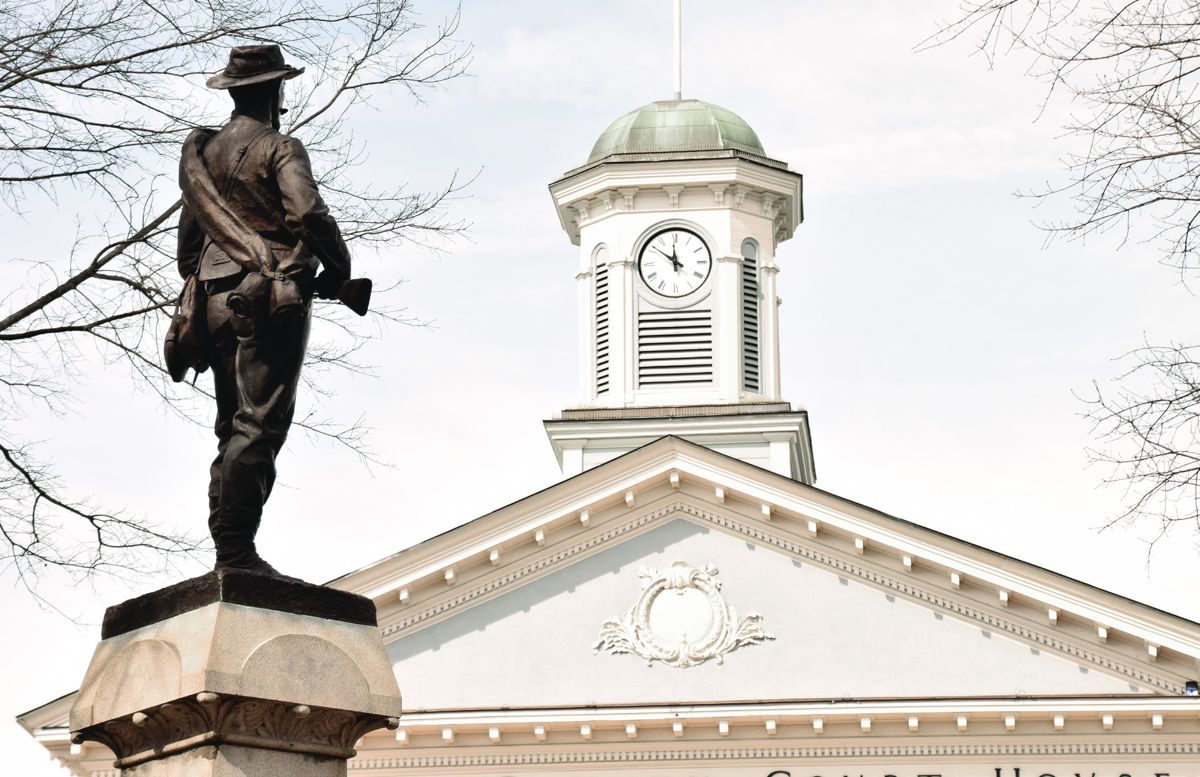
A solitary bronze soldier stands—his feet anchored to a marble column—22 feet above the ground in the courthouse square in Lexington, N.C. This warrior is no minuteman— no embattled farmer—who fired the shot heard ‘round the world. The soldier on this stone pedestal was intended to honor local heroes from Davidson County, N.C., who fought—and died— for the Confederacy. This memorial was built by the Carolina Marble Company of Lexington. The granite base supported a marble column topped with a bronze figure. It was sponsored by the Robert E. Lee Chapter of the Daughters of the Confederacy at a cost of $2,500. On the front of the monument, the inscription reads: “Our Confederate Dead.” The inscription requires no interpretation and leaves no doubt about the intention of the sponsors—at the time. The monument offers tribute to no particular unit nor does it represent a specific soldier. Over 5,000 people, including 300 to 400 Confederate veterans, gathered around the speaker’s podium placed directly in front of the Davidson County Courthouse to formally dedicate the monument on Sept. 14, 1905. The fundraisers, Daughters of the Confederacy, arrived at the
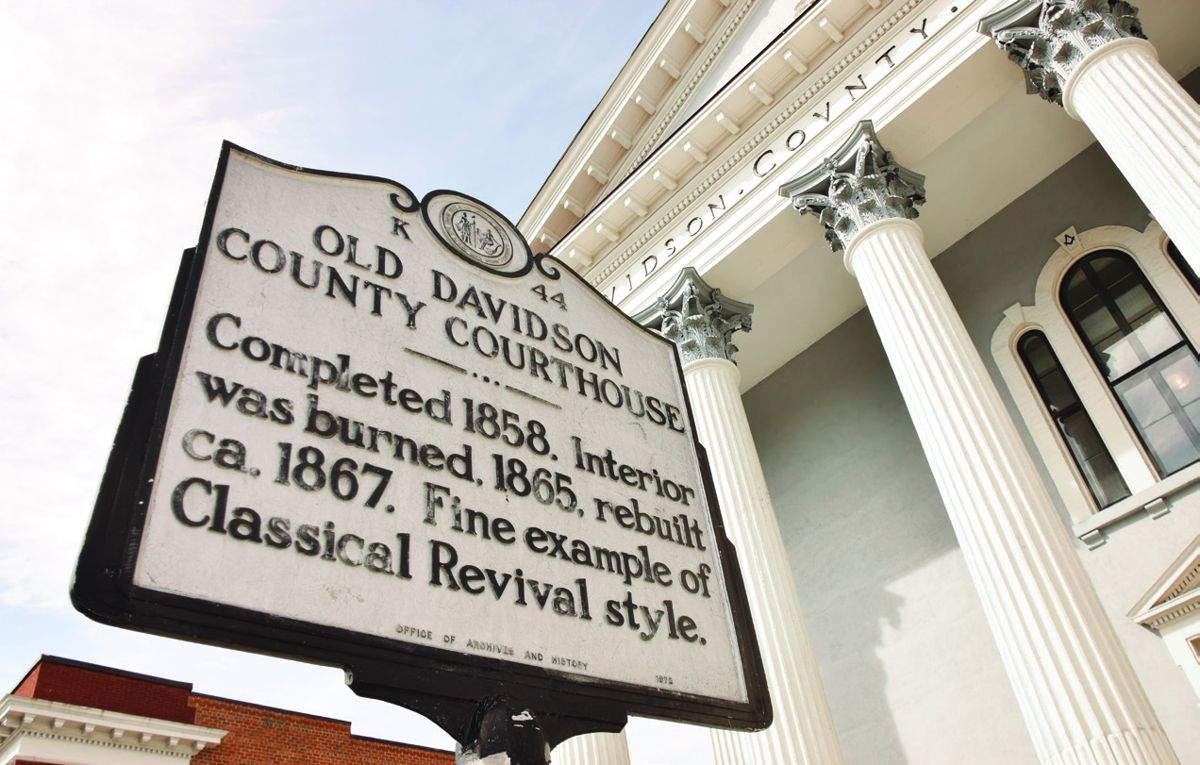
ceremony in “parade-like fashion,” in horse-drawn carriages. Children of the Confederacy rode on floats decorated with Confederate flags. Young girls wearing white dresses and red ribbons waved tiny Confederate flags. Confederate veteran and former North Carolina politician, Cyrus B. Watson served as orator for the dedication ceremony and agent for the unveiling. Watson spoke of North Carolina’s engagement in various conflicts including the Civil War. In closing Watson turned toward the bronze soldier and remarked that the figure would stand for ages as “representative of Southern heroes.” Today, the Confederate monument in Lexington stands across Main Street from the Old Davidson County Courthouse (circa 1859) that now houses the Davidson County Historical Museum. The ground the monument now occupies is not its original location. At one time, the bronze southern hero stood in the middle of the street then the center of the town square. It was moved because it was the cause of many traffic accidents over a period of 45 years. Time and traffic had taken their toll. In 1950, the monument was relocated to the side of the town square opposite the old courthouse, safely away from the Main Street traffic pattern. “At one point a car had hit the monument and knocked the statue off its pedestal onto the ground,” said Stephen Harris, Davidson County Historical Society Museum registrar. “It’s been through a lot. They moved it in order to preserve the statue itself.” Moving the monument in July 1950 was not without controversy. Some critics felt that moving the soldier from the square’s center square suggested a retreat. Others noted that instead of facing southwest the monument would be repositioned to defiantly “face the damyankees.” Shortly after the tragic events surrounding the Confederate monument controversy in
Charlottesville, Registrar Stephen Harris decided that a museum exhibit highlighting the history of the local monument and other Civil War elements might be a value to museum visitors. The goals of the “The Man on the Monument” exhibit involve presenting the historical facts relating to the monument that has stood in the courthouse square area for over 100 years and offering material that “possibly challenges the normal opinion on the monument.” “It’s gotten a little bit of attention. There have been some people who have enjoyed it, and there have been some people who did not,” said Harris. “There have been some complaints. Some people get defensive when you’re challenging an opinion on what the monument means.” In addition to discussing relocation of the monument, Harris’ modest exhibit explores selective concepts of the “Lost Cause” politics and the ultimate legacy of the monument. The Civil War claimed the lives of more than 650,000 soldiers and civilians. The losses were especially high in the Confederacy. Nearly one quarter of all white southern males were killed in battle or died of disease. The shock of defeat raised intense doubts among many white southerners regarding their faith in God. It led them to question the tremendous loss of life expended in supporting the Confederate cause. Southerners validated the crushing Confederate loss as a moral victory. The “Lost Cause” ideology held that secession was justified in the defense
restored in 1867. (Photos by Bob Ruegsegger) of Constitutional liberties. It stated that white southerners nobly defended their homes and families against impossible odds. It insisted that slavery was not a brutal institution and that slavery was not the cause of the Civil War.
“I would be the first to say that the monument does mean different things to different people,” said Harris. “We wanted to get people to start asking questions about it and maybe understand that one person’s perspective isn’t necessarily the same for another person” he said. “I think that’s important for everybody to recognize.”
The courthouse exhibit also focuses upon the legacy of the monument. Although the Civil War produced a “terrible toll in death and destruction,” it also secured freedom for 4 million enslaved southerners.
In addition, it fostered Constitutional amendments that guaranteed citizenship and equal protection under the laws regardless of race. Ultimately, the 13th, 14th, and 15th amendments formed the foundation of the Civil Rights Movement.
Davidson County’s Confederate monument was created in recognition of the “dedication and sacrifice of local men” who fought to create a Confederate republic.
Today, the monument in Lexington is a reminder of the tragedy of war—any war. It memorializes what was lost and symbolizes, in a sense, what was gained.
Bob Ruegsegger is an American by birth and a Virginian. His assignments frequently take him to historic sites throughout Virginia, the Mid-Atlantic, and the Southeast. His favorite haunts include sites within Virginia’s Historic Triangle—Jamestown, Yorktown, and Williamsburg. Bob served briefly in the U.S. Navy. He is a retired educator and has been an active newspaper journalist for the last twenty years.