
Book Reviews
Book Reviews — April 2018
Originally published April 2018 · pp. 32–39
The Great Valley’s Civil War Mystic Chords of Memory The Thin Light of Freedom: The Civil War and Emancipation in the Heart of America. By Edward L. Ayers. Maps, photos, notes, index, 640 pp., 2017. W.W. Norton, www. wwnorton.com. $35 hardcover. Reviewed by James J. Broomall
The Great Valley, lying between the Appalachian and Blue Ridge mountain ranges, stretched between the United States and the Confederacy. Vast armies moved through its fields. Enslaved African-Americans fled its plantations. Because of the region’s prosperity, its towns and farms were burned. Unlike fixed targets such as Richmond, Va., war threatened from every direction. In The Thin Light of Freedom, historian Edward L. Ayers traces the Great Valley’s Civil War by focusing on Augusta County, Va., and Franklin County, Penn.—Valley communities separated by two hundred miles. Ayers’ graceful writing and unique approach to history gives readers both a close-grain view of the Civil War’s complexities for soldiers, civilians, and slaves, and a masterful treatment of the larger issues facing NineteenthCentury Americans. Since the early 1990s, the University of Virginia has afforded researchers access to thousands of primary sources from Augusta and Franklin counties in the “Valley of the Shadow” digital archive. In 2003, Ayers published the award-winning book, In the Presence of Mine Enemies, which drew exclusively from the “Valley of the Shadow” and covered late 1859 to mid1863. The Thin Light of Freedom picks up the narrative with Robert E. Lee’s 1863 invasion of Pennsylvania and concludes with the Reconstruction era. Although the books are a matched set, one can be enjoyed and understood without the other. Composed of eleven chronologically driven chapters divided into two parts, a prologue and an epilogue effectively frame the book. The Thin Light of Freedom is history written on a human scale. Readers will meet famed Confederate mapmaker Jedediah Hotchkiss, Republican newspaper editor Alexander McClure, prolific Staunton, Va., diarist Joseph Waddell, and African-American soldier David Demus. Students of the Civil War will find the book’s basic narrative familiar but told in a new light through the panoply of primary sources guiding content and the perspectives of a broad cast of historical actors. Ayers ultimately creates a multidimensional view of Virginians and Pennsylvanians at war by artfully drawing “connections across time, across borders, and across the lives of many kinds of people” while concisely communicating how individual stories relate to the war’s broader military and political events. Contingency and destruction are two of the book’s most important themes. As Ayers writes, “the Valley of Virginia endured both the devastating burden of hungry armies and the prolonged torment of guerrillas, spies, and partisans” (emphasis in original). Events during the hot summer of 1864 are illustrative of Ayers’ methodology and approach, as Valley residents became “trapped in cycles of revenge and retaliation” (emphasis in original). For instance, Staunton’s residents first angrily endured military occupation and then witnessed the targeted destruction of sites of military importance. Farther north, the citizens of Chambersburg experienced one terrible day in July 1864, when troops under Gen. John McCausland burned the town. Despite their very different experiences, citizens of both communities interpreted these events in strikingly similar terms. Both described, for example, how “a villainous general unleashes drunken soldiers on a defenseless population.” And each community exaggerated the brutality of occupying troops. Ayers employs geography and chronology to focus his story and demonstrate “that the remarkable advances of emancipation and Reconstruction were not the inevitable victories of a modern economy, the overwhelming might of the North, or the intrinsic justice of the national cause.” The torturous road of Reconstruction demonstrated all too well that the “consequences of the Civil War remained in doubt” far beyond the conflict’s close. The Civil War was too affecting to have been otherwise. Indeed, as Ayers elegantly concludes his book, “The shadows of war and the thin light of freedom still fall across the Valley,” thereby reminding readers of the Civil War’s continued legacy. James J. Broomall is an assistant professor of history at Shepherd University and the director of the George Tyler Moore Center for the Study of the Civil War, which integrates academic scholarship, undergraduate education and public engagement. He has published articles in Civil War Times, Civil War History and The Journal of the Civil War Era. His forthcoming manuscript, Personal Reconstructions: Southern Men as Citizens and Soldiers, is under contract with the University of North Carolina Press.
Mystic Chords of Memory Civil War Memories: Contesting the Past in the United States Since 1865. By Peter J. Cook. Illustrations, notes, bibliography, index, 228 pp., 2017. Johns Hopkins University Press, [email protected]. $24.95 paper. Reviewed by Salvatore Cilella
Poor William Faulkner. Despite writing some great American literature, he is remembered too often for two anecdotes: his wonderful, fanciful description of a young Southern boy, any Southern boy, standing in line on that hot summer afternoon July 3, 1863, in Pickett’s Division waiting to charge the Union center at Gettysburg. The other is his oft-repeated quote: “The past is never dead. It’s not even past” (from Requiem for a Nun, 1951, act 3). It has been used more often than not by writers of history and is in grave danger of becoming a cliché. Unabashedly, I am going to regurgitate it. Peter J. Cook’s book, Civil War Memories: Contesting the Past in the United States Since 1865, falls into an increasingly long line of “histories of memory.” I don’t know who invented the history of memory, but David Blight’s Race and Reunion did for Civil War history of memory what Michael Kammen’s groundbreaking 1991 Mystic Chords of Memory did for the general history of American memory and tradition. Cook’s book is a microcosm of Kammen’s monumental work. It focuses on the history of Civil War memory from Appomattox to the recent massacre of nine innocent churchgoers in Charleston, S.C. It is much more than the recounting of how we got here. Subliminally, it is a treatise on language and communication. Cook traces the myth of the Lost Cause from war’s end to the present. He admirably documents how each group, demographic, organization, and institution throughout our last 150 years, adopted words and language to communicate their version of history to their own monetary or political advantage. In my experience, Cook coins a new phrase, “remembrance agency.” The phrase epitomizes the work of the postwar generation, the Grand Old Army (GAR) and the United Daughters of the Confederacy (UDC), in their continual struggle for the “historical truth.” As Cook points out, the UDC’s greatest accomplishment was the “consolidation of the Lost Cause narrative through their close attention to, and censorship of Confederate history.” When she was ten years old, Margaret Mitchell learned for the first time that Lee had lost the war. Cook owes a debt of gratitude to Blight, of course, but also to Caroline Janney (Remembering the Civil War) who demonstrated the power of the UDC in promoting the Lost Cause. In the North, “remembering agents” were a strong mixture of AfricanAmericans, Union veterans, and Republican politicians in the postwar generation. When I first picked up this book, I thought, “Great, another interesting read from Peter J. Cook.” He wrote an excellent treatise on the Civil War Centennial called Troubled Commemoration (2011). Not so. How could there be two Peter J. Cooks? The Cook of this review is Professor of History at the University of Sussex, England. In other words, Civil War Memories is a Brit’s view of our understanding of our history, and his perspective is refreshing. It is hard to categorize this one— is it a monograph or a survey? I guess it really doesn’t matter.
A Confederate Major General Finding a Purpose Finally Meets His Biographer During an Uncivil Time John C. Brown of Tennessee: Rebel, Redeemer, and Railroader. By Sam Davis Elliott. Illustrations, maps, notes, bibliography, index, 386 pp., 2017. University of Tennessee Press, www.utpress.org. $43 hardcover. Reviewed by Stephen Davis
When the Civil War started, John Calvin Brown was a thirty-four-year-old lawyer in Pulaski, Tenn. In May 1861, he was elected captain of the locally raised volunteer infantry company. When it became part of the 3rd Tenn. Regt., Brown was unanimously chosen as its colonel. No less than Albert Sidney Johnston recommended Brown for promotion to brigadier in October 1861. That failed to come through, but Brown was placed in brigade command anyway. He and his men were captured at Fort Donelson four months later; they were exchanged in August 1862. Within days Brown received his commission as brigadier general. Marching with Bragg into Kentucky, Brown was wounded at Perryville on October 8. Convalescing, he missed Murfreesboro at the end of the year. He rejoined Bragg’s Army of Tennessee in January 1863. John C. Brown “fought on every major battlefield of the Western Theater except where imprisonment or wounds intervened,” explains the general’s new biographer, Sam Davis Elliott. Rather, I should say, Brown’s only biographer. “From the standpoint of contemporary historiography,” as Elliott explains in his Preface, “John C. Brown is in a virtual void.” Sam—whom I saw recently at the Dalton Civil War Show— is not kidding. I note in his Bibliography an article on Brown in Confederate Veteran (1895) and an unpublished master’s thesis written in 1936. And even though Brown was one of eight Tennesseans to rise to the rank of Confederate major general, he does not get an essay in the three-volume Confederate Generals in the Western Theater (2010–2011). In Volume 2, Mr. Elliott contributed an article, but it was on Maj. Gen. Alexander P. Stewart (the subject of his book, Soldier of Tennessee [1999]). Sam Elliott is a sterling example of the non-academic who is both skillful researcher and talented writer. An attorney practicing in Chattanooga, he is a past president of the Tennessee Bar Association who somehow fits the Civil War into his life and lawyer’s vocation. In addition to his biography of Peter Stewart, Elliott has also edited Chaplain Charles Quintard’s memoir and Civil War diary (2003) and written a biography of Tennessee’s wartime governor, Isham G. Harris (2010). Researching John C. Brown’s life was no easy task. “There are virtually no personal papers,” Elliott writes; they burned in an 1871 house fire. Without diaries, letters or memoirs, the biographer had to stitch together his narrative from newspaper articles and papers from his tenure as governor of Tennessee (1871–75), which Elliott covers judiciously. Brown’s service as Confederate general will most interest readers of CWN. Elliott ably traces his subject through the Atlanta Campaign, during which he assumed temporary divisional command several times. It was Brown’s Division that broke the Federal line in Frank Cheatham’s assault during the battle fought east of Atlanta on July 22. Afterward General Hood, commanding the Army of Tennessee, recommended Brown for promotion to major general, which was granted effective August 4. Soon after, Brown took temporary charge of William B. Bate’s Division after the latter was wounded on August 10. When Hardee left the army and Cheatham succeeded him in corps command, Brown took charge of Cheatham’s Division on Oct. 2, 1864. At Spring Hill, Brown became involved in the legendary failure of Hood’s army to attack John Schofield’s forces on Nov. 29. Elliott mentions the accusation of Cheatham and Brig. Gen. James Chalmers that Brown failed to launch an expected assault, but cautiously concludes “the definitive answer” of what happened at Spring Hill “continues to be elusive.” The next day, in the bloody battle of Franklin, General Brown was seriously wounded. Borne to the rear, he spent months recovering. He rejoined the Army of Tennessee just before Johnston surrendered to Sherman at Durham, N.C., on April 26, 1865. Through all of this, Sam Davis Elliott describes the war record and subsequent career of his subject with scholarly authority and literary efficiency. I’ll bet my next paycheck that his John C. Brown of Tennessee will win acclaim as the definitive biography of this long-neglected Southerner. Steve Davis’ book, Flawed Image: Confederate General John B. Hood in 1864, is scheduled for publication by Mercer University Press.
A Civil Life in an Uncivil Time: Julia Wilbur’s Struggle For Purpose. By Paula Tarnapol Whitacre. Photographs, illustrations, appendix, index, 320 pp., 2017. University of Nebraska Press, nebraskapress. unl.edu. $32.50 hardcover Reviewed by Shelby Shrader
As men fought on the Civil War’s battlefields, they were not the only ones risking their lives and coping with the seemingly insurmountable obstacles as America confronted its defining moment. Women, too, played a critical role, putting all of their strength into fighting a war that seemed to last an eternity. Some women who lived in the North joined anti-slavery associations to aid runaway slaves and assist those recently freed by the Emancipation Proclamation. Amongst the countless women who aided freedom’s cause during the Civil War, while simultaneously pushing for women’s rights, was a schoolteacher from Rochester, N.Y., Julia Wilbur. A Civil Life in an Uncivil Time: Julia Wilbur’s Struggle for Purpose, by Paula Tarnapol Whitacare, an established author and editor, has produced a remarkably crafted volume based on a solid amount of primary evidence, including Wilbur’s diary. Through sixteen marvelously written chapters, the book is split into three different sections. The first, called “Before the War,” examines Wilbur’s prewar life. The second and longest section of the book, “During the War,” is the book’s main focus. “After the War,” the book’s final section, presents a succinct conclusion to Julia’s quite turbulent life.
Through Whitacre’s careful analysis and engaging narrative style, Wilbur’s story provides an opportunity to gaze into the life of a woman who coped with myriad personal struggles during the conflict, but managed them to assist African Americans during the era, aid the Union war effort, and pursue advancements in women’s rights. Throughout the book Whitacre does an excellent job of letting Wilbur’s voice resound. During this time women were not allowed to vote (a right for which Julia fought vigorously), and were often degraded by men. Wilbur’s diary entries allow us to see how powerful women were during the Civil War and how they asserted themselves through such activities as fundraising and caring for wounded soldiers. Additionally, this book offers tremendous insight into the experiences of women on the northern home front. Furthermore, this volume provides a glimpse, through Wilbur’s eyes, into some of the Civil War era’s most prominent figures, including Frederick Douglass. Wilbur, who characterized Douglass when first seeing him as “the eloquent fugitive slave,” met him during a lecture he delivered at Talman Hall in Rochester, N.Y., on July 23, 1845. Soon after, Wilbur’s judgment of Douglass went from “eloquent fugitive slave” to a lifelong business partner and friend. This splendidly written and researched study, replete with photographs pertinent to Wilbur’s experience, shares the thoughts and feelings of a female abolitionist, supporter of the Union war effort, and suffragist during truly uncivil times. It is highly recommended for anyone interested in the northern home front, women’s roles during the conflict, or the Civil War’s myriad social dimensions. Beyond its scholarly value Wilbur’s story, so elegantly crafted, provides a life lesson on how individuals can continue to move forward when tragedy is everywhere. Anyone who reads Wilbur’s story will surely be able to connect with her in some way. Shelby Shrader is a recent magna cum laude graduate from Shenandoah University, with a Bachelors of Science in History. She is also a member of the McCormick Civil War Institute.
Inspiration from Tragedy The Weeping Time: Memory and the Largest Slave Auction in American History. By Anne C. Bailey. Photos, index, 197 pp., 2017. Cambridge University Press, www.cambridge.org. $24.99 hardcover. Reviewed by Jonathan A. Noyalas
A newspaper reporter could not fathom the spectacle that unfolded before his eyes in the first week of March 1859 as 436 slaves were auctioned off at Savannah’s Tenbroeck Racetrack to pay off an exorbitant amount of debt accumulated by Pierce Butler Jr. “The expression on the faces of all who stepped on the block was always the same,” the journalist recorded, “and told of more anguish than it is in the power of words to express.” Perhaps unbeknownst to the reporter at the time, the twoday slave auction would earn the dubious distinction of being the largest in American history. For so many years forgotten, distinguished scholar Anne Bailey has resurrected the tragedy of that auction and its legacy with this insightful volume. Bailey, professor of history and Africana studies at SUNY, Binghamton, has done a remarkable job of reconstructing the auction and the lives of the many sold through careful analysis of census data, Freedman’s Bank records, various primary accounts and stories passed down through the generations to the slaves’ descendants. This finely crafted history offers much for those interested in slavery’s complex dimensions in the immediate years preceding the Civil War. Foremost, Bailey’s diligent research and fluid narrative offer a powerful window into that most inhumane activity of one person purchasing another. The author’s descriptions of the living conditions endured by the slaves prior to the auction, corralled in stables, and the sale of slaves such as “Dorcas” and “Jeffrey,” two human beings who loved each other dearly, separated by the drop of an auctioneer’s gavel, are gut-wrenching. Beyond the author’s moving examination of the auction, Bailey’s study provides an excellent case study of how the institution of slavery not only divided slave families, powerless at the hands of their owners, but also at times strained the marriage of slave-owners. In the case of Pierce Butler, his marriage to noted actress Fanny Kemble was plagued by her anti-slavery views. In the end Kemble’s abolitionist leanings contributed mightily to the couple’s divorce, which exacerbated Butler’s financial woes, ones which compelled him to sell 436 of his slaves. Furthermore, this book provides important insight into slaves’ lives on Butler’s Georgia plantation. The author not only provides a complete examination of slaves’ religious lives and their various labor roles at Hampton’s Point, but illustrates how slave and master at times joined together for purposes of entertainment. For example, Bailey discusses how Butler’s boatmen, “among the most important slaves on the plantation,” participated on “special days each year” in “regattas.” Racing boats, as Bailey notes, brought “much… delight” to “slaves and masters.” The author also does an admirable job of illustrating how, in the wake of President Abraham Lincoln’s Emancipation Proclamation and the Civil War’s end, individuals auctioned off during that terrible stretch of two days in 1859 worked tirelessly to reunite with families and loved ones they believed forever lost. Bailey’s powerful volume not only recounts America’s largest slave auction, but resurrects personalities long forgotten. Historians who seek a deeper understanding of all that slavery entailed in antebellum America and who desire a clearer understanding of the resiliency of African Americans both during and after the Civil War will find Bailey’s study not only revealing, but inspirational. Prof. Jonathan A. Noyalas is the director of Shenandoah University’s McCormick Civil War Institute and founding editor of Journal of the Shenandoah Valley During the Civil War Era. He is the author or editor of eleven books on Civil War-era history.
The Past is Never Dead The Blue & Gray Almanac: The Civil War in Facts & Figures, Recipes & Slang. By Albert A. Nofi. Maps, photos, notes, index, epilogue, appendix, further reading, 304 pp., 2017. Casemate publishers, www. casematepublishers.com. $32.95 hardback. Reviewed by David Marshall
Albert Nofi tells the story of the American Civil War through a range of insightful themes, tales and specific details. Author of over thirty titles, Nofi wrote The Blue & Gray Almanac as a guide to the critical events of the pre-war era, the war itself, its aftermath and legacy, as well as armies, key facts, lists, profiles, and places. Each segment skillfully and briefly searches subjects with well investigated, straightforward frankness. The result is a solid introductory guide and consultation reference for newcomers to this important topic. There have been more books written about the Civil War than most other important events in U.S. history. Thus it’s a challenge to come up with a totally new approach, but Nofi comes fairly close. He’s a historian who takes the method here of amassing more than causes, course, and effects of the conflict. The result is a large number of small, wellwritten chapters that the reader will have difficulty putting down. Small anecdotes are dispersed throughout and nearly every statement or declaration is documented mainly though secondary sources instead of primary sources. Nofi does a good job of supporting his analyses with back-up information. The “House Divided” section points out there was not only Nat Turner’s rebellion in 1831, but perhaps as many as 250 slave uprisings. An interesting factoid about the results of a plebiscite on secession held in Georgia on Jan. 2, 1861, was that 48 percent of voters opposed leaving the Union, and in certain parts as many as 75 percent; the state seceded on January 19. The long section about the War tells the story from the perspective of common soldiers, not necessarily from the point of view of generals. The author does not concentrate on battles, but what individuals accomplished in surviving and how they went about fighting for a new nation and preserving their country. The highlight of the Almanac is its extremely relevant “Epilogue: The Civil War since the Civil War.” Throughout the United States today, many state and local governments are debating whether to take down Confederate monuments and flags. Nofi points out the tragic death of nine members of Charleston’s historic Emanuel African American Episcopal Church by Dylan Roof on June 17, 2015. He is spot-on in his analysis of the subsequent national discussion on the remembrance and memorialization of the Confederacy and the display of the Confederate flag. Shortly after this event, Governor Nikki Haley of South Carolina called for the removal of the flag from the State House grounds, which was approved by the state legislature. A solution is offered by the author: remove battle flags from government and other public facilities, and replace them with the first national flag, the Stars and Bars, which served longest as the Confederate flag.
There are numerous Civil War memorials and monuments across the U.S. Many in the South were built following Reconstruction or since the Civil Rights movement in order to legitimize the Lost Cause with a one-sided narrative. An important point is made that monuments were erected in New Orleans and Colfax, La., to commemorate the attack on Easter Sunday, April 13, 1873, on black citizens and state militiamen, killing at least sixty and perhaps many others. Recently, New Orleans took down its statue of Robert E. Lee. Nofi again offers a reasonable resolution to this important national issue: remove and relegate to museums those statues that do not have local relevance. Additionally, he suggests erecting new monuments offering a new historical narrative. The value of this volume is its conciseness, lucidity, readability, and numerous images. It includes, however, only three hard-to-read maps. The book includes an enlightening Appendix on the Civil War and the Presidency, as well as notes, helpful “further reading” suggestions, and an index. This expensive tome is not a book to take on the battlefield, but affords enthusiasts enjoyment in their armchairs. David Marshall is a high school American history teacher in the Miami-Dade School district for the past thirty-one years. A life-long Civil War enthusiast who became interested during a family visit to Gettysburg when he was 10, David is president of the Miami Civil War Roundtable Book Club.
The XI Corps of the Army of the Potomac – Unfairly Maligned Under the Crescent Moon with the XI Corps in the Civil War – Volume 1: From the Defenses of Washington to Chancellorsville, 1862–1863. By James S. Pula. Photos, maps, footnotes, appendices, bibliography, index, 308 pp., 2017. Savas Beatie LLC, www.savasbeatie.com. $34.95 hardcover. Reviewed by Robert L. Durham Under the Crescent Moon is the first of a two-volume history of the Union XI Corps. (Volume II will take us From Gettysburg to Victory.) While Volume I begins with the corps’ duties in the Washington defenses, the main thrust, of course, is the Army of the Potomac’s Chancellorsville campaign in April and May 1863. The author, James S. Pula, makes use of a multitude of primary sources to let the soldiers speak for themselves in many cases. Pula’s account of the build-up of intelligence prior to General Thomas J. (Stonewall) Jackson’s famous flank attack is heartbreaking because reconnaissance reports of XI Corps line officers were largely ignored by higher command. His description of the breakdown of their defensive line is much different than I had previously believed. Many accounts led me to think that the line held by the XI Corps collapsed while most of the men were relaxing with weapons stacked, and that the surprise of Jackson’s attack completely demoralized them. This volume provides a much different perspective, as the men vainly attempted to establish a defense against overwhelming numbers. Outmaneuvered, outnumbered, and attacked with no room to maneuver, the Corps position broke down in a domino effect. This caused a confusion that the officers, unsuccessfully, made every effort to control. The mix-up was increased by the artillery and supply wagons trying to escape along the only road available: the road where the men of the corps were straining to set up a line of resistance. Pula illuminates the bewilderment among the men, bringing the scenes to life. Another misconception I held about the XI Corps was that it overwhelmingly consisted of German troops. In an appendix to this volume, Pula makes it clear that this is not true. As I read through this book, I discovered that I held many erroneous beliefs. I can’t wait to read the companion volume to find out more about the XI Corps after the Chancellorsville Campaign. I enjoyed this book a lot and believe others will feel the same way. This is the first look at a much-maligned body of men who deserved better. I’m happy to add it to my Civil War collection. Robert L. Durham of Centerville, Ohio, has been a devoted military (especially the Civil War) buff for many years. He has written articles for publication in various historical magazines and internet blogs, including CWN. He is retired from almost 40 years’ service with the Defense Logistics Agency as a computer specialist—employed all over the world, setting up communications systems for Foreign Military Sales countries.
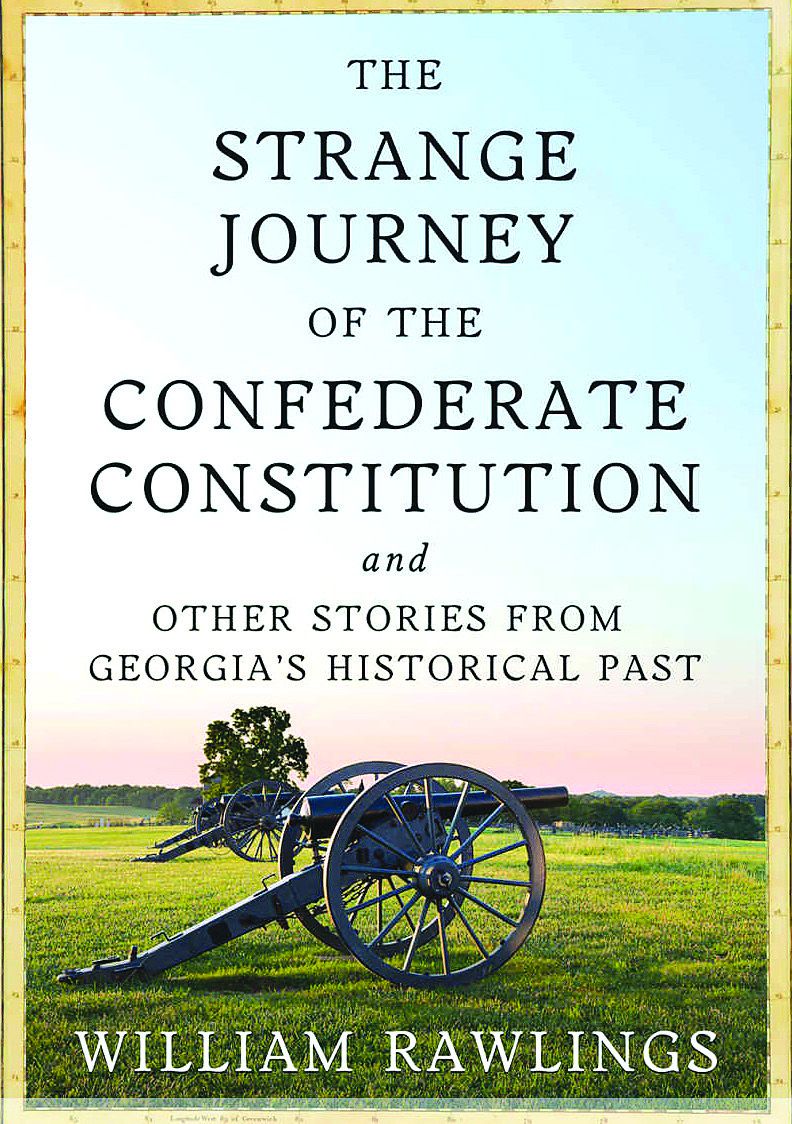
Don’t let the title of this book fool you. At first glance, I thought this 302-page hardback would be a long tedious work focusing specifically on the contents of the Confederate Constitution. In actuality, the mysterious story of the travels of this Southern document is only one of seventeen intriguing articles and essays— Southern history that should not be forgotten. William Rawlings of Sandersville, Ga., writes engaging books that focus on Southern history. The author, a part-time Sandersville physician and sixth-generation resident of Washington County, attended Emory and Johns Hopkins, and holds graduate degrees from Mercer and Tulane. He has traveled to many parts of the world and last spring presented a fascinating program at the Old School History Museum in Eatonton, Ga., focused on his book with the unusual title of A Killing On Ring Jaw Bluff: The Great Recession and the Death of Small Town Georgia. A Killing is a 1920s story involving two intertwined tales— the crash of Georgia’s cotton economy and an infamous murder that involved a prominent member of the author’s own family. This important era of Georgia’s history can be mundane reading but the audience was enthralled by Rawlings’s exceptional research and his ability to spice things up with an unusual murder story keeps things interesting. And he wasn’t shy about talking about family villains in this story, which was mighty refreshing. It is often said that “truth is more interesting than fiction,” and this especially applies to the work presented by Dr. Rawlings in The Strange Journey of the Confederate Constitution and Other Stories from Georgia’s Historical Past. The title story of this new book is relatively brief and explains how the historic document “is now relegated to near obscurity;” “how it arrived in its current location is one of the most fascinating tales in American history.” And while the focus of the book is on the state of Georgia, many of the stories will appeal to Southerners in general. More than half of the articles were previously printed in the popular Georgia Backroads magazine, with many reworked. The author explains, “I have adopted a somewhat less formal format than the usual work of history … footnotes have been kept to a minimum.” This strong research and readable style reminds me of the popular writings of Bell Irvin Wiley, the recognized authority on the Civil War who taught at Emory during the last century. Incidentally, we need more writers like Wiley and Rawlings, those with the ability to please both academics and general readers with superb research and engaging social history. Some of the sections of Rawlings’ book are devoted to historical events that may not now be remembered: the massive corruption perpetuated in the Georgia Legislature with land speculators in the state’s early days, as explained in chapters entitled “The Great Yazoo Fraud” and “The Land Barrens Speculation.” Also included is a chapter containing authentic accounts about the capture of Jefferson Davis from both the Southern and Northern perspectives. The author does a great service in clearing up false reporting that still appears in print about this singular event. Rawlings’ stories also tell of the region’s cotton industry, the Freedmen’s land insurrection of 1875, the political nature of Reconstruction, and the reign of terror of the KKK in Macon, Georgia—heavy but important topics. His chapters on the “Lost Cause on the Silver Screen” and “The Drum Returns Home” are entertaining and provocative, and I shouldn’t give away the author’s thought-provoking takes in the stories entitled “The Saga of the Lost Confederate Treasure” or “Gutzon Borglum and the Lost Stone Mountain Confederate Memorial.” My favorite section is Rawlings’ revealing appendix in the back of the book entitled, “Exploring Our Past.” This is essentially a guide for writers and offers practical advice on how to research, where to find resources, and how to write nonfiction. This section alone makes the whole journey complete. For those who are true history buffs and love true stories, this new book from Mercer Press will not disappoint. Hank Segars of Madison, Ga., is the author and editor of books about the South, including Black Southerners in Confederate Armies (2001) and John Townsend Trowbridge’s The South (2006). He is also employed as an associate editor for Smith Communications and a regular contributor to Georgia Backroads magazine.
A Small Book for a Big Week Richmond Shall Not Be Given Up: The Seven Days’ Battles, June 25–July 1, 1862. By Doug Crenshaw. Illustrations, maps, 192 pp., 2017. Savas Beatie, www.savasbeatie.com. $14.95 paperback. Reviewed by Douglas Ullman Jr.
The series of engagements known as the Seven Days’ battles was one of the most important turning points of the American Civil War. In the course of one week the embattled Confederate army defending Richmond seized the initiative and sent the onceproud Federals scurrying across the Virginia Peninsula. During that week Robert E. Lee, once an obscure military figure, suddenly became one of the Confederacy’s brightest stars, forging the army defending Richmond into an elite fighting force known as the Army of Northern Virginia. This same period of time also created the culture of the Union’s premier army in the east, the Army of the Potomac, a hard luck unit that would fight well if only it could be properly led. Indeed, as much as anything else, the Seven Days’ battles cemented—perhaps for all time—the image of Union General George McClellan as a man whose ambitions of glory were never fully matched by his performance in the field. It is, therefore, reasonable to say the Seven Days’ battles was one of the most significant campaigns of the Civil War and one of which too many Americans are ignorant. Given their obvious import, it is curious that there isn’t more written about the Seven Days’ battles. Stephen Sears’ excellent book, To the Gates of Richmond (1992), is perhaps the standard work on this period, but a good portion of Sears’ work focuses on the month prior to Lee’s assumption of command of the Confederate army and the onset of the Seven Days’ battles. Brian Burton’s Extraordinary Circumstances has a narrower scope, but is too detailed for the casual reader. In short, there is a definite need for a brief overview of the Seven Days’ battles that can be easily read by the average Civil War buff who is new to studying the campaign, but perhaps contains a little extra for the more widely-read. Into this gap springs Richmond Shall Not Be Given Up, Doug Crenshaw’s sprightly volume on the Seven Days’ battles. Like other titles in the Emerging Civil War series, Richmond… is an easily-digestible 164 pages, including many excellent photographs, images and maps to orient the reader to the landscape and help illustrate the major troop movements of the campaign. Crenshaw’s prose is clear enough for a reader with a basic understanding of the war and sufficiently precise to be of use to more knowledgeable readers.
The narrative demonstrates a firm grasp of the campaign, its primary actions and personalities, and is, at times, quite compelling. Additionally, Crenshaw’s work also serves as a guide to the various sites associated with the campaign. The work of preservation groups over the last few decades has provided Civil War enthusiasts with far greater opportunities to visit the battlefields of the Seven Days’ than was possible 20 years ago, making a new published guide of the landscape an important addition to the literature. Crenshaw, who is a volunteer interpreter at the Richmond National Battlefield, obviously knows the area well, but seems to struggle in balancing his tour guide aspirations with his stated goal of summarizing the campaign. Unfortunately, this imbalance is throughout the book. The author spends a good deal of time (nearly three chapters) setting the stage for the Seven Days’ battles. Thus, a book that claims to cover the Seven Days’ battles, actually begins its narrative with the Battle of Seven Pines (Fair Oaks). Some of this is necessary background, especially for the novice reader. However, there is too much of it, denying Crenshaw the opportunity to delve more deeply into the battle action—details Crenshaw obviously knows well and that the reader presumably wants to know. It also forces the author to condense the tour portion of the book, preventing Crenshaw’s work from filling a unique and necessary niche in the Seven Days’ canon. Taken altogether, however, Richmond Shall Not Be Given Up is an enjoyable, easy read, full of plenty of information about the Seven Days’ battles. Its shortcomings are outweighed by the overall benefit Crenshaw is able to provide the reader, and is a welcome addition to the literature about this pivotal week in American history. Douglas Ullman Jr. is an independent historian who focuses on the Union Twelfth/ Twentieth Corps. His is currently working on a regimental history of the 102nd New York Volunteers. He works for the Civil War Trust and lives with his wife and son in Centreville, Virginia.
Cook traces the line from war’s end to today, making history all that more relevant. But he also points out history’s fragility when facts become purposely bent to suit the time and the moment. Surprisingly, he omits the most important scriptural verse in the bible of the Lost Cause: Lee’s farewell address to his army (“The Army of Northern Virginia has been compelled to yield to overwhelming numbers and resources.…”). Cook documents the rise of Civil War Round Tables in the post-WWII era as an attempt to examine both sides of the 1861–65 conflict fairly and without prejudice. The Civil War Centennial, which started out as a disaster, recovered with a more balanced, scholarly tone by the time it mercifully ended in 1965. Cook argues that movies such as Gone With The Wind and Birth of a Nation spelled the end of the Lost Cause. As to the current monuments’ controversy, Cook reminds us that in the state of Virginia, only 34 monuments to Confederate soldiers were erected between 1880 and 1899, and 83 between 1900 and 1919. Back to Faulkner. He was correct. The events of the past few years bear out his observation that the “past isn’t even past.” I need only point to a December 4, 2017 article in The New Yorker entitled “How Virginia’s Past Spurred a Racial Reckoning” on removing statutes in Richmond. We live with the Civil War and its memories today and don’t usually know why. Cook’s book answers the “who” and some of the “why.” A small sample of books/ readings on the history of Civil War memory: David Blight, Race and Reunion: The Civil War in American Memory (2001); Caroline Janney, Remembering the Civil War: Reunion and the Limits of Reconciliation (2013); Peter J. Cook, Troubled Commemoration: The American Civil War Centennial, 1861–1865 (2007); and Benjamin Wallace Wells, “Annals of Politics: Battle Scars: How Virginia’s Past Spurred a Racial Reckoning,” The New Yorker, December 4, 2017 (pp. 32–37). Salvatore Cilella is the retired CEO of the Atlanta History Center. He is the author of Upton’s Regulars (University of Kansas Press, 2009) and editor of The Selected Correspondence of General Emory Upton, 2 volumes (University of Tennessee Press, 2017).
Essential Book on Gettysburg Artillery Silent Sentinels: A Reference Guide to the Artillery at Gettysburg. By George W. Newton. Bibliography, endnotes, illustrations, maps, appendices, 288 pp., 2017. Savas Beatie LLC, www.savasbeatie.com, $22.95 paperback. Reviewed by John Foskett
Field artillery is one of the few Civil War topics which encounters under-representation in the literature. As with so many other areas, however, Gettysburg is an exception. Even apart from the battle’s inordinate reputation as the “turning point” of the Civil War, there are other good reasons for this. More than 650 guns were involved; artillery played a significant role on both sides throughout the three days of combat; the terrain generally provided good fields of observation and fire which were lacking in whole or in part on many other battlefields; and well over 300 pieces are displayed on the battlefield today at any given time. In Silent Sentinels, licensed battlefield guide emeritus George W. Newton has authored a nice reference book/tour guide which will appeal to the casual student and the artillery buff alike. Originally published in 2005, this softcover reprint covers a wide range of subjects. Newton starts with a succinct overview of the campaign and battle. He then generally covers the equipment used—guns, carriages, caissons, limbers, and battery forge—as well as the types of projectiles, fuses, friction primers, and gunpowder. Newton’s focus is on the three gun types most prevalent at the battle—the 12Pdr. smoothbore “Napoleon,” the 3-inch Ordnance rifle and 10-Pdr. Parrott. The author’s discussion reflects an appropriate balance of detail and brevity. What follows is a description of how both sides organized their artillery, and the process of loading and firing (which appears to be based on the War Department’s 1861 drill manual Instruction for Field Artillery). The latter chapter includes a competent, and concise, discussion regarding ranges and tactics. While knowledgeable students will find little that is new thus far, the next two chapters should attract their interest. First, Newton has an illuminating description of the process by which the guns now present on the field were acquired, their origins (including the large number of replicas), techniques for identifying guns, and the ongoing process of restoration. The next chapter is a tour guide with nine detailed stops and a brief summary of other stops. Newton appears to have chosen these stops through a judicious process of finding locations where significant artillery action took place and where some of the park’s more unusual pieces are placed. When needed, he has inserted primary source accounts of the fighting. If I were to offer a criticism (however slight), it is the omission of a stop on the first day’s battlefield north of town. There, gun placements for Battery I, 1st Ohio Light, and for Battery G, 4th U.S., which are marked by several 12-Pdr. Napoleons, illustrate the significance of terrain, positioning and infantry support for Civil War field artillery. The author closes with an interesting selection of trivia, followed by several appendices. The latter contain both armies’ artillery organizations; the ordnance with which each battery was equipped and its strength and casualties; biographies and official post-battle reports of prominent artillery commanders from both sides, including Henry J. Hunt, Freeman McGilvery, and E. Porter Alexander; and a useful glossary. This book fills something of a gap. Dedicated artillery students are familiar with such publications as Civil War Artillery at Gettysburg by Philip Cole, The Artillery of Gettysburg by Bradley M. Gottfried (who has furnished an informative foreword for Newton’s book), and Summer Thunder by Matt Spruill. All treat their various subjects—technology, tactics and tour stops—with a level of detail which might intimidate casual students. Newton has covered these subjects in accurate but appropriately brief scope. The relatively compact softcover format is conducive to bringing this book along during a visit to the battlefield. The photographs of pieces on the battlefield (apparently taken by the author’s wife) are especially instructive for a casual reader. In summary, this book is essential for the novice but has enough meat to make it highly worthwhile for the enthusiast as well. It is strongly recommended. John Foskett is a practicing attorney in Boston with a lifelong interest in the Civil War. He is descended from Isaac Foskett, who served for three years in the Engineer Battalion with the Army of the Potomac. In addition to numerous book reviews for Civil War News, he has done Civil War Round Table presentations on the subject of Civil War field artillery tactics.