
An Unlucky Horseshoe: Second Reams Station
By Robert Durham · Originally published April 2018 · pp. 14–17
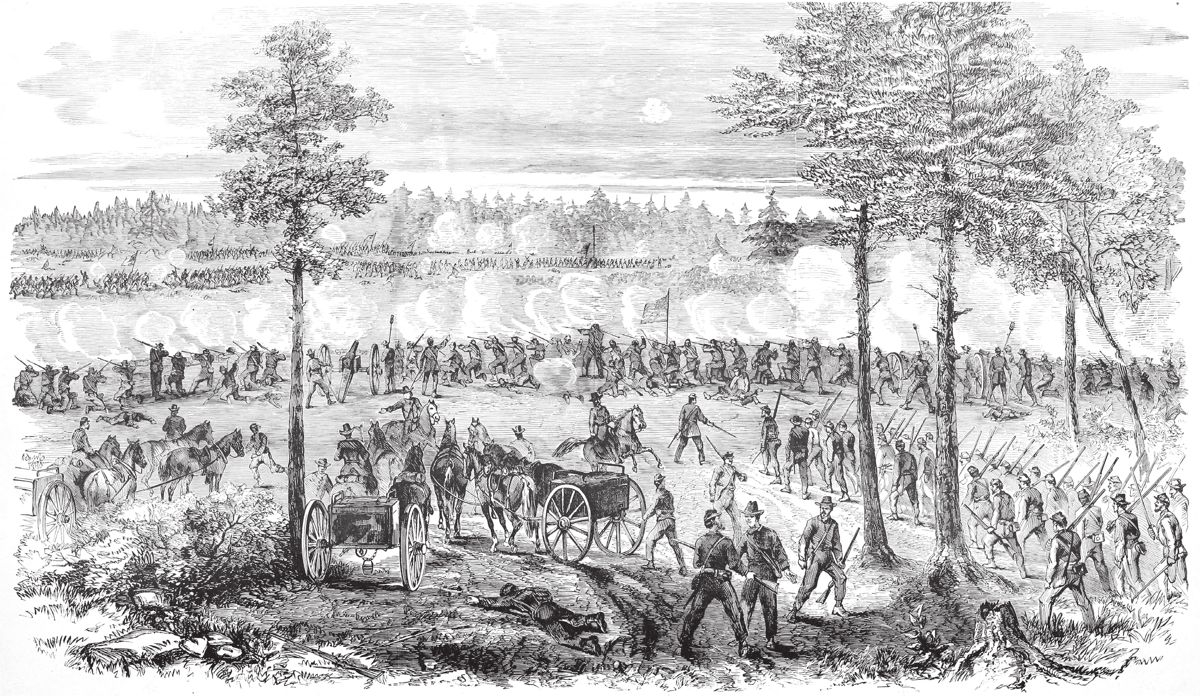
In late August 1864, the siege of Petersburg, Va., was well into its second month. Federal General Ulysses S. Grant was trying to put more pressure on the Confederate defenders by cutting the railroads they relied on for supplies. One of the major rail arteries was the Weldon Railroad; running from Petersburg to Weldon, N.C., with further connection to Wilmington, N.C. Wilmington was the South’s only remaining large port still partially open to blockade runners. Grant ordered General Winfield S. Hancock to cut the line north and south of Reams Station, Va., in Dinwiddie County. Hancock, commander of the II Corps, directed his First Division, under Brigadier General Nelson A. Miles, and the cavalry divisions of Brigadier General David McM. Gregg and Brigadier General August V. Kautz to march to Reams Station. Kautz sent only one brigade, that of Colonel Samuel P. Spear. The infantry division was exhausted from previous duties and the roads over which they marched were in a terrible condition. Many men were new conscripts and were a doubtful commodity. They arrived at Reams Station on the evening of August 21, and “spent the night in the mud, under a pouring rain.”1 On August 22, after Gregg’s cavalry drove off Confederate cavalry pickets, Miles had his division start tearing up the tracks north of Reams Station. They tore up four miles of track. Confederate cavalry Major General Wade Hampton, on discovering the damage, sent a dispatch to General Robert E. Lee, proposing an attack on the Yankees with infantry. Lee was concerned with the destruction of his supply line and determined to do something about it. He ordered Lieutenant General A.P. Hill to attack the Federal troops.
Lieut. Gen. Wade Hampton III. (Library of Congress)
Hill took with him Major General Cadmus Wilcox’s Division and two brigades of Major General Henry Heth’s Division. Two cavalry divisions under Major Generals Matthew G. Butler and W.H.F. Lee (Lee’s division was commanded by Brigadier General Rufus Barringer), were also assigned. All were placed under Hill’s command. However, Hill became ill before they arrived on the battlefield and turned command of the expedition over to Heth. The Rebels advanced against Reams Station, with Hampton’s cavalry in the lead, followed by Wilcox’s and Heth’s infantry.2
Maj. Gen. Henry Heth. (Library of Congress) The next day, Brigadier General John Gibbon arrived with the Second Division of Hancock’s Corps, and the Federals went to work south of the station. This was not simply a matter of tearing tracks from their ties. One of the detail described it thus: Brigade after brigade of the First and Second Divisions of the Second Corps would pass each other, form a line along the track, take hold of the uncovered ends of the ties, all at once, and throw rails and ties over on the opposite side. Cavalry had preceded us, and not only acted as skirmishers, but pulled the spikes which held the rails to the ties. After throwing them over, we would place the ties alternately in a heap until we had twenty or twenty-four piled up. We laid the rails on top of all. Then we took the fence-rails, boards, and posts, and split and broke them into small pieces and thrust them between the ties, and set the whole on fire. The heat would make the centre of the rails red hot, and they would bend of their own weight until the ends touched the ground. While the fire was heating the rails we went into the cornfields on each side of us, and pulled armfuls of green corn … and roasted it in the fire. Thus, they destroyed three miles of the Weldon Railroad.3
Just south of the station were earthworks constructed in June by Union cavalry during the Wilson-Kautz Raid, and Hancock occupied these works. The earthworks were degraded, only three feet high at the most and, in many places, offered no protection at all. “Built of fence rails … slightly banked with sod and loose earth,” they were poorly situated and partially filled with water; Miles and Gibbon made little effort to improve them. The entrenchments were in the shape of a horseshoe, with the open end facing east. The shorter western arch was twenty to thirty feet in front of the railroad, whose cuts and embankments made it almost impossible to reinforce from behind the railroad. The north and south entrenchments, parallel to each other, were so close that any artillery fire directed against one would take the other in the rear. The ground in front of the center, eastern section of the horseshoe, was mostly open except for some bushes, but on the south and north, the woods came close to the works. An abatis in front of the works would help delay any attack. Captain W.H.H. Lawhon of the 48th North Carolina Infantry said, “The timber for fifty or seventy-five yards in front of their works had been cut down, the limbs sharpened, making it very difficult to reach the works.” Indeed, the abatis was the most formidable part of the Union defensive works.4 Companies A and H of the 4th NY Heavy Artillery, fighting as infantry, were ordered to report to Colonel Spear, whose cavalry brigade had been scouting on the Federal right. They and the cavalry moved forward a mile, but Spear then ordered them to retire. In the afternoon, they were relieved by Companies G and M of the 4th under Captain Morrison. At first, these companies were held in reserve but then Captain Morrison was ordered to take forty men up a road that led toward the enemy’s line. When they reached the Confederate line, their orders were to form and charge into the Rebels. The infantrymen were to be supported by Spear’s cavalry. However, finding that his cavalry support was nowhere near, Morrison halted behind a rail fence until ordered by Colonel Spear to retire.5 Spear then ordered a mounted cavalry charge, supported by Company G, which failed. Captain Morrison was then ordered to march toward the enemy by the flank, with orders not to deploy until they were fired upon. When that happened, they were to deploy as skirmishers and charge. They attacked the enemy through a corn field, “the ‘Johnnies’ bullets whistling through the stalks … in the most discouraging manner.” When they reached a rail fence at the other end of the cornfield they saw that they were facing two full regiments. They “concluded the contract was a little heavy for one company to handle, and so took cover behind one side of the fence and commenced popping away.”6 Cavalry support never did show up. One infantryman quoted a saying of the time, “there wasn’t no sich [sic] person.” The men of Company G finally received orders to retreat. They suffered three casualties. One man was “a new recruit, who had joined the company two days before, and who had been most anxious to see what a fight was like. He found out, being shot through the face and made temporarily unable to express further curiosity.”7 Hancock arrived at Reams Station on August 24. He sent the First Division to tear up track again, this time south of the station. Colonel Spear’s cavalry protected the working parties; Gregg’s cavalry posted men on the roads from Petersburg and Dinwiddie. Spear was attacked by some enemy cavalry but he, assisted by some of the First Division infantry, drove them off. The work of tearing up the road continued for the rest of the day, destroying the track south of Reams Station for three miles, to a place called Malone’s Crossing. At the end of the day, the men returned to the fortifications. “The members of the regiment were in good spirits, and, after cooking coffee, sat around the camp-fires for awhile, enjoying the usual smoke and chat that almost invariably marked the close of a day like this.”8 About 11 p.m., Hancock received a message from Major General Andrew A. Humphreys. Humphreys warned Hancock that the Signal Corps had seen
Maj. Gen. Winfield S. Hancock. (Library of Congress) a large body of Confederate infantry heading south. It was thought that they would move against the troops of Major General Gouverneur K. Warren’s Fifth Corps, north of Hancock, or Hancock’s Second Corps, probably the latter. Hancock was ordered to be on the alert.9 On the morning of August 25, Hancock had his men continue ripping up track south of the station but then learned from his cavalry scouts that Confederate cavalry was pushing at Spear’s cavalry brigade, which had been picketing west of the tracks. Hancock ordered his men to take position behind the entrenchments. Miles’s Division moved into the north and west ends of the horseshoe. Gibbon positioned two of his brigades on the southern portion, with Lieutenant Colonel Horace P. Rugg’s brigade as reserve behind the west (center) of the Union line. Rugg’s men sheltered in the railroad cut, which was between twelve and thirteen feet deep. The cavalry of Gregg and Spear were stationed on Gibbon’s left flank.10 Believing that the only force of Rebels present may have been cavalry, Hancock ordered Gibbon to take his division and move down the road in force and find out for sure what enemy troops were present. At about 9:30 a.m., Gibbon moved off, with a regiment of Gregg’s cavalry in the lead, followed by Colonel Thomas A. Smyth’s
Gen. Nelson A. Miles. (Library of Congress) Third Brigade. About a half mile beyond Reams Station, the cavalry met with a body of Confederate skirmishers. Smyth deployed the 1st Delaware Infantry. They were supported by the 12th New Jersey and 10th New York infantry regiments.11 Colonel Smyth advanced his line, driving back the enemy skirmishers. They came upon the Confederate infantry brigade of Wilcox, drawn up in line of battle behind a small breastwork. Wilcox charged and drove Smyth’s skirmishers back on his main column. Smyth reported to Gibbon that there was a large force of Rebel infantry in his front. Gibbon ordered him to determine what force they were facing. Smyth employed the 7th West Virginia, 4th Ohio and 14th Connecticut. They pushed forward, forcing the Rebels back, until the Yankees, in turn, were compelled to retire. Gibbon directed his Second Division and Gregg’s cavalry back into the breastworks.12 Wilcox advanced skirmishers and sharpshooters, and drove in Miles’s pickets. The sharpshooters turned their deadly aim on artillery horses and gunners, picking them off one at a time. Shooting the men did not seem to trouble the sharpshooters, but the horses touched their sympathies; Major W.S. Dunlop noted, “At almost every shot some gay steed would rear and squeal and writhe and die.” Wilcox formed his division opposite Miles’s left (the center of the horseshoe) while Hampton dismounted his cavalry, sending skirmishers against Gibbon’s line. Wilcox attacked with his skirmishers, but this assault was driven off by the Union defenders. In his official report, Hancock said that some Confederates fell “within a few yards of the breast-work.”13 At about 1 p.m., Wilcox’s Confederates advanced again. Coming on in line of battle, they drove the Union skirmishers into the rifle pits. “As they advanced into the open ground they were met by a heavy fire.” John Billings, of the 10th Mass. Light Artillery, described the attack: They come at the double quick, with flashing bayonets, and ringing out their familiar yell. On the instant we turn, our muzzles to the right and give them canister… Some of our support (?) run to the rear, many lie inert in the ditch, and a few join in repelling the enemy’s assault. But even then it is a warm reception, and ere the hostile lines have fairly reached the works they break, reel, and surge to the rear in confusion … and leaving ground thickly sprinkled with their slain. The Rebels came within thirty yards of the Federal line before being repelled. The 148th Pennsylvania counter-charged in a skirmish formation and took a few prisoners.”14 About the time this attack was in progress, Hancock received a message from Major General George G. Meade that Brigadier General G. Mott, from the right of Warren’s line, was on the way with reinforcements. Meade told Hancock to call on Brigadier General Orlando B. Willcox’s Division of the Ninth Corps if it became “necessary.” They were supporting Warren’s Corps. In fact, Meade started them on the way without waiting for Hancock’s call. Meade told Hancock, “I hope you’ll give the enemy a good thrashing. All I apprehend is his being able to interpose between you and Warren.” Unfortunately, the distance was too far for either reinforcement to arrive in time. The First and Second Divisions of the Union Second Corps, and Gregg’s and Spear’s Cavalry would be compelled to fight the battle alone.15 The second assault was made at around 4 pm, by Wilcox’s men. Miles described the fighting: Another vigorous attack was made in front of the Fourth Brigade which was handsomely repulsed, with the assistance of the Fourth New York [Heavy Artillery] and the Consolidated Brigade, firing to the right and left oblique, the troops fighting with determination. In this attack, rebels were killed within three yards of the line. Captain Garrett Nowlen, in command of the Fourth Brigade’s 116th Pennsylvania, “stood up in front waving his sword and cheering on the men. At that moment, a ball pierced his heart.” Command of the regiment passed to Captain Samuel Taggart. Shortly, he was also shot, as he walked in front of the line. “The men ran forward and carried him behind the works and laid him beside Nowlen.” Sergeant Samuel Clear of the 116th described the Federal defense: “Four of our batteries opened with us and we mowed them with grape and canister, Buck and Ball, but on they came… But they recoiled fell back and left the sod covered with their dead and wounded.” Clear said, “This was the only fight that we could ever see after we had fired a few volleys, but this we could see all, the smoke would raise from the guns in an instant… When they would drop wounded they would haul out an old dirty handkerchief and wave it while they lay on their backs.”16 Thus far, the Confederates had not used their artillery. Heth ordered two batteries, under the command of Colonel William Pegram forward. “Adjusting our watches so that they indicated the same time, Pegram was ordered to open all of his guns [at 5 p.m.] and fire as rapidly as possible at the works.”17 At 5 p.m., their batteries opened a bombardment on the Federal entrenchments. A Union soldier described the barrage, “The air seems filled with the shrieking shells, with the flash, smoke, and crash of their explosion, and the harsh hurtling of their fragments.” Pegram’s guns enfiladed the entire Union defensive work. Solid shot shattered the breastworks “like kindling wood.” Gibbon’s Division suffered severely. They received artillery fire in their rear, so grave they were compelled to seek shelter on the opposite side of their breastworks. This provided some relief from the artillery fire, but they were now subjected to fire from Hampton’s cavalry skirmishers. The shelling lasted approximately twenty minutes.18 Hampton ordered his dismounted cavalry forward, acting as infantry. They had not received any infantry training, and all they knew was to keep an even front. Captain William N. McDonald of the Laurel Brigade described their attack: “The sharp volleys of Federal musketry were only answered by the rattle of Confederate carbines, but the grey line kept steadily advancing while delivering its fire.” Hampton reported, “The ground over which my troops advanced was very difficult, and it had been rendered more so by the enemy, who had cut down the timber. In spite of this … the line advanced steadily.”19 Wilcox failed to carry the works; now it was Heth’s turn. The Rebel infantry attacked the horseshoe’s center (Miles’s left). They came on in two lines of battle, Wilcox’s Division in the first line and two brigades of Heth’s Division in the second line. The men of Wilcox’s Division “were received by a heavy fire of both musketry and artillery.” Brigadier-General William MacRae, commanding the reserve brigade on the right of Heth’s attack, told his men that he knew they would carry the Yankee works when ordered to do so. He commanded them, “Don’t fire a gun, but dash for the enemy.” “All right, General, we will go there,” was the answer from his men. Major Charles Stedman of the 44th North Carolina, in the center of MacRae’s line, recalled “the men were in high spirits, jesting and laughing, and ready to move on an instant’s notice.20 MacRae saw that Lane’s Brigade and Cooke’s Brigade were taking heavy losses. He told his Adjutant-General, “I shall wait no longer for orders. Lane is drawing the entire fire of the enemy: give the order to advance at once.” They emerged from a pine wood, where they had been waiting, into a “tremendous fire of small arms, with a converging fire of artillery along MacRae’s whole front.” Without firing a shot, with a Rebel yell, they attacked the Yankee entrenchments. Cooke’s and Lane’s Brigades joined in on their right.21 One of Gibbon’s staff galloped up to the Federal Second Division line and told the commander of the 4th NY Heavy Artillery that they had to hold their position at the southwest corner of the horseshoe “if it cost every life there to do it.” When informed that ammunition was almost gone, he replied, “Hold it with the bayonet then.” The Fourth Brigade of Miles’s Division, further up the line on the eastern barricade, “was hurling death into those [Rebels] in the front.” “The men of the One Hundred and Sixteenth [Pennsylvania] stood shoulder to shoulder, pouring in their fire on the advancing hosts.”22 The Confederates gained the outside of the entrenchments. A member of the 28th North Carolina Infantry remembered how they “had to crawl through an almost impenetrable abatis, under a heavy fire of musketry and artillery.” There was some hand-to-hand fighting as the Yankees drove them back with bayonets. The 148th Pennsylvania infantrymen “were engaged during the terrible hand-to-hand fight which ensued.” A captain described the fighting: The enemy advanced, notwithstanding the galling fire they received, up to the works, and mounting the intrenchments were met by the command. The men in many instances knocked their assailants down with the butts of their guns, and only retired when the right and left flanks were completely overpowered and the enemy not only had possession of the works, but also occupied the railroad. Sergeant Joseph Fox, of the 148th, received seven bayonet wounds in the face and neck. The Confederates broke through the northwest corner of the horseshoe. Captain Holland, an officer of the 28th NC Inf., “was among the first to mount the works … yelled out: ‘Yanks, if you know what is best for you, you had better make a blue streak toward sunset.” Rugg’s Union brigade was ordered to move forward to fill the gap but refused to move or even fire. McKnight’s artillery battery was turned on the opening but the Rebels took them in flank, captured the cannon, and turned one gun against the Federals. Miles described the terror overtaking his troops: The One hundred and fifty-second New York Regiment [of Rugg’s Brigade], Captain Burke [Burt] commanding, when the assault was made, was directed to attack the enemy in flank and rear. The regiment had changed front, was moved up to within 200 yards, and directed to open fire… Not a shot was fired at it, but the men broke from the ranks and fled in a disgraceful manner, only two men in the regiment discharging their pieces.23 Lieutenant H.H. Granger, commanding the 10th Mass. Arty., described the action of some cannoneers: Breaking the lines a short distance from our right, they poured over the works, and driving our infantry before them, turning, advanced upon our guns. The right piece was swung round and poured charge after charge of canister into the approaching column. The cannoneers then fell back to the next piece, under direction of their lieutenant, and fired that piece in like manner. So, falling back from piece to piece, firing each in succession, they did not leave their guns until all their supports had gone and the last round of ammunition had been expended.24 After the initial break-through, the entire First Division was swept away, leaving their artillery behind. The 4th NY Heavy Arty. manned the nearest battery, attempting to stem the tide, but they too were over-run.25 They heard cries from the Confederates of “Surrender, Yank; no use holding out. We uns [sic] has won the fight and old Hancock and his corps, prisoners.” An officer of the 4th told how he saved the regimental flag: Major Williams, seeing that everything had gone out from our left, and recognizing the fact that without support we were bound to go to Petersburg [as prisoners], now ordered the battalion color-bearer, Sergeant Lynes to carry the colors to the left rear and plant them on the railroad embankment for a rallying-point… I saw him drop the colors, throw up his hands and fall to the ground rolling over into the ditch. At the same time an advanced skirmisher from the Johnnies started for the flag. It was the yellow regimental color … and I hated to see it lost so I started for the same point… I reached it first and as I stooped to pick up the flag the Johnny fired and sent a bullet through my hat. Seeing he had missed, he fixed his bayonet and charged me. I unlimbered my revolver, and when he arrived in good shooting distance opened fire. He was persuaded to stop… I got an infantry-man whom I met to tear the color from the staff and button it under my coat.26 The 44th NC captured an artillery battery and manned it with their sharpshooters who had been trained in manning artillery. They turned the battery on the Federals. One piece was sighted by Captain W.P. Oldham of Company K. “When he saw the effect of his accurate aim … [he] was so jubilant that General MacRae … remarked: ‘Oldham thinks he is at a ball in Petersburg.’”27 Those Yankees not captured ran for their lives. One officer tried to form a line to rally behind. “We no sooner halted than from our right and left doubled around the lines of gray, and from both ends came orders to surrender, accompanied by rows of leveled guns. I at once shouted to the men, ‘Fire and get out quick’ and suited the action to the command by setting such an example of racing and hurdle-jumping as would have secured an engagement in a Wild West show.” Rugg’s Brigade’s 20th Mass. Inf. was taken in rear and all but ten men and one non-commissioned officer became casualties, most of them captured.28 Hancock ordered Gibbon to about face and charge the Rebels who had over-run the First Division. General Gibbon ordered his division to reverse, move to the opposite side of their breastworks, and face the Rebels attacking Miles. Gibbon said: my division was then ordered forward by General Hancock to attack the enemy and retake the breast-works. In the attempt to obey this order, that portion of the division with me did not sustain its previous reputation, and, demoralized, partly by the shelling and musketry firing in its rear, partly by the refugees from other parts of the line, retired after a very feeble effort and under a very slight fire in great confusion, every effort of myself and staff failing to arrest the rout.29 Hancock led Miles’s Division in person, cheering the men on. One of his men saw him, “riding up to the main breastworks, waving his cap and shouting, ‘Come on! we can beat them yet. Don’t leave me for God’s sake!’” While he was leading his men toward the enemy, Hancock’s horse was shot from under him. A minié ball had struck the horse through the neck. It was thought the horse was dead but, after a short time, it recovered and got up, and Hancock remounted.30 Miles rallied part of his division, and between Hancock and Miles, they managed to regain Miles’s entrenchments. Gibbon then ordered his troops back to their original entrenchments, facing to the south. The Confederates renewed their attack with Heth’s Division and broke through Murphy’s Brigade, which held the extreme right flank of Gibbon’s Second Division, driving them toward the flank of Miles’s First Division. This was too much; both divisions were exhausted and dispirited. They abandoned the line, losing numerous casualties, most of them captured. Gibbon later said, “My men, I am sorry to say, did not behave well and the enemy beat us badly.”31 Many men would not leave their entrenchments, preferring to be captured rather than to be shot in the back while running away.32 Hancock and his staff tried to stop the retreat. Hat in his left hand and sword in his right, Hancock yelled, “For God’s sake, don’t run.” Nothing he could say or do would stop the men. The 5th New Hampshire’s William Child remembered “how two mule teams … also ingloriously retreated, [entrenching] tools flying, mules galloping, wagons jumping and rocking from side to side.” General Miles said “it was with the greatest difficulty that any line could be formed.33 Miles saw one regiment, the 61st NY Inf.: fighting with determination… It was contesting every foot of ground… I rallied a line on this regiment, … forming it as well as possible under fire… I directed it to advance, with a cheer. It swept the enemy from the entire north face of the works, recapturing the three guns of the Twelfth New York Battery, and driving the enemy into the railroad cut. This line was held by us until dark.34 Gregg’s dismounted cavalry, in rifle pits on Gibbon’s left flank “fought gallantly, and completely checked the enemy’s advance in that direction.” Gibbon ordered a color guard to stop and for the men to form on the colors. A soldier sang out, “Rally round the flag, boys, rally once again.” Some men rallied and formed a defensive line about three hundred yards east of the railroad tracks.35 About 6 p.m., volunteers of the 5th NH Inf. returned to the works, which were now between the enemy lines. In company with the 81st Penn. and 61st NY, they saved three cannon that had been lost by the 12th NY Btry. during the rout.36 The sun was sinking when Hampton’s dismounted cavalry troopers scrambled over the abatis. “Amid the roar of cannon, bursting of bombs, and the pattering of the deadly bullets through the foliage,” Hampton’s line moved forward against Gibbon. R.L.T. Pratt’s 9th Va. Cav. squadron leaped over the breastworks on horseback.37 Hancock ordered a retreat, as orderly as possible. He was chagrined at the conduct of his two divisions. Placing a hand on the shoulder of one of his staff officers, he said, “Colonel, I do not care to die, but I pray God I may never leave this field.” It was now about 8 p.m. and the Rebels did not pursue. Night put an end to the fight. Lieutenant-Colonel J.W. Spaulding of the 19th Maine Inf. said: The Regiment had no sooner gained the shelter of the friendly woods, where were assembled the rest of the Division, when General Hancock… inquired, ‘What regiment?’ On receiving the answer, he exclaimed, with an expletive. ‘The Nineteenth Maine will go anywhere. Deploy by the fence on the edge of the field in front and hold that position.’ The order was no sooner given than it was obeyed and the position held until midnight, when all of the forces were withdrawn.38 Hancock later said that, for the number of men engaged, the Battle of Ream’s Station was the hardest fight he was ever in. He said “I attribute the bad conduct of some of my troops to their great fatigue, owing to the heavy labor exacted of them and to their enormous losses during the campaign, especially officers.”39 Willcox’s Division of the Union Ninth Corps arrived just before dark. Willcox did not think it was too late to “recover everything that had been lost.” However, “Hancock did not think it wise to renew the fight…” Hancock told Willcox, “Had our troops behaved as they used to I could have beaten Hill. But some were new, and all were worn out with labor.”40 The loss for Hancock’s two divisions and the cavalry was 140 killed, 529 wounded and 2,073 captured or missing for a total of 2,742. The Confederates lost 720, mostly killed or wounded.41 Night brought new horrors. The ground in front of and behind the trenches was littered with the dead and wounded. As Southern cavalry trooper Captain McDonald described it: The shrieks of the wounded banished slumber. At midnight a terrific storm burst forth, deluging all with a downpour of rain… The dreadful patter of the elements with the sharp rattle and deafening roar of the thunder was appalling, and the bright flashes of lightning, that revealed the ghastly features of the dead and of others in the agonies of death, added to the horrors of the scene.42 The day after the battle, Rebel infantry was ordered back to Petersburg, leaving the field to Hampton’s cavalry. On August 27, Union General Gregg sent a request to General Hampton, asking to be allowed to send parties to bury the Federal dead. Hampton refused the request, saying, “I cannot accede to this request, but I have ordered all your dead to be buried. Your wounded have been collected, and they are under charge of your surgeons.”43 The two divisions of the Second Corps in the Battle of Reams Station were fought out and would never again be the same. A few days after the battle, Gibbon, commander of the Second Division, sent a message to Hancock, suggesting that his division be reorganized. In response, Hancock transmitted a message to Gibbon, requesting he resign his position. Gibbon submitted his resignation. The two eventually resolved their differences; Hancock withdrew his letter and Gibbon withdrew his resignation. However, their relationship was always cool after this.44 The Second Corps, which had been one of the premier fighting units of the Union’s Army of the Potomac, would never regain its lost status. Confederate units lost troops that could not be replaced at this stage of the war. The waste of lives on both sides accomplished very little. The only lasting result of the Union operations against the Weldon Railroad was that the Confederates had to off-load their railroad cars and transfer their supplies, by wagon, around the torn-up track, before reloading on another train. Endnotes: 1.
Walker, p. 581, Guernsey, p. 703. 2. Walker, p. 587., Clark (Stedman,) “Reams Station,” p. 208, Mulholland, p. 264. 3. Humphreys, p. 279. Kirk, pp. 336–337, Billings, p. 308. 4. Bruce, p. 419. Humphreys, p. 279. Kirk, p.341. Walker, p. 582, Clark (Lawhon), p. 121, Billings, p. 311. 5. Kirk, p. 333–334. 6. Kirk, p. 335. 7. Kirk, p. 335–336. 8. Mulholland, p. 257. 9. OR Part 1, p. 222. 10. New York Times. Aubery, p.128. 11. New York Times.
- New York Times. Walker, p. 589. 13. New York Times. Caldwell, p. 235. Child, p. 278. Kirk, p. 339, 343–344. OR Part 1, p. 224, Dunlop, pp. 193–194, Billings, pp. 314–316. 14. OR Part 1, p. 252. Walker, p. 588, Billings, p. 318. 15. B & L (Wilcox), p. 572. OR Part 1, p. 224 16. Menge & Shimrak, pp. 35–36. OR Part 1, p. 252, Mulholland, p. 259–260. 17. Mulholland, pp. 264–265. 18. New York Times. Kirk, p. 339, 348. OR Part 1, p. 226, Billings, p. 319. 19. McDonald, p. 272, Clark (Means), p. 621. 20. Clark (Stedman,) “Reams Station,” p. 208–209, Clark (Thorp,) “Forty-Seventh Regiment,” p. 97. 21. Clark (Stedman,) “Reams Station, p. 209, Clark (Young), pp. 565–566. 22. Kirk, p. 339, Mulholland, pp. 260–261… 23. Aubery, p. 127. Humphreys, p. 281. Muffley, p. 158., Sloan, p. 105. SHSP vol. 24, p. 337. OR Part 1, pp. 226, 253, 287. Walker, p. 594, Clark (Robinson), p 249. 24. OR Part 1, p. 415, Billings, p. 321. 25. The accounts of the heroism of the 4th New York Heavy Artillery are at variance with the account of the battle by John Billings, who accused the whole regiment of cowardice (Billings, pp. 317, 319, 321.) Probably, Hyland Kirk, General Miles and Billings were each recording, accurately, what he personally saw and experienced on a confusing battlefield. 26. Kirk, pp. 349–350. 27. Clark, (Stedman,)”FortyFourth Regiment,” p. 31, Clark (Stedman,) “Reams Station,” p. 211. 28. Bruce, p. 422. New York Times, Aubery, p. 127, Humphreys, p. 281, Kirk, pp. 340, 347–348. 29. OR Part 1, p. 293. 30. OR Part 1, p. 246, Billings, pp. 322–323. 31. New York Times. Gibbon, p. 258. 32. Conyngham, p. 480. 33. Child, p. 279. OR Part 1, p. 253. 34. OR Part 1, p. 253. Walker, p. 595. 35. Gibbon, p. 257, OR Part 1, p. 246. 36. Child, p. 278. OR Part 1, p. 262, 324. 37. McDonald, p. 273, Beale, p. 144. 38. New York Times. Smith, p. 237. Walker, p. 599. 39. Bruce, p. 422. Kirk, p. 357. 40. B & L (Wilcox), p. 573. 41. B & L (Wilcox), footnote, p. 573. 42. McDonald, p 276. 43. OR Part 2, p. 1231. 44. Gibbon, pp. 260–262.
•
•
•
•
•
•
•
•
•
•
•
•
•
•
Bibliography:
Aubery, James M., The ThirtySixth Wisconsin Volunteer Infantry, 1900. Beale, R.L.T., History of the Ninth Virginia Cavalry in the War Between the States, 1899. Billings, John D., The History of the Tenth Massachusetts Battery of Light Artillery in the War of The Rebellion: Formerly of the Third Corps, and Afterwards of Hancock’s Second Corps Army of the Potomac 1862–1865, 1909. Bruce, George A., The Twentieth Regiment of Massachusetts Volunteer Infantry 1861–1865.1906. Caldwell, J.F.J., The History of a Brigade of South Carolinians First Known as “Gregg’s” and Subsequently as “McGowan’s Brigade,” 1992. Child, William, A History of the Fifth Regiment New Hampshire Volunteers, in the American Civil War, 1861–1865, 1893. Clark, Walter, Editor, Histories of the Several Regiments and Battalions from North Carolina in the Great War 1861–’65, Volume III. • Charles M. Stedman, “Forty-Fourth Regiment.” • John H. Thorp, “ForthSeventh Regiment.” • W. H. Lawhon, “ForthEighth Regiment.” • John H. Robinson, “FiftySecond Regiment.” • Paul R. Means, “Additional Sketch Sixty-Third Regiment (Fifth Cavalry).” Clark, Walter, Editor, Histories of the Several Regiments and Battalions from North Carolina in the Great War 1861–’65, Volume IV. • Louis G. Young, “The Pettigrew-KirklandMacRae Brigade.” Clark, Walter, Editor, Histories of the Several Regiments and Battalions from North Carolina in the Great War 1861–’65, Volume V. • Charles M. Stedman, “Reams Station: 25 August, 1864.” Conyngham, David Power, The Irish Brigade and Its Campaigns, 1994. Correspondence of the Philadelphia Inquirer, The New York Times, “The Battle at Ream’s Station; Interesting Description of the Struggle,” August 26, 1864, 1988. Dunlop, W.S., Lee’s Sharpshooters; Or, The Forefront of Battle: A Story of Southern Valor That Never Has Been Told, 2000. Gibbon, John, Personal Recollections of the Civil War, 1988. Guernsey, Alfred H., and Henry M. Alden, Harper’s Pictorial
•
•
•
•
•
•
•
•
•
•
•
•
•
•
•
History of the Civil War. Horn, John, The Petersburg Campaign, The Destruction of the Weldon Railroad: Deep Bottom, Globe Tavern, and Reams Station, August 14–25, 1864, 1991. Humphreys, Andrew A., Campaigns of the Civil War – XII: The Virginia Campaign of ’64 and ’65, 2002. Johnson, Robert Underwood and Clarence Clough Buel, Editors, Battles and Leaders of the Civil War Volume IV. • Orlando B. Willcox, “Actions on the Weldon Railroad.” Kirk, Hyland C., Heavy Guns and Light: A History of the 4th New York Heavy Artillery, 1890. McDonald, William N., A History of the Laurel Brigade: Originally the Ashby Cavalry of the Army of Northern Virginia and Chew’s Battery, 2002. Menge, W. Springer and J. August Shimrak, Editors, The Civil War Notebook of Daniel Chisholm: A Chronicle of Daily Life in the Union Army 1864– 1865, 1989. Muffley, J.W., Editor, The Story of Our Regiment: A History of the 148th Pennsylvania Vols.,1904. Mulholland, St. Clair A., The Story of the 116th Regiment Pennsylvania Infantry: War of Secession, 1862–1865. Page, Charles D., History of the Fourteenth Regiment, Connecticut Vol. Infantry, 1906. Sloan, John A., Reminiscences of the Guilford Grays, Co. B, 27th N.C. Regiment, 1883. Smith, John Day, The History of the Nineteenth Regiment of Maine Volunteer Infantry 1862– 1865, 1909. Southern Historical Society Papers, Volume 24. “TwentyEighth North Carolina Infantry.” United States War Department, The War of the Rebellion: A Compilation of the Official Records of the Union and Confederate Armies, Series 1, Volume 42, Part 1, 1880–1901. United States War Department, The War of the Rebellion: A Compilation of the Official Records of the Union and Confederate Armies, Series 1, Volume 42, Part 2, 1880–1901. Walker, Francis A., History of the Second Army Corps in the Army of the Potomac, 1887.
Robert L. Durham is a retiree from DLA, where he was a computer specialist doing installations of communications systems for FMS countries. He is a long-time Civil War buff and has written numerous articles. He also is addicted to Old West and Napoleonic history.