
Through The Lens
A Fair Trial
By Stephanie Hagiwara · Originally published April 2018 · pp. 8–9
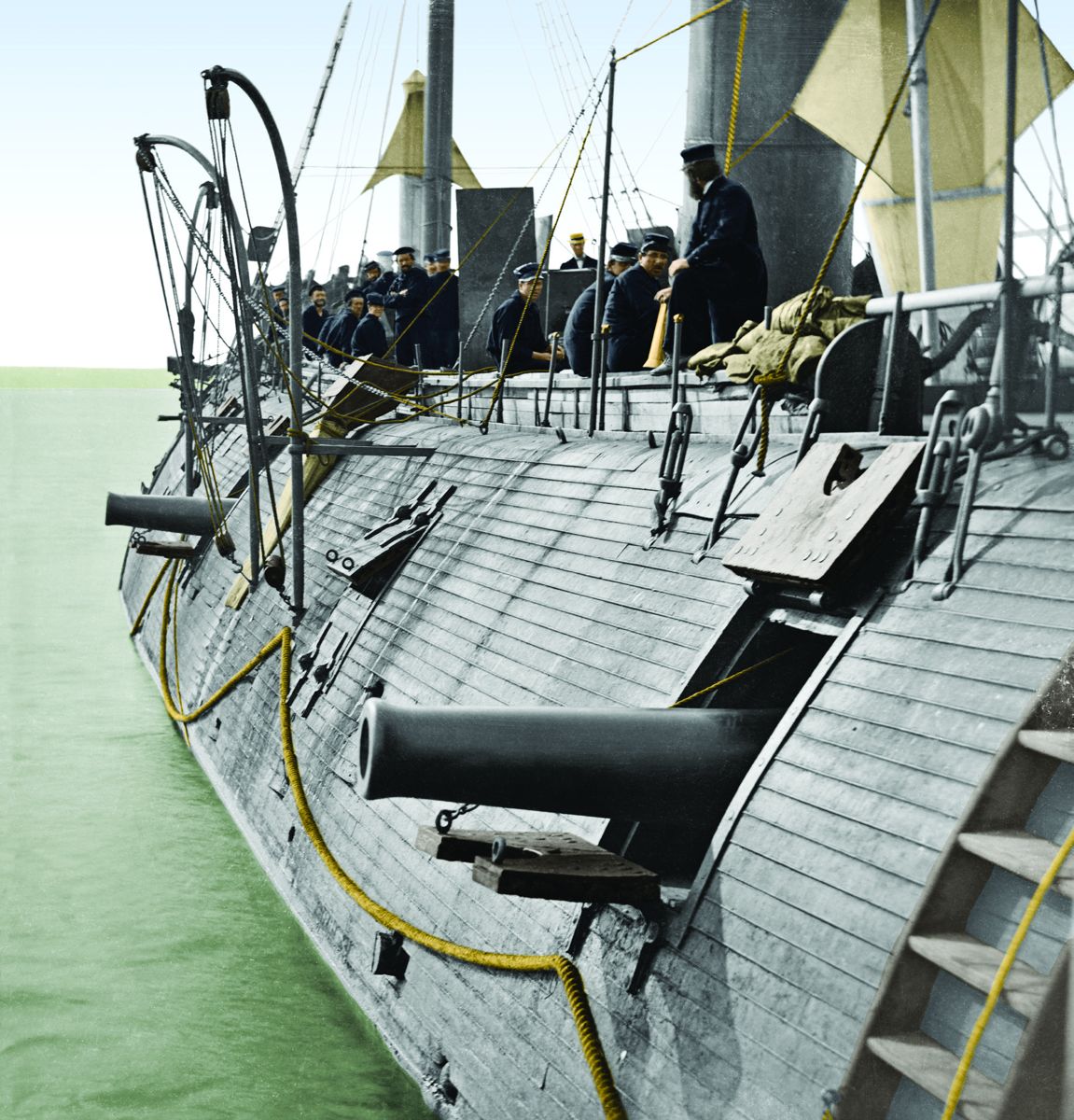
“Tell Capt. Jeffers that is not the way to Richmond.” – Lt. J.T. Wood, CSS Virginia, to an officer in the pilothouse of the departing USS Monitor Fear permeated the air of Richmond, Va., in May 1862. Refugees from the Federal advance up the Peninsula poured into the city as residents scrambled to leave. President Jefferson Davis’s family was sent to Raleigh, N.C. The Confederacy’s treasury was crated up ready to go. This was in stark contrast to the bands playing and crowds cheering on April 4, as Gen. Joseph Johnson’s troops marched through the city on their way to Yorktown, Va. On May 4, reality reared its ugly head as Johnston’s troops withdrew in the face of Gen George McClellan’s Yorktown, Va., siege cannons. On May 10, the mayor of Norfolk, Va., surrendered the city and the Navy Shipyard. The loss of the shipyard meant the ironclad CSS Virginia lost her home port. On May 11, flag officer Josiah Tattnall blew up the Virginia before allowing her to fall into Federal hands. The Federal Navy was ordered to send a flotilla up the James River to capture Richmond. The Virginia General Assembly vowed to defend the Confederate capital “to the last extremity.” The Richmond Dispatch articulated the popular sentiment, “To lose Richmond is to lose Virginia, and to lose Virginia is to lose the key to the Southern Confederacy.” Davis wrote to his wife, “…. I do not know what to expect … yet will try to make a successful resistance.” With the Virginia gone, Richmond’s defense lay with a battery on top of a 90-foot bluff. Located eight miles below Richmond on a sharp bend in the James River; Drewry’s Bluff commanded a mile-long stretch of the river. The redoubt boasted one 10-inch and two 8-inch Columbiads. Focus turned to strengthening the position. After two days of rain and mud, three 32-Pdrs. and two 64-Pdrs. taken from the CSS Patrick Henry and the CSS Jamestown were mounted on the bluff. To create river obstacles, anything, including the gunboat Jamestown was scuttled, her masts rising out of the water as evidence of her sacrifice. Lining the banks of both sides of the James were sharpshooters from Norfolk, including the Marines from the Virginia. On May 15, the Federal flotilla, ironclads USS Monitor and Galena with the Naugatuck, Aroostook, and Port Royal appeared through the mist. The Battle of Drewry’s Bluff would be the Galena’s maiden battle. Unlike the Monitor, the Galena was a 210-foot-long wooden hull steam frigate with a sail rig. Her armor was rows of interlocking iron sheets, giving her an appearance “like a great fish with iron scales.” Her commander, Capt. John Rodgers, “was convinced as soon as I came on board that she would be riddled under fire, but the public thought differently, and I resolved to give the matter a fair trial.” On approach, the sharpshooters fired upon the flotilla. The leadsman and his replacement on the Galena were wounded. Nevertheless, the Galena led the way past the obstacles that narrowed the river to about twice Galena’s beam, dropped anchor within 600 hundred yards of the bluff, used the current to swing into position and at 7:45 a.m. fired. Master Hasker, C.S.N., “…could not but admire this maneuver, although executed to bring death or wounds to so many of my brave comrades.” Richmond’s defenders had the advantage of the Galena being “within point-blank range” making her an easy target. But their 10-inch Columbiad recoiled off its platform when accidentally loaded with a double powder charge. The Monitor was unable to raise her guns to elevation and withdrew. The Naugatuck’s single 100-Pdr. Parrott gun burst on firing its 16th round, taking her out of the fight.
(Library of Congress)
The sharpshooters were firing at any seaman sighted; limiting their mobility, but the Galena’s 14-man Marine detachment would not be deterred. They fired their muskets through the gun ports at the sharpshooters on shore. Then, two of four consecutive shots passed between the Galena’s thin armor, disabling the gun crew of the 100-Pdr. Parrott gun. Realizing the Parrott rifle was silenced, John Mackie, shouted “Come on, boys, here’s a chance for the Marines!” As the men cheered, the 26-year old loaded and fired the gun three times. By 11 a.m., the Galena’s railings were shot away, her smokestack riddled, her decks “were covered in large pools of blood,” several crewmen were dead or wounded, but it took running low on ammunition for Rodgers to finally give the order to withdraw. The Confederates gave three cheers and threw their hats into the air as the flotilla retreated downstream. In Richmond, the silence was almost as deafening as the roar of the battle. By early afternoon the grateful citizens of Richmond were sending wagon loads of “good food” to the defenders. The Galena would not receive a positive performance review as an ironclad. She had taken 44 hits; 13 men were dead and 11 wounded. Shells that pierced through her armor ricocheted around the interior. William Keeler, paymaster of the Monitor described the aftermath as “a slaughterhouse of human beings.” According to Rodgers, who understated the destruction, “We demonstrated that she is not shotproof. Cannon balls came through and many men were killed with fragments of our own armour.” The Galena would continue to serve; not as an ironclad, but as a wooden sloop with three masts, armor removed. The Monitor may have received only three hits, but her crew suffered for lack of fresh air. The men were not allowed on deck due to the sharpshooters. Keeler wrote, “At times we were filled with powder smoke below threatening suffocation to us all. Some of the hardest men dropped fainting at the guns.” The battle did create job openings for escaped slaves. The Monitor’s Engineer George Geer wrote to his wife, “The Countrabands come off to us every night but we send them back in most cases, as we have no room for them. We have one
(Library of Congress)
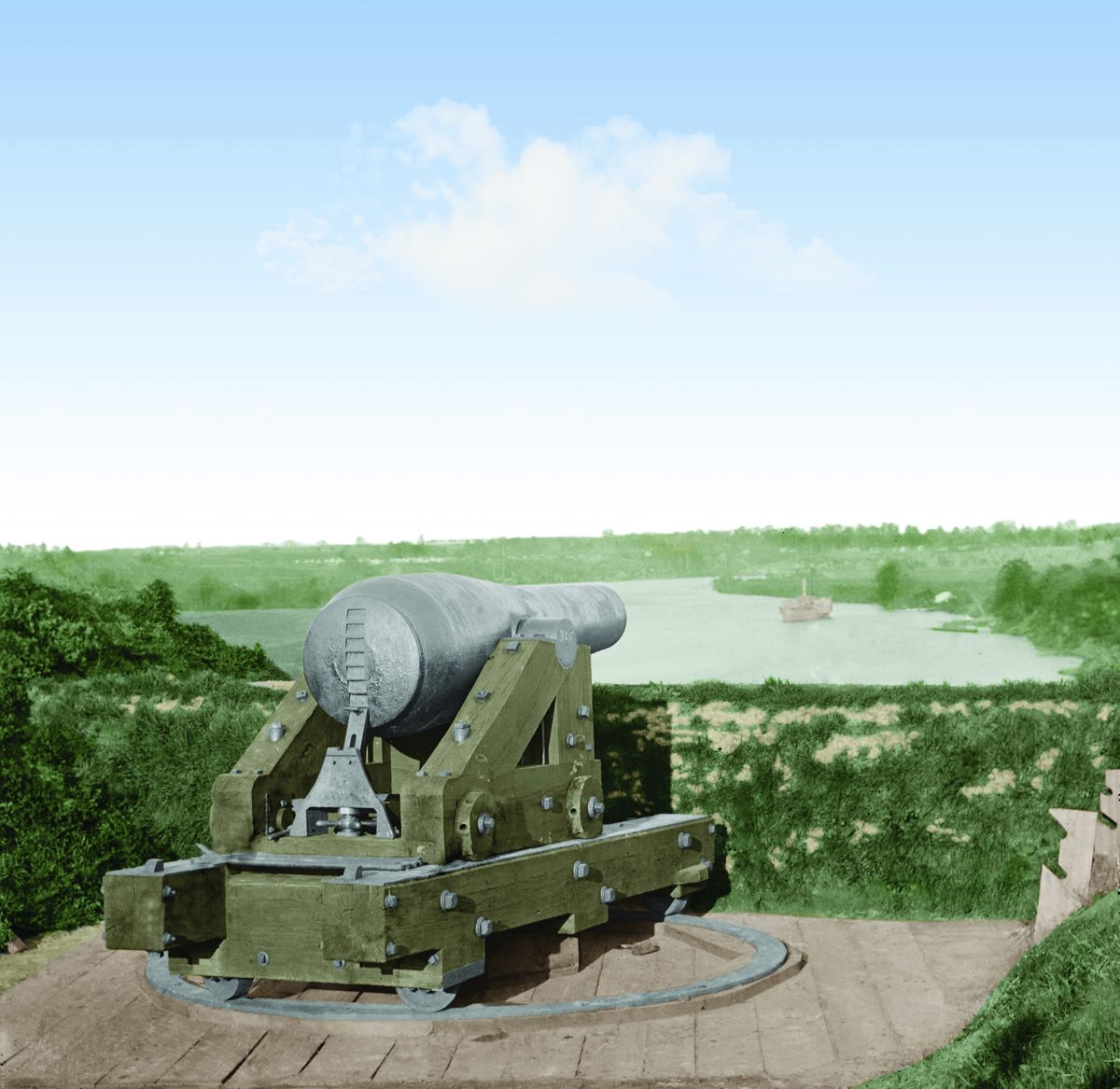
as a Ships Cook.” The Monitor enlisted 22-year-old Siah Carter. Carter, “… says his master owns 100 Slaves and is a Colonel in the Rebel army.” The Galena hired more, “as they were so short handed, having so many killed and wounded.” On July 8, President Abraham Lincoln toured the Galena and was shocked by the damage. He ordered that Marine Corporal John F. Mackie, Quartermaster Jeremiah Regan, and First-class Fireman Charles Kenyon receive a promotion and the Medal of Honor. Mackie would become the first Marine to receive the Medal of Honor. Despite the failures of the Galena, the battle might have been won if it had been a joint Navy and Army endeavor. Capt. Jeffers of the Monitor reported, “So long as our vessels kept up a rapid fire they rarely fired in return, but the moment our fire slackened they remanned their guns. It was impossible to reduce such works, except with the aid of a land force.” Notwithstanding attempts at framing it as a reconnaissance mission, the battle was a defeat for the Union. As Geer wrote, “We have been fighting all day and have come off 2nd best.”
Sources: • Coski, Capital Navy: The Men, Ships, and Operations of the James River Squadron • Quarstein, John V., The Monitor Boys: The Crew of the Union’s First Ironclad • Scharf, John Thomas, History of the Confederate States Navy from Its Organization to the Surrender of Its Last Vessel, pgs. 713–718 • Sears, Stephen W., To The Gates of Richmond: The Peninsula Campaign • Report of the Secretary of the Navy, with An Appendix, containing Reports from Officers. December 1862 • Wallace, Lew, The Story of American Heroism: Thrilling Narratives of Personal Adventures During the Great Civil War as told by the Medal of Honor Winners and Roll of Honor Men, p. 658. Stephanie Hagiwara is the editor for Civil War in Color.com and Civil War in 3D.com. She also writes for History in Full Color.com that covers stories of photographs of historical interest from the 1850’s to the present. Her articles can be found on Facebook, Tumblr and Pinterest.