
The Graphic War
The Graphic War — September 2017
By Salvatore Cilella · Originally published September 2017 · pp. 4–5
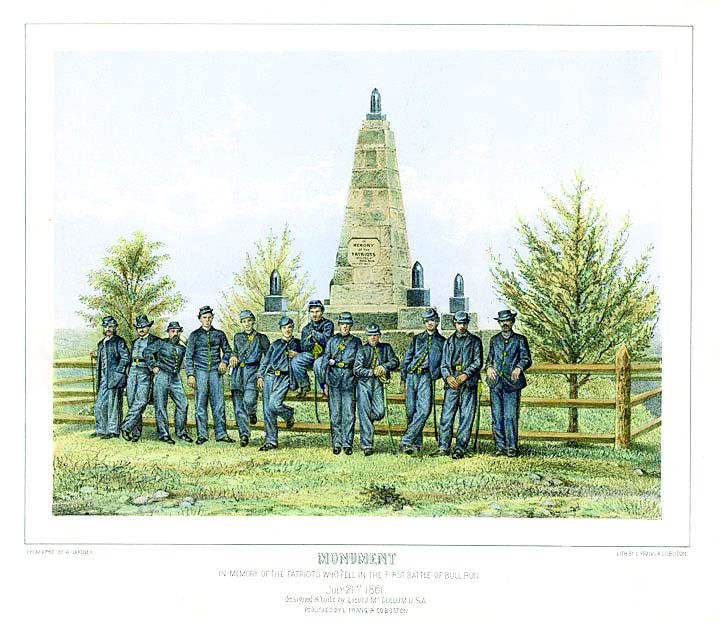
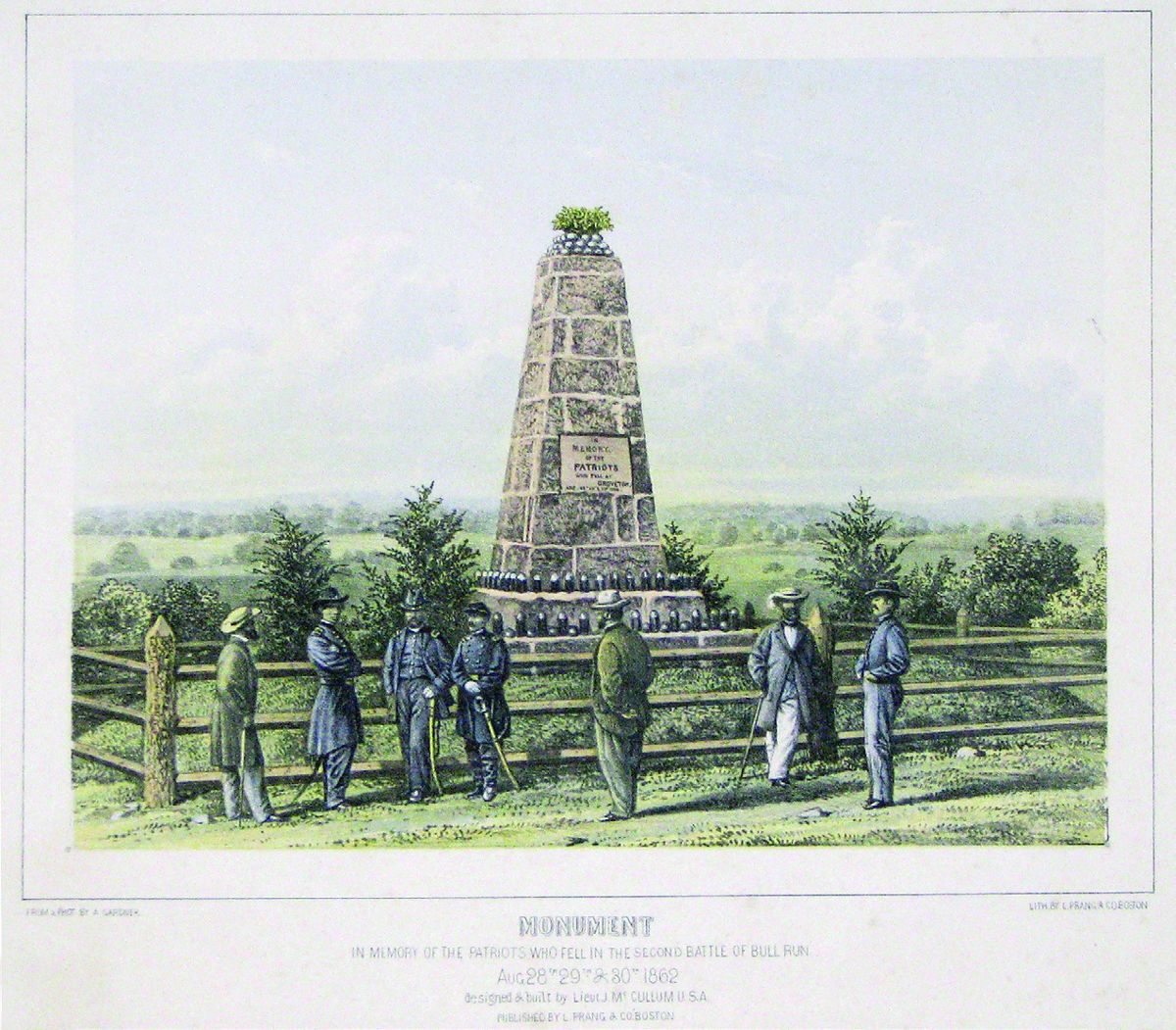
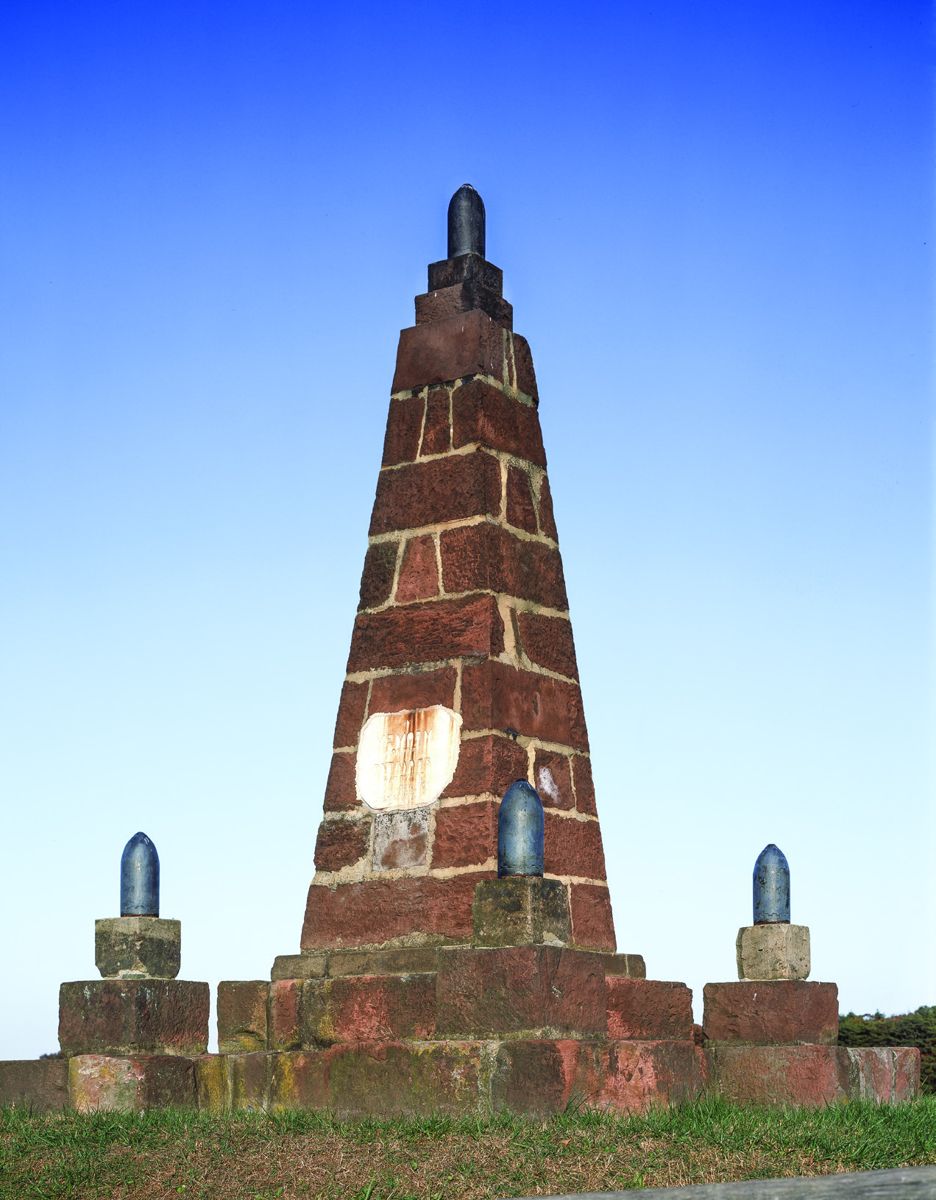
The Graphic War By Salvatore Cilella An occasional article in a continuing series examining prints and printmakers during the Civil War. Trivia Question: where was the first Civil War Battlefield monument erected? The answer is Bull Run, Manassas, Va., and there were two not one. The summer of 1865, with the war barely over, the Union army agreed to build a monument to those who fell at First Bull Run, July 21, 1861, and Second Bull Run, Aug. 28-30, 1862. Both were “plain, simple structures of red sandstone, the first twenty seven and the latter twenty one feet high.”1 They were block pyramids cemented together and adorned with spent artillery shells. They took only four days to build and were completed June 10 and officially dedicated on June 11, 1865. The monument dedicated to First Bull run stands on Henry Hill; the second, at Groveton. According to Harpers Weekly, “the movement to erect such monuments on this field was quite impromptu.”2 The paper credited a Lieutenant Callum of the Sixteenth Mass. Lt. Btry. with the idea. The Anne S. K. Brown Military Collection at Brown University lists the designer and builder as Lieut. J. McCullum.3 Actually it was James McCallum, a 32 year old railroad conductor who enlisted in company C, 43rd Mass. Inf.and transferred to the 16th Mass. Lt. Btry. March 11, 1864 nine days after he was promoted to 2nd Lieutenant.4 The New York Times recorded him as “Lieut.
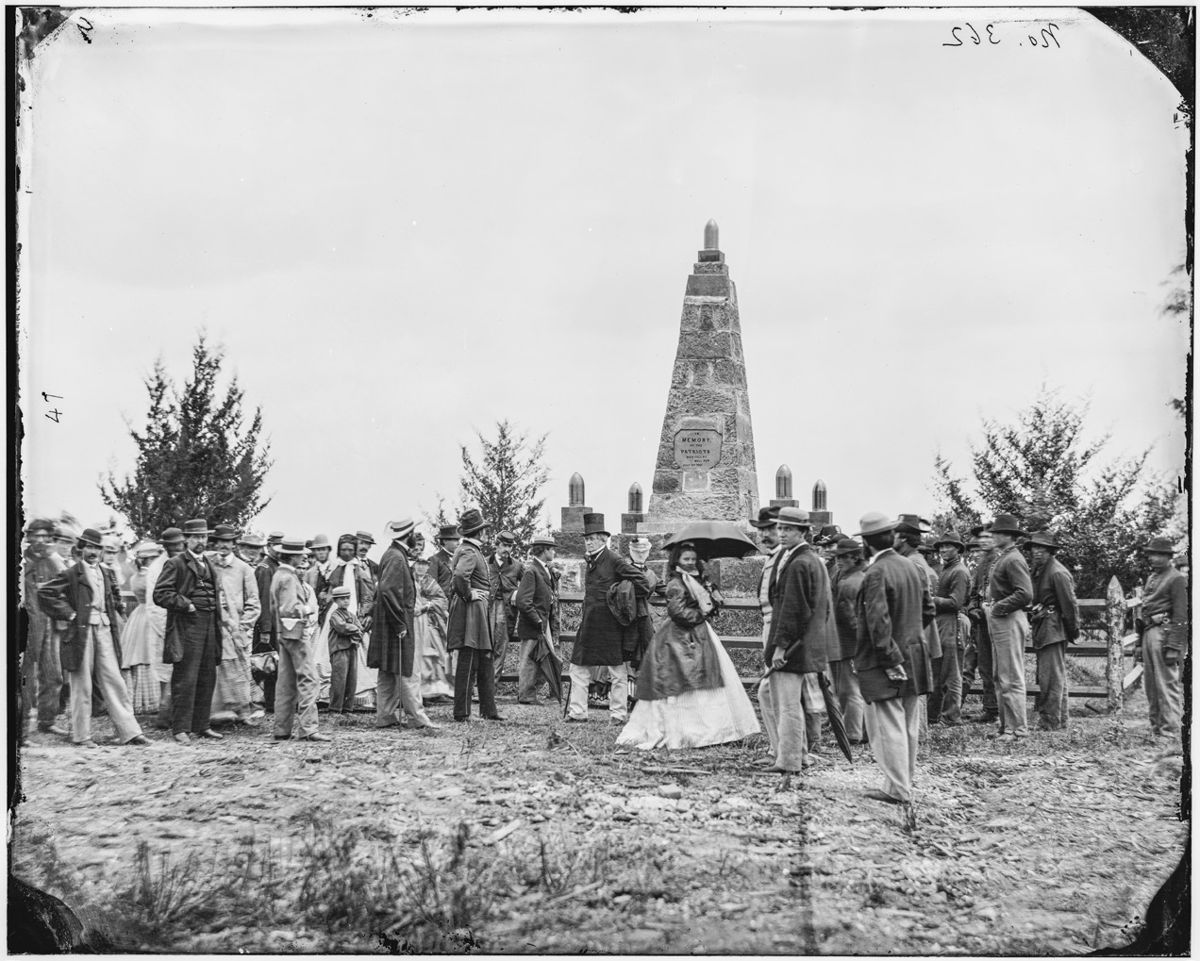
MCCallom.”5 Federal units that participated in both battles duly attended the ceremonies. A brass band played, hymns were sung, homilies were given, an artillery salvo was rendered and a Reverend Dr. McMurdy read “a most impressive prayer and the solemn burial service of the Episcopal Church.” Generals Montgomery Meigs, Samuel Heintzelman, Orlando Wilcox, William Gamble, and Henry Benham were in attendance. In addition, the First Secretary of the Smithsonian Institution, Joseph Henry, was present. McMurdy’s words were followed by a hymn and a military parade by the 5th Penn. Hvy. Arty. and a salute by the 16th Mass. Btry. Speaking that day were associate Justice of the Washington, D.C., Supreme Court, Abraham Olin; Gen. Orlando Bolivar Wilcox, a Bull Run veteran; his immediate commander Maj. Gen. Samuel P. Heintzelman and Brvt. Brig. Gen. Addison Farnsworth.6 The first monument dedicated was for the first battle. The group moved two miles to Groveton where the proceedings were repeated. Harpers described the first monument as “about twenty feet in height, and is a pointed column, built of sandstone ornamented with 100 pound elongated [Parrott] shells. This shaft,” the paper continued, “will not, we are inclined to believe, last many years. It bears on its surface the inscription, ‘Erected to the memory of the patriots who fell at Bull Run July 21, 1861.’ The other is about sixteen feet in height, and is composed in great part of shot, shell and other materials of war collected.”7 The dedication ceremony, the earliest in the post war world, was held with evidence of the two battles still present. At Groveton, “pieces of shells, broken muskets, and here and there human bones…lay bleaching in the sun.” One participant picked up “part of a human skull exhibiting the hole of the deadly bullet.” The New York Times reported on the devastation but noted the tremendous commercial possibilities the scorched landscape around Manassas offered to Northern businessmen. Visitors to the area had become so numerous that “a hotel is talked of, to be erected as soon as the railroad is again in operation. It will be a paying investment,” the Times wrote.8 Almost immediately Alexander Gardner, the Government’s official photographer, was there to record the two events. In his Sketchbook of the American Civil War, he included only a photograph of the first Bull Run monument.9 It appears, however, that he took several photographs of the crowd and the ceremonies at both monuments. Today, in the Library of Congress, at least three original photographs of the day can be found. Harper’s Weekly printed a composite of Gardner’s photos in its July 1, 1865 edition. As it turned out, two Gardner photographs were reproduced as lithographs. The two prints featured in this article capture the veterans of both battles. Today, the whereabouts of the two photographs is unknown. If not for these prints, these images would be lost to time. The lithographic firm of Louis Prang & Co. chose to highlight the soldiers and not the dignitaries who appeared in Gardner’s published photographs. The firm may have copied all of Gardner’s other photographs of the dedication, but none have come to light. Prang, a German immigrant who settled in Boston, elevated color lithography to “fine art work.” Known as “chromolithography,” it became the main staple of the company’s production. According to art historian Peter Marzio, Prang believed that “colors…make the picture itself.” He developed his process during the war when a “demand for popular prints of war-related subjects,” and an opposing “sentimental popular affection for peaceful genres” made him a very wealthy man.10 In 1860 he bought out his partner and as the war commenced, he produced colored pictures devoted to those “peaceful genres.” In addition he did war maps, portraits of famous generals and, collaborating with artist Winslow Homer, camp and soldiers scenes. It was only after war’s end that he collaborated with several other prominent artists to depict several well-known infantry and naval battles.11 His two, small lithographs of the Bull Run monuments featured here, were not sweeping but done in color. Yet they probably remain as the only two pictorial representations left by Gardner that we have of the common soldier remembering his fallen comrades. Both prints reveal an unmilitary-like, casual repose of the soldiers as they lean and rest on the wooden fence surrounding the new monuments. The impression one has is that the ceremonies were over when these photo-lithos were taken and only the comrades in arms remained. Gone are the ladies in their finery, the generals in their uniforms and the government dignitaries in their long frock coats. Several secondary sources have been devoted to Louis Prang and his lithographs, but not one mentions these two prints. Many listed below were consulted in writing this meager article. Perhaps these words will fill a gap in our history of the Graphic War and, more importantly, our history of memory.
Salvatore Cilella is retired after 43 years in the museum field. His last position was President and CEO of the Atlanta History Center. He is the author of Upton’s Regulars: A History of the 121st New York Volunteers in the Civil War (U. Press Kansas, 2009) and editor of The Correspondence of Emory Upton, 1856-1881 (U. Tennessee Press, 2017). 1. 2. 3.
New York Times, June 12, 1865. Harper’s Weekly, July 1, 1865. https://repository.library.brown.edu/studio/item/bdr:233334/. Last accessed, March 26, 2017. Historical Data Systems, Inc. Last accessed March 26, 2017. New York Times, June 12, 1865. Alexander Gardner, Gardner’s Photographic Sketchbook of the American Civil War, 1861-1865. New York, Delano Greenridge Editions, LLC, 2001. P. 210, plate 100. Hereafter Gardner, Sketchbook. Harper’s Weekly, July 1, 1865. New York Times, June 13, 1865. Two days later, the Times erroneously reported that rebels had destroyed the two monuments. “This seems impossible,” the paper wrote, and yet there is strong reason to believe it. The temper of the people in that part of Virginia is not a whit more loyal than it was six months ago.” New York Times, June 16, 1865. 9. Gardner, Sketchbook. P. 210, Plate 100. 10. Peter Marzio, The Democratic Art: An Exhibition on the History of Chromolithography in America, 1840-1909. Fort Worth Tex; Amon Carter Museum of Western Art, 1979, p. 11 as cited in Mark E. Neely, Jr. & Harold Holzer, The Union Image: Popular Prints of the Civil War North, Chapel Hill, The University of North Carolina
Press, 2000, p. 215; Harold Holzer, ed. Prang’s Civil War Pictures: The Complete Battle Chromos of Louis Prang. New York, Fordham Press, 2002, p.5. See also Peter Marzio, The Democratic Art: Chromolithography, 1840-1900 Pictures for a 19th Century America. Boston, David R. Godine, Publisher, 1979, especially chapters 6-8, pp.94-129. 11. Katharine Morrison McClinton, The Chromolithographs of Louis Prang, New York, Clarkson Potter, Inc. Publisher, 1973, pp. 139-151.