
Lee, Hood and the Fog of War
By Stephen Davis · Originally published September 2017 · pp. 20–22
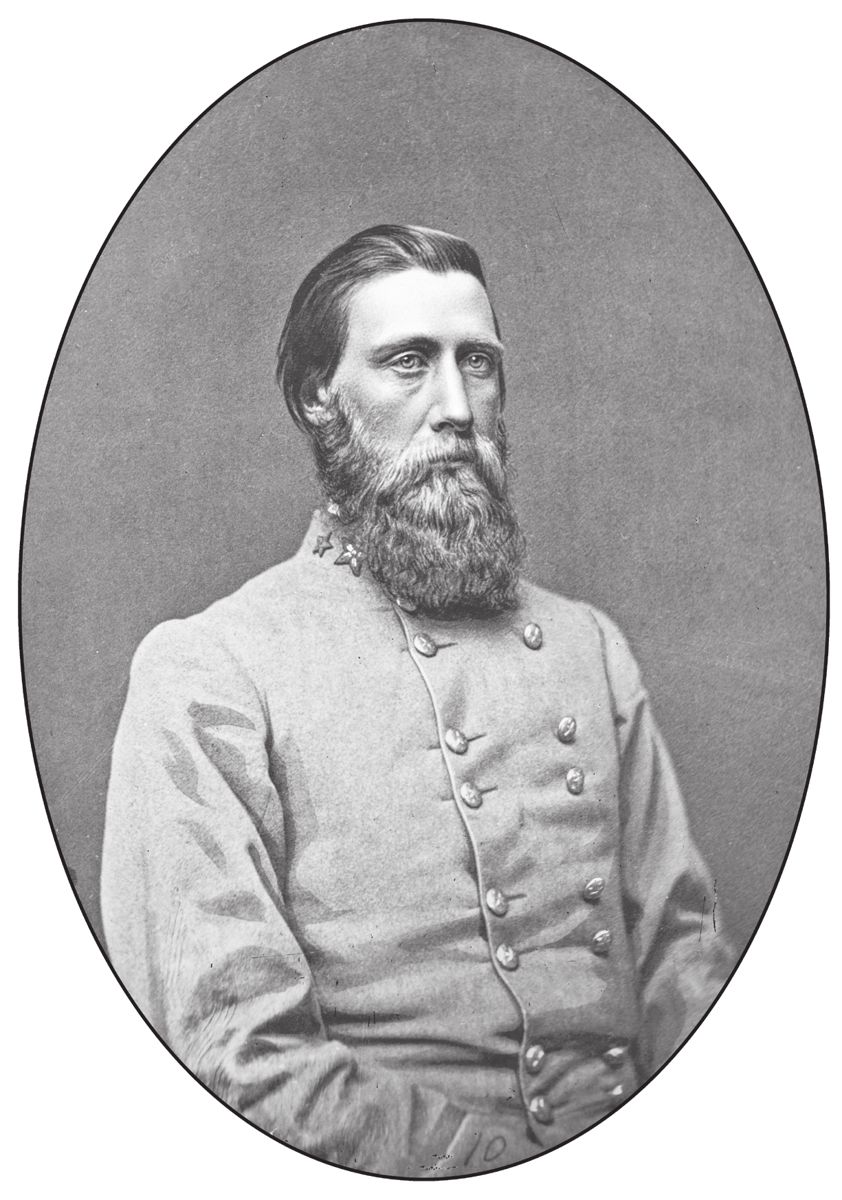
Gen. John Bell Hood. (Library of Congress)
Lee, Hood and the Fog of War By Stephen Davis Confederate Generals Robert E. Lee and John B. Hood had few things in common, but one of them was that both assumed army command at a critical juncture, thanks to General Joseph E. Johnston. In Lee’s case, it was Johnston’s retreat up the Peninsula in May 1862, to the very outskirts of Richmond, and his uninspired attack on Union Maj. Gen. George B. McClellan’s army at Seven Pines, that precipitated the change. Johnston was severely wounded on May 31, and Lee took over the Army of Northern Virginia the next day. It was arguably Joe Johnston’s greatest contribution to the Confederate cause. In Hood’s case, Johnston’s nerveless retrograde through north Georgia two years later, during the spring of 1864, brought Maj. Gen. William T. Sherman’s Federal forces to the very outskirts of Atlanta. Again, the good of the service demanded Johnston’s removal, this time by presidential order. On July 18, Hood acceded to army command. Military historians see another trait shared by Lee and Hood: their inclination to offensive battle. It was Lee’s order for a frontal attack at Gaines’ Mill, June 27, 1862, that allowed Hood to shine at the head of his Texas Brigade. Lee’s order for infantry charges at Malvern Hill and Gettysburg proved as bloody as Hood’s at Franklin. At the same time, both Hood and Lee looked for alternatives. Lee devised his masterful flank attack at Chancellorsville, May 2, 1863; Hood did the same east of Atlanta, July 22, 1864. Historians have not, on the other hand, paid much attention to another striking similarity between Lee and Hood: how both generals responded to a swift movement of the enemy at a critical point in their campaigns of 1864. In Virginia, Lee’s challenge was to respond to the Union Army of the Potomac’s crossing of the James River. During June 13-18, Grant stealthily, but suddenly, shifted his front from north of the James to the south, from Cold Harbor to Petersburg, a key railroad junction south of Richmond. During several critical days, Lee scrambled for intelligence of the enemy’s movement and struggled to move his troops accordingly. Similarly, Hood’s challenge was to deal with Sherman’s abrupt change of front, August 26-31. Having laid loose siege to Atlanta for a month, Sherman suddenly slipped six of his seven infantry corps away from the city in a wide sweep to the southeast, aiming to cut Hood’s vital railway between East Point and Jonesboro. Hood scrambled to learn details of the enemy’s movement and struggled to shift his troops to cope with it. Actually, the argument can be made that in contending with his respective enemy’s front-shifting crisis, both Lee and Hood performed comparably. Each responded as best he could, given the limitations of their numerical strength and their uncertainty as to the enemy’s objective—the mysterious “fog of war.” The difference is that Lee held onto Petersburg and prevented Grant from cutting the railroads south of the capital, which Confederates held for another nine months. Hood, on the other hand, failed to prevent Sherman from cutting his railroad south of Georgia’s prize city. The result was that he abandoned Atlanta within twentyfour hours. A tactical detailing of the two different campaigns will thus demonstrate how Bob Lee and Bell Hood, in the summer of ’64, responded similarly to a command crisis.* After the June 3 battle of Cold Harbor, Lee and his army held defensive positions northeast of Richmond with Grant and his forces before them. On June 7, Grant sent Sheridan and his cavalry off raiding, at least partly to force Lee to send away his mounted troops. “The only practical effect of the raid,” English military historian Alfred Burne has written, “was that it deprived Lee of his ‘eyes’ at a time when, as will be seen, he had most need of them.”1 Just then, Grant began shifting troops leftward, to the south. Longstreet’s A.A.G., Lt. Col. Moxley Sorrel, sent out word on June 7, that “General Lee is exceedingly anxious to be advised of any movement the enemy may undertake.”2 The really anxious one, however, was not Lee, but Gen. P.G.T. Beauregard, the Confederate commander at Petersburg, with only several thousand troops there. On June 7, Beauregard cautioned Richmond that if Grant were on the march, it could be to cross the James River. “Petersburg being nearly defenseless would be captured before it could be re-enforced,” he warned.”3 To be sure, Lee was aware of this threat. Yet he had to worry more about Grant’s presence nearer the capital. “Grant was within nine miles of Richmond and might continue his hammering,” Dr. Freeman writes.4 Unwilling to expose Richmond, Lee kept most of his army north of the James. As Beauregard pleaded with Lee to return troops he had earlier sent him, Lee tried to settle the jittery Creole down. “No troops have left General Grant’s army to my knowledge,” he wrote on June 9, “and none could have crossed James River without being perceived.”5 Compounding Beauregard’s concerns was a Federal attack, June 9, upon his line at Petersburg, conducted by Maj. Gen. Ben Butler’s forces out of Bermuda Hundred. Petersburg’s scratch garrison repulsed the assault, but that night Beauregard called for more help: “Necessity for troops here still urgent.”6 On June 11, Grant informed Butler that he intended to cross the James. That day he instructed Maj. Gen. George Meade, nominal commander of the Army of the Potomac, on how the several infantry corps would head south. They began doing so on the June 13. Grant held back enough cavalry to screen the movement and keep Lee in the dark. By the end of the day, however, Lee knew that Grant was moving troops. “I think the enemy must be preparing to move south of James River,” he wired President Davis on June 14, “with the view of getting possession of Petersburg before we can reinforce it.”7 As a precaution, Lee sent Maj. Gen. Robert F. Hoke’s infantry division toward Petersburg; beyond that Lee awaited developments. “He could not afford to cross the river in anticipation of Grant’s crossing,” Lt. Col. Burne wrote, “for it would uncover the city that he was expressly enjoined to protect.”8
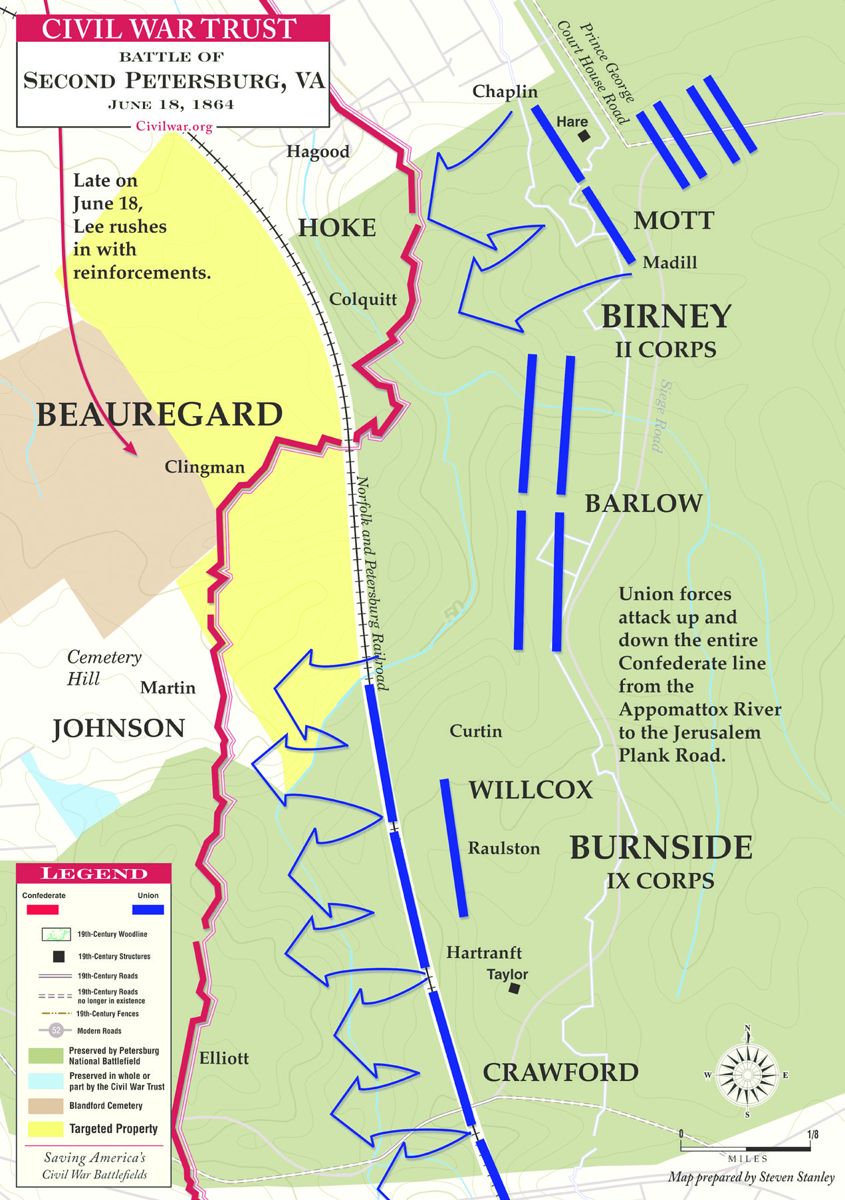
June 14 was the day Grant’s engineers laid their pontoon boats over the James. Enough troops got across the next day, joining Butler, to launch an attack on Beauregard’s fortified lines at Petersburg. The Federals broke through at one point, but that night the Southerners drew back and stitched together another line. Beauregard called for help; Lee sent another brigade of infantry, Brig. Gen. Matt Ransom’s. Lee could not be sure that Grant was still not hovering north of the river, within striking range of the capital. As one historian has written, “poor intelligence kept Lee in the dark.”9 On the afternoon of the June 15, Lee wired Gen. Braxton Bragg, the president’s advisor in Richmond, “unless therefore I am better satisfied, I shall remain where I am today, as the enemy’s plans do not seem to be settled”10 When Beauregard yammered for more reinforcements, Lee could only reply somewhat testily, “I do not know the position of Grant’s army and cannot strip north bank of James River,” he wired at 10:30 a.m. on June 16. “Have you not force sufficient?”11 Robert E. Lee on June 16 seems to have been testy to everybody. Brig. Gen. Eppa Hunton observed that Lee was “in a furious passion….He was mad because he could not find out what Grant was doing.12 “I do not know the position of Grant’s army,” Lee acknowledged to
Beauregard, who failed to send confirmation that the buildup of enemy forces before him had come from Grant.13 Meanwhile Grant realized he had stolen a march on Lee. By mid-afternoon on June 16, Grant and Butler had three corps in front of Petersburg, 48,000 troops against Beauregard’s some 15,000. More, the Army of the Potomac’s other two corps were on their way, another 35,000. That night Col. Theodore Lyman noticed, “He smiled, like one who had done a clever thing.”14 Indeed Grant had. On June 17 Beauregard confessed in a telegram to Lee, “nothing positive yet known of Grant’s movements.” That afternoon Lee ordered his available cavalry to “push after the enemy and endeavour to ascertain what has become of General Grant’s army.”15 That night, Lee finally received confirming intelligence that Grant’s entire army was across the James. He sent the rest of his infantry on to Petersburg; it arrived in the nick of time. Union assaults had been testing Beauregard’s lines, and their main assault came on June 18. The Confederates repelled the enemy attack; Lee arrived at Petersburg, and the crisis was over.
Sherman’s march on the Macon & Western—The approach of Howard’s Army of the Tennessee on Jonesboro occupied Hood’s attention Aug. 30-31, but it was actually Schofield’s and Thomas’ infantry which cut the vital railroad on the afternoon of Aug. 31. Map by Hal Jesperson, from Davis, All the Fighting They Want.
Lee has been criticized for all of this. As the British historian J. F.C. Fuller comments, “Beauregard was attacked on the 15th, 16th and 17th, and sent message after message asking for support; Lee however did nothing till the 17th.”16 Marse Robert, though, has always had his defenders. Of his performance during those several critical days in June, Freeman judges that Lee “was not outgeneraled nor taken by surprise.”17 Yet by this narrative, it is hard not to conclude that for a couple of days, at least, June 15-16, Robert E. Lee had been blindsided on the Southside. Faced with a similar crisis in late August 1864, Gen. John B. Hood at Atlanta has also been accused of having been outgeneraled and taken by surprise—hoodwinked, as it were. In the concluding portion of this essay, we’ll see if such criticism is merited. Just as Grant sought to break the stalemate at Cold Harbor with his swift lunge to the James, so did Sherman determine to end his semi-siege of Atlanta with a campaign–ending coup. For a month, from mid-July, his forces had faced Hood’s army in its fortifications, as Sherman extended his right gradually south, hoping to cut the last railroad, the Macon
& Western, feeding the Rebels. Characteristically, though, Sherman grew impatient, especially when Hood proved able to stretch his lines to guard the railroad wherever Sherman threatened. “I do not deem it prudent to extend more to the right,” he wired General Halleck in Washington on Aug. 7.18 So after he sent his cavalry to try to cut the railroad (Judson Kilpatrick’s raid, Aug. 18-22), and learned that it had failed to do so, Sherman planned his big move, which he called “the grand movement by the right flank.” Leaving his XX Corps at the Chattahoochee River, he swung the rest of his army (56,000 officers and men) south of Atlanta, in a wide sweep to cut the railroad somewhere between Jonesboro and East Point. During the night of Aug. 25-26, Federal infantry on Sherman’s left flank withdrew from their lines north and east of Atlanta. The XX Corps retreated back to the river; the IV Corps marched west, behind the Union line. Confederates knew quickly, from the sound of wagons and artillery, that the enemy was on the move. Pickets probing at dawn on Aug. 26 found trenches north of the city empty and the Yankees gone from that sector. “General Hood and his Chief of Staff (Brig. Gen. Francis A.) Shoup are in high glee,” a staff officer recorded in his journal, “they think that he is now preparing to retreat.”19 Two weeks before, Hood had sent Maj. Gen. Joseph Wheeler and 4,500 troopers raiding behind Sherman’s lines toward Chattanooga. On the morning of the 26th Confederate HQ jumped to the conclusion that maybe Wheeler had broken enough of Sherman’s railroad supply line to force the Yankees to retreat. Several hours later, the euphoria wore off; Southern infantry in their lines west of Atlanta found the enemy still in their front. Hood ordered out cavalry patrols to ascertain Sherman’s new position. That night Hood wired Richmond that the enemy left had withdrawn, but his right remained in place. During night of Aug. 2627, four more Union infantry corps slipped out of their lines, marching southwest. Hood knew of their withdrawal the next morning from picket reports. But he also learned the enemy remained southwest of the city, where Maj. Gen. John Schofield’s XXIII Corps still held its position. On the morning of Aug. 27 a reconnaissance-inforce confirmed a large Union presence at the Chattahoochee (prisoners belonged to the XX Corps). More important, cavalry reported enemy movements southwest of Atlanta. That night, Hood wired Richmond the enemy were moving to the south, but he could not deduce their objectivepoint. Hood’s cavalry were busy. The leader of the corps, Gen. Wheeler, had continued his raid into Tennessee. But more than half of the army’s mounted troops, at least 5,000, remained under Brig. Gen. William H. (“Red”) Jackson. These men contested the Union advance and reported when it reached the railroad heading southwest of Atlanta to Montgomery. “The enemy have made their appearance at Fairburn, on West Point railroad [eighteen miles southwest of Atlanta], in quite a large force, consisting of cavalry, artillery, and infantry,” General Shoup entered in his journal on the night of Aug. 28.20 That day, too, the last of Sherman’s infantry (Schofield’s XXIII Corps) followed the rest of the army marching southwest. Hood reckoned that the enemy were heading ultimately toward the Macon & Western Railroad. He shifted troops gradually in that direction, but rather cautiously (as Lee had done when Grant was marching southward). Infantry were sent by rail to Rough and Ready, a depot fourteen miles south of Atlanta. Another two infantry brigades along with a cavalry regiment were dispatched late on Aug. 28 to Jonesboro, almost thirty miles south of Atlanta by rail. Shoup, Hood’s chief of staff, wrote on Aug. 28, “Every precaution has been taken by the commanding general to keep our line of communication from being cut by the enemy.”21 On the 29th Sherman halted his columns to wreck more of the railroad to Montgomery; Southern cavalry reported their position mid-afternoon. That evening, Hood called in his corps commanders for a briefing. “We know that five certainly, perhaps six Corps are on the West Point R. Road,” Lt. Gen. William J. Hardee wrote his wife, summarizing the situation accurately. The presence of the bulk of Sherman’s army on the West Point Railroad, a dozen miles southwest of East Point, pointed to the Yankees’ intent to break the Macon line well below that place. “The enemy are still moving,” Shoup recorded on Aug. 29, “in the direction of Jonesborough and Rough and Ready, on the Macon railroad.” But where precisely the Federals would strike was unknown. “I suppose by tonight we shall know more of his designs,” Hardee observed.22 All of the intelligence streaming in and being mulled over by Hood should invalidate the accusations of otherwise redoubtable historians, who have written about Hood’s leadership during these days. Accusations there are, aplenty. “Hood seems to have been completely in the dark as to Sherman’s plans and intentions,” Thomas R. Hay intoned in a seminal 1923 essay. Stanley Horn was harsher two decades later: “Hood had apparently been completely bewildered by Sherman after August 25.” “It was August 30 before Hood…realized that Sherman was attacking, not retreating,” McDonough asserted in his biography of General Schofield. Dyer, Hood’s biographer, is even worse, claiming that it was not till the afternoon of Sept. 1 that Hood “at last comprehended Sherman’s plans.” “He had no idea that practically the entire Federal army was about to march on the Macon & Western,” Bailey remarkably claims in his TimeLife volume. Even McMurry is off-base in his biography, stating, “for several days Confederate headquarters in Atlanta simply lost contact with the Northern army.” More recently in their narrative on the war, Murray and Hsieh repeat the old saw that “Hood had no idea of what was transpiring other than the fact that much of the Union host had pulled back from their positions surrounding Atlanta.”23 They’re all wrong. Hood knew where Sherman’s forces were heading, at least generally. The question was thus not one of intelligence, but of manpower. Could the Confederate commander stretch his outnumbered army far enough to meet all possible threats? Just as General Lee had to keep men north of the James to guard the capital, so too did Hood have to keep several divisions, plus the Georgia militia, in the fortifications of Atlanta, against a possible strike by Slocum’s corps. Still, Hood threw most of his strength to the left. On the 30th, he had at least four infantry divisions from Hardee’s and Lt. Gen. Stephen D. Lee’s corps in a fortified line running parallel with the railroad to five miles below East Point. The leftmost flank was still another seven miles north of Jonesboro. In between were no Confederate infantry, only cavalrymen who were contesting the advance of three Federal corps (IV, XIV and XXIII) with some 35,000 men. At Jonesboro itself there were still two infantry brigades with cavalry. One might argue that this tactical situation was far dire than that faced by Lee and Beauregard at Petersburg. The Army of Tennessee on Aug. 20, without cavalry, numbered just under 38,000 officers and men, who were stretched from fortifications north of Atlanta to Jonesboro. Hood’s inability to both guard the city and stretch his army along the M. & W. was his weakness, not any failure to have figured out Sherman’s general goal. Hood did the best he could. On Aug. 29 General Shoup recorded, “the general commanding, in his opinion, has taken all necessary precautions, and made such disposition of his forces as to prevent either of the abovenamed places [Rough and Ready and Jonesboro] from falling into enemy hands.”24 Note the “opinion” part, for the argument has traditionally been made that Hood did not mass troops quickly at Jonesboro, toward which Maj. Gen. Oliver O. Howard and 20,000 infantry were marching. It is worth pointing out, however, that in none of his orders for a week, Aug. 23–29, did Sherman specify where he wanted his columns to fall on the Macon railroad. On Aug. 30, when they got moving again after wrecking the Montgomery railroad around Fairburn, the six corps marched east on a broad, seven-or eight-mile front. They could strike the road at Jonesboro (Howard’s three corps), or just as easily north of it (Schofield’s XXIII and Maj. Gen. George H. Thomas’ IV and XIV). Sherman seems to have been content to set his troops in motion, and then see what developed. Somewhere— it didn’t really matter—Federal infantry would break Hood’s lifeline. Break it, they did. About 3 p.m. on Aug. 31 elements of Brig. Gen. Jacob Cox’s division of the XXIII Corps struck the Macon & Western at Quick Station, eight miles north of Jonesboro. By that time, Hood had sent Hardee’s and Lee’s infantry to Jonesboro, where the Yankees of Howard’s army also threatened. Hood ordered them to attack, which they did on the afternoon of Aug. 31. The Confederates were repulsed at Jonesboro, but without strategic consequence: the railroad had already been broken to the north. Cox had seen no infantry before him, so his men easily drove off the hovering Rebel cavalry, then started tearing up the track. Southern horsemen stopped two southbound trains as Hood was trying to get the army’s reserve ordnance stores out of the city. The troopers told the engineers that Yankees were up ahead. Chugging back to the city in reverse, they arrived around 5 p.m. News of the enemy on the Macon road was immediately sent to Hood’s headquarters. Even before he learned of Hardee’s/Lee’s repulse (the enemy had cut the telegraph as well as the railroad), Hood thus concluded that he would have to evacuate the city. Orders went out for the withdrawal of Stewart’s corps and the militia the next day, Sept. 1. In the end, there are at least two important distinctions to make between Lee and Hood’s respective situations in explaining why the Confederates succeeded in holding their rail base in Virginia, but failed to do so in Georgia. First, when Sherman began his flanking march, Hood did not have a base of strength at Jonesboro. The place was an undefended railway station; what troops Hood eventually had there were pushed south Aug. 28-29. In Virginia before Grant set out, Beauregard, commander of his own department on the Southside, had a division of infantry at Bermuda Hundred, in addition to a few thousand local defense troops in Petersburg. Another division soon joined these forces June 15-16. Moreover, the Confederates at Petersburg had an earlier, well-constructed earthwork system, the Dimmock Line, which helped them repel Federal attacks that started on June 15. Second, Grant’s and Butler’s forces had only one target, made obvious by the convergence of three railroads at Petersburg and the contours of the James and Appomattox Rivers. Sherman’s infantry, in contrast, were spread out on a broad front during Aug. 30-31, aiming in two, if not three, directions, with their only objective to cut the Macon & Western somewhere south of East Point. Sherman’s wide frontage and open target made Hood’s task of deployment that much harder. Most students of the GrantLee campaign have accepted Dr. Freeman’s judgement that during Grant’s crossing of the James and attack on Petersburg, Lee “was not outgeneraled nor taken by surprise.” Rather, their generous conclusion is that Lee during June 13-16 was a temporary victim of the fog of war, the shroud of uncertainty which besets generals trying to deduce their enemy’s aims. If one accepts this for Lee, one may do the same for Hood, who was beset by the fog of war enshrouding Sherman’s movement in the last days of the Atlanta Campaign. Both generals responded to their respective crises with cautious deployments and wary troop movements. At the same time, Robert E. Lee may have been blindsided on the Southside, but I will argue that John B. Hood was not hoodwinked south of Atlanta. End Notes:
*In postwar letters to his wife Anna, Hood signed himself “Bell,” a fact which Stephen M. Hood learned when he found a priceless cache of Hood papers in a Philadelphia attic in 2012. See Stephen M. Hood, The Lost Papers of Confederate General John Bell Hood (El Dorado Hills CA 2015), p. 148 (“Anna’s pet name for him was ‘Bell’”). 1. Alfred H. Burne, Lee, Grant and Sherman: A Study in Leadership in the 1864-65 Campaign (New York: Charles Scribner’s Sons, 1939), 53. 2. Official Records, vol. 36, pt. 3, 877-78. 3. OR, vol. 36, pt. 3, 878.
Douglas Southall Freeman, R. E. Lee: A Biography (New York: Charles Scribner’s Sons, 1935), vol. 3, 397. 5. Alfred Roman, Military Operations of General Beauregard (New York: Harper & Brothers, 1884), vol. 2, 566. 6. OR, vol. 36, pt. 3, 885. 7. Clifford Dowdey and Louis H. Manarin, eds., The Wartime Papers of R. E. Lee (Boston: Little, Brown and Co., 1961), 777-78. 8. Burne, Lee, Grant and Sherman, 55. 9. Thomas J. Howe, The Petersburg Campaign: Wasted Valor, June 15-18, 1864 (Lynchburg Va.: H. E. Howard, 1988), 38. 10. Dowdey and Manarin, eds., Wartime Papers, 781. 11. OR, vol. 40, pt. 2, 659. 12. Howe, Wasted Valor, 58. 13. Burne, Lee, Grant and Sherman, 57. 14. Brian Holden Reid, “Another Look at Grant’s Crossing of the James, 1864,” Civil War History, vol. 39, no. 4 (December 1993), 309. 15. Burne, Lee, Grant and Sherman, 59. 16. J. F. C. Fuller, Grant and Lee: A Study in Personality and Generalship (Bloomington: Indiana University Press, 1957 [London, 1933]), 227. 17. Freeman, R. E. Lee, vol. 3, 445. 18. OR, vol. 38, pt. 5, 408. 19. W. L. Trask war journal, May-September 1864, manuscript at Kennesaw Mountain National Battlefield Park. 20. OR, vol. 38, pt. 3, 693. 21. OR, vol. 38, pt. 3, 694. 22. Hardee to “My own dear Mary,” Aug. 30, 1864, William J. Hardee Papers, Alabama Department of Archives and History; Shoup journal, entry of August 29, OR, vol. 38, pt. 3, 694.