
Conservation of a Rare USCT Banner
By Jessica Hack · Originally published September 2017 · p. 38
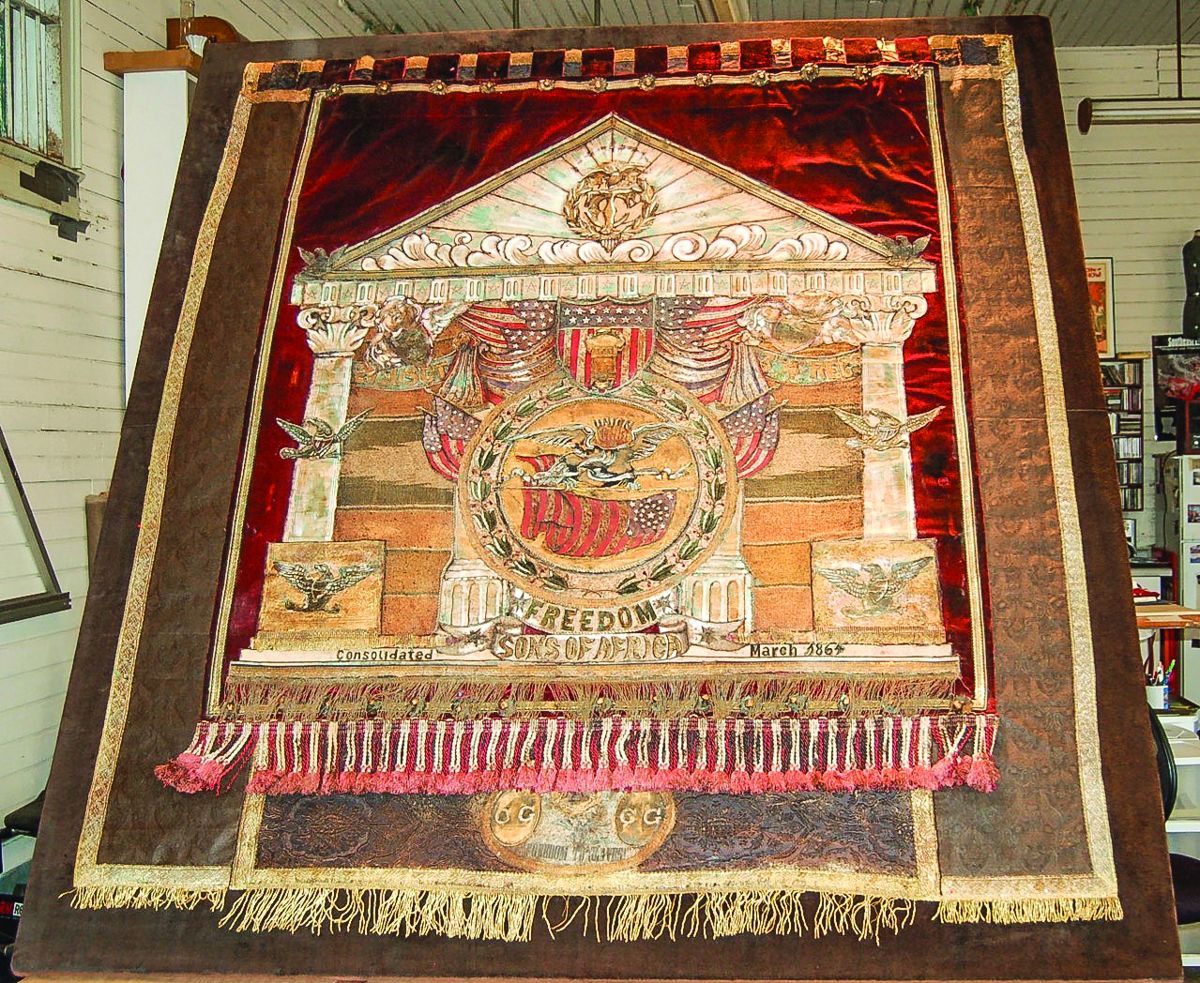
Conservation of a Rare USCT Banner By Jessica Hack With his issuance of the Emancipation Proclamation in 1863, President Abraham Lincoln not only decreed that all slaves held in the Southern states were “then, thenceforward, and forever free,” he also officially approved the enlistment of black soldiers into the Union Army. During the next four years, more than 180,000 men of color would answer the call to duty. One of the rarest and interesting artifacts to come through my studio was an honor banner, displayed by the 21st Regiment of the United States Colored Troops during Civil War processions and parades. The banner is certainly one of the earliest, largest, and most ornate artifacts from the United States Colored Troops’ infantry regiments. It measures 5’ x 5.75’, and almost 6’ x 7’ in its frame. Consolidating the former 3rd and 4th Regiments of the South Carolina Colored Infantry, the 21st participated in key operations against Charleston. After the city’s capture in Feb. 1865, the 21st Regiment garrisoned Charleston through the end of the war. Erasmus W. Jones, chaplain of the 21st USCT, retained possession of the banner when the unit was mustered out of service in April 1866. Jones then traveled through his native Wales, displaying an extensive collection of slavery-related items, including this “Sons of Africa” banner. After Jones’ death in 1909, the banner remained for many years in Wales and England. During its time abroad, the banner was loaned for display in museums in Manchester and Middlesex, England. In 2003, it was offered at auction in the U.S. The inner banner was produced between March 1864 and April 1866 (the dates of the 21st’s existence) by Schuyler, Hartley and Graham, a New York merchant house, noted for military and Masonic items. The appliquéd composition and bullion work was contracted to Baker, Godwin & Co., a small firm known for high quality Masonic and holy art works. The silk damask backing was likely adhered as an addition to the piece in the 1870’s though the fabric itself is circa 1850’s. The multi-media inner banner is resplendent with iconography relevant to American, Masonic, and military traditions. Much of the panel’s surface is raised, either in appliqué, embroidery, gilded twine, or bullion wire. An unusual and noteworthy element of the banner’s imagery is a Native American striped blanket fragment that forms the banner’s background between the Greek columns. Lettering on the banner includes various pertinent words and phrases: “FREEDOM,” “SONS OF AFRICA,” “UNION,” “this Flag….Preserve,” “21st USCT,” “CONSOLIDATED MARCH 1864,” “FREEDOM TO SLAVES,” and (on the reverse of the banner) “True as the Stars that are Shining.” The banner is currently owned by Mr. Jay Johnson, of Purcellville, Va., for whom I restored it, and who has generously given permission to present the historical information and documentation of that restoration included here. Upon receipt, the banner was extremely dusty, and was generally dirty overall. There was significant blue/green oxidation in evidence on the metal nail head spikes, on the gold fringes and woven metallic braid trims, and in a horizontal line across the red cotton backing fabric at the point where the metal spikes are set into the banner. The red backing fabric was also dusty and stained throughout. The silk brocade fabrics comprising the wide border on the left and right sides of the central inner banner were in shreds, although the original silk brocade remains intact on the upper and lower borders. Several silk velvet tabs for hanging the banner were torn. The Conservation treatment included the following: 1. All the gold metallic fringes, the woven metallic braid trim, the nail head spikes, and their flat mounts were first cleaned with ammonia applied with cotton swabs. Vinegar was subsequently applied, after which the metals were flushed with distilled water. Additional cleaning of the metal work included application of mineral spirits in areas that previously resisted cleaning, and cleaning by mechanical means, lightly scraping away some oxidation. 2. The raised and painted elements of the inner banner were cleaned with distilled water and organic enzymes. The Navajo carpet fragment backing the center medallion was cleaned with sodium lauryl sulfate (a neutral pH surfactant) and distilled water. 3. The front and back of the banner were hand vacuum cleaned with a low suction HEPA filtered cleaner through a screen of fiberglass mesh.
- New Chinese silk brocade material was located in a paisley pattern that approximated the design of the original 1850’s gold and white silk brocade, that had been painted brown for use in the banner. The new silk material was painted brown with matte watercolor paint. 5. Strips of the new, painted replacement silk were cut, fitted, and stitched into the borders over the original fragments. 6. Holes in the silk velvet hanging tabs were secured by insetting patches of new silk velvet into the holes and securing them to the interlining with Jade 403 PVA adhesive. 7. In order to support the banner’s hanging weight, a sheet of corrugated plastic board was attached to the strainer before it was covered with brown cotton velveteen mounting fabric which was stretched, pinned, and stapled to the mount. 8. The perimeter of the banner was stitched to the mounting fabric with linen carpet thread. The inner banner was secured to the mount by stitching directly through the coroplast board with linen carpet thread. 9. The metallic bullion fringes and plied red and white silk fringes were secured to the banner by stitching with cotton and linen threads. 10. The banner was framed in a wooden shadowbox frame.
Conservation treatment was completed in October 2012.
-
Banner, front, before conservation treatment.
-
Detail of banner, before treatment.
-
Detail, damage to silk border, bottom left corner, before treatment.
-
Reverse of banner, before treatment.
-
Banner, during treatment. 5. Detail, carrying handle, left, reverse of banner.
-
Closeup of the carrying handle on reverse of banner.
-
Stitching painted silk brocade border material in place, during treatment.
-
Banner, after conservation, mounting and framing.