
Book Reviews
Book Reviews — September 2017
Originally published September 2017 · pp. 30–33
A Tidy Little Gem of Lincoln Lore Lincoln in Indiana. By Brian R. Dirck. Illustrations, notes, index, 132 pp., 2017, Southern Illinois University Press, www.siupress.com, $24.95 cloth. Reviewed by James A. Percoco
The most recent publication in the Concise Lincoln Library collection is a tidy little gem. Lincoln in Indiana by Brian R. Dirck offers a terrific, yet concise overview of Lincoln’s life experiences growing up in the Hoosier State. The author draws on a variety of sources, starting with Lincoln’s law partner, William Herndon (who in order to clear away the growing haze of early Lincoln mythology penned Herndon’s Informants). Dirck provides not only a glimpse of a slice of Lincoln’s formative years, but places it within the context of the history of the pioneer movement of the early to middle 19th century— thus creating a parallel narrative. That he does so well in such a trim effort, which is immensely readable, is quite noteworthy. Dirck pulls back the curtain and provides an arguable thesis regarding Lincoln’s father, Thomas, who has often been characterized as a shiftless and unmotivated individual, whose attitudes the younger Lincoln spurned. To be sure, some of that unfavorable attitude was perpetuated by Lincoln himself, who often ignored any discussion about his upbringing and youth; he famously declined to attend his father’s own funeral. For Dirck, Thomas Lincoln “was actually a hardworking, if somewhat hapless Indiana farmer and carpenter.” The author provides a new view of Lincoln’s father, demonstrating that he cared for his family, did the best he could under his circumstances, and rec-
Reviews of Civil War Books Civil War News book reviews provide our readers with timely analysis of the latest and most significant Civil War research and scholarship. Stephen Davis, Civil War News Book Review Editor. Email: [email protected] ognized the importance of being a present parent when needed. When Lincoln’s mother Nancy dies of the milk sickness, Thomas Lincoln not only knows that he needs to replace the lost female head of the household, but he knows exactly to whom to turn as his second wife, Sarah Bush; he brings her home as stepmother for his children. Dirck analyzes Lincoln’s relationship with his stepmother, as well as his early years on Indiana’s hardscrabble soil. In 1860 Lincoln wrote, “My life can simply be summed up as the short annals of the poor,” and his life in Indiana proved to be just that. In Indiana, Abraham Lincoln learned the value of hard work and of material rewards, as well as an understanding of the struggles of ordinary people—a value that served him well as an adult and as President. It is easy, then, to see how President Lincoln could dismiss his wife’s redecorating the White House with “flub dubs.” Prior to his presidency, Lincoln left his adopted state of Illinois to revisit the sites of his youth in Indiana and penned a doggerel poem of personal reflection. The opening stanza reads, “My childhood home I see again, And sadden with the view; And still as memory crowds my brain, There’s pleasure in it, too.” Abraham Lincoln clearly had mixed feelings about his childhood existence in Indiana. There he did, after all, at the age of nine lose his mother, with whom he was close. At the same time, Sarah Bush cultivated in her stepchild a confidence that put young Lincoln on the path to the White House. Without getting into exhaustive detail, the author has written a book, based on solid research, which offers an intriguing and colorful look at the childhood of the 16th president. Jim Percoco of Lorton, Va., is Teacher-in-Residence for the Journey through Hallowed Ground Partnership, a non-profit initiative to raise historical awareness in the Pennsylvania-Maryland-Virginia area.
Abolitionist’s Golden Trumpet Wendell Phillips: Social Justice and the Power of the Past. Edited by A.J. Aiseirithe and Donald Yacovone. Notes, index, 370pp., 2016, Louisiana State University Press, www.lsupress.org, $55 hardcover. Reviewed by Wayne L. Wolf
The editors of this compilation present twelve articles that illustrate the life of Wendell Phillips—abolitionist, advocate for women’s rights, opponent of unfettered capitalism and social justice icon. Each of these selections portrays Phillips as the consummate agitator, a role he felt was ordained for him to protect a true democratic society. His effectiveness in this role rested upon his evoking and playing upon deep-seated historical values and loyalties. His aristocratic background created for him an urgency to make his life’s work significant and even transformational. People were drawn toward Phillips by his charisma, intellect, and forensic ability. He used these gifts to channel his early Calvinistic philosophy and republican ideals into a life of action on behalf of social equality, worldly economic cooperation, temperance, and full suffrage for women and blacks. Wendell Phillips was a lawyer who respected the rule of law. While advocating for racial justice, labor rights, and women’s equality he never could accept the need to break the law or engage in violence to achieve his objectives. The power of words would be his weapon in the battle against slavery and for justice and fairness. After his marriage in 1837 to Anne Terry Greene, an ardent abolitionist, he found not only love but an impetus to channel his life into the abolitionist cause. His motto could easily have included “the liberty of the intellect and the effusion of knowledge to the masses.” This he felt would create a modern democracy, pure in form, universal in appeal, and equal for all. He always maintained that political and economic pressure on the South, not violence, would end slavery. Contemporaries like William L. Garrison, John Brown, and W.E.B. DuBois did not always agree with his strategy, but never failed to applaud his achievements toward abolition and racial equality. Phillips was always “comfortable in his own skin” in dealing with all races and income levels. He never wandered from his life’s mission, never compromised his ideals and thus became an icon for equality and freedom, even after his death in 1884. For historians there is much to see in these essays that relates to contemporary society. Are sanctuary cities today the equivalent of antebellum Northern cities that refused to enforce the Fugitive Slave Act? Is peaceful resistance to perceived social injustice more effective than violent protests? And is universal suffrage and direct election preferable to the Electoral College? These questions need attention today as they did in Wendell Phillips’ America and their relevance still energizes today’s activists. The editors have done a splendid job of selecting readings that address every aspect of Phillips’ life, political philosophy and moral crusade. While earlier works, e.g., Thomas Wentworth Higginson’s Wendell Phillips and George Austin’s The Life and Times of Wendell Phillips, concentrate substantial energy on abolitionism, the current selections extend his philosophical impact to Native American rights, the labor movement, temperance movement, civil dissent, interracial relationships and women’s rights. While many of the articles contain material that is redundant, each stresses an important aspect of who Wendell Phillips was and thus is valuable in its own right. Despite its hefty price tag, this book is recommended for readers interested in the role of abolitionist agitation in the demise of slavery, political alliances in antebellum America, and how radical ideas were transformed into mainstream aspects of American democracy. Wayne L. Wolf is Professor Emeritus at South Suburban College in Illinois and the author of numerous Civil War books and articles including Two Years Before the Paddlewheel: Charles F. Gunther, MThe sissippi River Confederate, co-edited with Bruce S. Allardice (2012). He currently is lecturing on “Civil War Firsts” to area roundtables.
Brandy Station and the Detailed Treatment of Little-Known Evolution of the Union Cavalry Battle on the James River The Union Cavalry Comes of Age: Harwood Church to Brandy Station, 1863. By Erick J. Wittenberg. Maps, photographs, appendix, index, bibliography, 411 pp., 2017. The History Press, www.arcadiapublishing.com, $24.99 paperback. Reviewed by Walt Albro
At many times during the cavalry battle of Brandy Station, the fighting descended into a melee involving sabers and pistols. As one of the Union brigade commanders, Col. Judson Kilpatrick, watched on June 9, 1863, he noticed something that displeased him. He spied a Confederate officer whom he had known while a cadet at West Point—a person whom he had never liked. The colonel spurred his horse into the fray and engaged the Rebel officer, who fired his pistol, but missed. Both men drew their sabers and vigorously slashed away at each other. Although cut on the arm, Kilpatrick still managed to kill his opponent. Then, Kilpatrick rode back to his troops, explaining, “That rights a wrong.” The colonel’s brash action was representative of the new, bolder, more aggressive cavalry of the Army of the Potomac that emerged during the Battle of Brandy Station. This book is a detailed analysis of how that cavalry evolved: from an embarrassment in 1862 into what ultimately would become the world’s finest corps of horse soldiers by 1864. Eric J. Wittenberg’s original hardcover book, which has been out of print for eight years, is reprinted here in paperback. The author focuses on a series of all-cavalry engagements in 1863, including Hartwood Church, Stoneman’s Raid, Kelly’s Ford, Alsop’s Field and Brandy Station. Under Maj. Gen. George McClellan in 1862, the cavalry arm never reached its potential. Little
Mac had little respect for volunteers, who comprised the bulk of the horse soldiers. He believed that it took two years to train a good cavalryman, and he did not expect the war to last that long. So McClellan broke up the volunteer units and used them mostly as vedettes, messengers or headquarters’ guards. The situation improved when Maj. Gen. Joseph Hooker was appointed commander of the Army of the Potomac. He implemented a plan that consolidated the cavalry into a single corps. Hooker named Maj. Gen. George Stoneman as the corps’ first commander. The author argues that Stoneman’s Raid, during the Battle of Chancellorsville, was actually a success, and not a failure, as Hooker claimed. Because of Hooker’s criticisms, Stoneman and Brig. Gen. William W. Averell have been underappreciated by most historians. In fact, the author says, both made critical improvements that bolstered the cavalry’s growing effectiveness. The Battle of Brandy Station was the coming-out party of the new and improved Northern cavalry. Not only did commander Alfred Pleasonton catch Jeb Stuart and the Southern cavalry by surprise, but he also fought them on an equal basis—in other words, he gave as good as he got. Although Brandy Station was a confusing engagement, with some locations captured and re-captured multiple times, one of the virtues of this book is the clear and understandable description and overview of the action. I was particularly impressed by the large number of colorful quotes gathered from diaries and letters of front-line participants. This personalizes the story and enlivens the narrative.
Walt Albro is a writer and editor who resides in Rockville, Md. He serves as a director of the Monocacy National Battlefield Foundation, Frederick, Md.
U.S. Colored Troops Defeat Confederate Cavalry. By Edwin W. Besch. Photos, notes, index, bibliography, 292 pp., 2017. McFarland, www.mcfarlandpub.com. $35 softcover. Reviewed by Gould Hagler
Edwin Besch has conducted extensive research and accumulated a great store of factual information on the small battle at Wilson’s Wharf on the James River, fought on the afternoon of May 24, 1864. In addition to describing the battle itself (in one 36-
page chapter), Besch provides: mini-biographies of the principal commanders (the Federals’ Edward Wild, the Confederates’ Fitzhugh Lee and others); short histories of the units involved; coverage of controversies related to the use of black troops; a summary of Benjamin Butler’s James River Campaign; and an analysis of the conflicting estimates of the size of the forces engaged and the number of casualties. A final chapter discusses the preservation of Fort Pocahontas, which was completed at the wharf soon after the battle. The author relies on numerous primary and secondary sources, and is to be commended for his prodigious research, which he pursued from 1993 to 2016. Unfortunately, the quality of the writing and editing is uneven. The facts are not properly marshalled to create a coherent and unified whole. The reader would be better served if the many long quotes from other sources were distilled into more comprehensible narration and more concise analysis. The book is further weakened by digressions, repetitions and barely relevant minutia, as well as stylistic eccentricities and organizational shortcomings that distract and confuse the reader. The only map in the book is not a map of Wilson’s Wharf but of the unrelated Battle of Yellow Tavern. Faust’s Encyclopedia has no entry on Wilson’s Wharf. Long’s Almanac devotes a total of five words to this affair on the James. Besch’s work fills the void and tells us much about a small but significant engagement. There is much to be found in this book, but the reader must labor to find it. Gould Hagler is the author of Georgia’s Confederate Monuments: In Honor of a Fallen Nation (Mercer University Press, 2014). His new book on Alabama’s Confederate monuments is to be published by Indiana University Press.
An Invitation, Not a Guide A Tourist Guide to Civil War Washington, D.C. By Thomas P. Lowry. Maps, appendix, 136 pp., 2017, Idle Winter Press, www.idlewinter.com. $9.99 paper. Reviewed by Douglas Ullman Jr.
In Specimen Days, his final work, Walt Whitman claimed that the real Civil War soldier, “with all his ways, his incredible dauntlessness, habits, practices, tastes, language…will never be written—perhaps must not and should not be.” More than 100 years later, Dr. Thomas P. Lowry endeavored to right this wrong by studying the dark corners of Civil War history. He is, perhaps, best known as the author of The Story the Soldiers Wouldn’t Tell, an exploration of the sex lives of the men of the Union and Confederate armies. He has written a number of other books, most of them aimed at uncovering previously hidden history, the dark underbelly of our nation’s defining conflict. Lowry’s most recent work, A Tourist Guide to Civil War Washington, D.C. is very much in the same vein. Evidence of the more sordid episodes of life in the divided nation’s capital-–tales that Whitman and a good many others would rather forget—can be found in the records of the National Archives. Lowry once again attempts to shed light into these dark corners, providing future researchers a guide for their own discoveries. Those interested in examples of the depravity and debauchery to which Civil War soldiers often descended will find much to excite their imagination in Lowry’s book. Unfortunately, they will find little to satisfy their curiosity. Lowry provides lists of infractions or offenses, but seldom delves more deeply into the details. For example, a chapter on gambling contains many examples of gambling in the army in general (spoiler alert: Civil War soldiers gambled), but virtually no references to stories of gambling within the confines of Washington City, presumably Lowry’s focus. Thus, those few who think of the 19th century Americans as perfect paragons of Victorian virtue will be easily disabused of the notion, but they will learn comparatively little about the nature of those nefarious deeds or about the characters who committed them within the limits of Washington City. Most critically, A Tourist Guide to Washington, D.C. fails to live up to its title. Those wishing to trace the footsteps of Civil War soldiers will find little in the way of guidance in Lowry’s work. The maps, of which there are too few, are offered with little to no explanation. Little is done to orient the reader to either the modern or historical landscape. Thus, those who are not familiar with Washington will struggle to find the locations described in Lowry’s book; the task is only slightly easier for residents of the Capital City. The book does, however, have its bright spots. Lowry’s writing is flavored with a diverse mélange of literary references (one passage contains references to Marlene Dietrich, Rudyard Kipling, and a well-worn sea chantey, providing a chuckle to those who get the joke.) Dr. Lowry also shines in his description of Ricord hospital, the medical facility where most cases of sexually transmitted infections were treated. Likewise, the chapter on Washington’s theatres, about which the “provost marshal’s files had nothing to say,” is, ironically, quite strong. Here, Lowry has provided descriptions of the theatres with historical sketches from the Civil War period to today, as well as tales of misadventures experienced by soldiers in Washington City. This is precisely the sort of thing you’d hope for in a tourists’ guide, of which there is, sadly, too little in Lowry’s work. It is apparent Lowry never intended to draw many conclusions from the records he discusses. Instead, he presents topics often overlooked in broader studies and gives the reader the tools by which they might embark on their own journey of discovery. Indeed, Lowry’s appendix is an incredibly valuable guided tour of the available sources at the National Archives. Would that all the resources in the Archives had such a guide. Thanks to Dr. Lowry, enterprising students may know where to begin their search. Douglas Ullman Jr. is an independent historian who focuses on the Union Twelfth/ Twentieth Corps. He is currently working on a regimental history of the 102nd New York Volunteers. He works for the Civil War Trust and lives with his wife and son in Centreville, Virginia.
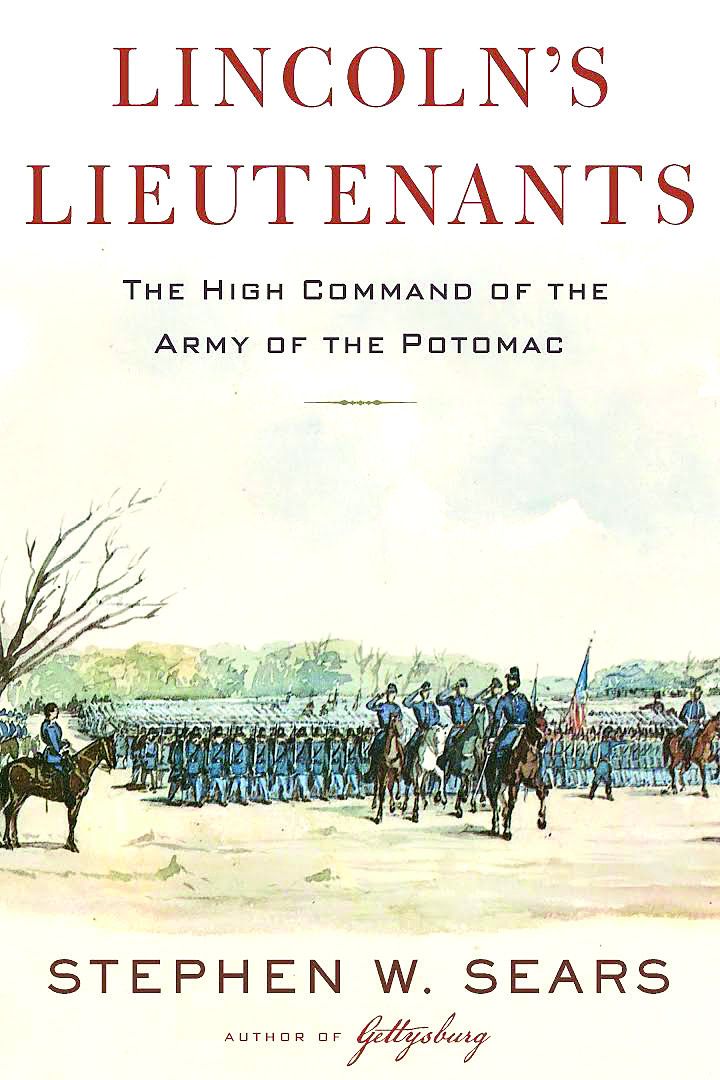
Massive New Study on the Army of the Potomac’s High Command Lincoln’s Lieutenants: The High Command of the Army of the Potomac. By Stephen W. Sears. Illustrations, maps, notes, bibliography, index, 912 pp., 2017, Houghton Mifflin Harcourt, www.hmhco.com. $38 hardcover. Reviewed by Paul Taylor
The battles fought by the leading generals of the Army of the Potomac occurred not only on the battlefield with musket and shell against its Confederate adversary, but also against each other, President Abraham Lincoln, and Congressional legislators. Over the army’s four-year existence, its generals initiated—and often endured—such backbiting and political infighting that made the high command often appear to be defending itself against its own civilian leaders rather than waging war on their behalf. In Lincoln’s Lieutenants: The High Command of the Army of the Potomac, eminent Civil War historian Stephen W. Sears lays out in detail these behind-thescenes maneuverings and the effect they had on army efficiency. From presidential secretary John Hay’s private allegation against General George McClellan’s “insolence of epaulettes” toward Lincoln, to Secretary of War Edwin Stanton’s chameleon-like character, Sears’ new work is primarily a study that examines the
Army of the Potomac’s internal political machinations and various command crises, rather than a traditional military analysis. Sears is familiar with the topic, having first explored this theme in his 1999 book, Controversies & Commanders: Dispatches from the Army of the Potomac. The high command’s early growing pains were almost pre-ordained, given that the nation was primarily a loosely woven compact of states, where any military need would be met via state militia and the citizen-soldier. As Sears explains, “a one-dimensional ‘national’ Army would not be tolerated.” To help clarify the army’s necessary and rapid growth, and how these men came to obtain their respective posts, Sears offers biographical background on the AOP’s general officers who held corps, division, and brigade commands. He describes how each man’s personality, quirks, military experience, and political beliefs eventually worked for or against army cohesiveness. The army’s initial dismal results created a revolving door of seven commanding generals in only three years, until Ulysses S. Grant took control of the army in 1864. Only six generals who were with the AOP in 1861 were still there when the Confederate Army of Northern Virginia surrendered at Appomattox in April 1865. In addition, twenty-one of the army’s general officers had been killed during that four-year period. Sears certainly does not ignore the military fighting, though his narrative and interpretations of the various battles serve as context for the cooperation—and often dysfunction—which characterized the AOP’s senior leadership. As is the case with Sears’ earlier work on the army’s internal controversies, Sears is well versed in the Civil War’s eastern theater, having penned previous, highly-regarded strategic and tactical studies on the 1862 Peninsula Campaign, as well as individual works on the battles of Antietam, Chancellorsville and Gettysburg.
All of these fine books also analyze the political intrigues that infected the AOP within their respective time-frames. Sears succinctly points out that “the high command that closed the war in April 1865 was a world apart from the high command that opened the war.” Whereas the latter was largely a closeknit one filled with career military men from West Point, those that finished the war were mostly self-taught volunteers from civilian life who rose from regimental and brigade command. These men were often held in contempt by the professional soldier, especially in the war’s early stages. The author praises these unsung officers as the core of the army, and the ones who held it together from one march through Hell to the next. It is an argument shared by Thomas Goss in his book, The War within the Union High Command: Politics and Generalship during the Civil War (University Press of Kansas, 2003). Since war is merely politics by other means, Goss contended that the AOP’s civilian “political generals” served a vital, symbiotic role between Washington and the army that career military men often could not appreciate. Stephen R. Taaffe took a slightly different tack in his Commanding the Army of the Potomac (Kansas, 2006) by focusing on the AOP’s thirty-six men who held corps command during the war. All three authors agree that personal connections, along with the ever-changing whirlwind of Washington politics, played as much a role in determining a senior general’s career success as did military prowess. Thirteen maps and over 150 period photographs, drawings, paintings and political cartoons enhance a deeply researched, career-capping work that shines with Sears’ polished, elegant prose. For newer or casual students of the Civil War who are not familiar with Sears’ distinguished body of work, Lincoln’s Lieutenants should stand as a superb, robust portrait of the pitched battles—fought concurrently against the Confederacy, the White House, Congress, and each other—by the Army of the Potomac’s high command. Paul Taylor is an award-winning author of six books pertaining to the Civil War era. His next book is titled “The Most Complete Political Machine Ever Known”: The North’s Union Leagues in the Civil War and will be published by Kent State University Press in early 2018.
A Shenandoah Scholar’s Guide to Winchester Winchester’s Three Battles: A Civil War Driving Tour Through Virginia’s Most WarTorn Region. By Brandon H. Beck. Maps, photos, bibliography, 175 pp., 2016, Angle Valley Press, AngleValleyPress.com, $21.95. Reviewed by Shelby R. Shrader
Perhaps no city endured more during the Civil War than Winchester, Virginia. The scene of three major battles, scores of other actions and numerous occupations, Winchester experienced the conflict incessantly. While various historians have written about elements of Winchester’s Civil War history, few publications exist that make its rich Civil War history accessible. Therefore, anyone wishing to immerse themselves in Winchester’s Civil War history will want to invest in Brandon H. Beck’s recent guidebook. Beck, professor emeritus of history at Shenandoah University, is the author of numerous books on the Civil War and has based this exquisite guide on decades of research. For those unfamiliar with Winchester’s Civil War story, he begins the guide with background information on the conflict in the Shenandoah Valley. After ably setting the contextual stage, Beck devotes the book’s core to each of Winchester’s three major battles. In the guide’s section on the First Battle of Winchester, Beck provides sixteen tour stops. In an effort to provide broader context for this engagement, Beck offers stops in Front Royal as well as Middletown to help users understand troop movements in Stonewall Jackson’s victory on May 25, 1862. The author, unlike traditional guidebooks, does more than provide clear directions from site to site and describe the significance of each stop—he provides crisp analysis of Stonewall Jackson’s leadership, strategic and tactical abilities. Beck’s examination of the Second Battle of Winchester, June 15, 1863, is equally impressive. Throughout this chapter Beck tells the story of Union general
Robert H. Milroy, an ardent abolitionist from Indiana. In addition to offering a succinct examination of Milroy’s occupation and the battle’s ebb and flow, Beck does a fine job discussing the construction of Union earthwork fortifications during Milroy’s sixmonth occupation of the city— Star Fort, Fort Milroy, and West Fort. While Fort Milroy is inaccessible and West Fort is mostly destroyed, Beck’s guide takes users to Star Fort, an impressively preserved and interpreted site. As important as the First and Second Battles of Winchester were to the course of the conflict, none proved more significant than the Third Battle of Winchester, Sept. 19, 1864. Although the tour for the opening battle of Gen. Philip H. Sheridan’s 1864 Shenandoah Campaign contains seven stops, Beck places special emphasis on the culmination of the battle: the cavalry attack at Fort Collier Throughout this marvelous book Beck not only focuses on the soldiers’ thoughts and feelings during the war, but he frequently includes examinations of how the war impacted Winchester’s civilians. Through the inclusion of diary excerpts from such notable citizens as Cornelia McDonald, Beck offers the opportunity to contemplate how civilians felt during the war, how they coped with the conflict and tried to maintain normalcy in the midst of the war. Beck’s magnificent guide not only informs and transports readers to Winchester’s most significant Civil War sites; it serves as a reminder of the preservation challenges the lower Shenandoah Valley community confronts in the twenty-first century in what Beck calls the “Fourth Battle of Winchester.” This superb field guide, replete with numerous illustrations, excellent maps, and orders of battle, does more than just guide tourists over the hallowed grounds of Winchester’s three battles. It offers the user an immersive experience, one that allows them to connect with the soldiers and civilians who endured Winchester’s three gruesome battles. Shelby R. Shrader is a magna cum laude graduate of Shenandoah University with a BS in History, where she studied Civil War Era history under Prof. Jonathan A. Noyalas. She is a member of Shenandoah University’s McCormick Civil War Institute Advisory Board and is a recipient of CWI’s first-ever Miles Summer Fellowship.