
United States Marines Civil War Uniforms
By United States Marine Corps – Historical Company · Originally published October 2017 · pp. 22–23
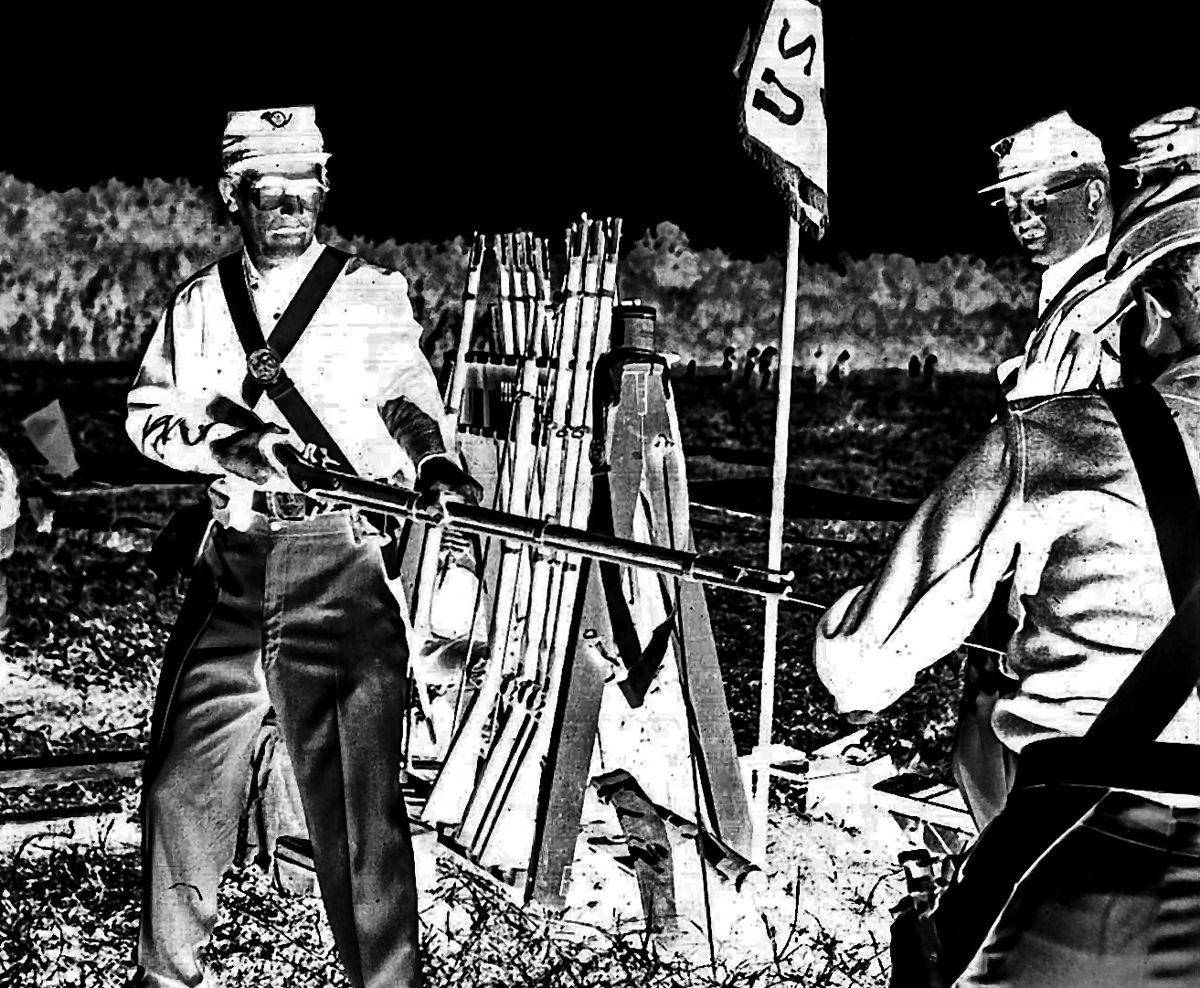
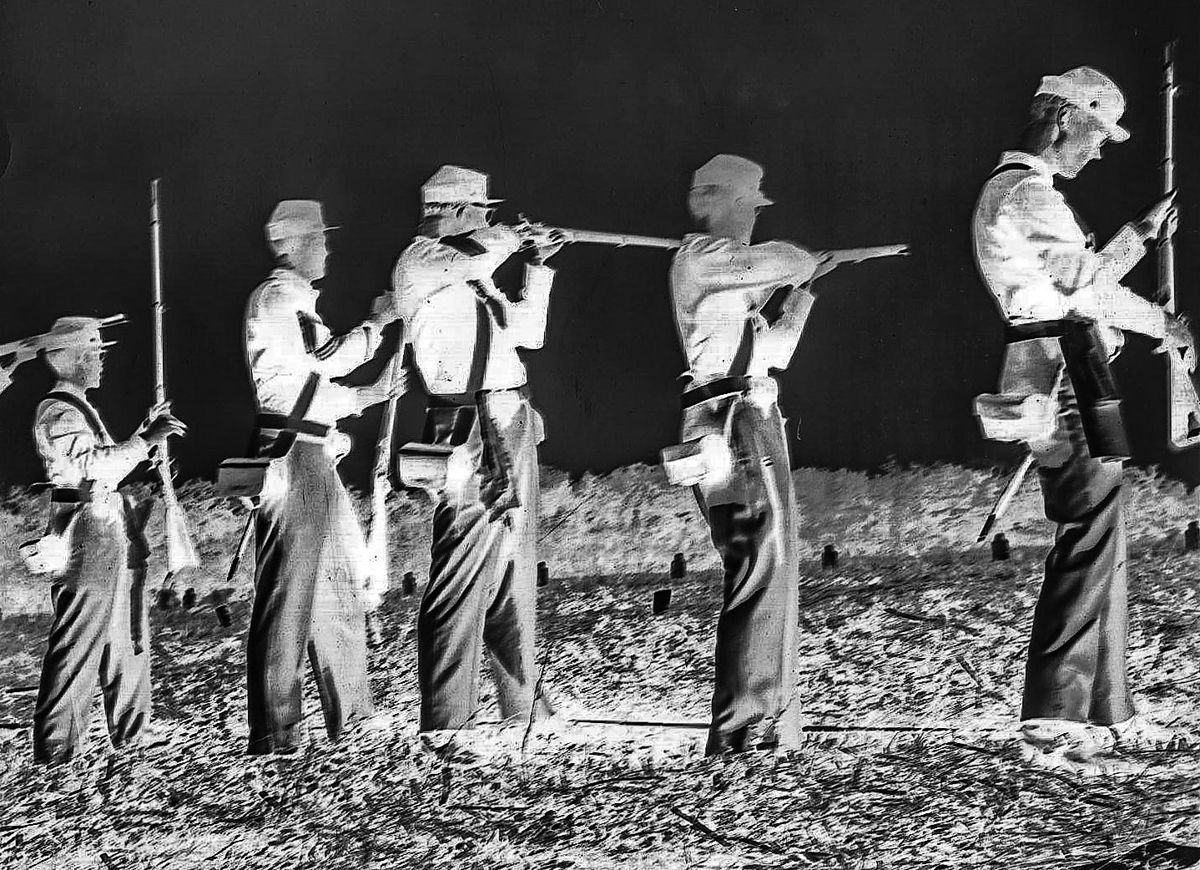
I thought members of the Civil War community might like to see official United States Marine Corps photographs of members of Forney’s Battalion, USMC, attired in uniforms like those worn by U.S. Marines during the Civil War era. They are standing inspection prior to a drill competition held at the 1959 Fall Nationals conducted by the North-South Skirmish Association. Forney’s Battalion was preparing to portray U.S. Marines who participated in the capture of John Brown in 1859, during a reenactment of the historic event Oct. 17, 1959, at Harper’s Ferry, W.Va. The photos were taken by Acting Sergeant B.H. Manlove, USMC, on Oct. 4, 1959. We know now that this was not the uniform worn by US Marines at the time of the John Brown Raid. More recent research has established that the enlisted Marines were dressed in the M-1852 fatigue uniform, but even today there remains some discussion as to the officer’s dress. The uniforms Marines were wearing in 1959 were first adopted in 1839. The service dress consisted of a tailed coat of dark blue wool edged in red with yellow worsted trim and topped by shoulder epaulets. A leather shako nicknamed the “tar bucket” served as headgear. The uniform reflected European influences and had changed little from earlier uniforms. Fatigue dress changed from gray to “sky blue” wool, with the fatigue cap going from leather to a more practical leather brimmed wool cap. The uniforms were modified slightly by the 1852 uniform regulations, but the general appearance changed very little. Though both officer and enlisted uniforms also had white linen variations for summer or hot weather use, that had no bearing on the uniforms worn at Harpers Ferry. By 1859 military fashion had evolved and new radically different uniform designs under review would be implemented in the Uniform Regulations of 1859 posted in Oct. The old 1839/1852 fatigue uniform was still in use and would see one last action.
The Marine Enlisted Fatigue Uniform
The “fatigue” uniform had changed little since 1839. The coat was a plain sky blue kersey wool unlined waist length jacket with narrow cut sleeves closed with nine Marine buttons evenly spaced down the front. The design was almost identical to its army counterpart of the Mexican War, but without any trim. The pattern included shoulder epaulets, a 2 ¾ inch stand up collar, two interior pockets near the waist, and functional cuffs. Noncommissioned officer (NCO) rank was indicated by half inch yellow worsted ‘half chevrons’ on each lower sleeve. Following French influence, sergeants would have two chevrons per sleeve, corporals only one. “ The sky blue trousers were a standard high-waisted design rising slightly higher in the back, with a split and tie to allow for minor waist adjustment. They had a single fly front, replacing the older broad fall pattern. The cuffs were split about 1 ½ inches on the outside seam to allow the trousers to spread properly over the boot. Sergeants had a 1 ¼ inch dark blue strip edged in scarlet along the outer seam of each leg The fatigue cap, commonly referred to as a ”wheel hat,” was adopted in 1839. It was made of dark blue wool cloth with a steep, slightly pointed leather visor. The leather chin strap was attached on either side by a small Marine Corps button. The letters USM in brass were on the cap’s front, recent research has concluded that they were one inch Roman block style. The Marine pattern cap did not have the folding neck cape of its army counterpart. A red flannel shirt of the period’s common military pattern was prescribed for wear under the coat, with a leather stock worn around the neck. The boots, referred to as “ankle” or “Jefferson” pattern were an ankle high, black leather design often nicknamed “brogans.”
Weapons and Equipment
Officers and Enlisted Men in the 1852 USMC Uniform.
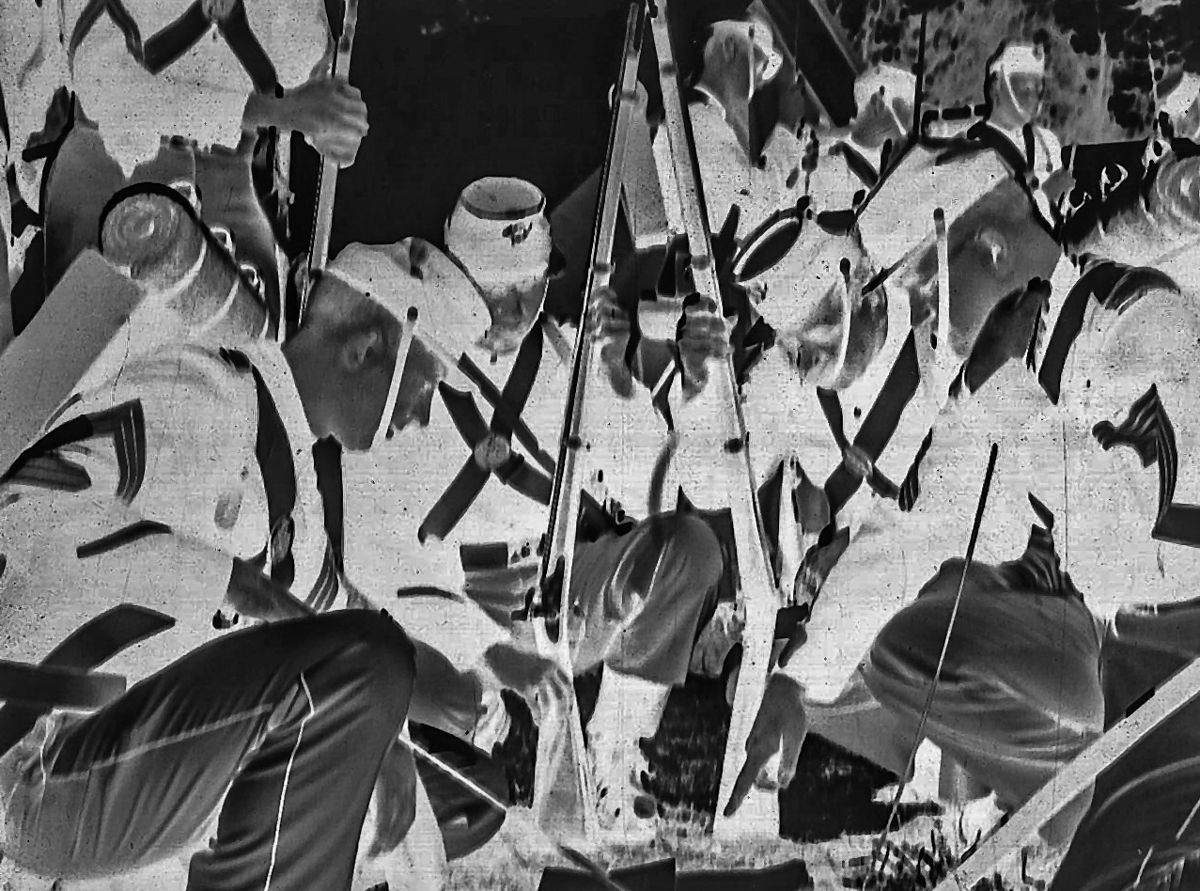
The equipment carried by the Marines at Harpers Ferry had remained consistent for over 30 years. The accouterment belts were white “buff” leather. The shoulder carriage, which held the bayonet and scabbard suspended on the left hip, had an oval, plain brass plate, which allowed adjusting the belt. Most of the Marine Corps was still using the model 1839 (late pattern, non-embossed) cartridge box., this black leather cartridge box, designed to carry forty .69 caliber cartridges, was suspended at the right hip by a white buff leather sling. The waist beltways 1 ¾ inches wide and closed by a plain rectangular brass buckle. This same basic design belt and buckle, in appearance, is still being used with the Marine dress blue uniform today. A Model-1855 “shield front” cap pouch holding percussion caps for the musket was carried on the waist belt.
Pass in Review!
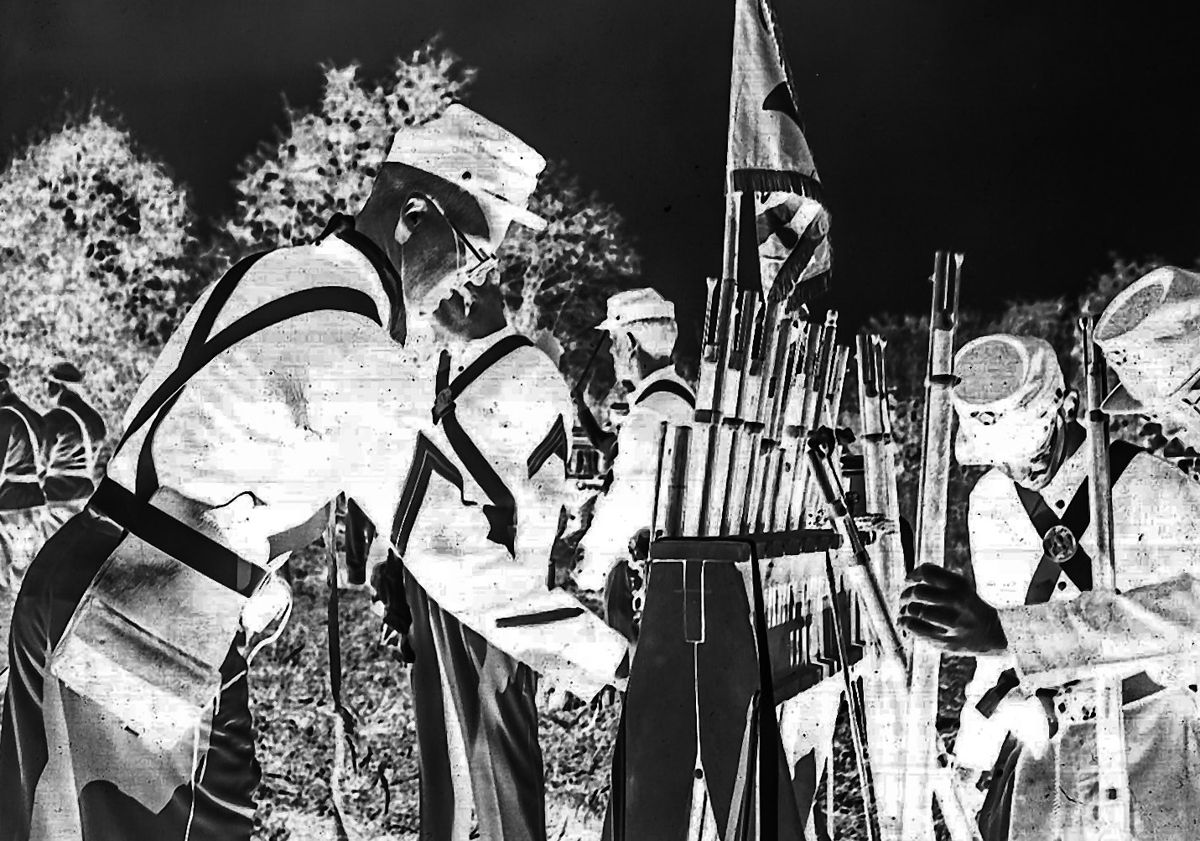
Readying For Action! The “service rifle” was the Model 1842 smoothbore. The version being carried by the Marines had been produced by the Federal Arsenal at Harpers Ferry. The version carried by the Marines was a .69 caliber smooth bore with a 42 inch barrel to which an 18 inch triangular socket bayonet could be attached. The Marines were well trained in the use of the bayonet and it would be used as the principle weapon in the final assault to capture John Brown. The tin canteen was round, smooth-sided, with a cork stopper usually covered in gray wool. The haversack, used for carrying rations, was also the same as Army issue. Made of “tarred” canvas (including the sling), the bag was approximately 12 x 12 inches with a single leather strap and buckle closure.
The Marine Officer’s Uniform at Harpers Ferry: Far more debate and controversy revolves around the attire of the two Marine officers dispatched to Harpers Ferry. First Lt. Israel Greene, a line officer was acting commanding officer of the Marine Barracks in Washington. Major William Russell was a staff officer holding the position of Pay Master of the Marine Corps.
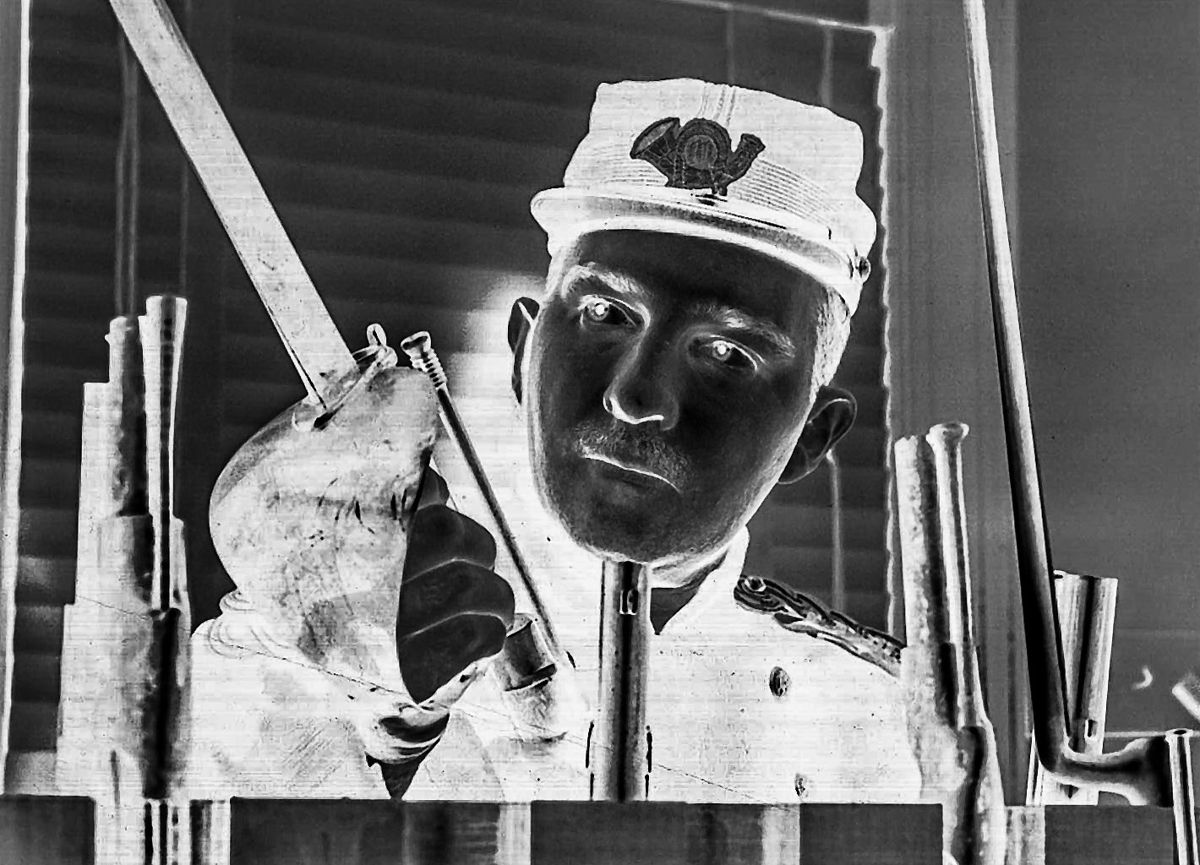
Traditionally, it has been believed that both officers were wearing the officers “undress” uniform, a category not yet implemented for the enlisted ranks. This can best be described as an intermediate duty uniform, or fatigue dress for officers. Replacing the dress coat was a frockcoat of navy blue wool. The frockcoat was a plain garment with a fully lined skirt extending to just above the knee. For field officers, staff (such as Maj. Russell), and captains of the line, the coat was double breasted with two rows of ten Marine buttons. Subaltern officers (Lieutenants of the line like 1st Lt. Greene) were single breasted. The rank of the commissioned officers was designated by a blue cloth shoulder strap four inches long and one inch wide with a one-eight inch gold embroidered border on each shoulder. Specific rank was indicated by the appropriate symbol embroidered on each strap. Further indication of rank was a crimson silk net sash worn round the waist. An officer’s version of the fatigue cap was worn, but the USM was replaced by an embroidered gold wreath with a diagonal silver anchor at its center. There is some discussion, based on drawings of the action at Harpers Ferry, that Lt. Greene and/or Maj. Russell may have been wearing the new French pattern kepi described in the 1859 Marine Uniform Regulations. Although these regulations were not officially posted until Oct., it is theorized that, with Russell and Greene both being at headquarters, in anticipation of the posting of the new uniform regulations, they may have had at least the new caps, if not complete uniforms, made up. The officer’s trousers were of dark blue cloth with a scarlet stripe one and three-fourth inches wide down the outer seams. The regulations further state that, when in “undress” similar pants without the stripe were to be worn. The officers were prescribed a “half-boot” to be worn under the trousers. Both Lt. Greene and Maj. Russell would have worn a sword belt to complete the uniform. The prescribed belt for Marine officers was white leather, two inches wide, with a sliding frog to hold the sword. The belt was clasped in front with the “prescribed” brass rectangular plate. In 1840 an alternate undress belt was authorized. It was made of black patent leather, with the sword to be suspended from black patent leather straps with brass swivel hooks to attach the scabbard. Officers of the era had a tendency to mix and match, and we may never know exactly what belts the two officers at Harpers Ferry were wearing at the time. The regulation Marine officer’s sword was a variation of the now famous Mamaluke hilt sword in use today. It had white ivory grips, and a brass scabbard. The blade, just over 32 inches in length, was slightly curved. Swords of the time were intended to be functional combat weapons, but many officers, such as Lt. Greene, purchased cheaper versions for ceremonies and other non-combat related duties. Personal accounts state that, in his haste to depart the Marine Barracks in Washington, 1st Lt. Greene took his “ceremonial” sword with him. This would prove a notable factor when Greene’s sword failed to stand up to the rigors of combat, and bent as he attempted a thrust against John Brown. As to Maj. Russell, the only description of his arms states that he entered the engine house “carrying only a rattan switch.” Visual records of the Marine uniforms at Harpers Ferry are cursory and conflicting as to details. We may never know the specific details of what the Marines were wearing at Harpers Ferry. There is no doubt of what the Marines accomplished, and how their actions impacted future events. While the materiel history is important, the actions and conduct of the Marines who used the equipment is what made the history, and is the principle story that needs to be told.
Balance your blade.