
Through The Lens
The Siege After Hell
By Stephanie Hagiwara · Originally published October 2017 · p. 9
The Siege After Hell “Hell can’t be any worse than Battery Wagner. I have got out of that, and the other place ain’t going to worry me anymore.” Confederate evacuating Morris Island, S.C. In 1863, the Federals decided to renew efforts to seize Fort Sumter, S.C., from Confederate control by first capturing the approximately 4-mile-long Morris Island located in Charleston Harbor, S.C. As the site of the first shots of the War, Charleston’s importance was symbolic not strategic. As an 11th Maine Infantry Volunteer wrote, “To capture Richmond [Va.] would be grand, but to capture Charleston would be glorious.” According to Gillmore the objective was to take Morris Island and reduce Fort Sumter, so the U.S. Navy could make it into Charleston Harbor and force the city’s surrender. Also, though reduced, Charleston still had strategic importance as a blockade running port. Off and on for 58 days, during a combined U.S. Army and Naval bombardment, Battery Wagner and Battery Gregg held firm. Fort Sumter’s walls were turning into rubble, almost unfit to support cannon. On Sept. 6, 1863, C.S. Gen. Pierre G.T. Beauregard pulled out the troops, leaving
Morris Island to the Union. The Federals had succeeded in reducing the blockade runner traffic in Charleston Harbor. The Confederates still controlled Fort Sumter, James and Sullivan’s Islands, protecting the submerged obstacles in the channel leading into Charleston. This “victory” boasted Southern morale and retained foreign support after the defeats at Gettysburg, Penn., and Vicksburg, Miss. Famed nurse Clara Barton described the brutal campaign as having “captured one fort – Gregg – and one charnel house – Wagner – and we have built one cemetery, Morris Island.” Instead of moving on, the Federals immediately set to work. Between remodeling the hard-won batteries and building additions, the Federals had ten forts and batteries on Morris Island. Hell on Morris Island turned into the siege of Fort Sumter and Charleston. Life for the Federals improved as ice, ovens to bake bread, and women nurses arrived on Morris Island. Furloughs were granted and artillery positioned. Battery Wagner, renamed Fort Strong, now mounted 21 guns and mortars, ranging from 12-pdr. field pieces to the 200-pdr. Parrott, with a garrison of four officers and 132 men. Battery Gregg, mounting ten guns, ranging from
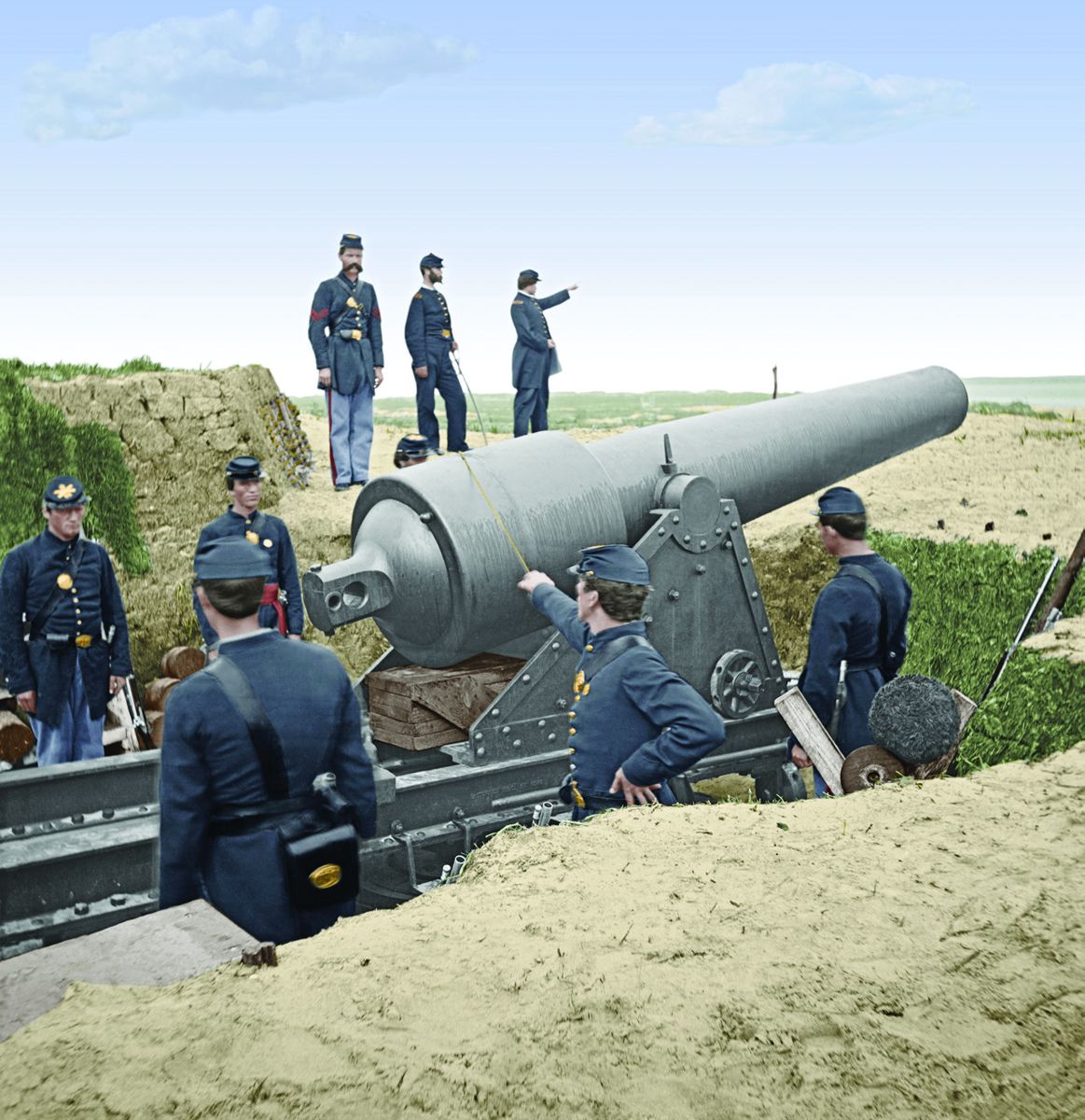
Battery Chatfield Morris Island with gun pointed at Fort Sumter. Colorization © 2014 civilwarincolor.com courtesy civilwarincolor. com/cwn (Library of Congress)
a 12-pdr. howitzer to a 200-pdr. Parrott, with a garrison of 5 officers and 100 men, was renamed Fort Putnam. East of Putnam was Battery Chatfield with two 100pdr. and one 300-pdr. Parrotts, four 10-inch sea-coast mortars, and two 10-inch Columbiads. The combatants on Morris Island settled into a routine of firing at Fort Sumter, James and Sullivan’s Islands and Charleston with the Confederates returning fire from James or Sullivan’s Island. A soldier of the 11th Maine describes the detail at Chatfield Battery during October 1863: “Our battery work was mainly directed against ruined Sumter. Day after day we trained the mortars on that crumbling fortress, sending their 10-inch shells high in air, to drop into Sumter and burst. After a shot was fired, it was watched through a field glass by an officer and its effect noted; whether it burst in the air or after striking its objective point, the men at work in the magazine filling the flannel bags each charge of powder weighed out was enclosed in receiving orders to put in more or less powder as the effects of the shots were noted, and those cutting fuzes receiving their orders to cut them shorter or longer from the same observations. As one officer observed the effects of the shots, another would note on a prepared form the results given him by the officer in charge of the firing, thus keeping a tabulated statement of each day’s work, the number of shots fired, and their individual results.” “Sometimes these results were plain to all of us. A shot would fall into the fort, and a whirl of flying fragments of stone, or a leaping barbette caisson, would tell us just where it had struck and just what the effect was. And a few times we succeeded in our incessant endeavor to bowl down the rebel flag. But, to the credit of the garrison of Sumter it must be said, no sooner was it down than some brave fellow would mount the parapet and set it flying again.” The men developed the skill of determining “… the course of a shell by the shriek.” Tales would later be told of narrow escapes. “Lt. Foster, who, after remaining comfortably seated for hours upon an empty ammunition box …, quickly rose and stepped off the parapet, and just as he stepped off it the box he had been seated on went into the air, struck by a piece of shell.” Pvt. Darling, “suddenly stepped backward to avoid being sliced in two by a Brooks’s rifle shell.” Another man abruptly dashed off to a bomb-proof, leaving a canteen of whiskey to be shelled in his place. The Confederates too, became experts in the sound of the
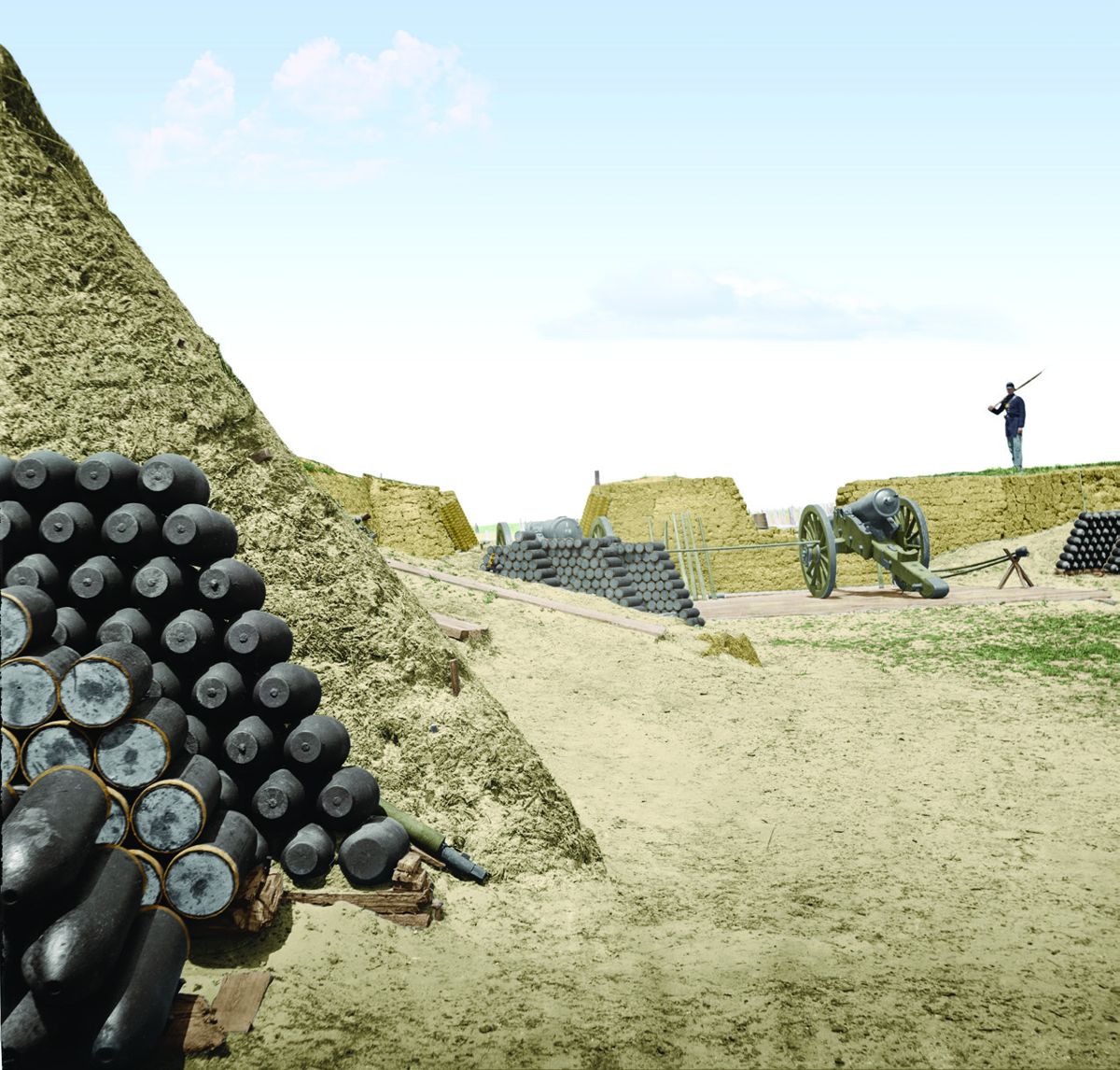
Parapet of Fort Putnam with stacks of ammunition, April 1865. Colorization © 2012 civilwarincolor.com courtesy civilwarincolor. com/cwn (Library of Congress) enemy’s guns. Captain Colwell was firing the 300-pdr. Parrott gun at Fort Moultrie and Fort Moultrie was responding with a 10-inch Columbiad. Colwell decided to “fool them a little” by placing a charge of powder and setting it off. “Mr. Rebel was not to be deceived by any such shallow device, and reserved his shot until the Parrott gun really spoke, when he answered as usual.” February 3, 1864, was a day to remember for the 11th Maine. The Presto, a side-wheel steamer, tried to run the blockade and hit the submerged wreck of the Minho. A sentry spotted the vessel at daybreak. Within “… minutes [a] 100-pound shell was whirling through the fog at the grounded steamer, the powerful impact of the shell boring a gigantic tunnel through the fog bank, through which we could see the lead-colored vessel, with hundreds of men swarming in and out of it, engaged in a desperate attempt to unload freight” of liquor, blankets, bacon, ham, and other goods. One of Chatfield’s shells hit the furnaces. Fort Strong began firing every 15 minutes from the 200-pdr. Parrott until 7 p.m. Strong’s 100pdr. fired from noon until the following morning. The navy got into the action by firing at long range. Between the 2nd and the 4th, 769 projectiles were thrown at the steamer from the batteries. To dissuade salvage attempts, the Federals continued to batter the wreck after the 4th. However, the Confederates did manage to rescue the liquor and “had a grand drunk.” The siege at Charleston ended from the land not the sea. The approach of U.S. Gen. William T. Sherman forced the defenders of Fort Sumter to slip away on the evening of Feb. 17, 1865. Troops from Morris Island, sensing change, investigated. By 9 a.m. the Union flag had returned to fly above Fort Sumter. During the 587-day Siege of Charleston, U.S. rifled artillery on Morris Island fired over 12,300 shells into the city for more than 260 days. Between 1863–1865, C.S. Major John Johnson, an engineer stationed at Fort Sumter, estimated that 46,053 projectiles were fired against it. Charleston, Sherman reported had become “a mere desolated wreck … hardly worth the time it would take to starve it out.” Sources: •
Maxfield, Albert, The Story Of One Regiment; The Eleventh Maine Infantry Volunteers In The War Of The Rebellion
•
OR, Series I, Volume 35, Part II, pages 39-44
•
OR, Series I, Volume 35, Part I, pages 103-104
•
Bordewich, Fergus, “Preservation or Development at Morris Island?”, Smithsonian Magazine, updated Mar 25, 2011
•
Gaines, W. Craig, Encyclopedia of Civil War Shipwrecks
•
Wise, Stephen R.; Gate of Hell
•
Cawood, Hobart G.; Combat History Of Fort Sumter 1863—1865
•
“Report of the Bombardment of Charleston January 1st 1864 to January 1st 1865”. Record Group 94, Box 2 File Maj. Gen. Quincy A. Gillmore, Jan-Mar 1865. National Archives and Records Administration,Washington, D.C.
•
OR, Series I, Vol. 35, Parts 1 & 2.
Stephanie Hagiwara is the editor for CivilWarinColor.com and CivilWarin3D.com. She also writes a weekly column for HistoryinFullColor.com that covers stories of photographs of historical interest from the 1850’s to the present. Her articles can be found on Facebook, Tumblr and Pinterest.