
The Founding of the Civil War Round Table of Atlanta
By Hank Segars · Originally published October 2017 · pp. 38–39
The Civil War Round Table of Atlanta, founded in 1949, remains one of the foremost historical societies in North America and the roll of early founders reads like a “Who’s Who” of notable Civil War historians. Approaching 70 years of operation, the group’s mission has not changed: present day members remain firmly committed to “furthering the serious study of our nation’s greatest conflict and tragedy— the American Civil War.” The idea of forming a Civil War Round Table in Atlanta was conceived by Richard Barksdale Harwell and his friendship with Ralph Newman, owner of the Abraham Lincoln Book Shop in Chicago, played a large part. Newman’s bookstore, founded in 1938, opened in part to meet the collecting needs of Civil War enthusiasts. The store’s customers included close friends of Newman and included Carl Sandburg, Bruce Catton, Stanley Horn, and William O. Douglas, as well as the original fifteen members of the Civil War Round Table of Chicago. Chicago is recognized as the first city with an official Civil War Round Table and this chartered group continues to be very active and most influential. Although Newman died in 1998, his Abraham Lincoln Book Shop remains in operation with books sales nationwide and the original round table is preserved inside the shop. The inception of Atlanta’s chapter began with Richard Barksdale Harwell hosting a dinner at his Atlanta home in November 1949. The guests included Civil War enthusiasts who are now recognized along with Harwell as the original founders: Beverly Means DuBose Jr., Carl C. Forrester Jr., Franklin Miller Garrett, and Wilbur G. Kurtz Sr. This was no ordinary assemblage but a select group of distinguished historians whose specific purpose was to discuss and plan for the formation of the city’s first Round Table. At the request of the group, Harwell agreed to serve as secretary of the organization committee. An organizational dinner meeting followed on Dec. 10, 1949, at the Piedmont Driving Club. Afterwards, the Atlanta Historical Society served as location for Monroe Cockrell, the first president of the Civil War Round Table of Chicago, to speak on “The Siege of Vicksburg.” There is no record of attendance but those remembered to be in attendance included Charles A. Collier, Beverly M. Dubose Sr. and Jr., Franklin M. Garrett, Ernie Harwell, Wilbur G. Kurtz Sr. and
Jr., and Richard B. Harwell. After the establishment of Round Tables in Chicago and Milwaukee, Atlanta became the third chartered organization and the first in the South. In those early days, it was customary to issue membership cards and certificates, chronologically numbered, to members. For example, Richard Harwell’s membership being no. 1, Beverly Dubose no. 2, Wilbur Kurtz Jr. no. 3, Franklin Garrett no. 4, Wilbur Kurtz Sr. no. 5, and Beverly Dubose no. 6. During the formative years of 1949-52, a total of 49 numbers were assigned including such notables as Bell Irvin Wiley no. 13, Henry King Stanford no. 23, and James Z. Rabun no. 40. (Wiley family)
The Atlanta Round Table initially met in the homes of members before moving to the Atlanta Historical Society. As the membership increased, the group decided in 1951 to schedule dinner meetings, initially beginning at Mammy’s Shanty, Herren’s, and The Variety Club which was located on the top floor of the Atlantan Hotel on Luckie Street. At that time, a meal cost $2.50 and drinks were 75 cents each. Featured speakers were not paid honorariums and meetings were not scheduled for any specific day; meetings were established in conjunction with the speaker’s travel schedule.
From the beginning, the founders wanted the Round Table to be a forum where likeminded Civil War buffs could hear a variety of authors, historians, and local members speak on specific interests. Programs also included debates and discussions, film presentations, and field trips. The earliest years of the Atlanta Round Table are explained in excerpts from this letter dated Sept. 9, 1977, from Beverly DuBose to Robert Meek of Stone Mountain: Looking back, admittedly prejudiced, I consider the golden age of the Round Table, from a historian’s standpoint, as being from 1952 to possibly 1960 … Our membership was under 100 and our attendance was around 60. Many of our members were well informed and students of the War … we had an amazing array of what is now accepted as the tops in the field: Otto Eisenschiml, Bruce Catton, Dr. E. Merton Coulter, now Dean of Georgia History, Harnett Caine, the well know novelist, Dr. Tom Clark, extensive author and head of Department of History, University of Kentucky, McKinley Cantor, author of
ˆRalph Newman, Pye DeFour, author and newspaperman from New Orleans, Dr. Franklin G. Slaughter, who is now author of 70-odd books, T. Con Bryan, author of Confederate Georgia, and countless others. This is no way belittles our own, such as Bell Wiley, Wilbur G. Kurtz Sr., Dr. J. C. Bonner, head of the History Department at Milledgeville, and many others. The national standing of the Civil War Round Table of Atlanta is not lost on the current membership. Moreover, the notable contributions of the founding members to Civil War research and scholarship are appreciated by enthusiasts from all around the nation. In the annals of 20th Century historical societies, the accomplishments of the founding members in Atlanta have not been duplicated. As examples, a few biographical sketches are included here: Beverly Means DuBose Jr. (1918-1986), an Atlanta insurance executive with a degree in American history from Emory, was one of the first relic hunters to use military metal detectors to legally search for Civil War artifacts. As a dedicated member of the Atlanta Historical Society, he also purchased a variety of valuable pieces from other collectors. The DuBose Collection includes hundreds of buttons, firearms, letters, medical equipment, mess kits, swords, and uniforms. The vast collection was generously willed to the Atlanta History Center which resulted in the construction of the presentday Atlanta History Center. Bell Irvin Wiley (1906-1980) is nationally and internationally renowned for his scholarly research and bestselling Civil War books to include The Life of Johnny Reb and The Life of Billy Yank for LSU Press. As an eminent professor of history at Emory, Wiley is reported to have examined over 30,000 letters and 1,000 diaries.
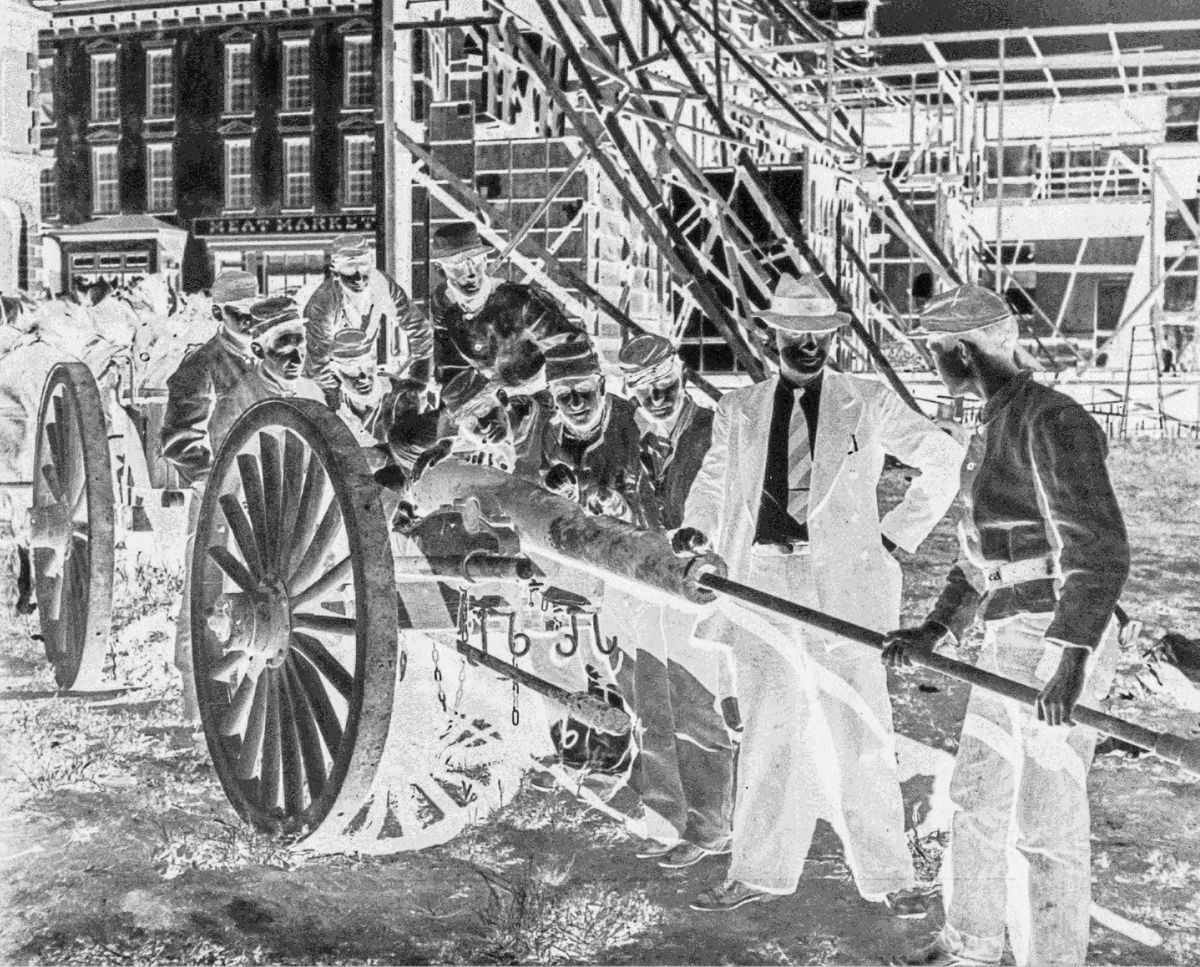
Wilbur Kurtz, left, with Franklin Garrett, center, (and possibly Bev DuBose, Sr. and Jr.) (Wilbur Kurtz III)
C. Vann Woodward, Yale University Historian and Pulitzer Prize-winning author, said that his “contributions to the understanding of the common soldier was a great and lasting part of his achievement.” The professor was the only Southerner appointed to the National Civil War Centennial Commission and served with distinction as chair of the executive committee and of the committee on historical activities. During Wiley’s lifetime, he was recognized for his many contributions to Civil War studies and, of his research, E. Merton Coulter said, “I consider him the person of first importance in the period of the Civil War, undoubtedly the top man in the work concerning the lives of the soldiers.” Richard Barksdale Harwell (1915-1988), nationally recognized librarian, bibliographer, and historian with a long academic career at major universities to include Duke, Emory, Arizona State, the University of Georgia, and the University of Virginia. Harwell also authored and edited over 65 books to include The Confederate Reader, The Union Reader and In Tall Cotton. This researcher introduced the concept of Civil War Round Tables to Atlanta and became the first president. Also, the local chapter named their prestigious book award in his honor in 1989. Franklin Miller Garrett (1906-2000), is recognized as Atlanta’s official historian and his massive book entitled Atlanta and Environs: A Chronicle of its People and Events remains a primary historical reference. Garrett spent years as a genealogist researching and recording family names found on thousands of Atlanta headstones. This longtime historian of the Coca-Cola Company was personal friends with Margaret Mitchell, Wilbert G. Kurtz Sr., and other Civil War notables and, for many years, held numerous positions with the Atlanta Round Table and the Atlanta Historical Society. Wilbur G. Kurtz Sr. (1882-1967), became nationally known for his Civil War art and historical research. His historical paintings and expressive murals are found in private art collections and on public buildings throughout the South. Kurtz was also instrumental in the restoration of The Battle of Atlanta Cyclorama and served as technical advisor for Gone With The Wind (1939) and Walt Disney’s Song of the South (1946) and The Great Locomotive Chase (1957). He researched and wrote the text for a large number of Georgia Historical Markers and created illustrations for major Atlanta newspapers. Almost seventy years have passed since the founding of the Civil War Round Table of Atlanta and its continued success is credited to the exceptional vision and foresight of the original members who chose to found this influential organization. Members continue to share their research with a wide variety of communities through countless presentations and symposiums, as panelists and consultants, and through decades of Barksdale Book Award presentations. Atlanta members are still remembered for their prominent roles in both National and Georgia Civil War Centennial Observances, highlighted by the 100th Anniversary of the Great Locomotive Chase in 1962, and in Sesquicentennial programs during 2011-2015. Now numbering over 300 members, the Civil War Round Table of Atlanta continues to draw the most desirable speakers from around the country to include these notable historians: Albert Castel, William Davis, James I. (Bud) Robertson Jr., Richard McMurry, Gary W. Gallagher, Charles P. Roland, Anne J. Bailey, Brian Wills, Robert K. Krick, and Edwin C. Bearss. Speakers drawn from the local membership have included Tom Watson Brown, Philip Secrest, William Bragg, Franklin Garrett, Bell Wiley, Colonel James Bogle, William R. Scaife and Stephen Davis. For ten months of the year, Atlanta Round Table meetings are held on the second Tuesday at the Capital City Club in downtown Atlanta. As in the past, members are involved in field trips to Civil War sites as well as social activities and philanthropic projects. For addition information and membership inquiries, please contact David L. Floyd, Secretary-Treasurer, at [email protected] or visit www.crwt.org. Hank Segars of Madison, Ga., is the founding president of the Northeast Georgia Civil War Round Table in Lawrenceville and was a member of the CWRT of Atlanta from 1999-2004.