
The Artillery that Charged with Pickett
By Shannon Pritchard · Originally published October 2017 · pp. 24–25
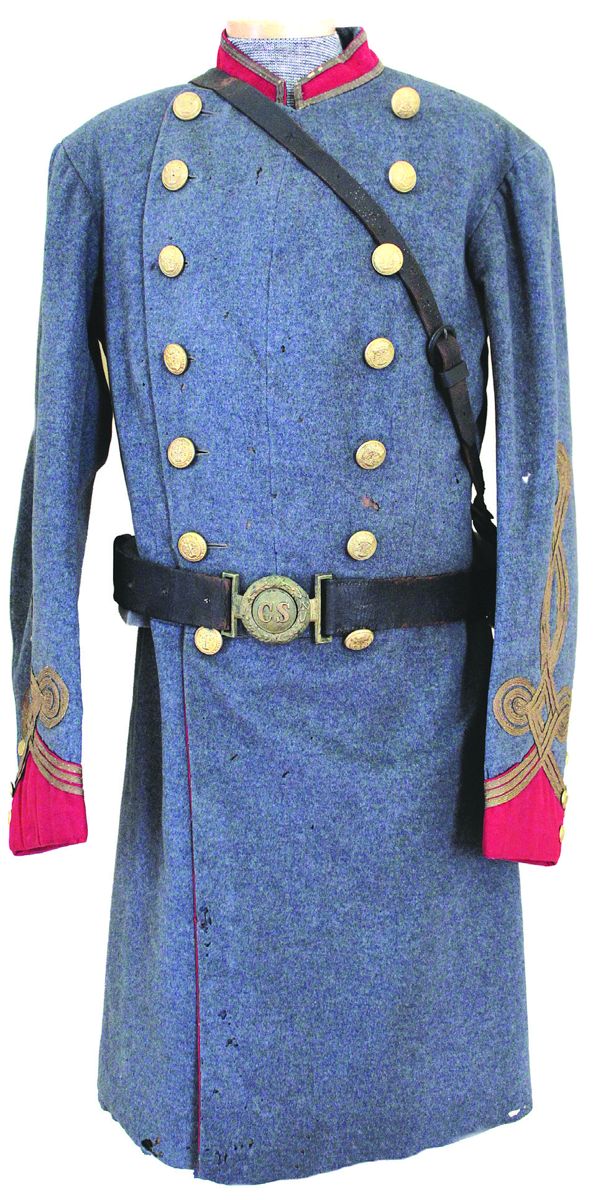
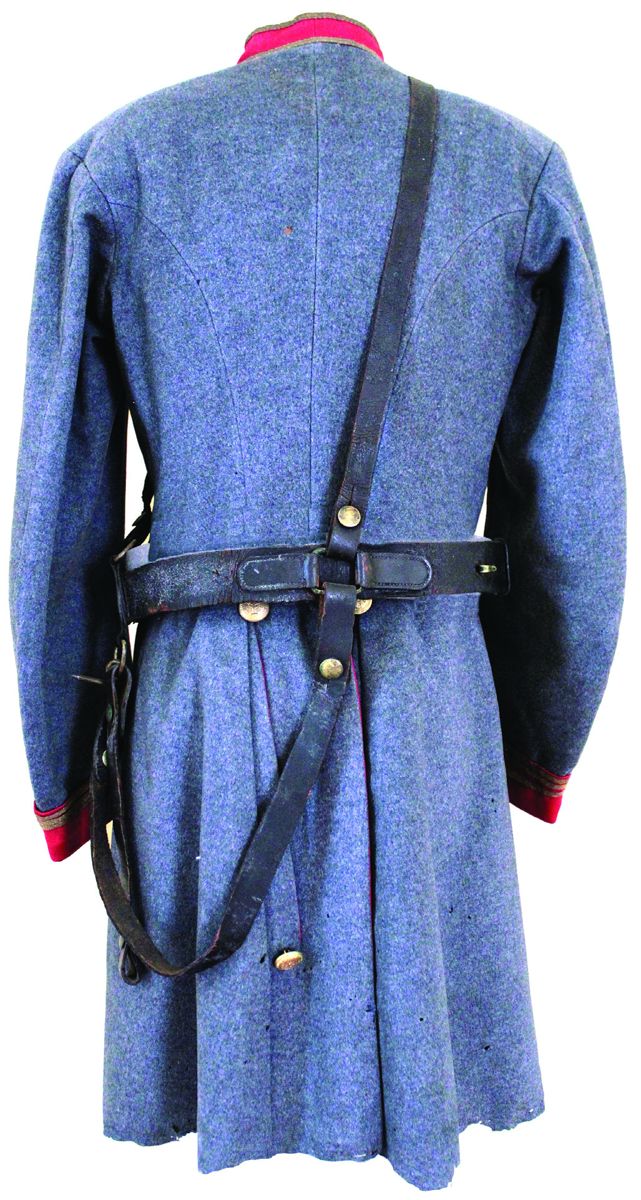
The frock coat shown here was worn by Captain Hugh Richardson Garden. The details of Capt. Garden’s service follow, but the short version is that Garden has a war record from the first battle to the last battle that is second to none in the Confederacy. His record is rife with acclaim for bravery, fortitude, and good judgment. His deeds of valor are mentioned in the Confederate official records. Hugh Richardson Garden was born on July 9, 1840, in Sumter, S.C. In 1860 he graduated from the South Carolina College in Columbia. South Carolina College was founded in 1801 and it became one of the most influential colleges in the South before 1861. It offered a traditional classical curriculum. It quickly earned a reputation as the training ground for South Carolina’s antebellum elite. The class of 1860 reads like a who’s who of S.C., military officers: Barnwell, McQueen, Haskell, Anderson, Dubose, Dupont, Garden, Hill, Wardlaw, Gadsden, Minninger, Richardson, Stuart, Witherspoon, McCreary, Gregg, Gerrard, Keitt, and a host of others. Garden attended the S.C. secession convention and took great interest in the state’s military affairs. Though he was a member of South Carolina’s aristocracy,
(Shannon Pritchard)
Garden enlisted as a private in the Sumter Guard under Captain Richardson on April 9, 1861. The company was mustered into service as Co. D, 2nd S.C. Inf. under illustrious Colonel Joseph Brevard Kershaw. Garden was recognized as a leader from the very beginning. Only ten days after his enlistment, the regiment elected him as color bearer. Shortly thereafter the regiment was transported to northern Virginia, the seat of war. While serving under Gen. Bonham, on July 17, the South Carolinians were attacked at Fairfax Court House and fell back to Bull Run. They fought at Blackburn’s Ford on July 18th and they played a significant part in the great battle on July 21, 1861. The 2nd S.C. was in the charge at Henry House Hill and the famous charge on Rickett’s Battery. Through it all, Sergeant Garden bore the colors at the head of the regiment. Garden continued to carry the colors through the fall and winter of 1861. The regiment was reorganized in February 1862, at which time Sergeant Garden reenlisted as a private. He obtained a twenty-one day furlough and traveled to Richmond, Va., where he received authorization from the War Department to raise a battery of artillery at his own expense. In 1862, 22 year old Hugh Garden stood 5’ 11”. He had black eyes and black hair. Returning to South Carolina, he proceeded to make contracts for cannon, carriages, harness, and all the implements necessary for a battery. He had six guns cast at Columbia, S.C.; unfortunately, all six burst at trial due to the inferior metal used in their casting. He then began to collect church bells and anything else made of brass that could be found in the Columbia area. He had six twelve pounders cast from the material he had gathered. These guns suited the purpose well. He also raised a company of 150 men, who promptly elected him captain. His battery was known officially as the “Palmetto Light Artillery,” but was usually referred to as “Gardens Battery.” Garden’s now fully equipped and staffed battery began the trek to Virginia on April 27, 1862. Initially, Garden’s Btry. was attached to Hampton’s Legion, but when Hampton was transferred to cavalry command, the battery was assigned to Gen. John Hood’s Division artillery battalion, under Maj. B.W. Frobel. Confederate Military History states that Garden’s Battery fought in the Seven Days battles around Richmond and then moved to Manassas. Garden’s Battery played a prominent role in the battle of Second
Manassas. Major Frobel’s official report of the action follows: CAMP NEAR FREDERICK, MD. September 9, 1862. CAPTAIN: I have the honor to submit the following report of the participation of the batteries under my command in the battles of Friday and Saturday, August 29 and 30:…. At 3 p.m. on Saturday (Aug. 30) I was ordered by General Longstreet to proceed down the turnpike with the batteries and take position on the left of the road, opening fire on the enemy’s batteries … In the mean time I was ordered by General Longstreet to advance Captain Garden’s battery in the field on the left of the road. This was done, and a flanking fire opened on the batteries near Dogan’s House. We were soon, however, ordered to cease, as Colonel Law’s brigade was advancing in the opposite direction on the same point, the Federals at the same time manifesting great energy in the rapidity of their movement down the turnpike and Sudley Ford roads. Captain Garden, with two other batteries, continued to pursue until the Sudley [Ford] road was reached, when, not being able to distinguish friend from foe in the darkness, the battery was finally withdrawn. Of the conduct of officers and men in both engagements I cannot speak in terms too high. Captains Bachman and Garden handled their batteries with great skill, while Reilly sustained his old and well cemented reputation. …Enclosed you will find a list of the killed and wounded. I am, captain, very respectfully, your obedient servant. B. W. FROBEL, Major and Chief of Artillery, Commanding. Garden’s Btry. saw limited action at South Mountain on Sept. 14, but on Sept. 17, 1862, the battery was in the thick of the fight at Sharpsburg. In the early afternoon, Garden’s Btry. was posted on the extreme right at Burnside’s Bridge. Here they played a conspicuous part in keeping the Yankees at bay for five hours, giving A.P. Hill’s Division time to arrive on the field. Garden’s Battery was in the hottest of the fight as demonstrated by his losses: the battery lost nine horses killed outright and five more wounded. His battery suffered twelve casualties and had two of his guns disabled, yet he remained calm at his post until out of ammunition and brought his guns off safely. Major Frobel’s after action report follows: O.R.— SERIES I—VOLUME XIX/1 [S# 27] OCTOBER 1, 1862. Capt. W.H. SELLERS, Assistant Adjutant-General. CAPTAIN: In compliance with orders to report the participation of the batteries under my command in the recent engagements before Sharps-burg, I would respectfully submit the following: After bringing up the rear on the march from Boonsborough… Garden’s battery being held in reserve, in case the enemy should attempt an advance by a bridge over the Antietam, still farther to the right. We held these positions on Monday night. …Tuesday night we occupied the same positions. On Wednesday morning the battle was again renewed. … At 2 p.m. I received orders from Major-General Jones to prepare to hold the road leading from the bridge over the Antietam on our extreme right. A few minutes after, the enemy was reported advancing, the infantry near the bridge at the same time giving way. I immediately placed Garden’s battery in position on the left of the road. The enemy had crossed the bridge and were advancing rapidly, under cover of a furious fire from all their batteries concentrated upon us, when Garden opened a most destructive fire upon them, and, assisted by a rifle section under Captain Squires, soon drove them back. Fearing they might yet turn us by passing still farther to the right, I directed Captain Garden to look well to the road and woods in front of him, while I proceeded to the right in search of General Jones. On arriving at the top of the hill on the right of the road, the enemy was seen advancing in strong force in that direction. … At this time, large bodies of the enemy (infantry and artillery) were moving on the opposite side of the river. When near the bridge they halted some ten or fifteen minutes. I immediately sent to Captain Reilly to come up, as the guns then in position were all short range and could not reach them or the bridge. Being without ammunition, only his howitzer section was available. I at once placed it in position. The enemy had, in the mean time, advanced some eight or ten guns across the river and placed them in front of us. Under fire of these, assisted by all their long-range batteries on the opposite bank, their line advanced. Their sharpshooters, at the same time, opened a hot fire on us from a corn-field on our right, a stone fence in front, and a wood and orchard near by. Our batteries immediately replied, and continued their fire until the line was broken and the enemy recoiled. At this time they were distant less than 100 yards. Our ammunition was exhausted. One of Captain Garden’s guns was dismounted, the carriage being entirely destroyed; another, rendered utterly useless by the bursting of a shell, while from one of Captain Reilly’s pieces all the horses had been killed. But three guns remained fit for service, and they were without ammunition. Having run the pieces to the rear by hand and secured our disabled guns (the enemy all the time advancing and firing upon us), I ordered the batteries to retire. …At this time General A.P. Hill came up, and, charging, drove them from the field. I regret to report that First Lieutenant [S. M.] Pringle, of Garden’s battery, after fighting his guns most gallantly, fell, late in the day, mortally wounded, and has since died. I cannot too highly applaud the conduct of both officers and men. Captains Bachman and Reilly fought their batteries with their usual determination and devotion to the cause. Captain Garden, Lieutenants [James] Simons, jr., Myers, Ramsay, and Sergeant Schlemmermeyer deserve particular notice for their gallant Conduct during the battle, and also Assistant Surgeon Buist, for his attention to the sick. … I am, captain, very respectfully, your obedient servant, B. W. FROBEL, Major and Chief of Artillery, Commanding. After the Sharpsburg fight, Garden’s Btry. was rewarded with six 12-pdr. Napoleons captured in the fight. The battery was held in reserve at Fredericksburg the following December. The battery served in the Suffolk, Va., campaign before being transferred to Gen. Pickett’s Division under Maj. James Dearing in mid-April, 1863. In May, the battery returned to the Army of Northern Virginia in time for the march into Pennsylvania. The end of June found Capt. Garden marching from Chambersburg, enroute to Gettysburg. Garden reached on the Confederate right on July 2nd and shelled the Yankee positions above Devil’s Den from 3:45 until dark in support of Gen. Hood’s advance and capture of Devil’s Den. On July 3, 1863, Garden’s Btry. was put in support of Pickett’s Division. One of Garden’s guns and four guns from the Washington Arty. were the only guns to move forward with the infantry assault and at times actually moved ahead of the infantry! Garden’s 12-pdr. howitzer was disabled in the attack and Garden personally led a team to recover the gun. Seven brave men went forward with their captain to recover the disabled gun: Lt. W. Alexander McQueen (wounded), Sgt. Matthew E. Haynesworth, Pvt. James Henry Haynesworth, Cpl. Robert Small (wounded, died July 7th), Pvt. Charles Haynesworth (wounded), Pvt. Thomas McIntosh (wounded, died July 4th), Pvt. William Moultrie Reid, Pvt. James Merrick Reid, and Pvt. “Bill” Grady. November and December found Garden’s Btry. posted along Mine Run. After a dull winter the battery found itself in action in the Wilderness, Spotsylvania, North Anna, and Cold Harbor. July saw the battery fighting at the Crater outside of Petersburg, Va. During this battle, the battery was lobbing mortar shells into the pit. By October Garden’s Btry was posted north of the James River in an Artillery Battalion under Maj. John Haskell, Garden’s old classmate from South Carolina College. The battalion shared in the repulse of the Yankee troops on the Darbytown and New Market roads. During the battle of
Fort Harrison, the battalion performed with their accustomed energy and success and Maj. Haskell received a grazing wound on the head from a minie-ball, and L.t McQueen, of Garden’s Btry. was severely wounded during the first day’s battle. The battery was slightly engaged again the following day. The battalion spent the winter months in the Petersburg trenches, holding the line at Drewry’s Bluff. When forced out of the Petersburg lines, the battery withdrew to Farmville where they went into action on April 7, 1865. On the following day Capt. Gardner was directed to abandon his guns, but keep his horses in case the situation improved. On April 9, Gen. Lee was forced to surrender at Appomattox Court House and Capt. Garden made a list of his remaining assets: 14 officers, 25 men and 8 horses. Captain Garden lived a charmed life. He enlisted April 9, 1861 and served until April 9, 1865. In the beginning, he bore the 2nd S.C. Inf. regimental battle flag and he served in an active battery which fought on many of the hottest fields of the Army of Northern Virginia, yet he passed through all of this unscathed. Shortly after the War, Capt. Garden moved to Warrenton, Va., where he practiced law for the next 15 years, and then later moved to New York City where he founded the New York chapter of the Confederate Veterans organization. He also became a Doctor and botanist in his later years. When he retired he moved back to Sumter, S.C., where he is buried. His double breasted officer’s frock coat is adorned with seventeen S.C. buttons backmarked Horstmann Bros & Allien/NY and six eagle staff officer buttons with Scoville backmarks. The coat has scattered moth damage to the exterior but no restoration has been done inside or out. “H.R. Garden P.L. Art.” (Palmetto Light Artillery) is written in ink on the inside of the right tail pocket. Shannon Pritchard has authored numerous articles relating to the authentication, care and conservation of Confederate antiques, including several cover articles and is the author of the definitive work on Confederate collectibles, the widely acclaimed Collecting the Confederacy, Artifacts and Antiques from the War Between the States, and Confederate Faces in Color.