
Black Powder, White Smoke
Battlefield Pickups & Fenian Parts Guns
By Joe Bilby · Originally published October 2017 · p. 6
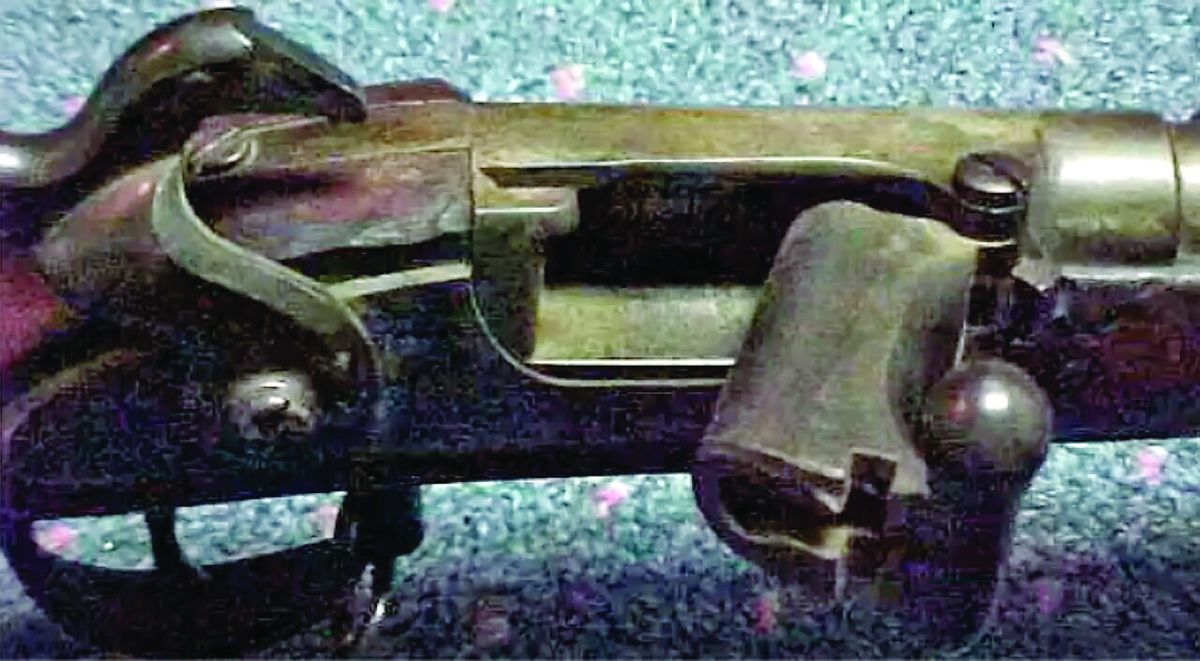
Battlefield Pickups & Fenian Parts Guns I recently received some more material for my Civil War firearms in the field information file from my North Carolina correspondent and battlefield researcher Skip Riddle. Skip discovered a story in the Worcester, Mass., Palladium newspaper of April 2, 1862, describing two weapons captured by Massachusetts troops from “the Rebels in North Carolina.” One firearm was described as a “breech loading rifle made at Harper’s Ferry in 1836.” The gun, obviously a Hall carbine, was accompanied by “a cartridge box nearly full of ball cartridges. The second weapon, described as “taken at Newbern,” was “manufactured in Windsor Vt.,” which indicates that it was a Model 1841 “Mississippi” rifle made by Robbins, Kendall and Lawrence. The latter gun had “upon it the evidences of blood both above and below a space upon the breech where the hand of the bearer was manifestly upon it—showing that someone had either been wounded or killed.” Skip, an assiduous researcher, advised that he had discovered that one company of the 2nd North Carolina Cavalry carried Halls during the Battle of Newbern. The regiment, originally classified as the 19th North Carolina Regiment, was re-designated the 2nd N.C. Cav. prior to the battle. Two companies were dismounted and deployed to assist infantry units defending positions near the railroad. One of these was the company armed with Halls, and the other company was likely armed with Model 1841 rifles. It is probable, then, that both captured arms, probably better described as “battlefield pickups” were acquired by Union soldiers in the aftermath of the battle.
Fenian Parts Guns Several months ago, I discussed the N.J. Quartermaster General’s actions while contracting for rifle muskets with various manufacturers to arm the state’s newly organized “Rifle Corps” during 1863-1864. In the course of an email conversation on Civil War small arms with expert Kenneth Smith-Christmas and Bill Adams, my resident Enfield scholar, the subject of Fenian guns came up. The Fenians were the Irish American branch of the
Irish Republican Brotherhood. The end of the American Civil War led to a step up in both organizations’ activities, both in Ireland and in the United States, where the Fenians were recruiting Irish veterans of both sides to launch an invasion of Canada, to “twist the lion’s tail” and complement a rising in the homeland. The U.S. government, still angered at British support of the Confederacy during the conflict, looked the other way as the Irishmen planned their operation. One theory posits that Secretary of State Seward was actively supporting the Fenians behind the scenes.
Fenian markings on stock.
The Irish needed arms, and there were plenty available in the wake of the war. The Fenians were able to openly buy quantities of Civil War surplus arms and ammunition, even though the government was aware of their probable plans, and the fact that politicians were also courting them for their votes added to their sense of empowerment. Perhaps, surprisingly, considering the availability of Spencers, the Fenians purchased Bridesburg rifle muskets from Alfred and Barton H. Jenks, who had, at the outset of the Civil War, converted their cotton and wool manufacturing facility in the Bridesburg section of Philadelphia, Penn., into a rifle musket factory, adding another factory building during the war to become a major small arms contractor. At the close of the Civil War, Jenks had, Kenneth noted, between four and five thousand rifle muskets in stock for repair. At least 700 of these, and probably more, had been rejected for service by Federal inspectors at least as assiduous as those at the N.J. state armory. Kenneth added that “all of the Fenian Bridesburg R-Ms and Fenian Bridesburg/Needham conversion rifles that I have seen, either in person or online, are “parts” guns, or rebuilds, although some of them are in excellent shape. However, most of them, like all four of mine, are made up of disparate mix-andmatch parts, or new parts and obviously well-used, and heavily pitted, parts.” Apparently the Fenians did not have the same quality of inspection that the state or Federal governments had, and Jenks took the opportunity to get rid of what may be generously called “old stock.” Following the failure of their1866 invasion of Canada, the U.S. army confiscated the
Fenians’ muskets, but two years later returned them to the organization, allegedly “upon their giving bonds that no unlawful use should be made of them.” Apparently the Fenian leadership decided that if they were converted into breechloaders, that bond would no longer apply. Kenneth’s mention of the Needham conversions refers to many returned Bridesburg muskets shipped to the former Trenton Locomotive Works factory where the Trenton marked rifle muskets were assembled during the war. Here the guns were converted to breech loaders using the Needham method, ironically developed by a British inventor. Following the failure of the 1870 Fenian incursion into Canada, a newspaper described the conversions as “altered into breech loaders in some cheap way, with a cast iron breech pin, which did not stand much firing.” Interestingly, P. J. Meehan, the editor of the New York Irish American newspaper, was a major stockholder in the Trenton company, which might have influenced the site of the conversion work. The cost of conversion was $15 a rifle, while a used Sharps was going for $6 to $8. You can still find original Fenian marked pieces in both muzzle and breech loading versions on the collector market, and they are indeed unique historical survivors of a forgotten episode connected to the Civil War in American history. Fenian markings vary, and include cartouches of a small shamrock and/or “IR” or “IN” for “Irish Republic” or “Irish Nation.” An additional characteristic of a Fenian Needham conversion is a stock split under the second barrel band, which facilitated the Fenians disassembling the guns and shipping them in smaller boxes labeled “furniture.”
(Jim Madden)
Joseph G. Bilby received his BA and MA degrees in history from Seton Hall University and served as a lieutenant in the 1st Infantry Division in 1966-1967. He is Assistant Curator of the New Jersey National Guard and Militia Museum, a freelance writer and historical consultant and author or editor of 21 books and over 400 articles on NJ and military history and firearms, and as publications editor for the NJ Civil War 150 Committee edited the award winning New Jersey Goes to War. His latest book, New Jersey: A Military History, was published by Westholme Publishing in 2017. He has received an award for contributions to Monmouth County (NJ) history and an Award of Merit from the NJ Historical Commission for contributions to the state’s military history. He can be contacted by email at [email protected]