
Book Reviews
Book Reviews — November 2017
Originally published November 2017 · pp. 22–40
Success in Spite of Ourselves Contradictions of a Slave Trader’s Life Two Against Lincoln: Reverdy Johnson and Horatio Seymour, Champions of the Loyal Opposition. By William C. Harris. Photographs, notes, bibliography, index, 272 pp., 2017, University Press of Kansas, www.kansaspress.ku.edu, $36.95 hardcover. Reviewed by Richard J. Blumberg
In an unlikely alliance, a Maryland Senator, a New York Governor and the President of the United States achieved the preservation of the Union using different paths. Award-winning Lincoln historian William C. Harris explores how these men negotiated various political agendas in a manner not unlike what current politicians face today. Reverdy Johnson, who enjoyed a personal relationship with President Lincoln, was one of only three men who served the U.S. Senate during both the Mexican-American War and the Civil War. Horatio Seymour, Governor of New York from 1863 to 1865, emerged as a Democratic leader espousing the old Jacksonian tenets and the original purpose of the war. Both Johnson and Seymour opposed Lincoln, but not in the way most Copperheads did. Harris’ tome has four objectives: 1) provide readers with a better understanding of those like Johnson and Seymour who opposed Lincoln and the Republicans; 2) explain the political alignments and conflicts of Union states during the Civil War; 3) outline various political issues polarizing the nation and 4) describe Johnson’s and Seymour’s unsuccessful attempt to secure an immediate Southern restoration to the Union after the Civil War. The author uses an extensive collection of manuscripts and diaries to address his four themes. Harris shows readers that midnineteenth century politics are not that different from today’s political arena. The Emancipation Proclamation, which shifted the Northern war aim from simply preserving the Union to ending slavery, is an excellent example of a heated issue where Johnson, Seymour and President Lincoln had to make concessions and compromises in order to achieve their desired goals. In the process, each held others accountable for their actions. In spite of themselves, these men accomplished their desired political aims. This work is a comprehensive study of politics before, during and immediately after the Civil War. The author’s structure of two separate parts treating Seymour and Johnson creates a small obstacle in determining when these leaders agreed with each other while disagreeing with Lincoln. The end notes and essay on sources tend to mask the extensive research of primary source materials used in this study. However, neither of these weaknesses is significant compared to the information and fresh insight provided in this work. Richard J. Blumberg has been a book reviewer for Civil War News for over 15 years. His article on hospital transports appeared in our Feb. issue.
Reviews of Civil War Books Civil War News book reviews provide our readers with timely analysis of the latest and most significant Civil War research and scholarship. Stephen Davis, Civil War News Book Review Editor. Email: [email protected]
The Secret Life of Bacon Tait a White Slave Trader Married to a Free Woman of Color. By Hank Trent. Notes, index, 224 pp., 2017, Louisiana State University Press, www.lsupress.org, $38. Reviewed by Tracy J. Revels
Often a person of the past leaves only scattered footprints behind, enough of a trail to follow his life’s journey but not enough to truly understand his heart. Despite the impressive research and solid prose of his biographer, independent scholar Hank Trent, the Richmond slave trader Bacon Tait remains an enigma at the center of a biography which raises more questions than it answers. Born near Lynchburg, Va., in 1796, as a young man Tait experimented with shop-keeping and real estate speculation before concluding that slave trading was the surest route to prosperity. Thanks to good luck and a sound partnership, Tait established a thriving business, running a prominent slave jail in Richmond’s Shockoe Bottom. But financial bounty came with a curse; slave traders were despised by virtually every stratum of southern society. No “respectable” woman would consider matrimony and Tait seemed destined to suffer permanent bachelorhood. Around 1842, Tait met and began a sexual relationship with Courtney Fountain, a free black woman. The couple would eventually have four children. Fountain was part of an extended family and many of her relatives were active as abolitionists in Massachusetts. In 1852, Tait purchased a home in Salem, where he and Fountain lived as husband and wife, though he continued to spend part of each year in Richmond, conducting his traffic in enslaved people. This double life provides the book’s greatest mystery: how did Tait feel about Fountain, and how did she regard his career, which was based on the buying and selling of people like herself? To modern sensibilities, it seems an impossible relationship. Trent excels in re-creating the world of antebellum fortunehunters like Tait. Lynchburg and the Richmond slave trade are diligently explored. A reader curious for more details as to how the trade worked (especially in terms of the operation of slave jails or “pens”) will find this small book an excellent resource. Trent makes it easy to imagine a grimy place of petty cruelties and vast injustices, where virtually every interaction possible within the boundaries of the peculiar institution might be found, all within a city block. Though Tait unrepentantly made his living buying and selling people, Trent argues Tait was not a participant in the culture of sexual abuse. Trent finds no evidence that Fountain, who was a free woman, was in any way coerced into a relationship with Tait. Instead, Trent argues that Tait was a lonely man, isolated by his trade, who eventually found personal happiness and indulgent fatherhood by ignoring the racial prejudices of his age. At its best, The Secret Life of Bacon Tait reminds readers of the great complexity of social life in the antebellum South. Variation existed, and for men like Tait, compromises were possible. While we gaze backward into the nineteenth century and see stark moral drama, for most people of the age life was banal and ordinary, filled with basic concerns of earning a living and establishing a family, in whatever form possible. Trent’s book would benefit from some illustrations. While portraits of Tait and his family may not exist, images of slave jails or sketches of abolition meetings would enhance the narrative. A map of the slave trading district in Richmond would be especially helpful. In general, however, the writing is sound and the author is fair to his subject, making him neither a hero nor villain. Lacking more documentation, Trent cannot reveal the contradictions that Tait and Fountain surely must have felt, or explain why, at the end of his life, Tait made some rather shocking choices. Perhaps one day a packet of letters or more documentation will surface to answer the many questions that are left dangling at the end of the narrative. Tracy J. Revels is Professor of History at Wofford College.
Lincoln Gets Serious Wrestling with His Angel. The Political Life of Abraham Lincoln, Volume II, 1849-1856. By Sidney Blumenthal. Timeline of major events, cast of major characters, photos, notes, bibliography, index, 581 pp., 2017. Simon & Schuster, www.SimonandSchuster.com. $35. Reviewed by William D. Pederson
The author, a thoughtful political journalist who also has earned a national reputation as an eloquent writer, already has published more than a half dozen political books on Bush, Clinton, Reagan, and the Republican
President Abraham Lincoln. An image from this sitting was the basis for the engraved portrait on the five dollar bill used from 1914 to 2007. (Library of Congress)
Party, as well as a play. Sidney Blumenthal has now shifted his focus to Abraham Lincoln, with ambitious plans to complete a four-volume biography. This is the second in that quartet of volumes. The third volume is scheduled for release in 2018 and the final volume is scheduled for publication in 2019. Based on the first two volumes, Blumenthal is halfway through writing what promises to be the best multi-volume biography of America’s greatest president, who also is considered the greatest political leader in world history. Lincoln the frontier outsider who transformed himself into a statesman and became the touchstone of democratic leadership has found his biographer equal in Blumenthal. The first volume, A Self-Made Man: The Political Life of Abraham Lincoln, 1809-1849, was published last year. It is simply the most readable and interesting biography about Lincoln from his birth through his single term as a congressman. A variation on the Horatio Alger “rags-to-riches” American dream saga, Lincoln’s story holds universal reader appeal. Lincoln finds his calling as a politician, but the neophyte politician is at best pedestrian early in his career. He approaches legislative life much like a latter-day frat boy eager for peer acceptance, understandable perhaps for the unpolished up-and-comer trying to fit into polite society. Then, unexpectedly, Lincoln meets his match in Mary Todd. Blumenthal unravels Lincoln’s first forty years in a page-turner, no small achievement when writing about the man who has been the subject of more books than any other democratic leader. The author gets Lincoln “right” through his meticulous research; Mary Todd similarly intuited the potential of her backwoods suitor. Unlike the page-turner pace of the first volume, the tempo of the second volume is slow. It begins with a complex narrative skillfully interweaving a convergence of diverse historical threads. It thrusts the reader in the thorny labyrinth of slavery—the peculiar institution threatening the great American experiment in democracy—as the obscure local lawyer-politician contemplates how to free himself from the briar patch of slavery to achieve his audacious aspiration of becoming president of the United States. Volume II at the same time opens on a low note in Lincoln’s legal career, his failure in Todd Heirs (1849). The outcome of that case, brought to recover his wife’s rightful inheritance from her father, subtly underscores the pervasiveness of the slavery issue through the dramatic changes in Kentucky, Mary Todd’s home state, under pro-slavery extremists. This context prevails for nearly two-thirds of Volume II. As the nation’s conflict heated up, John C. Calhoun, the foremost Southern intellectual, became tangled in his illogical “concurrent majority” that proposed two simultaneous majorities. Many lesser intellects favored violence to decide the conflict. Even Lincoln’s aging traditional hero, Henry Clay, became co-opted by two master manipulators—Jefferson Davis and Stephen Douglas, who soon eclipsed Calhoun and Clay. Sorting out the politics, Blumenthal demonstrates that Davis served as Franklin Pierce’s “acting president.” Davis actively worked to create a Southern empire in Latin America while the emerging Lincoln exposed Douglas’ sophistry. And yet, when Blumenthal chronicles Lincoln’s emergence from “the most racist state in the North,” Illinois, the readability of the final one hundred pages of Volume II rivals Volume I. Lincoln never traveled beyond the borders of the United States, unlike Douglas, but he was a student of human nature as well as an autodidact with an insatiable appetite for learning (even subscribing to British periodicals to broaden his knowledge base). Importantly, Lincoln could—and did—think for himself. As early as October 1854, Lincoln stated that justice (and morality) should have priority in democratic government. Blumenthal shows that Lincoln understood he could be bested in the courtroom, but also that he was more than a lawyer. Lincoln had formulated a moral vision for an open society. The second volume concludes with America’s only published poet-president poised to become its first great “legislator” during the transition from a slave culture to an open one. It may evoke for readers Percy Shelley’s notion that poets are the real legislators of the world. Readers now eagerly await release of the next volume in Blumenthal’s engaging series. William D. Pederson holds the American Studies Endowed Chair at Louisiana State University in Shreveport and directs the university’s International Lincoln Center. Most recently, he delivered the May 2017 lecture on “Lincoln’s Legacy Abroad” for the Abraham Lincoln Group of Washington, D.C. The first in his dozen-part series on Lincoln stamps abroad appears in Americana Philatelic News, 2017.
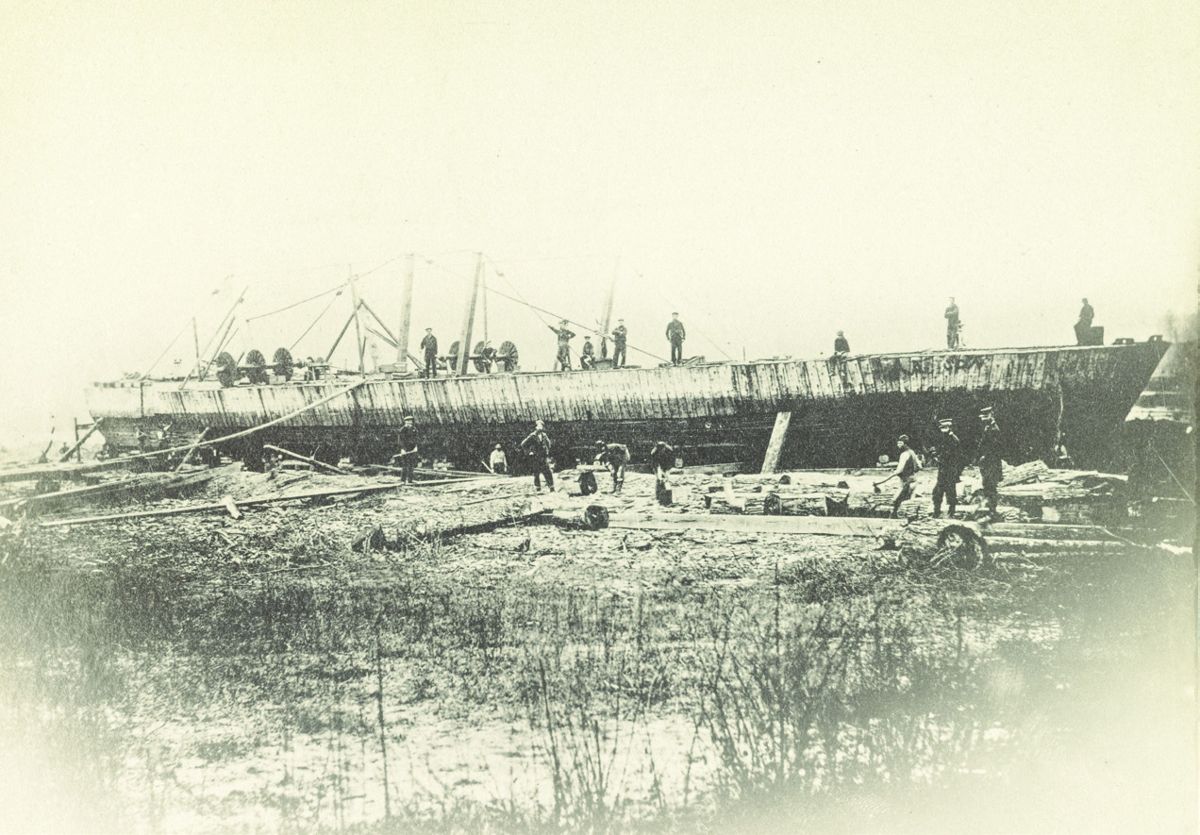
From Steamboat Captain to Gunboat Builder Joseph Brown and his Civil War Ironclads: The USS Chillicothe, Indianola and Tuscumbia. By Myron J. Smith, Jr. Illustrations, maps, notes, bibliography, index, 396 pp., 2017. McFarland, www.mcfarlandpub.com, $39.95 paper. Reviewed by Joan Wenner
This fact-filled and generously illustrated, comprehensive book focuses on a self-starter individual of immigrant parents, Joseph Brown. An early Alton, Ill., steamboating entrepreneur, Brown became a builder of gunboats for Grant’s critical Western river campaigns. This is Myron Smith’s eighth book from McFarland Publishers relating to Civil War naval operations. It offers an in-depth look at the gearing up of the Union inland fleet, how the vessels were built, the assignment of vessel commanders, as well as army and naval rivalries both in the field and in Washington. All the while, Joseph Brown was able to forge ahead despite incredible challenges and setbacks. Other chroniclers have noted that for the Union navy the Civil War had begun in an atmosphere of disorder; it remained to be seen if Gideon Welles could bring order out of chaos. His greatest asset (together with a willingness to assemble a board of experts to advise him) was that he had an established navy and infrastructure to make the attempt. His Southern counterpart, Stephen Mallory, basically had neither. One more thing Welles had going for him was that Congress expanded the navy for the war as part of a general bill, and authorized the appointment of an assistant secretary of war, Gustavus Vasa Fox, Welles’ detail man. As Smith acknowledges, naval vessel historian and exceptional blueprint artist David Meagher has greatly advanced our understanding of the sizes and layout of Brown’s USS Chillicothe, Indianola and huge Tuscumbia ironclads. The book covers thoroughly the rise of Joseph Brown in political and business circles with assistance from his older brother (who had become politically connected). Chapters chart the familiar expeditions of the substantial and growing Union fleet, including conditions encountered by ship and crewmen during their long, hard slogs of service. Rather than describe examples here, readers will be better left to considerable hours of digesting this exemplary book. Joan Wenner, J.D. is a frequent contributor to Civil War News.
(Library of Congress)
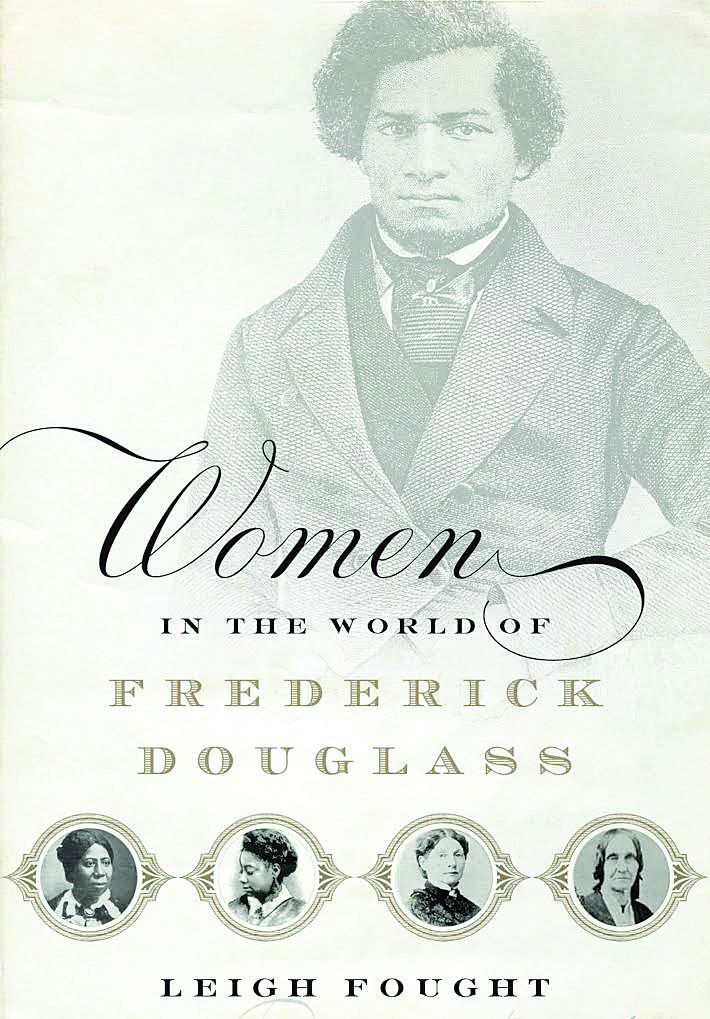
The Women Behind A Great Reformer Detailed history chronicles Women in the World of Frederick Douglass. By Leigh Fought. Appendix, endnotes, index, 401 pp., 2017, Oxford University Press, www.oup.com/ us. $29.95 hardcover. Reviewed by Meg Groeling
Frederick Douglass is known to most as the father of the Civil Rights Movement. His autobiographies, Narrative of the Life of Frederick Douglass, an American Slave (1845), My Bondage and My Freedom (1855), and Life and Times of Frederick Douglass (1881 & 1892), have given a good account of his life, but the focus of those works was Douglass himself, not the elite white women who did so much to help him promote his cause. Author Leigh Fought, Assistant Professor of History at LeMoyne College in Syracuse, N.Y., examines the women associated with Frederick Douglass during his lifetime and, by doing so, brings Douglass himself—a self-proclaimed “women’s rights man”—into clearer focus. The first of these was Sophia Auld, wife of wealthy Baltimorean Hugh Auld, who taught twelve-year old Frederick to read. Although her husband soon interfered with these literacy lessons, Frederick continued to learn from white children in his neighborhood, stating later on in his first autobiography that “knowledge is the pathway from slavery to freedom.” Author Fought continues to introduce readers to Maria Weston Chapman, foreign correspondence secretary to the Boston Female Anti-Slavery Society, whose letter of introduction to Irish abolitionists Richard and Hannah Webb set the stage for Douglass’s two-year sojourn in Europe in 1844-47. Douglass attended the Seneca Falls Convention in 1848, meeting Elizabeth Cady Stanton and speaking in favor of the resolution calling for women’s suffrage. By the time of the Civil War, Douglass was one of the most famous black men in the world, speaking for the rights of both women and people of color in the U.S. and Europe. He was appalled that black men could not be accepted into the Federal Army immediately, although two of his sons would soon join the 54th Massachusetts USCT, and a third son served as a recruiter. Fought examines Douglass’s relationship with two women in particular: Julia Griffiths and Ottilie Assing. These elite white women were friends of Douglass, helping him with his newspaper publishing and other writing. It has been suggested by some that Douglass may have been intimate with either or both of these women, but Fought also clearly delineates his relationship with Anna, his wife of forty-four years, as one in which Douglass, although he was absent for years at a time, was completely faithful. From this reader’s point of view, however, staying “overnight” at someone’s house for years is intrusive, to say the least. Apparently it was the norm in the 1800s. Anna’s objections are understandable. She remained a loyal supporter of her husband’s work, even though Douglass’s relationships with both women caused recurring speculation and scandal. They had five children: Rosetta, Lewis Henry, Frederick Douglass, Jr., Charles Remond, and Annie Douglass, who died at the age of ten. After two years of mourning Anna’s death in 1882, Douglass married Helen Pitts, a white feminist from New York. The reaction to his choice was contentious on both sides. Pitts’s family stopped speaking to her, and his children considered the marriage a repudiation of their mother. Douglass responded to the criticisms by saying that his first marriage had been to someone the color of his mother, and his second to someone the color of his father. Douglass and his new wife traveled extensively in Europe, lending their voices to such causes as Irish Home Rule. On February 20, 1895, Douglass attended a meeting of the National Council of Women in Washington, D.C. During that meeting, he was brought to the platform and received a standing ovation. Shortly after he returned home, Frederick Douglass died of a massive heart attack or stroke. He was seventy-seven. Helen dedicated the rest of her life to maintaining and planning for Cedar Hill, the Anacostia home of Douglass near Washington, D.C., to become a monument to her husband, preserving his papers and his legacy. In Women in the World of Frederick Douglass, author Leigh Fought looks carefully at the female figures in Frederick Douglass’s life. As she brings these women into clearer focus, so does she point her lens on Douglass, and his lifetime. The rights of all people, male and female, black and white, changed dramatically from the 1840s to the end of the 19th century. Much of that change can be attributed to the efforts of Frederick Douglass and to the support of the educated, upper class, white women who shared his values. For anyone interested in women’s history, this book—well-researched and well-written—is a compelling read. Meg Groeling, [email protected], is a contributor for the blog Emerging Civil War, author of The Aftermath of Battle: The Burial of the Civil War Dead, and is currently working on First Fallen: The Life & Times of Colonel Elmer Ellsworth.
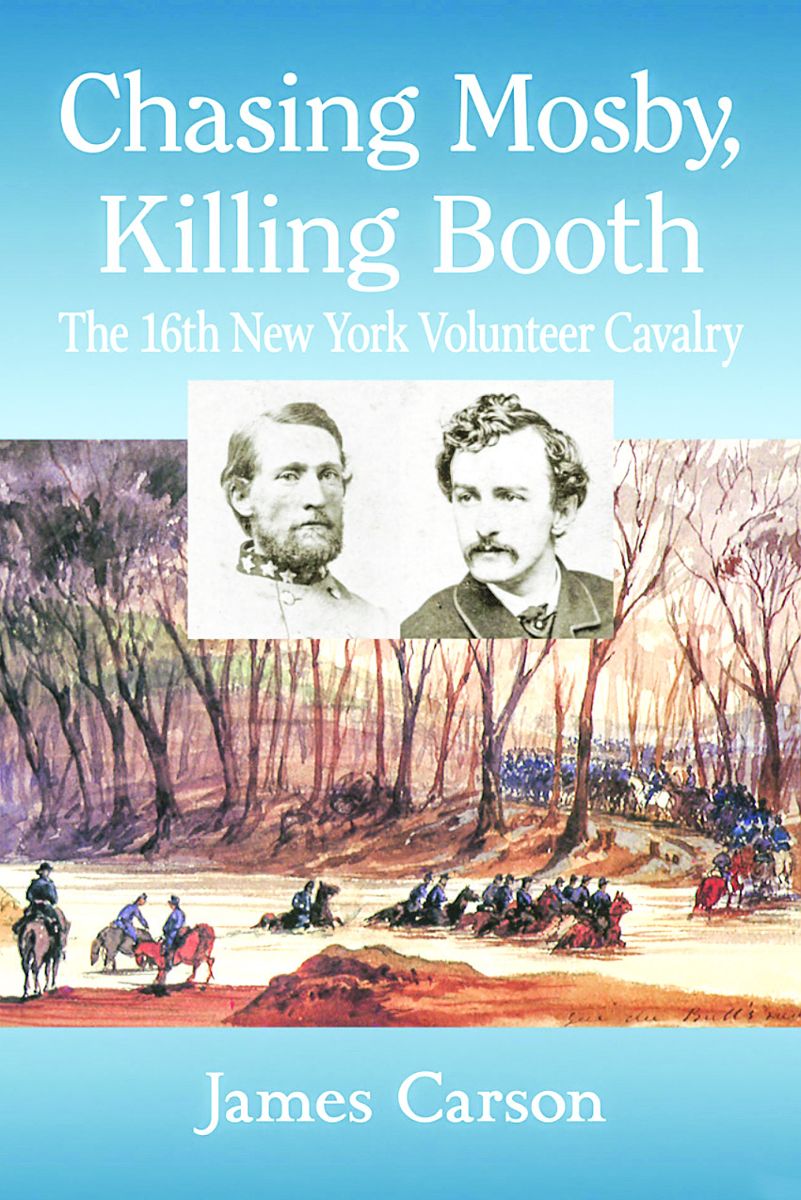
CivilWarNews.com experiences of 16th New York Cavalry Chasing Mosby, Killing Booth: The 16th New York Volunteer Cavalry. By James Carson. Maps, photos, notes, index, 264 pp., 2017. McFarland, www.mcfarlandpub.com, $35 softcover. Reviewed by David Kindy
With bugles blaring “Boots and Saddles,” the 16th New York Volunteer Cavalry rode off into history during the Civil War, dueling with Mosby’s Rangers and tracking down John Wilkes Booth. A new book carefully chronicles the saga of this famous regiment during its deployment to Virginia and the defenses surrounding Washington, D.C. from 1863 to 1865. James Carson has written a thorough history of the unit in Chasing Mosby, Killing Booth: The 16th New York Volunteer Cavalry. Assiduously researched and packed with detail, the book provides an insightful look into the daily lives of the cavalrymen who answered the call to duty during this national crisis. The 16th New York played a vital role in the Civil War, protecting the nation’s capital from Confederate attacks while allowing other units to engage the enemy deep in its own territory. Mostly, the regiment engaged Mosby’s 43rd Battalion of Virginia Cavalry as it attacked and disrupted Union activities in and around the perimeter defenses of Washington. Carson is a retired CIA and Army officer living in Vienna, Va., home base for the 16th New York during most of its service near the capital. He includes significant descriptions of the local terrain, battle sites and former fortifications to bring an honest accounting of the scope of warfare faced by the Empire State regiment. The author delves deep into personal diaries and correspondence to provide a critical understanding of the unit’s actions and the ordinary lives of soldiers. He details many of the people who played important roles in the regiment’s history and gives perspective to the mostly mundane daily existence of the average cavalryman. The 16th New York usually bore the brunt of Mosby’s wrath, often coming out on the losing end of engagements. Poor leadership, due to political appointees and their lack of formal military training, hampered the unit time and time again. Still, it distinguished itself by bending and not breaking as it withstood the suffocating fog of guerrilla warfare. Eventually, the regiment resorted to tactics that would become more familiar during the Vietnam War. Search-and-destroy missions, based on local intelligence, became standard operations for the 16th New York as it attempted to counter the hit-and-run attacks of Mosby’s Rangers. Cavalrymen would covertly slip into the countryside and try to stop their adversaries before they could get started. The regiment became famous for the capture of Abraham Lincoln’s assassin. While a black pall enveloped the country in April 1865, the New Yorkers located Booth at Garrett’s Farm in Virginia and killed him when he refused to surrender. While participating cavalrymen were honored with financial and laudatory awards, the author points out that there likely would have been courts-martial for failure to follow orders if not for the high visibility of the crime and the vengeance demanded by a grieving nation. In the end, Carson offers a pliable defense for the 16th New York, claiming that it gave as well as it got during its engagements with the enemy. Even though the regiment often came out on the losing end, it inflicted heavy casualties on Mosby’s Rangers and prevented the Rebels from penetrating deeply into Washington. Despite its limitations, the 16th New York Volunteer Cavalry distinguished itself during a tumultuous time. James Carson brings honor to this illustrious regiment with an honest assessment of its courageous actions under fire. David Kindy of Plymouth, Mass., is a lifelong student of history, and researcher of Civil War veterans from his hometown area.
First Biography of War Secretary Cameron in Fifty Years Amiable Scoundrel: Simon Cameron, Lincoln’s Scandalous Secretary of War. By Paul Kahan. Illustrations, notes, bibliography, index, 367 pp., 2016, Potomac Books, www.potomacbooksinc.com. $36.95 hardcover. Reviewed by Sean A. Scott
In November 1861 über-patriotic Vermonter Leonard Haskins, surely to his wife’s chagrin, named his triplet sons after Abraham Lincoln, Gideon Welles, and Simon Cameron. Although christening children after politicians was more common in the nineteenth century than today, it still seems strange that a father would saddle his son with a name as associated with political corruption as Cameron’s. That Haskins did so at the suggestion of Cameron himself speaks volumes about the war secretary’s ego and self-assurance that his record would stand the test of time. Indeed, Paul Kahan’s semi-revisionist biography showcases Cameron’s mastery of party machinery that made him a potent force in Pennsylvania politics for fifty years. Most students of the Civil War likely think of Cameron as an incompetent secretary of war who lined his own pockets by doling out contracts to political cronies, until a groundswell of complaints convinced Lincoln to dismiss him from the cabinet. On the one hand, Kahan acknowledges Cameron’s ineffectiveness, describing him as “temperamentally unsuited” for the job and “overwhelmed and out of his depth.” However, the author cuts him slack by pointing out the difficulties he faced—a peacetime army partly equipped with obsolete weapons and entirely unprepared for war; an inadequate staff unable to keep up with the pace of mobilization; the president’s initial failure to manage competing personalities and issue direct orders; and the nearly impossible task of satisfying numerous demands from state governors and countless requests from self-important appointment seekers. Yet on the other hand, Kahan asserts that no evidence of corruption or unethical financial dealings blackens Cameron’s record as secretary, an assessment already put forward by several historians. Instead, his reputation for crooked dealings, which he acquired in the late 1830s after President Martin Van Buren appointed him as commissioner to settle Winnebago land disputes, dogged him for the rest of his career. Kahan points out that other Republican politicians and generals showed poor judgment by making “shady” contracts or followed the accepted practice of using patronage to reward supporters, and they received significantly less censure than Cameron. Like many other career politicians who came of age during the second party system, he switched affiliations, first leaving his Democratic roots to court nativist support, and finally settling with the Republicans. In the process he had accumulated a throng of rivals eager to topple him with allegations of financial impropriety. Kahan parts from the standard interpretation by positing that Cameron’s antislavery opinions, rather than rumors of corruption, ultimately resulted in his removal from the cabinet. During the summer of 1861 he privately made clear his preference to arm African Americans, and that August he supported General John Fremont’s failed attempt to confiscate slaves in Missouri. In November he endorsed speeches of a New York colonel in favor of black troops, and in his annual report later that month he argued for employing slaves as soldiers. Some fellow cabinet members and most historians have questioned his motives, instead seeing his antislavery stance as political opportunism aimed at ingratiating himself with abolitionists and radical congressmen. In 1878 Cameron claimed to have espoused these opinions “sincerely” and asserted that their being “a trifle too advanced for the time” led to his dismissal. However, this reasoning falls short, since neither Gideon Welles nor Salmon Chase were canned for advocating the same position—demonstrating that the combination of alleged improper dealings, even if untrue, and his conspicuous ineffectiveness necessitated replacing him. Kahan has produced a well-written account that highlights how mid-nineteenth century political culture shaped Cameron and how he adeptly used the system to gain political prominence. Although far from a Cameron apologist, the author sometimes credits him overmuch, in one instance claiming that the war secretary “both laid the groundwork for later military success and pushed the administration to make the destruction of slavery a war aim.” Nevertheless, the volume deserves a reading alongside other recent and more publicized biographies of Lincoln’s cabinet members. A specialist in religion during the Civil War era, Sean A. Scott teaches survey courses in Western Civilization and U.S. History, as well as electives on the Civil War era and the life of Abraham Lincoln at the Indiana Academy in Muncie.
The Civil War is without a doubt the most studied event in American history. Ironically, the immediate aftermath, the period of Reconstruction, is one of the least understood. The battle of how America remembers the war and its immediate consequences still rages in the public square. Controversies exist over the use of the Confederate flag, the naming of public facilities after proponents of slavery, or the commemoration of former Rebels in city parks.
Overturning “Traditional” Reconstruction History Remembering Reconstruction: Struggles Over the Meaning of America’s Most Turbulent Era. Edited by Carole Emberton and Bruce E. Baker. Notes, index. 296 pp., 2017, LSU Press, lsupress.org, $45 hardcover. Reviewed by David A. Galli
Carole Emberton and Bruce Baker have edited a very nice collection of essays attempting to make sense of the polarizing time following the Civil War. Their focus is how the era is remembered, and how Reconstruction continues to influence America to the present day. The essays are not a litany of events and a repetition of political happenings. Remembering Reconstruction focuses on how the era was understood by the key players: white supremacists trying to claw back to their antebellum status following the devastation of the war, freed exslaves bravely trying to claim their rights, and how the memory of Reconstruction would influence the way Americans viewed their government and the South. The so-called “traditional” telling of the Reconstruction story is the white supremacist view. This view holds that Reconstruction was a disaster, created by arrogant Northerners of the Radical Republican stripe, their “carpetbagger” allies who came to corrupt and profiteer off a vanquished South, and their uneducated African-American lackeys. This crude thinking further stated that only the white elites had the special knowledge and experience to keep unruly blacks in their proper place. Never mind, of course, that this was the same elite planter class which put the South into the horrible position it found itself as losers of a destructive total war. This narrative was reinforced in Southern literature and film, notoriously by the movie Birth of a Nation, whose premise was that the horror of black rule and integration of the South could only be countered by the alleged heroism and violence of the Ku Klux Klan. Beyond the media of popular culture, the white supremacist view of Reconstruction also took on a scholarly gloss of acceptance through the “Dunning school” of historians from Columbia University. An essay by Natalie Ring, of the University of Texas-Dallas, demonstrates how insidious this largely unknown group of academics could be, as many of Professor William Dunning’s students would become the thought leaders of 20th century Reconstruction memory, and influence textbook and school curricula for years to come. The rebuttal to this unfortunate yet entrenched orthodoxy would come from several black voices. Some would be tentative in their criticism of the white supremacist recapture of the postwar South. A fascinating essay by Professor Emberton, who teaches at SUNY-Buffalo, focuses on the corruption of memory itself, especially of former slaves. She cites the Federal Writers Project ex-slave narratives, and how even into the 1900s, learned approaches to dealing with white violence was a core part of the Southern black existence. A system built on abuse, rape and family separations left many former slaves hesitant to fully share with interviewers even decades later their experiences during slavery and Reconstruction, never certain they would be safe in speaking against the prevailing white-dominated leadership if expressing their true feelings. The “revisionist view” of Reconstruction would be told in scholarly form by notable African-American writers W.E.B Dubois, Carter Woodson and later John Hope Franklin. To summarize the frustration in presenting the black experience of the era, Dubois said: “The chief witness in Reconstruction, the emancipated slave himself, has been largely barred from the court.” Other courageous resistance against the dominant school of thought would come from journalists such as T. Thomas Fortune and the personal recollections of Mississippi Congressman and former slave John R. Lynch. Perhaps the most interesting essay in the collection is on a subject that occurred 50 years after the Civil War. Samuel Shaffer, a teacher and writer, focuses on the impact of Reconstruction memory on one of the most controversial events of the 20th century: the ending of World War I and the writing of the Versailles Treaty. President Woodrow Wilson was a Virginian by birth, and spent his youth in Georgia and South Carolina, imbibing the view that Reconstruction’s goal was “not the rehabilitation of southern governments,” but “bent upon bringing the South
1872 Harper’s Weekly cartoon depiction of Carl Schurz as a carpetbagger. to utter humiliation.” Former slaves, Wilson felt, were “unfit to exercise their new liberty.” Wilson would tell French Prime Minister Georges Clemenceau, “I was born in a conquered and devastated country.” Wilson was lauded for his stance in demanding self-determination, but as Shaffer points out, selfdetermination would not be for “less developed peoples read: darker skinned ones,” as Wilson took a condescending view of non-European, non-whites worldwide, people he viewed as less intelligent or mature enough to govern themselves. These nations, many in the modern Middle East and Africa, still suffer from having no say in the creation of their borders and the humiliation of requiring “tutelage” from their allegedly more enlightened European overseers. Emberton and Baker have done a very nice job of collecting a variety of essays explaining how the memories of Reconstruction have cemented themselves into the American consciousness and how this memory is more than just a trivial academic discussion. David Galli is a physician practicing in St. Louis, and a longtime book reviewer for Civil War News.
Just Another Eccentric American An Insider’s Look at SouthThe Extraordinary Life of Charles Pomeroy Stone: Soldier, Surveyor, Pasha, Engineer. By Blaine Lamb. Photos, notes, bibliography, index, 276 pp., 2017, Westholme Publishing, www.westholmepublishing.com, $29.95 hardcover. Reviewed by Meg Groeling
One of the best things about studying the American Civil War is finding those participants who are intriguing individuals in their own right. Brig. Gen. Charles Pomeroy Stone is just such a person. Author Blaine Lamb, former archivist and Chief of the Archeology, History, and Museums Division of California State Parks, brings Stone’s unique story to readers in this enjoyable book. Unfortunately, Civil War aficionados best remember General Stone as the luckless commander at Ball’s Bluff who was chosen to take the fall for the well-meaning but inept work of Col. Edward D. Baker, sitting U.S. senator from Oregon and best friend of President Lincoln. The infamous Joint Committee on the Conduct of the War arrested Stone and sent him to Fort Lafayette for seven weeks. Stone was denied a trial and evidence against him was withheld. Finally, Stone’s lawyer, James McDougall, was able to get Stone released because “a court could not be convened within the time prescribed by law.” Stone never again held a significant command position in the U.S. Army and, on Sept. 13, 1864, he resigned his commission. Stone’s story does not end there, however. With a West Point education in engineering, he worked in Virginia until 1869, when now-Commanding General William T. Sherman recommended him for service in the Egyptian Army. From 1870 to 1883 he served as Chief of Staff and general aide-de-camp for Khedive Ismail Pasha of Egypt. While there he was given the rank of lieutenant general and the title of “Pasha,” which is the Egyptian equivalent of a knighthood. Stone served the Khedive faithfully, implementing a general staff, expanding Egypt’s boundaries, and establishing schools for the education of Egypt’s soldiers and their children. He remained in the service of Khedive Ismail (and Ismail’s successor, son Tewfik) for 13 years. When the British bombarded Alexandria and self-styled rebel leader Urabi led the revolt of the Egyptian army, Stone stayed with Tewfik in Alexandria, even while his wife and daughters were trapped in Cairo. Author Lamb’s attention to detail and almost hard-boiled style make Stone’s adventures in Egypt one of the most interesting and exciting parts of this biography. One waits anxiously for “Stone Pasha” to be safely reunited with his family, and relief is palpable when it finally occurs. A side detail of Stone’s sojourn in the Egyptian Army was his reception of former president/ general Ulysses S. Grant. Grant and his family visited Egypt in January 1878 during their twoyear world tour, and the Khedive was very concerned that honor be shown to this American hero. Stone, whose now-completely white hair surprised Grant, met his former commander in Cairo. He hosted a dinner party in Cairo for the Grants, and glasses were raised in the former president’s honor. When the Grants returned a year later on their way to India, Stone escorted them to Suez. In February 1883 the “last American pasha” returned to America.
Loyal Legion of the Confederacy
Although Stone was now at least a B-List celebrity, he still needed to support his family. Sherman and Grant again came to the rescue. They recommended Stone and his engineering expertise to the American Committee of the Franco-American Union, which was looking for someone to manage construction of the foundation and pedestal on Bedloe’s Island that would eventually hold the Statue of Liberty. This was Charles Pomeroy Stone’s last contribution to the national good. Three years and many squabbles later, on Oct. 28, 1886, a dedication ceremony was held. The streets of New York were covered with the remnants of the first ticker tape parade, and the harbor around renamed Liberty Island was filled with boats. Former General Stone was the Grand Marshal of the event, and President Grover Cleveland headed the procession from Madison Square to Battery Park. The weather was rainy and cold, and the fireworks display had to be postponed. Stone maintained his office after the celebrations to be sure that everything continued to go well, but one evening in January 1887 he fell ill. He came home that night with a cold, and was dead within a week, at age sixty-two. To have packed that much adventure and excitement into so short a life is amazing, but Victorian men and women seemed to do that all the time. Author Blaine Lamb brings Stone’s story to life in a way that makes the reader care about what happened to the general. From Civil War scapegoat to engineer in charge of mounting the Statue of Liberty, Charles Pomeroy Stone indeed lived an “extraordinary” life. Meg Groeling, of Hollister, Cal., is author of The Aftermath of Battle: The Burial of the Civil War Dead, published in 2015 by Savas Beatie.
west Missouri’s Guerrilla War Bloody Engagements: John R. Kelso’s Civil War. Edited by Christopher Grasso. Maps, photos, notes, index, 264 pp., Yale University Press, www.yalebooks.com, $35.00 cloth. Reviewed by Jeff Patrick
John Russell Kelso was a complicated man. A self-disciplined and highly intelligent schoolteacher from a small town in Missouri, Kelso was said to have always carried a book in his saddlebags. When he left his students and became a soldier in 1861, however, he proved ruthlessly efficient in battling conventional Confederate forces, guerrillas and Southern sympathizers, becoming a hero to Missouri’s Unionists and a monster to his enemies. An Ohio native, Kelso moved to Missouri in 1840. By the spring of 1861 he had established a successful school in the southwestern Missouri town of Buffalo (Dallas County). When the Civil War began, he became an outspoken supporter of the Union cause, helped organize the Dallas County Home Guard Regiment, and was elected the unit’s major. The ambitious Kelso now entered the war “with all the energy of my restless nature.” When the Home Guard regiment dissolved, Kelso enlisted as a private in the 24th Missouri Infantry, but also served as a spy in southwest Missouri in the fall of 1861. That winter, when his home was burned by the secessionists, Kelso was transformed from a soldier motivated by “pure patriotism alone” to one who was driven by the “less noble” desire of revenge. In fact, revenge became an “all-absorbing passion which nothing but blood could ever appease.” Kelso’s services and sacrifices for the Union cause were rewarded the following spring, when he was elected an officer in the 14th Missouri State Militia Cavalry Regiment. After surviving a number of skirmishes and the successful Union defense of Springfield, Mo., Kelso was elected to the U.S. Congress in 1864 as a Radical Republican. About ten years before his death in early 1891, Kelso penned an extensive “auto-biography” that now resides in California’s Huntington Library. Regrettably, Kelso’s surviving memoirs end in early 1863. Although a number of historians in southwest Missouri were familiar with Kelso’s manuscript and recognized its historical significance, none were willing to tackle the complex job of transcribing and annotating the work. Fortunately for students of the war in the Trans-Mississippi theater, College of William and Mary history professor Christopher Grasso accepted the challenge. Kelso’s detailed and colorful memoirs make for interesting reading. Many of his spying forays and military expeditions against his Confederate foes are recounted in vivid detail, illuminating the personal nature of combat in Missouri and the mindset of a confident junior officer bent on using all his talents to defend the Union. On one occasion in the fall of 1862, for instance, Kelso served as second-in-command of a 60-man force that rode into Arkansas to attack four houses containing the “Medlock band,” “a large band of rebel thieves and cut-throats.” Kelso moved against one house alone, “feeling a kind of strange, wild delight in the very madness of my undertaking.” Kelso managed to rout or kill all the inhabitants of the dwelling. Not all his expeditions were easy victories, however. A few months later, Kelso and his troopers captured and destroyed a Confederate saltpeter works, but narrowly avoided being destroyed by a large force of pursuing Confederates. Extensive reminiscences by Missouri officers like Kelso who participated in both conventional battles and guerrilla warfare (“aspects of the conflict that tore apart Missouri,” as Grasso writes) are quite scarce. Kelso’s valuable “auto-biography” helps us understand, at least in part, how Union forces dealt with the guerrilla threat in Missouri. Grasso’s superbly edited volume also allows readers a glimpse into how and why a rural school teacher became a determined and often ruthless warrior. Jeff Patrick is the librarian at Wilson’s Creek National Battlefield. He is currently working on a study of the 2nd Kansas Colored Infantry.
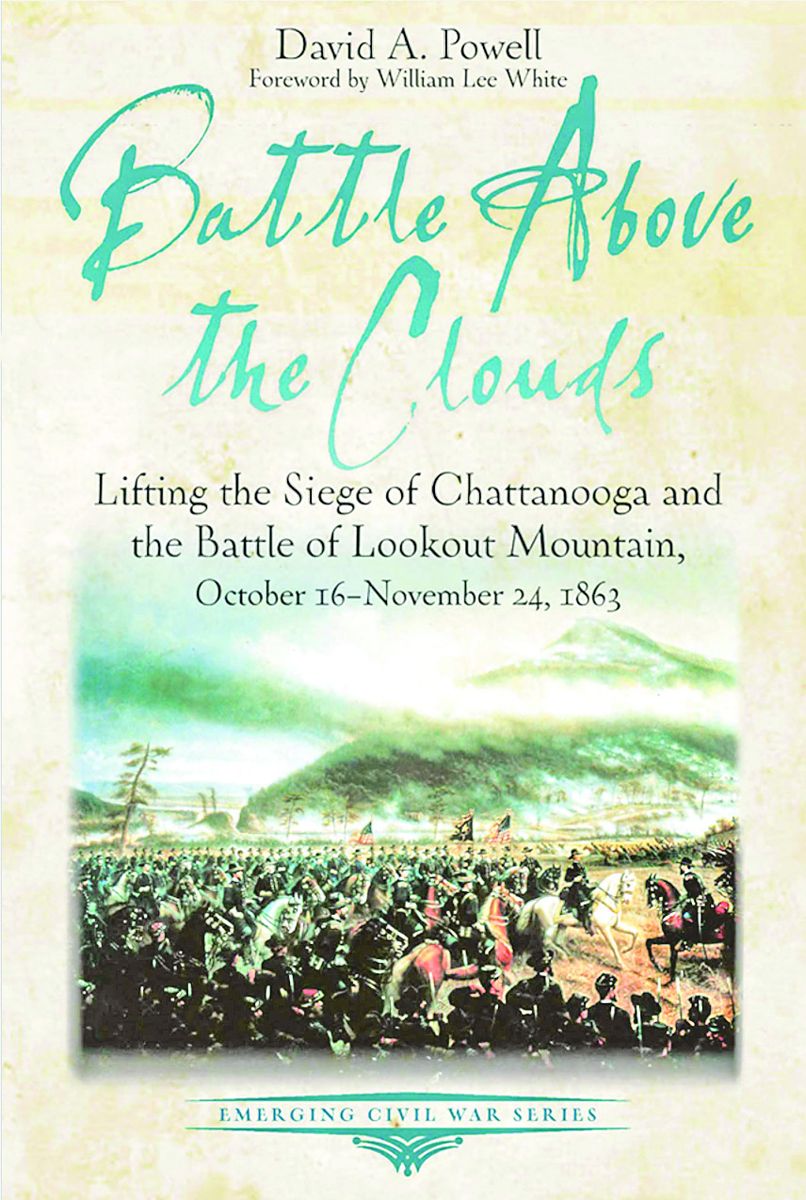
New Look at Battle of Lookout Mountain Battle Above the Clouds: Lifting the Siege of Chattanooga and the Battle of Lookout Mountain, October 16 – November 24, 1863. By David A. Powell. Illustrations, maps, 192 pp, 2017, Savas Beatie LLC, www.savasbeatie.com. $14.95 paperback. Reviewed Peterson by
Lawrence
K.
Another addition to the Emerging Civil War Series by Savas Beatie, well-known Battle of Chickamauga author David Powell addresses the “Battle Above the Clouds,” as it was titled by many witnesses to it. Powell’s extensive knowledge of these battles and familiarity with the area allow him to provide a quite reasonable review of the events and characters involved. As I understand this series, it is aimed to provide the reader with an easily readable, but not too in-depth or detailed version of this battle. For those intrigued by Powell’s overview, additional, more detailed books may be consulted. The author provides many interesting pictures as well as several very helpful maps to keep the reader orientated. The reader is not encumbered with either notes or index, which, for some, will be missed. While I found the story line very satisfactory, what I found most interesting were the appendices. Appendix A, “Myth of the Cracker Line” by Frank Varney, describes in some detail Maj. Gen. William S. Rosecrans’ participation in events after the Battle of Chickamauga in and around Chattanooga. One of apparently many “facts” that we have been given to believe is that after the Battle of Chickamauga, Rosecrans sat around, doing virtually nothing to redevelop his required supply line while his men and animals starved. It took Maj. Gen. Ulysses S. Grant to be appointed to command and arrive on scene before any real action took place. Varney dispels this whole notion, pointing out that its origins come from Grant himself! This will change the minds of many readers as to their view of Rosecrans’ effectiveness after his loss at Chickamauga. Appendix B, “A Tale of Two Paintings,” provides some detail on two of the paintings inspired by this battle, including James Walker’s now seen at the National Park Service’s Visitor Center at Lookout Mountain. Appendix C, “Civil War Tourism: Lookout Mountain,” explains that Union soldiers were just like any tourists desiring to visit where the action above the clouds took place. This is another excellent addition to the Emerging Civil War Series and will be a helpful quick reference source for anyone interested in this battle. Powell’s writing makes the historic events easily readable and understood.
Lawrence K. Peterson is the author of Confederate Combat Commander: The Remarkable Life of Brigadier General Alfred Jefferson Vaughan Jr. (University of Tennessee Press, 2013). He is president of the Rocky Mountain Civil War Round Table. His next book, Decisions at Chattanooga: The Nineteen Decisions that Defined the Battle, the fourth book of the University of Tennessee Press’ Command Decisions in America’s Civil War series, is scheduled to be published in 2018.
Preserving the military history of the Western Hemisphere since 1949. Membership includes a scholarly quarterly magazine with an annual twelveprint uniform series.
They Want: The Atlanta Campaign from Peachtree Creek to the City’s Surrender, July 18-September 2, 1864, (2017), continues the story begun in his A Long and Bloody Task: The Atlanta Campaign from Dalton through Kennesaw Mountain to the Chattahoochee River, May 5-July 18, 1864. (2016). As he did with the prequel by introducing us to the early-war failures of Johnston at Seven Pines and Vicksburg, Davis begins this piece with Hood’s early-war successes and reminds us of how Hood first came onto the stage as a prominent battle hero at Gaines’s Mill. Serving under Lee and Jackson, John Bell Hood distinguished himself as a bold, aggressive leader in combat, becoming the embodiment of what he would later describe as the “Lee-Jackson School” of war or tactic for offensive operations which Confederate President Jefferson Davis favored over Johnston’s Fabian (defensive) Policy. Rising to the rank of lieutenant general following his successes at Gettysburg and Chickamauga by the age of 32, the impetuous
After a sluggish stretch, biography is once again the stock in trade of American Civil War historians. In the last two years, we’ve been treated to major new accounts of the lives of William Tecumseh Sherman (by James Lee McDonough), Montgomery C. Meigs (by Robert O’Harrow), Edwin McMasters Stanton
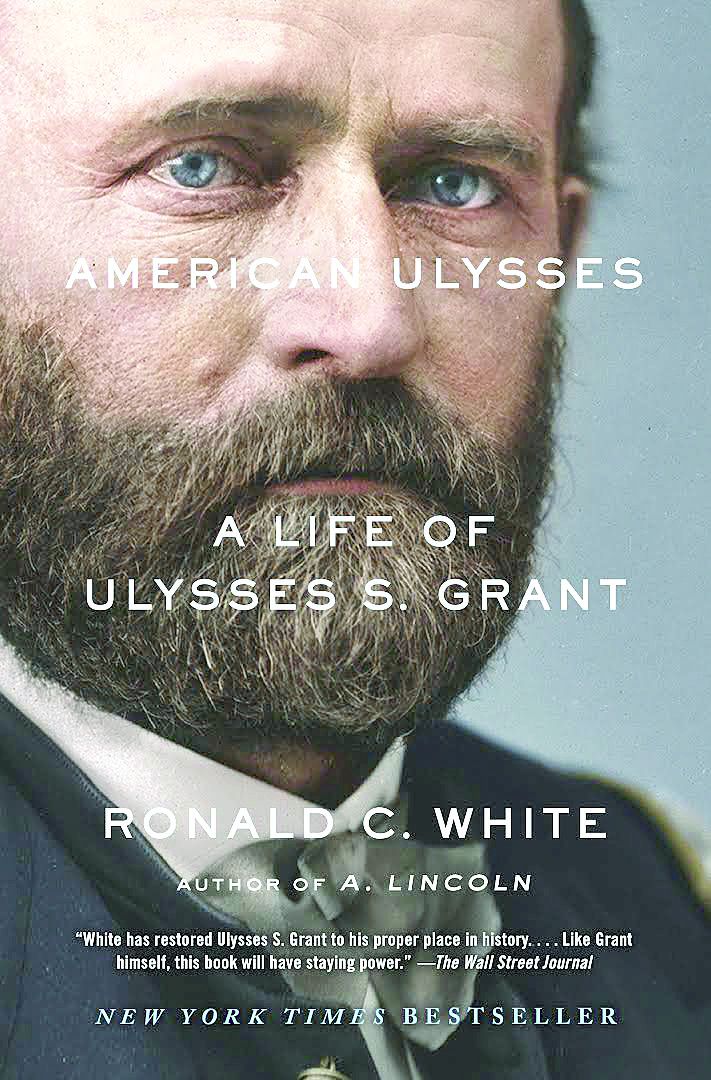
Bringing General Grant to a Popular Audience American Ulysses: A Life of Ulysses S. Grant by Ronald C. White. Illustrations, maps, index, 826 pp., 2016, Random House, www.randomhousebooks.com, $35 cloth. Reviewed by Brian Matthew Jordan
(by William Marvel), Julia Ward Howe (by Elaine Showalter), Braxton Bragg (from the prolific pen of Earl J. Hess), George Armstrong Custer (by Pulitzer Prize-winning author T.J. Stiles), and “Stonewall” Jackson (by S.C. Gwynne). Nor, it seems, will this renewed industriousness fade anytime soon, with new treatments of Robert E. Lee (by Allen C. Guelzo), Benjamin Butler (by Elizabeth Leonard), George G. Meade (by Christopher Stowe), and Frederick Douglass (by David Blight) on the way. Even the period’s lesser known figures are at long last getting their due treatment, as evidenced by Elizabeth R. Varon’s forthcoming work on the African-American veteran and historian Joseph T. Wilson, and James Marten’s upcoming book on “Oliver Optic,” who penned popular tales of the war for children in the late nineteenth century. What does this biographical bumper crop mean within the larger scheme of Civil War historiography? For one, it may suggest a growing unease with sweeping interpretations and works of synthesis. The productivity of social and cultural historians of the Civil War era over the last two decades has made the task of synthesis not impossible, but much more labor intensive. In their focus on the human and emotional experience of war, these scholars have demonstrated the obvious but too easily effaced reality that individuals experienced the war in unique ways. Working in smaller, micro-historical spaces and along what historian Stephen Berry has called the war’s “ragged edges” has opened our eyes to a much broader range of wartime experiences. Biography, while no doubt obliged to draw conclusions about its subject’s culture and society in the service of a larger argument, is nonetheless principally interested in how one individual saw, felt, and made sense of the past. The best biographies resist both the myopia of the monographic case study and the mirage of big box generalization; with some combination of original research and keen analysis, they tell us something new about a person and his or her times. Ronald C. White’s American Ulysses arrives amid this biographical turn, notching yet another victory in the larger struggle—waged by Joan Waugh, Brooks Simpson and other talented writers—to rehabilitate Grant’s long-tarnished historical reputation. The real Grant, White contends, “has slipped from our American memory.” His book’s principal service to the Civil War community is its ability to translate decades of Grant revisionism for a popular audience in clear and convincing prose. To be sure, this is not a book intended for scholars or even Civil
War buffs, but instead one aimed at readers with a general interest in military history, the presidency, or mid-nineteenth century America. From the pen of an important Lincoln scholar (White’s The Eloquent President and Lincoln’s Second Inaugural both belong on the short shelf of “indispensible” volumes written about the sixteenth president), this tome is a competently drawn portrait of the cigar-chomping Union general who won at Shiloh, captured Vicksburg, and then wrestled Robert E. Lee to Appomattox. It is prolifically illustrated with a number of period sources and stunning battlefield maps. White’s Ulysses S. Grant is “an exceptional person and leader” who “combined modesty and magnanimity.” “He could be decisive yet understated, strong but gentle,” the author writes. Building on his own scholarly training and previous work, White attempts “to understand Grant from the inside out,” considering in turn the “breadth” of Grant’s book habit, his “religious odyssey,” his marriage to Julia Dent, and his remarkable faculties as a writer. Overall, the Grant who emerges in these nearly nine hundred pages is much more intellectual—and much more committed to maintaining the fruits of the Union victory he choreographed—than the bumbling, half-witted drunkard of popular memory. While the war years retain a mostly familiar outline, White calls in Grant’s presidentialand post-presidential years for significant revisions. “Grant as president,” he summarizes, “defended the political rights of African Americans, battled against the Ku Klux Klan and voter suppression, reimagined Indian policy, rethought the role of the federal government in a changing America, and foresaw that as the United States would now assume a larger place in world affairs, a durable peace with Great Britain would provide the nation with a major ally.” White further contends that previous biographers have unfairly “criticized” Grant “for spending lavishly and lacking an appreciation of the history and culture of the countries he visited” during his “world tour.” Grant’s globetrotting, the author concludes, was a significant boon for the image of the reunited nation—and her people—abroad. American Ulysses is stained by several admittedly minor errors of fact. Abraham Lincoln delivered the “House Divided” speech at the outset of his celebrated senatorial campaign of 1858, not in 1856. In the summer of 1864, Maj. Gen. Benjamin F. Butler was a former state senator, but not a “former Massachusetts congressman.” And a black and white photograph of Grant’s boyhood home reproduced in the book appears to be an image of the schoolhouse that the future president attended in Georgetown, Ohio. White’s narrative style suits his intended audience well, but sometimes at the expense of deeper analysis. Take, for example, the conclusion to the chapter that wrestles with Shiloh. The battle, White declares, “revealed to both North and South that this civil war was now total war”—a sweeping statement that begs for a more careful and critical examination. And the author is curiously silent on the “flag of truce” episode following the devastating battle at Cold Harbor, one of the most controversial and myth-generating affairs of Grant’s military career. Yet on balance, the Civil War community is in Ronald C. White’s debt for this most laudable effort to repair the blemished reputation of the eighteenth president. Among popular audiences, the author’s “hope…that readers will discover a fresh meaning of Grant” may well be realized. Brian Matthew Jordan, who teaches Civil War history at Sam Houston State University in Texas, is the author of Marching Home: Union Veterans and Their Unending Civil War (Liveright, 2015).
Revisionist Substitute for a Venerable Standard Patriots, Leaders and Reconstruction in Alabama: white and black radicals of Re- almost 250 detailed, exhaustive Soldiers Who Did their Duty From Civil War to Redemption construction and demonizes the pages to Alabama in war and prein the Cotton South. By Michael W. Fitzgerald. Maps, photos, notes, index, 451 pp., 2017, Louisiana State University Press, lsupress.org. $49.95 hardcover. Reviewed by William H. Bragg
With this book, Michael W. Fitzgerald seeks to supplant Civil War and Reconstruction in Alabama (1905) by Walter Lynwood Fleming (1874-1932), whose Dunning School history remains the “standard account” of its subject. Fitzgerald wishes to do this because Fleming’s book “shares the racial presuppositions of the Jim Crow era,” a well-founded criticism. In particular, Fitzgerald wishes to view Alabama Reconstruction “with contemporary eyes and different assumptions.” In this aim he succeeds, for Fleming’s racial views are those of another time and place. But, as will be shown, Fleming’s book, for the most part, continues to remain the standard work on Alabama Reconstruction, since it covers a multiplicity of subjects, unrelated to race, that are untreated by Fitzgerald. Fitzgerald’s book follows the “scholarly model” of Eric Foner (b. 1943), award-laden history professor at Columbia University—and a man of the left. Foner, who has occupied the summit of Reconstruction historiography since the 1980s, valorizes the period’s white conservatives, a point-by-point ideological reversal of the Dunning School histories. The original Dunning School studies were prepared by Southern scholars in the graduate seminar of William A. Dunning (1857-1922), like Foner a Columbia history professor and likewise the principal Reconstruction historian of his time—but a man of the right. Dunning’s students published (ca. 1900-1915) well-received books on Reconstruction in their native states, and their interpretation was followed for many decades by many other Reconstruction historians. Fitzgerald’s target, Walter Lynwood Fleming, arguably ranks highest among Dunning’s Reconstruction scholars. On his general subject, Fleming was incredibly prolific, and among the state studies, his Alabama book excels all other Dunning School works in conception, depth of research, and width of coverage. Consequently, in seeking to replace Fleming’s 800-page opus with around four hundred pages of his own, Fitzgerald sets himself a monumental task. A cursory glance at Fitzgerald’s book promises much. The back matter appears complete, even lavish, especially the up-to-date bibliography, where Fleming’s voluminous footnotes served as his source list. In particular, Fitzgerald’s twelve chapter titles and epigraphs are quite polished, sometimes inspired. But Fleming’s twenty-four workmanlike, descriptive chapter titles, further subdivided into almost three hundred subtopics in the table of contents, immediately place his entire book at the reader’s command. As to the content of the two books, readers interested in antebellum and Civil War Alabama will find Fitzgerald’s forty-odd pages disappointing, as well as weakened by unclear chronology—a serious problem that bedevils the remainder of the book. For his part, Fleming devotes war peace, the equivalent of a separate book. There is simply no contest between the two books on this score. Obviously the lion’s share of both books focuses on Reconstruction, some 550 pages in Fleming’s case—more pages than Fitzgerald’s entire book. Quantification, of course, becomes meaningless when the content is superficial or ill-organized, not defects of Fleming’s book. And, as writers, Fleming expresses himself clearly, while Fitzgerald’s cumbersome style often resists the reader. Fitzgerald’s book also suffers from meager illustrative material. The seven Alabama maps display county boundaries (and confusingly express data in shades from light gray to black), but always omit county and town place names, despite constant references to them in the text. On the other hand, Fleming’s seventeen clearly delineated maps identify Alabama’s counties, with one providing the locations of the state’s major towns. As for images of the era’s historical actors, Fitzgerald supplies only ten, omitting several major players— including, oddly, Republican governor William H. Smith, one of the book’s most conspicuous figures. Contrastingly, Fleming provides fifty-plus pictures, including likenesses of most of the era’s major figures, arranged alphabetically by surname in the table of contents. In the final analysis, Fleming’s book remains the compendium of information on Alabama in the Middle Period. This writer, in fact, used it constantly to find his way through Fitzgerald’s book. Consequently, Fitzgerald’s revisionist substitute for Fleming, while it serves its ideological purpose, is not needed as much as the truly objective synthesis that has been long demanded. Sadly, this holds true for almost all works on Reconstruction, because most of its historians seem to follow Flaubert’s prescription for preparing the biography of a friend: they write “as if taking revenge.” William Harris Bragg, author of several Civil War books, retired in 2009 from Georgia College, where he taught Reconstruction and other subjects related to Southern history. His current project involves Lt. Col. Lewis Stevenson Craig, an officer of “The Old Guard,” and his experiences during the Seminole and Mexican Wars and the Mexican Boundary Survey, based on his journals and letters.
Brigadier General Robert L. McCook and Colonel Daniel McCook, Jr.: A Union Army Dual Biography. By Wayne Fanebust. Photos, illustrations, notes bibliography, index, 244pp., 2017. McFarland, www.mcfarlandpub.com $35 paperback. Reviewed by David Marshall
Wayne Fanebust’s new book on Robert McCook and Daniel McCook Jr. is part dual biography and part military history. It concerns two brothers, born into a politically prominent Ohio family known as the “Fighting McCooks,” and how they left the Buckeye state to go to war. Fanebust evenly splits his twelve chapters between his two subjects. The bulk of the book covers battles and campaigns in the Western Theater and the roles that Robert and Daniel McCook Jr. played in such significant clashes as Mill Springs, Corinth, Shiloh, Chickamauga, and Kennesaw Mountain. Fanebust stresses the development of the two McCook brothers as Union officers during the war and their actions on the battlefield, drawing on quotations from enlisted men and officers throughout the narrative. Robert McCook gained fame for leading a bayonet charge at Mill Springs, Ky., on Jan. 19, 1862. He was promoted to brigadier general two months later. Later that same year, he was killed by Southern cavalry/bushwhackers while ill and riding in an ambulance. He was not in uniform and surrendered to men fighting without uniforms; his death was thus viewed as a murder. Fanebust spends a chapter thoroughly examining whether Confederate Frank B. Gurley was a soldier or a murderer of a defenseless Northern officer. Daniel McCook Jr., died a more heroic death than his brother Robert, falling in the Union charge at Kennesaw Mountain,
June 27, 1864. He was a brigade commander in General William Sherman’s army during his Atlanta Campaign during the summer of 1864. Sherman and McCook were not only friends, but had practiced law together in Leavenworth, Kan., prior to the war. Sherman would later acknowledge in his memoirs that he was responsible for McCook’s death, due to the Federals’ ill-advised attack at Kennesaw Mountain against well-fortified Confederate troops. Daniel McCook was promoted to brigadier general the day before he died, although he turned down the promotion. The McCook brothers and family were viewed as patriots, leaders and soldiers who did their duty, protecting the Union and the Constitution. Fanebust acknowledges their hard fighting without romanticizing it, as so many other writers have. Both brothers served with honor and distinction, both were Union brigadier generals, and both died from battle wounds. The monograph is not without its shortcomings. While Fanebust utilizes McCook Family Papers, he relies heavily on secondary sources and a minimum of first-person accounts when discussing his subjects. He rarely uses the words of Robert or Daniel in his narrative and seldom compares and contrasts the two McCook bothers in this dual biography. This small softcover book, while offering chapter notes, a bibliography and an index, is published by McFarland rather expensively at $35. While there are no maps included of the battles in which the brothers participated, there are 25 helpful photographs and illustrations appropriately located throughout the text. An intriguing feature is the author’s moving tribute, Remembering Bob and Dan, in his conclusion. Fanebust’s tome is a reasonable overview of Robert and Daniel Jr. for the casual reader. This is not the definitive work on these two brothers’ lives, but for newcomers interested in Civil War history, this biography will be useful as an introduction to the McCook brothers. Serious students can bypass it. David Marshall is a high school American history teacher in the Miami-Dade School district for the past thirty one years. A life-long Civil War enthusiast who became interested during a family visit to Gettysburg when he was 10, David is president of the Miami Civil War Roundtable Book Club.
Often overlooked, rarely understood, and never fully appreciated, the Campaign for Georgia of 1864, more commonly known as The Atlanta Campaign, was, in the estimation of many historians, the pivotal campaign of the Civil War. By comparison to many other events of the war, the Atlanta Campaign has historically received little treatment. Nevertheless, the spotlight on Georgia remained unlit for far too long… until 1992 when Albert Castel’s Decision in the West: The Atlanta Campaign of 1864, Univ. Press of Kansas, changed all of that, and historians, scholars, readers, and casual fans of the war began to take notice that there was more civil war “gold in them, thar hills” to be mined. With appetites whetted, people wanted more. More Sherman, more Johnston, and yes, more Hood! What happened in the Georgia hills that Dr. Richard McMurry has so poignantly titled the “Red Clay Minuet?” The past twenty-five years since the lights went on in Georgia with Castel’s enlightening work have revealed a number of new titles including at least two books each on the Battle of Atlanta, the Battle of Kennesaw Mountain, the Battle of Ezra Church, and, most recently, the Battle of Peach Tree Creek. Moreover, several additional campaign-length works have emerged including an excellent read, War Like the Thunderbolt: The Battle and Burning of Atlanta by Russell S. Bonds. Also, the seminal work on the siege of Atlanta, What the Yankees Did to Us: Sherman’s Bombardment and Wrecking of Atlanta, Mercer Univ. Press 2012 was written by the Civil War News’ very own Dr. Stephen Davis. Now, Dr. Davis has provided us with two new gems: A Long and Bloody Task: The Atlanta Campaign from Dalton through Kennesaw Mountain to the Chattahoochee River, May 5-July 18, 1864, and All the Fighting They Want: The Atlanta Campaign from Peachtree Creek to the City’s Surrender, July 18-September 2, 1864. Published by Savas Beatie Press as part of their Emerging Civil War Series in 2016 and 2017 respectively, these two works provide a fresh, new look at the Atlanta Campaign in a condensed, but still detailed format, perfect for use as a tour guide companion. This review will focus on the first book, A Long and Bloody Task, which is the half of the Campaign in which the Confederate forces were led by the defensive-minded Gen. Joseph E. Johnston, while a companion review will concentrate on the title All the Fighting They Want which covers the portion of the Campaign in which the rebel army was led by the aggressive Gen. John Bell Hood. The Campaign for Georgia began as part of a multi-pronged effort by all the Federal forces to press the Southern Confederacy during 1864 by using the North’s numeric and material advantages to try and bring the South into submission. Davis adroitly gets right to the point and lets us understand that Sherman’s role in advancing into Georgia was originally a supporting one while Grant was to go after Lee’s menacing Army of Northern Virginia in the Eastern Theater. When Grant’s strategy in Virginia and elsewhere become stagnant, the National spotlight turned to Georgia and to Sherman. Davis correctly points out Sherman’s lack of appetite for head-long battle and his quest for the ever-elusive march to checkmate Johnston’s army away from its King, the Western and Atlantic Railroad, and his supply line to Atlanta. Grant wanted Sherman to “move against Johnston’s Army…break it up, …and get into the interior of the enemy’s country as far as you can,” and destroy the enemy’s resources. One the other hand, Sherman responded, that he would “knock Joe Johnston.” With a few exceptions such as the ill-advised assault at Kennesaw Mountain and several probing attacks at Resaca, New Hope and Pickett’s Mill, Sherman predominately favored maneuver over blunt-force tactics. One can forgive Davis’ mistaken belief that Sherman wanted Sweeny’s Division to take the railroad at Calhoun following his crossing the Oostanaula River at Lay’s Ferry on May 14 and 15 for that is what we arm-chair Monday-morning historians see as the coup-de-grace for this is what Sherman should have been thinking instead of merely asking his officer to simply create a bridgehead of a mile to provide a platform by which he could launch an advance on Rome. This glaring exception marks the otherwise excellent, accurate, informative and entertaining narrative of the complex and ever-evolving strategy of the Georgia Campaign which has often escaped the pen of previous writers. Davis navigates between the Official Reports of Sherman and his subordinates and personal letters and diaries including
Marching Through Georgia, Steve Davis Style Publisher’s note: it is our policy, when reviewing a book written by our Book Review Editor, to solicit and handle reviews ourselves. Accordingly, we have secured the following critique from Robert D. Jenkins Sr., author of the feature article on Dalton battlefield preservation in our March issue. A Long and Bloody Task: The Atlanta Campaign from Dalton through Kennesaw Mountain to the Chattahoochee River, May 5-July 18, 1864. By Stephen Davis. Maps, photos, appendices. 192 pp. Savas Beatie, www.savasbeatie.com. $14.95 paperback. Reviewed by Robert D. Jenkins Sr.
Atlanta: The Death Knell of the Southern Confederacy All the Fighting They Want: The Atlanta Campaign from Peachtree Creek to the City’s Surrender, July 18—September 2, 1864. By Stephen Davis. Maps, photographs, appendices, 175 pp., 2017. Savas Beatie. www.savasbeatie.com. $14.95 paperback. Reviewed by Robert D. Jenkins Sr. Dr. Davis’ All the Fighting
Sherman’s correspondence with his wife, Ellen, and brother to tell us what Cump is really thinking. On the one hand we learn that Johnston adeptly beat Sherman to Dallas, Ga. On the other, Davis shows us that Uncle Billy Sherman was happy to draw Old Joe out from the Allatoona Mountains and Etowah River lines, strong natural defensive positions in rugged terrain, without drawing a substantial battle. The partial battles which defined the space and time in between—from the Hell Hole at New Hope, Pickett’s Mill, Dallas, Pickett’s Mill, Gilgal Church, and Lost Mountain—were merely the cost of doing his flanking business for Sherman. The relative and hard numbers of both army groups during the Atlanta Campaign have long been a source of debate, beginning with Johnston’s tri-monthly reports and Hood’s subsequent calculations of casualties, desertions and non-combatants, and continuing with modern unit muster roll counts and reviews of unpublished officer diaries, journals and after-action reports. Drawing on his long-time research of this touchy subject as may be found in his prior work Atlanta Will Fall: Sherman, Joe Johnston, and the Yankee Heavy Battalions, Rowman Littlefield Press (2001), and Richard M. McMurry’s Atlanta 1864: Last Chance for the Confederacy, Univ. of Nebraska Press (2000), Davis makes no apologies for his claim that Johnston’s army was much closer to the size of Sherman’s during the period of the campaign following Resaca to the Chattahoochee River line than hitherto realized. Davis is both fair and just in his complements and criticisms of Johnston and Sherman, and he teases us with his opinion of Hood, inviting us to find out in the sequel where he falls on the ill-fated leader. Recognizing that these were imperfect men, Davis points out where they stood tall and where they fell short of the mark. Told in a refreshingly positive light, he finds the best in each side, does not hide from the worst, and invites us to take a Sunday stroll down the Old Dixie
Highway into Georgia. His illustrations and modern-day photos can be easily used to retrace the steps of the armies and tramp among the woods and ravines to find evidence of earthworks and mills which still dot the red-clay landscape. The Emerging Civil War series does a wonderful job of introducing new readers to the war as well as refreshing the old buff with stories while providing a fresh, updated analysis of the subjects with the latest scholarship. Davis’ two works strike a perfect balance between providing an informative overview of the Campaign while still feeding my hunger for detail. For example, at Resaca, I still can learn that it was Col. Benjamin Harrison’s (later President) 70th Indiana who bayoneted the gunners of Van de Corput’s Battery to capture their guns in the salient while at the same time Davis moves us over the river in time to meet the next crisis as Sherman flanks and Johnston retreats. He even manages to humor us with tales of Johnston’s planned defense of Cuba! I would be remiss if I failed to applaud the numerous, detailed and helpful maps by Hal Jespersen which dot the pages of both titles. Although printed in black and white, his maps, twelve in the first book, and eight in the second, are very helpful to understand the terrain and useful to get a concept of the space and direction from one moving part of the campaign to the other. For instance, finding Lost Mountain on the map and its due west relation to Marietta and due east relationship with Dallas is compelling. The road leading there from Gilgal Church and New Hope Church is even called Due West Road! Telling the story of a large and complicated campaign with many moving parts and competing strategies is difficult. Writing it in a smooth, seamless, informative, and accurate manner is darn near impossible. Giving it in an illustrating, illuminating and entertaining fashion is Davis! Both the beginner and buff alike will enjoy and appreciate this work and the companion piece—more on that one next!
Hood had paid a dear price for his fame. Losing the use of his left arm at Gettysburg and losing his leg at Chickamauga the result of battle wounds which permanently impaired the young man, Hood was certainly brave enough, if not brash. While not a scholar, Hood was not stupid, either, as many tongue-in-cheek would be historians would have you believe, and Davis proudly opens our eyes to see the total man. His frailties, his strengths, his weaknesses are all on display during the Georgia Campaign, both in the first half as Hood served in a supporting role, and in the second half when Hood became the chief actor. To the unfair and inaccurate claim that he was constantly high on laudanum, Davis astutely points to newly-found documents including Hood’s personal doctor’s journal to refute the charge. Davis gives us fresh, compelling reasons to see Hood in a new light, one which is not tainted by his failures at Franklin and Nashville which would occur in a few months. For now, at least, John Bell Hood should be seen, argues Davis, as the 33-year-old audacious, imaginative fighter that he was when he took command of the Southern forces at Atlanta, and that he had been given the unenviable task of turning the fortunes when his enemy had the advantage in “position, numbers (106,000 to 59,000), and morale” as Secretary of War James Seddon put it when he wired Hood upon his elevation to Army command. The first test for the new commander, the Battle of Peach Tree Creek, would be one of both promise and futility. Davis and I differ on one central issue here, the authorship of the Confederate battle plan at Peach Tree Creek. In my work, The Battle of Peach Tree Creek: Hood’s
First Sortie, 20 July 1864, Mercer Univ. Press, 2013, I argue that the plan was initially Johnston’s, but that Hood had to consider it, approve it, and modify it to make it his own. (for more on that topic see the numerous accounts I provided which point to the claim that Johnston was contemplating an attack at Peach Tree Creek in my book The Battle of Peach Tree Creek, pp. 11-17). Davis follows Hood’s post-war writings in exclaiming that the idea began and finished with Hood. However, the more important question that Davis poses (in which I agree) was whether the general had the moxie to deliver an offensive blow. Davis correctly points out that regardless of whether Johnston had a plan to defend Atlanta and attack at Peach Tree Creek or not, Johnston did not have the nerve to launch an attack. After all, playing defense was always safer, and less risky in terms of losing an army. Davis explains the view shared by Judah P. Benjamin and the Confederate Cabinet in Richmond that Johnston had a profound “fear of losing” a battle which prevented him from carrying out an offensive battle plan. Johnston’s timidity gave Davis the President reason enough to remove him in favor of Hood the lion and Davis the master communicator here the impetus to draw the important distinction. Davis correctly lays the blame of the Confederate failure at Peach Tree Creek at the feet of the sulking General William Hardee who was passed up for command of the army in favor of the junior officer Hood. Hardee failed to reconnoiter the area prior to his attack (did not realize that there was a gap in the Federal line in his front), he made a halfhearted effort (as compared with the troops of Stewart’s Corps), and he was slow to carry out the charge (it was planned for 1 P.M., but did not begin until nearly 4 P.M.). Davis also points out that the prospect for a Confederate success was small given the tiny window of opportunity