
Critic’s Corner
Bell Wiley and McCowat-Mercer Press
By Stephen Davis · Originally published November 2017 · pp. 34–35
Bell Wiley and McCowatMercer Press In my column last March I wrote about The Bell Irvin Wiley Reader, a collection of the great Civil War historian’s writings assembled by Hill Jordan, “Hank” Segars, and “Bud” Robertson (LSU Press, 2001). The compilers include a fine bibliography of Wiley’s works. It lists thirty-two books which the professor wrote or edited, and another dozen and a half for which he wrote forewords and introductions. A number of the titles which he edited or introduced were published by the University of Georgia Press and a few other academic houses, such as the Confederate letters of Sgt. John W. Hagan (Georgia, 1954) and of Sgt. Edwin H. Fay (University of Texas, 1958). By my count, Dr. Wiley assisted in more Civil War books— fourteen in all—printed by McCowat-Mercer Press of Jackson, Tenn., than any other publisher.
Yes, McCowat-Mercer. If you haven’t heard of it, don’t worry. Founded in 1938, it’s still in Jackson, today manufacturing cardboard boxes. Bell Wiley put McCowat-Mercer on today’s Civil War bookshelf, beginning in the 1950s. To wit: CONFEDERATE JOURNALS OR MEMOIRS EDITED BY WILEY, PUBLISHED BY McCOWAT-MERCER PRESS • Co. Aytch Maury Grays First Tennessee Regiment or A Side Show of the Big Show. By Sam R. Watkins (1952) • Fourteen Hundred and 91 Days in the Confederate Army. By W.W. Heartsill (1954) • Reminiscences of Big I. By William Nathaniel Wood (1956) • Kentucky Cavaliers in Dixie: Reminiscences of a Confederate Cavalryman. By George Dallas Mosgrove (1957) • Recollections of a Confederate Staff Officer. By G. Moxley Sorrel (1958) • A Southern Woman’s Story: Life in Confederate Richmond. By Phoebe Yates Pember (1959) • Four Years on the Firing Line. By James Cooper Nisbet (1963) Wiley’s diligent research is evident throughout his McCowat-Mercer series. In his Introduction to William W. Heartsill’s Fourteen Hundred and 91 Days in the Confederate Army, he describes the veteran’s self-printing of one hundred copies of the journal a decade after the war; his location of only thirteen surviving copies of the book at the Library of Congress and elsewhere; and his comparison of Heartsill’s handwritten manuscript (at the University of Texas) with the printed version. Wiley even added a note to his Introduction, that after it had been typeset he had found another manuscript version of “1491 Days” in the hands of a private dealer. That’s diligence. The editorial staff in Jackson obviously appreciated Dr. Wiley’s labors. Gathering material for publication in The Wiley Reader, Hill Jordan found in the professor’s papers at Emory his typescript Introduction to Heartsill’s book. I compared Wiley’s typescript with McCowat-Mercer’s printed text, and found nary a change. Wiley’s style of editing was deft, learned, and conscientious. James Cooper Nisbet’s Four Years on the Firing Line is the intelligent memoir of a Confederate officer (Col., 66th Georgia Inf.), published in a small edition in 1914. It was long out of print when McCowat-Mercer republished it in 1963, with Wiley as editor. “Considerable revising has been done” to Nisbet’s volume, he explained in his Introduction, to “sharpen the focus on Nisbet’s war experience.” The author was not at Chickamauga; Wiley omitted that section. He did the same with passages which the veteran wrote from secondary sources, not firsthand. When Nisbet quoted from published sources, Wiley identified them and even noted where he had misquoted them. Almost all McCowat-Mercer’s reprints are of Confederates’ writings. Wiley wrote the Foreword for five of them, edited by other scholars: • Gunner with Stonewall: Reminiscences of William Thomas Poague. Ed. by Monroe F. Cockrell (1957) • A Life for the Confederacy: As Recorded in the Pocket Diaries of Pvt. of Robert A. Moore Co. G 17th Mississippi Regiment. Ed. by James W. Silver (1959) • Cleburne and His Command by Capt. Irving A. Buck. Ed. by Thomas Robson Hay (1959) • Whipt ‘em Everytime: The Diary of Bartlett Yancey Malone Co. H 6th N. C. Regiment. Ed. by William Whatley Pierson, Jr. (1960) • One of Jackson’s Foot Cavalry by John H. Worsham. Ed. by James I. Robertson, Jr. (1964) In addition, the printing house in Jackson released As They Saw Forrest: Some Recollections and Comments of Contemporaries, edited by Robert Selph Henry (1956). In his biography of General Forrest (1944), Henry had found a lot of writings about the famed Confederate cavalryman which he wanted to see published. Henry was friends with Seale Johnson, the head of McCowat-Mercer (who called the biographer “Booty” Henry). By that time, Wiley was working with Johnson and his press, and so was drawn in to write a Foreword. Years later, Johnson’s printing house re-released Henry’s esteemed biography, “First With the Most” Forrest in a 1969 edition, for which Wiley also contributed a Foreword.
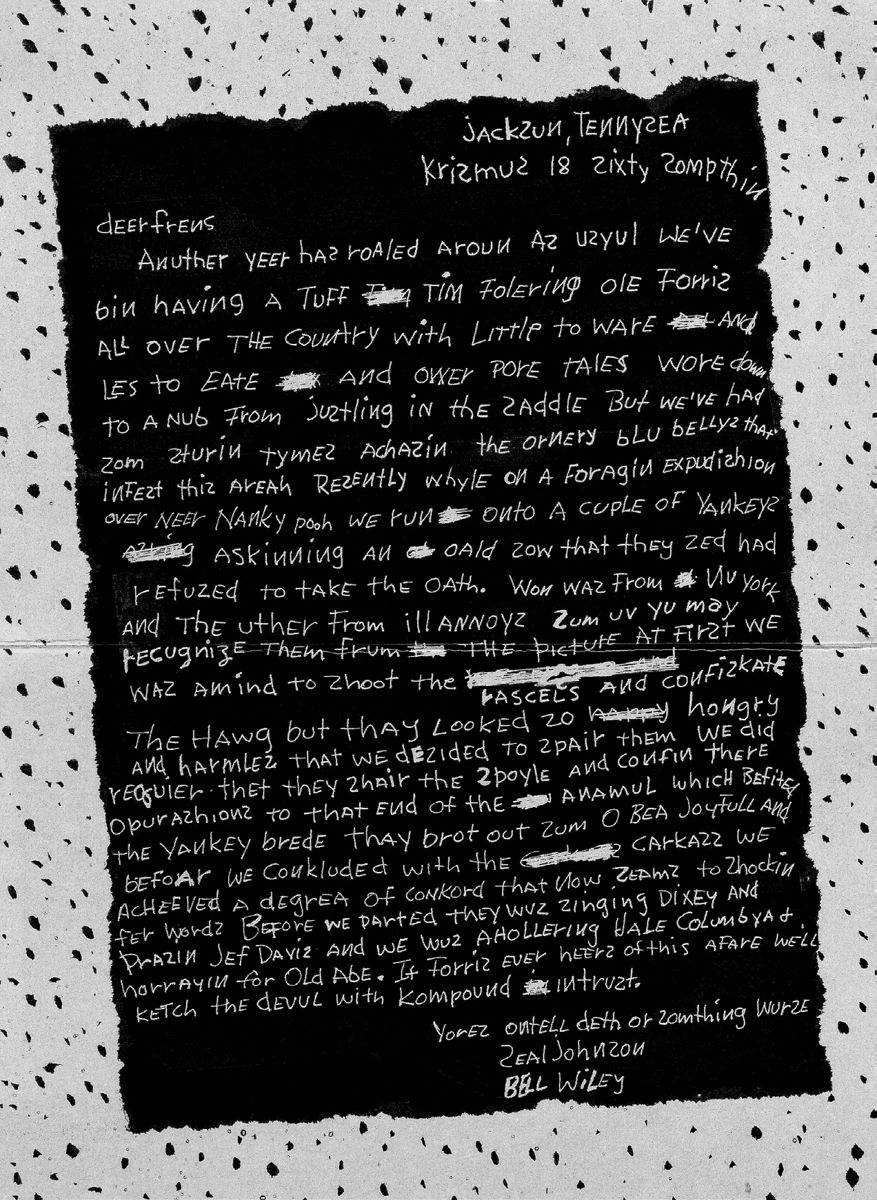
McCowat-Mercer sent Christmas cards in 1960 to friends and customers of the press.
It is evident that Wiley enjoyed friendship with Seale Johnson, a fellow West Tennessean and, like Wiley, a bibliophile. I recently attended a Civil War conference with Dr. Robertson, who studied under the professor in the 1950’s. I asked Bud if he knew how Wiley had become connected with McCowat-Mercer. He didn’t know. But their work together is highly esteemed by today’s Confederate book collectors. On the title page of Henry’s As They Saw Forrest is a note that this is “No. 3 of a Series/ Monographs, Sources and Reprints in Southern History, Bell Irvin Wiley, Editor.” Half of the other Wiley/McCowat volumes also carry this series title. In my personal library I am privileged to own ten of these fourteen
Inserted with the Christmas card, Johnson and Wiley listed books published by McCowat-Mercer, 1956-60, in Wiley’s series as editor.
Illustrated in McCowat-Mercer’s card are four followers of Bedford Forrest. Bell Wiley is second from the left. works, and they are among my most valued treasures. Inside my copy of As They Saw Forrest I see a special page, “Riders with Old Bedford Edition,” autographed for the Civil War Book Club by Robert S. Henry. Back then, paper jackets were actually printed with books’ retail prices; my Forrest originally went for a full $5.00 (imagine that!). I was in Dover, Tenn., a few months ago, about to speak to the Round Table there, when a gentleman, Bill Wells of nearby Mayfield, Ky., introduced himself as another former student of Wiley’s. He showed me a Christmas card sent to him way back in December 1960. Bill still had the envelope, printed with “Crismus Greetins” and with its senders’ names: “Bell Irvin Wiley and Seale Johnson P.O. Box 748
Jackson, Tenn.” It’s obvious that Bell and Seale shared a great sense of humor. The card’s drawing shows them in Confederate uniforms about to skin a pig. Inside, in semi-literate, misspelled printing, they extended their seasonal wishes: “deer frens—another yeer has roaled aroun….We’ve bin having a tuff tim folering old Forris,” they explain, “but we’ve had some sturin tymes achasin the ornery blu bellys that infest this areah.” The senders signed their card, “Yores ontell deth or something wurse, Seal Johnson Bell Wiley.” What an uproarious time Bell and Seale must have had, producing their “Crismus Greetins”! Of particular interest, as Mr. Wells showed me, was an included listing of the “Confederate Reminiscences” for which Wiley was serving as McCowat-Mercer’s General Editor. Eight titles were already in print (named above); Henry’s” “First With the Most” Forrest was “in preparation.” Evidently Wiley and Johnson sent Christmas cards another year or two after that, ca. 1961-62, to friends of the Press; Hill Jordan found them in the Wiley Papers at Emory. One is headed, “In Camp neer Jaxsun, Tinysea Crismus 186—(bin fiting Yankees so long we’ve lost track uv the yeer).” Here, an artist has drawn the two as Confederate soldiers roasting a chicken with a corked jug nearby. They explain the scene: “we aire indulgin ourselves in some Rock mea to sleap muther, otherwyse known as O Bea Joyfull, thoughtfully provided by the Yankeys. The foul is a Union sympathyzer that we had to kill in self defense when hit strutted into our camp and threatened to do us hurt at the Crismus time. That’ll larn him.” Bell Wiley taught me many things when I was a student working with him at Emory in the late 60’s. Having now seen his and Seale Johnson’s “Pusonal Greetins at the Yuletide from Two old Cotton-Pickin’ Rebels,” I can now add another lesson: one can be the world’s leading authority on Civil War soldiers, but don’t take yourself too seriously. Steve Davis of Atlanta is a regular contributor to Civil War News and is the Book Review Editor. His book, A Long and Bloody Task: The Atlanta Campaign from Dalton through Kennesaw Mountain to the Chattahoochee River May 5-July 18, 1864, was published as part of Savas Beatie’s Emerging Civil War paperback series. The companion volume, All The Fighting They Want: The Atlanta Campaign From Peachtree Creek To The City’s Surrender, July 18-September 2, 1864, was published this Spring.