
Through The Lens
A Real Soldier
By Stephanie Hagiwara · Originally published November 2017 · p. 8
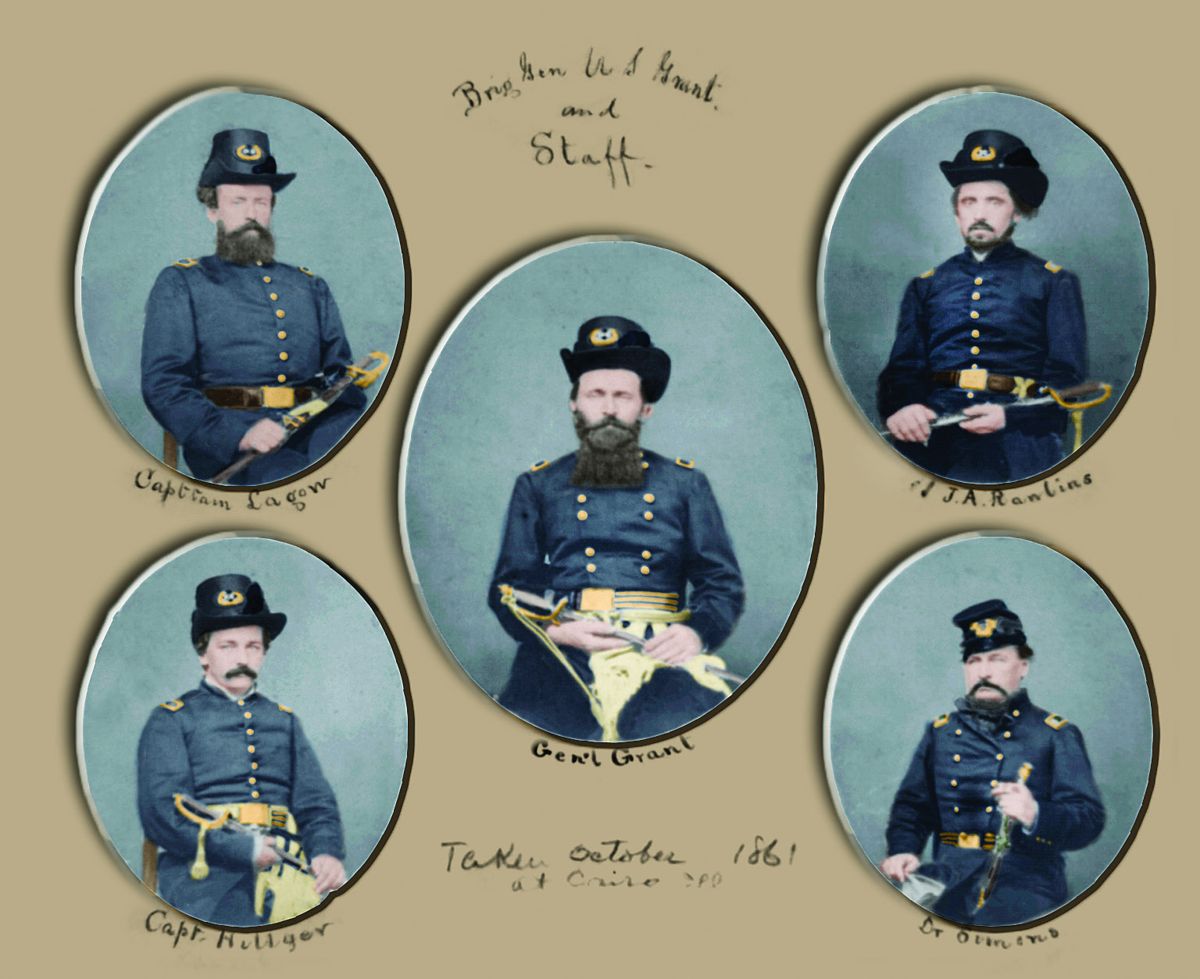
A Real Soldier “There is a Yankee; you may try your marksmanship on him if you wish,” commented C.S. Gen. Leonidas Polk spotting a solitary U.S. Gen. Ulysses Grant in a cornfield. Despite Kentucky’s declaration that it intended to be neutral, on Sept. 3, 1861, Polk occupied Columbus, Ky., which overlooked the Mississippi River. Three days later, Grant seized Paducah, Ky., 45 miles from his headquarters at Cairo, Ill. While the shocked inhabitants hastily took down Confederate flags intended to greet the opposing army, that didn’t stop the women greeting Federal troops with a few cries of “Hurrah for Jeff Davis”. Both sides, to give their green troops training, sent their men on scouting missions on each side of the Mississippi. Excitement would happen when the enemy was spotted and a chase ensued. After a couple of miles, the pursuing squad’s commanding officer would call off the hounds and all would return to their perspective camps with a tale to tell by the fire. Grant would later write that on Nov. 7, 1861, “The National troops acquired a confidence in themselves at Belmont [Ky.] that did not desert them throughout the war.” The battle came about from a combination of faulty intelligence and Grant’s awareness that his men were growing impatient to fight. Grant had sent Col. Richard Oglesby, Cairo’s previous commanding officer, on a trip to pursue Confederate raider Gen. Jeff Thompson, the “Swamp Fox of the Confederacy,” no matter where he might go. Intelligence had it that C.S. Gen. Gideon Pillow was staging a force at Belmont to attack Oglesby. To their delight, Grant ordered 2,800 men equipped with ammunition, one day’s cooked rations, and to be ready to board steamboats, destination unknown. Down river, the jubilant men traveled until stopping overnight six miles from Belmont. Grant and his staff gathered around a table in the ladies’ cabin of the “Belle Memphis,” lit by glittering chandeliers. Around that table were men new to battle. It was common at the time for staff to include friends and family.
Grant picked men to whom he could delegate responsibilities and trust to make onsite decisions. As Grant described it to his wife, “that is of a class that can do something.” Grant appointed his lawyer friends John Rawlins and William Hillyer, and a merchant in civilian life, Cpt. Clark Lagow of the 21st Ill. to his staff. His Medical Director, Dr. James Simmons, a full surgeon of the regular army, was on leave, so Dr. John Brinton, came in his place. At first light, the men ate breakfast from their haversacks as the boats took them to the disembarkation point hidden from Columbus by a bend of the river. To protect Columbus, three tiers of batteries had been built for 143 guns, including a 128-pdr. rifle called “Lady Polk” on the bluff; a chain was placed across the river, mines positioned under the surface. Guns from the battery began firing towards the men as Federal gun-boats moved downstream to return fire. About 7:30 a.m. the men were positioned to march through a cornfield and into the woods. About 1,000 feet in, Cpt. John Seaton gave a rousing speech ending with, “… if I should show the white feather, shoot me dead in my tracks and my family will feel that I died for my country. Boys, it is now quite warm-and we are going to have a hot day; I propose that all of us take off our coats, pile them at the foot of this tree … when we come back to the boats, we can get them, and if we don’t come back, we may not want them again.” Ready, the company “deployed on the double quick and we commenced the march in skirmish line.” Within minutes, men began to fall. The Confederates, abandoning their breakfast, had rushed three miles from their camp to fight. From the Belmont camp, the artillery fired at the approaching troops. Directing and encouraging his men, Grant was everywhere. As he “was trying to urge his horse up to the ranks of our men,” Grant’s horse was shot. Grant told Rawlins that he would have to leave him. Hillyer offered his horse and Grant rode on, leaving his “$140 saddle with his name on it, his mess chest, and his gold pen.” About noon the rebel camp had been seized. “The gunners fled with the infantry in great confusion, while their speed was accelerated by the loads they had just put into their guns and left to be fired at them by our men with gunners fleeing with infantry.” In victory, the regimental band tasked with hospital duty, whipped out their instruments and began to play “soul-stirring patriotic airs,” speeches were made and the boys started looting tents. Brinton, who had been busy caring for the wounded, noticed two enemy steamers approach and pointed them out to Grant. Grant ordered the tents set afire to catch the attention of his celebrating men. The Columbus garrison, seeing the smoke and realizing the camp was no longer in their control, turned the “Lady Polk” on the invaders. Polk with his troops had crossed the river. The Confederate infantry, driven to the river would have gladly surrendered if asked, now attacked their camp. Surrounded, surrendering was suggested. Grant recalled, “But when I announced that we had cut our way in and could cut our way out just as well, it seemed a new revelation to officers and soldiers.” Grant calmly had his men reform their lines. The 31st Ill. led the way but “Every man was trying to save himself, some would throw down their arms and part of a regiment would take one route and the other part start another way.” As the last of the men made it to transports, Grant rode back to search for stragglers. Grant recounted, “The corn [was] so tall and thick as to cut off the view of even a person on horseback, except directly along the rows. I had not gone more than a few hundred yards when I saw a body of troops marching past me not fifty yards away. I looked at them for a moment and then turned my horse towards the river and started back, first in a walk, and when I thought myself concealed from the view of the enemy, as fast as my horse could carry me. … I was the only man of the National army between the rebels and our transports.” At the water’s edge Seaton, whose new coat was still by the tree, saw Grant at the top of river bank. Grant shouted, “Get aboard the boat; they are coming!” To the captain of the boat he called out, “Chop your lines and back out.” Grant wrote, the captain, “had a plank run out for me. My horse seemed to take in the situation. There was no path down the bank and every one acquainted with the Mississippi River knows that its banks, in a natural state, do not vary at any great angle from the perpendicular. My horse put his fore feet over the bank without hesitation or urging, and with his hind feet well under him, slid down the bank and trotted aboard the boat, twelve or fifteen feet away, over a single gang plank. I dismounted and went at once to the upper deck.” The return trip upriver was solemn. At dinner, the officers were glib, but Grant only spoke to the waiter. Seaton wrote, “We thought he was hard-hearted, cold, and indifferent, but it was only the difference between a real soldier and amateur soldiers.” Sources: • Captain John Seaton, “The Battle of Belmont” in War Talks in Kansas, Vol. 1 • Bruce Catton, Grant Moves South • Ronald C. White Jr., American Ulysses: A Life of Ulysses S. Grant • U.S. Grant, Personal Memoirs of U.S. Grant, Vol. 1 • James Harrison Wilson, The Life of John A. Rawlins: Lawyer, Assistant Adjutant-general, Chief of Staff, Major General of Volunteers, and Secretary of War Stephanie Hagiwara is the editor for Civil War in Color.com and Civil War in 3D.com. She also writes a weekly column for History in Full Color.com that covers stories of photographs of historical interest from the 1850’s to the present. Her articles can be found on Facebook, Tumblr and Pinterest.