
The Graphic War
The Graphic War — May 2017
By Sal Cilella · Originally published May 2017 · p. 46
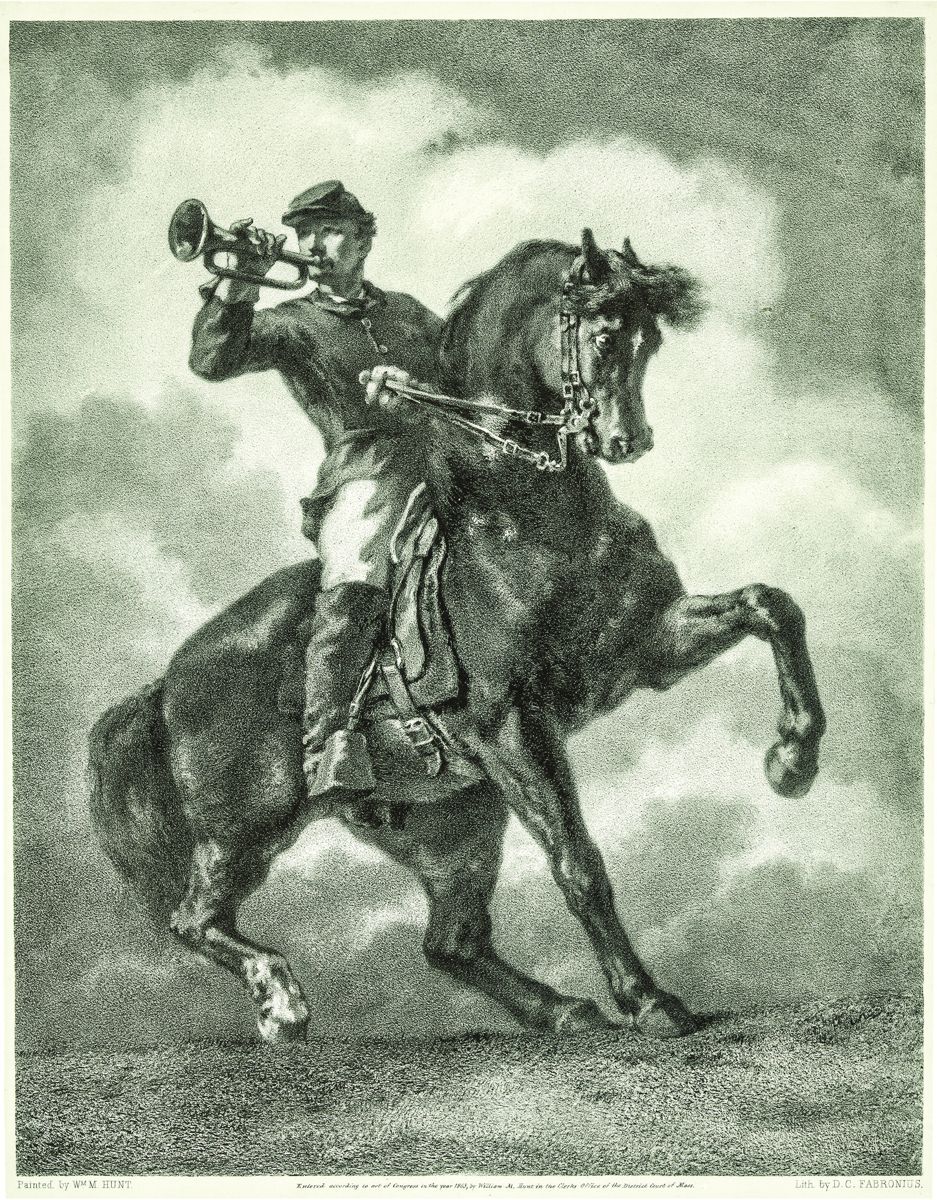
The 19th Century was the age of the print and the printer. By the 1840’s, old techniques such as etching, engraving and wood cuts were joined by lithography. As photography slowly replaced lithography, the latter survived into the 20th century until the firm of Currier and Ives sold its last prints in 1907. Simply, etching and engraving were the chief means of making pictures in the 18th century; in the 19th, it was lithography and photography. Today, the most recognizable name among print collectors is Currier and Ives, but they had innumerable competitors. They persevered for some 75 years spanning the century because they mass-produced “Colored engravings for the People.” They shrewdly marketed and distributed their lithographs (even though they called them engravings), never sold on credit, and insured that their titles had a hint of drama and intrigue. With the advent of the Civil War, the myriad producers of prints found a natural subject. The war, with its unprecedented savagery, sentimentalism, heroics, deeds of daring, patriotism and tragedy provided print makers and illustrated newspapers with countless subjects on which to focus their attention before, during, and after the conflict. Ostensibly, print makers claimed that they were providing the public with “the news” as they churned out black and white and hand colored prints of current events, but the real motivation was profit. This occasional column will highlight prints from the Civil War. It will discuss their meaning and most importantly, what the print maker or artist was trying to achieve. Perhaps the most iconic print from the war is William Morris Hunt’s Bugle Call. Hunt was 38 when war broke out and he was too old to serve. According to one author this was “his offering to the Union effort.”1 Bugle Call is also a mystery. Most artists composed a work of art with oil and canvas first and, if lucky, they were able to find a printer to make “multiples” of their work to make a profit on the artwork. According to two early books on Hunt, it appears that he painted “Bugle Call” in 1864 after the print appeared with an 1863 date.2 At an 1879 exhibition of Hunt’s work in Boston, the catalog listed “#133—The Bugle Call. Painted 1864.” Owner, “Quincy A. Shaw.”3 The 1878 Art Journal called Hunt’s Civil War pictures of Bugle Call and companion The Drummer Boy (1861), “very popular through photographs and lithographs, but there appeared in them a lack of the simple grace and simplicity that had endeared his earlier works to the public.”4 So which came first? The most recent scholarship muddies the water. In 1997, Vincent Virga, Curator of Prints at the Library of Congress argued that Hunt’s “composition was translated to the lithographic stone by the Belgian-born print maker Fabronius.”5 In addition to oil painting on canvas, Hunt also designed and drew lithographs. Yet on The Bugle Call, Dominique Fabronius is listed as the lithographer and Hunt as the copyright holder. Fabronius was a printer to much of the English nobility before he emigrated from Belgium to the U.S. just before the War. One account is that he joined the lithographic firm of Huddy & Duval in Philadelphia in 1855. Another asserts that his first job was with Middleton, Strobridge Lithography Company in Cincinnati in 1859. Afterward he worked for several east coast printers in Boston, New York and Baltimore. Today, the original painting’s whereabouts are unknown. However, prints are held by the Library of Congress, The Smithsonian, The National Gallery of Art, The Metropolitan Museum of Art, the Boston Museum of Art and scores of other major Amer-
Bugle Call painted by Wm. M. Hunt ; lith by D.C. Fabronius.
ican art institutions. Civil War readers will recognize it as the volume one frontispiece of the 1887 monumental four-volume Battles and Leaders of the Civil War. It remains as one of the most iconic and romantic image of the “uncivil” war. Endnotes: 1. Vincent Virga and Alan Brinkley, Eyes of the Nation: A Visual History of the United States. New York: Random House, 1997, 165. Hereafter Virga, Eyes. 2. Helen M Knowlton, Art –Life of William Morris Hunt. Boston: Little, Brown, and Co., 1899, 28. Hereafter Knowlton, Art. Knowlton attributes ownership of the painting to Quincy A. Shaw of Boston. Quincy Adams Shaw, (1825-1908) a Boston Brahmin, was the uncle of Robert Gould Shaw, Col. of the 54th Mass. Inf. Regt. of Fort Wagner fame. 3. Museum of Fine Arts, Exhibition of the Works of William Morris Hunt. November 11 through December 15, 1879. Fourth Edition, Boston: Alfred Mudge Printers, 1879, 34. 4. Anonymous, “American Painters— William Morris Hunt,” The Art Journal for 1878. New York: D. Appleton & Co., Publishers, 1878, 116. Author Knowlton labeled The Drummer Boy an “epic poem—a work full of virility and enthusiasm, embodied in the noble, handsome figure of a boy who was evidently posed high above the artist’s head, against a sky background. Knowlton, Art, 49. 5. Virga, Eyes, 165. 6. Harry T. Peters, America on Stone: The Other Printmakers to the American People. New York: Doubleday, 1976 Reprint, 183; Impac: The Library Company of Philadelphia Digital Collections, “Dominique Fabronius.” Last accessed February 27, 2017. http://lcpdams.librarycompany. org:8881/R/?func=dbin-jump-full&object_id=79143&local_base=GEN01.
Salvatore Cilella is the retired CEO of the Atlanta History Center, having spent 43 years in the museum field. He is the author of Upton’s Regulars (University of Kansas Press, 2009), and editor of The Selected Correspondence of General Emory Upton, due out this year from the University of Tennessee Press.