
The Unfinished Fight
The Banjo
By Craig L. Barry · Originally published May 2017 · p. 11
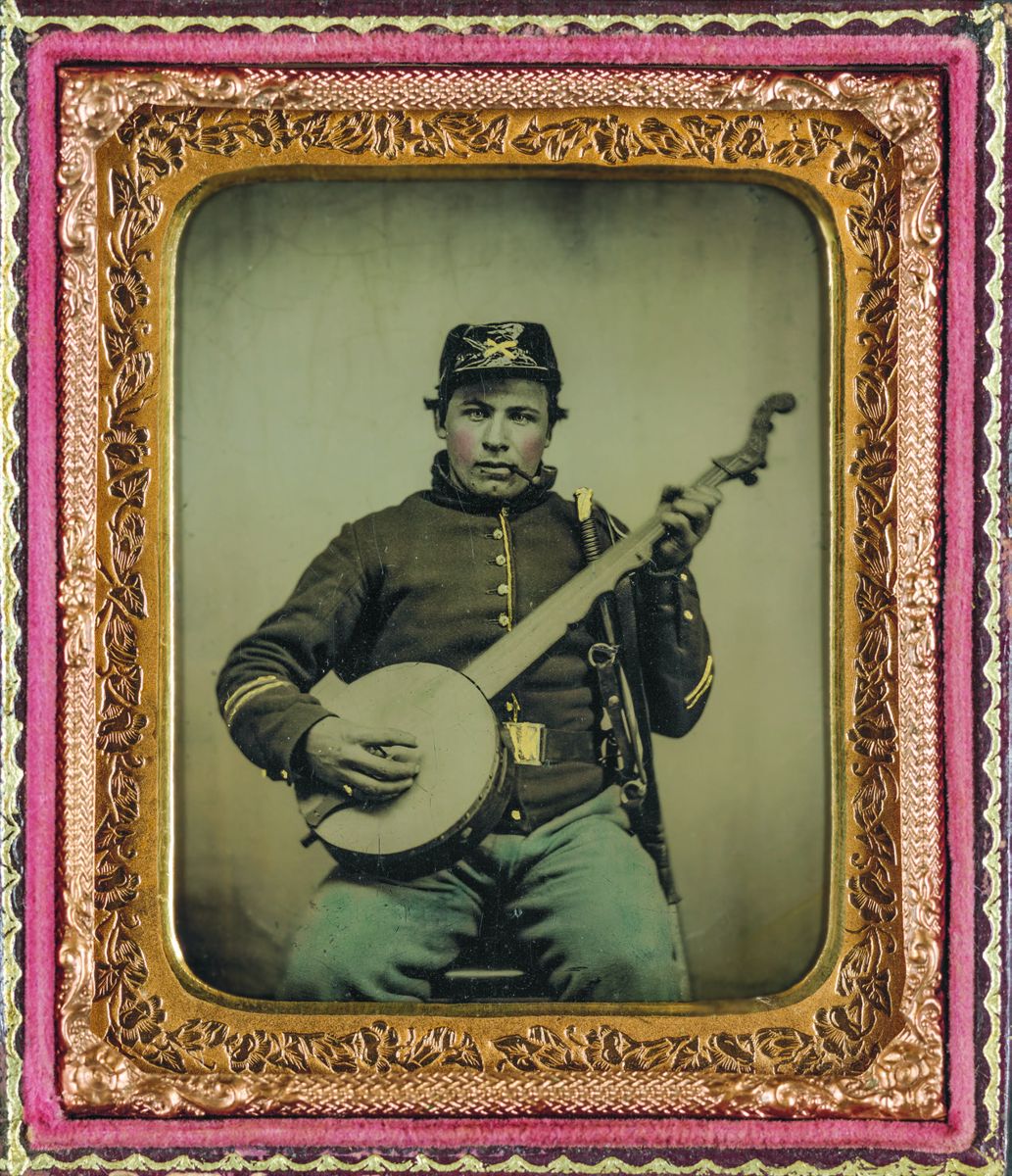
“There was probably not one regiment in the service that did not boast at least one violinist, one banjoist, and a bones player in its ranks…and one or all of them could be heard in operation, either inside or in a company street, most any pleasant evening…The usual medley of comic songs and negro melodies comprised the greater part of the entertainment, and, if the space admitted, a jig or clog was stepped out on a hard tack box or other crude platform.” John Billings “Hardtack and Coffee or The Unwritten Story of Army Life” At the recent 155th Anniversary programs at Fort Donelson in Dover, Tenn., the well-known musical historian and artist Bobby Horton gave a twohour performance on Sunday afternoon. Horton is best known for his musical contributions to Ken Burn’s well known PBS documentary The Civil War in 1990. Before Horton’s recent performance we were enjoying a little friendly banter and sharing a few “banjo player jokes” between us, which I will not bore you with. Well, maybe just one, “What do you call a banjo player without a girlfriend? The answer…homeless.” Horton said between songs during his first set, “Civil War soldiers used music for everything. For propaganda. They used it to create a martial feeling, a feeling of patriotism. They used it to celebrate people they admired, and they used it to talk about how foolish the enemy was. They used it to tell their own story. And a lot of soldiers wrote tunes.” They also used it to entertain themselves in camp. The banjo along with the accordion and the fiddle were by far the most common camp instruments of the Civil War soldier. Bobby Horton plays a nice variety of period music using Civil War-era instruments, but his banjo is not one of them. What were banjos like in the mid-19th century and how were they different from the common bluegrass instrument we hear so often today? Without getting into too much of the instrument’s history and its ancient African heritage, there were two main types of banjo in wide use during the Civil War. There was the socalled minstrel banjo and the simpler, handmade tackhead version. The typical mid-19th century five string banjo had an oil finished maple, or other hardwood, neck and a scroll type peghead with wood friction tuners and a fretless fingerboard. The strings were made of “gut” which was a natural cord constructed from animal intestines. The minstrel banjo was a fancier “store bought” instrument that had a twelve-inch maple base rim with hardware to adjust the calfskin head’s tension. The tackhead banjo was a more basic handmade version used by those who could not afford a “store bought” instrument or perhaps did not have access to a professional musical instrument maker in their hometown. The banjo was a favorite musical instrument of Civil War soldiers on both sides. According to period banjo maker and reenactor Bob Flesher of “Dr. Horsehair” fame, “Minstrel music was established in the late 1830s with the development of the five-string banjo by Joel Sweeney of Appomattox Court House, Va. This new form of music became very popular as the performers, usually working in pairs, toured from town to town or traveled with a circus. In 1843, Dan Emmett’s “Virginia Minstrels” performed the first minstrel show with banjo, fiddle, bones and tambourine. From this point, “minstrel mania” swept the nation as hundreds of minstrel troupes toured throughout the country. It reached its peak in the 1850s and 1860s as it became the popular folk music of the time. The banjo, the foundation of the minstrel show, was always played with the back of the fingernail in the “stroke” or “banjo” style.” This is different from the modern bluegrass clawhammer method of picking. The modern bluegrass banjo is also distinct in that it uses steel strings and a fretted neck. It also has a large, heavy resonator plate on the back of the instrument which provides the volume required for today’s unique bluegrass music sound. The Civil War-era banjo had an open back and the natural gut strings produced a much softer and warmer tone than the metal strings of the modern bluegrass banjo. It is worth mentioning that the so-called inventor of the 19th century minstrel banjo (Joel Sweeney), passed away in 1860, but his brother Sam gained renown as an expert banjo and fiddle player in his own right. Probably the most famous banjo player of the Civil War-era, Sam Sweeney was on the staff of Gen. J.E.B. Stuart, the Army of Northern Virginia’s cavalry commander. His song “Jine the Cavalry” was one of Stuart’s favorites. Sweeney’s only job during the war was to play banjo for Gen. Stuart, his officers and guests. Col. Thomas Taylor Munford, a junior officer from whom Stuart “permanently borrowed” Sweeney’s services later wrote, “Stuart’s feet would shuffle whenever he was in Sweeney’s presence, or even at the calling of his name. He issued an order for Sweeney to report at his quarters and ‘detained’ him. It was a right he enjoyed, but not very pleasing to me or my regiment.” Acquiring Sweeney gave General Stuart some amusement toward Colonel Munford who was quite prickly over the loss of his “band.” John Esten Cooke, a novelist and historian with the ANV, noted that Stuart would ask Munford in jest: “Why don’t you come on over and enjoy the music?” Sweeney was present with General Stuart during Gettysburg and several other campaigns. The Charleston (S.C.) Mercury newspaper noted on Jan. 16, 1863: “Are you readers aware that Gen. JEB Stuart carries with him wherever he goes, in all his circuits and raids, a brother of Joe(l) Sweeney, the famous banjo player? Such is the fact. Sweeney is also a banjoist, and Stuart calls him his band. He carries his banjo behind his saddle, wrapped up in a piece of oil cloth, and whenever the cavalry stops, even to water their horses, the band strikes up on the banjo and picks a merry air. The performance of the banjo band in Pennsylvania drove several Dutch farmers raving distracted, for Sweeney swore that his banjo strings were made out of the viscera of their departed relatives and friends!” Sadly, two years into his military service, Sam Sweeney passed away at age 32 on Jan. 13, 1864, in winter camp just south of the Rappahannock. Stuart wrote of the loss to his wife in early 1864,“I suppose you heard the sad tidings of poor Sweeney’s death. He died of smallpox while I was gone. His loss is deeply felt.” Of course, a senior officer could afford the luxury of his own private “band” as Gen.
Stuart did with Sam Sweeney, but what about the common soldiers on campaign? Did they have access to musical instruments with which to amuse themselves in camp? There is evidence that they did and even carried them on campaign when it was possible to do so. In America’s Instrument: The Banjo in the Nineteenth Century by Philip Gura (1999), there is an anecdotal story attributed to Albert Baur who served in the Union army early in the war. He writes “In 1864 there were very few regiments in the service that had more than one wagon for the whole regiment. Strict orders were at all times issued that no baggage must be carried for an enlisted man in any of the wagons. Well, where there’s a will, there’s a way, and a few of us managed with the help of a friendly teamster to stow away a tackhead banjo and an accordion.” Since Civil War-era tackhead banjos were famously fragile and hard to keep in tune, how did the common soldiers manage to keep the instruments serviceable? Baur also made note of those difficulties, “Owing to poor facilities for keeping the instruments in order, the instrumental part of our entertainments were always the poorest. Sometimes it would be weeks before we could get a (banjo) string, and if the banjo head was broken, it took much time and maneuvering for one of our party to steal into the tent of a drummer and punch a hole in a drum (head) near the shell, after which we would watch that drummers tent with eagle eyes until he took the damaged head and threw it out, when one of the gang would pounce on it and bring it to camp in a round-about way. Owing to their thickness, the drum heads did not make very good banjo heads, but they beat nothing clear out of sight. In addition to the banjo and accordion, we had a set of beef bones and a sheet iron mess pan answered for a tambourine.” We are left to wonder what kind of music such a band might have performed. Albert Baur also recalls, “If the weather was pleasant a crowd would gather around the camp fire, the banjo and accordion having been sneaked out of the wagon and a door from some farm house or a couple of boards having been put on the ground on one side of the fire, the audience would take its place on the opposite side, then the evening’s entertainment would be gone through with. It consisted of songs with banjo and accordion accompaniment, stories of home and jig dancing. Taking into consideration our surrounding and the disadvantages under which we labored, we had some tolerably good shows and at any rate satisfied our open-air audiences.” Craig L Barry was born in Charlottesville, Va. He holds his BA and Masters degrees from the University of North Carolina (Charlotte). He is the author of several books including The Civil War Musket: A Handbook for Historical Accuracy (2006, 2011), The Unfinished Fight: Essays on Confederate Material Culture Vol. I and II (2012, 2013) and three books (soon to be four) in the Suppliers to the Confederacy series on English Arms & Accoutrements, Quartermaster stores and other European imports.
Unidentified soldier in Union cavalry uniform with banjo, sword, and pipe.