Inspection, ARMS!
Lefaucheux’s Pin Fire Revolver in the American Civil War
By Tim Prince · Originally published May 2017 · pp. 12–13
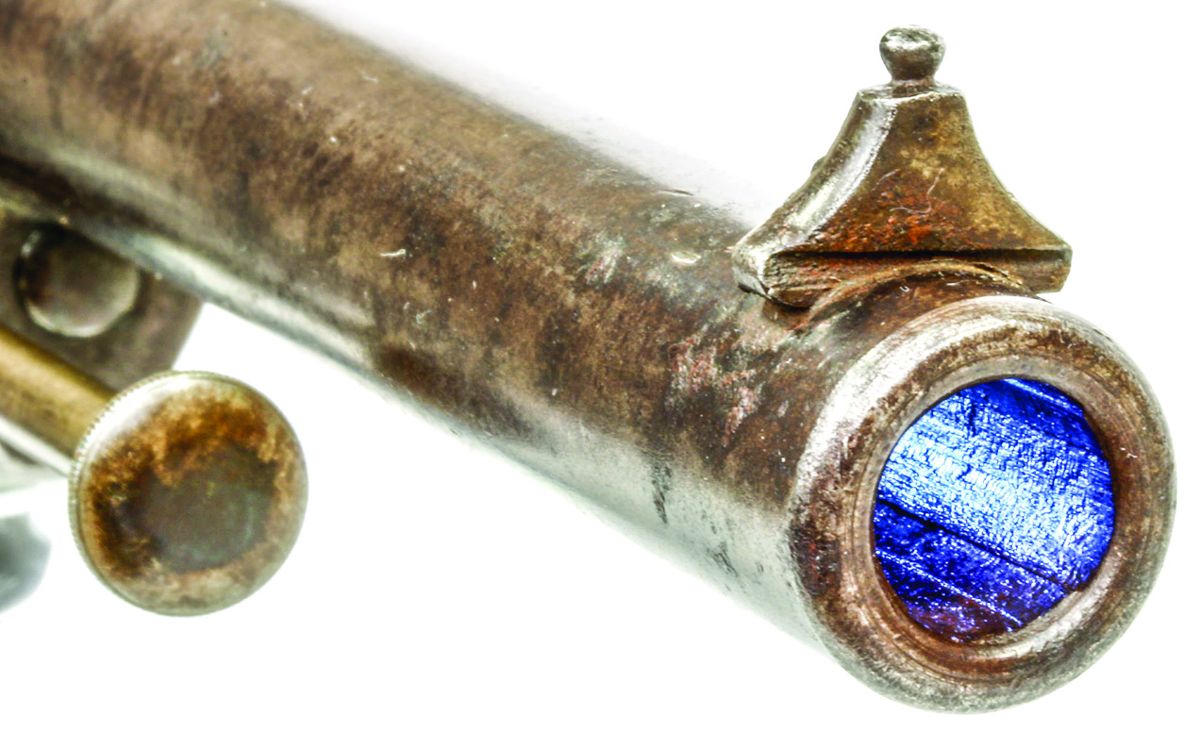
In 1835, Casimir Lefaucheux developed what would become the first truly successful self-contained cartridge system. This became known world-wide by its method of ignition; the pin fire. Lefaucheux was a French gunsmith and inventor born in 1802, only a year before the Napoleonic Wars plunged Europe into a dozen years of nearly constant conflict. Lefaucheux was not the first to experiment with combining powder, projectile and ignition source into a single, easy to handle cartridge. Swiss-born French gunmaker Samuel Joannes Pauly probably created the first workable system about a decade after Lefaucheux’s birth. It was to Pauly that young Casimir was apprenticed at age 12, and where he learned the arms trade. By 1827, Lefaucheux was the manager of Pauly’s Paris establishment and very soon thereafter, Casimir became the company’s owner. Lefaucheux can be credited as the first to come up with a broadly successful and reliable self-contained cartridge system. Although the pin fire cartridges that we think of today are metallic, Lefaucheux’s new cartridge used a cardboard tube to contain the black powder, lead bullet and pin fire primer. It would not be until more than a decade later that improvements in Lefaucheux’s revolutionary design by Benjamin Houllier would result in the metallic cartridge that we think of today as a “pin fire.” Due to a French government that felt military arms production was strictly for their national armories and not for private contractors, Casimir concentrated on manufacturing sporting arms. He applied his cartridge design to arms for that market, including breechloading shotguns and single shot pistols. Casimir’s son Eugene put the Lefaucheux name indelibly on the map with his revolutionary revolver design. Eugene had an interest in applying the pin fire concept to a revolving pistol and in 1851 he exhibited such a handgun at the London Exhibition. The revolver was revolutionary in that the cartridges loaded from the rear of the cylinder, which had bored through chambers. Any student of firearms history will immediately note that in America, the concept of the “bored through” cylinder is attributed to Rollin White. White’s U.S. patents #12,648 and #12649, granted on April 3, 1855, granted him sole control of this essential design element for any metallic cartridge revolver until the patent expired in 1869. White subsequently entered into an agreement with Smith & Wesson, granting them the right to produce revolvers that incorporated his patent in exchange for a twenty-five cents per gun royalty payment. By so doing, White essentially granted Smith & Wesson a monopoly on the most efficient cartridge revolver design and kept major manufacturers, including Colt and Remington, from being able to compete in the cartridge revolver market. Lefaucheux’s design pre-dated White’s patent by at least four years, however, and Lefaucheux received a French patent for the concept (#19,380) on April 15, 1854, almost exactly a year prior to White’s American patent for the same principle. Had Lefaucheux the younger been forward thinking enough to register his patent in America, the history of American cartridge handgun design would have been very different and it is arguable that Smith & Wesson might not have become the industry leader they remain today, and might even have failed financially during their first decade in business. Eugene Lefaucheux’s design, that would become the Model 1854 Pin Fire Revolver, was based upon his original April 15, 1854 patent, but also incorporated additional modifications, registered on June 10 and Nov. 9, 1854. The revolver depicted in Lefaucheux’s patent application bore a strong resemblance to the Colt Model 1851 Navy revolver, including the open-top frame, octagonal barrel and single action lock work. His patent drawing even included the square-backed triggerguard of the earliest production Colt M-1851. The primary differences between the Colt and Lefaucheux designs were the inclusion of a hinged loading gate where the Colt had the frame cut out for capping, the inclusion of an ejector rod along the lower right hand side of the barrel to push spent cases out of the cylinder
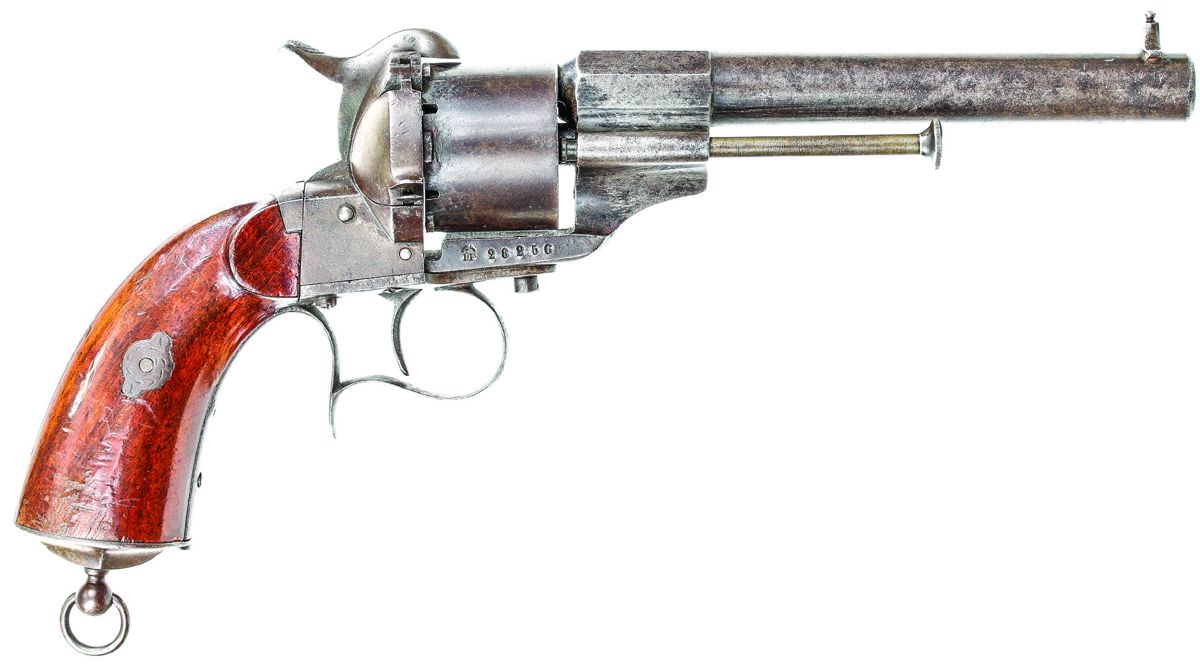
Overall view of Lefaucheux M-1854 12mm revolver #28256. This gun is numbered slightly below the lowest documented M-1854 serial number (#33,895), but is certainly a legitimate candidate for Civil War purchase, issue and use. This is the most frequently encountered configuration for Civil War era martial revolvers. (All photos Tim Prince) and, of course, the six boredthrough chambers for metallic cartridges. Interestingly, the patent drawing looks very much like a Richards-Mason cartridge alteration of a square-backed Colt Navy revolver, almost two decades before Colt produced these conversions! The following year, Lefaucheux submitted his new revolver design to the French military for testing. The French Navy wanted to replace the single-shot percussion muzzleloading pistols then in service, and the pistols selected for evaluation were the Colt M-1851 Navy, the M-1854 Beaumont-Adams and the Lefaucheux. Whether it was nationalism or simple practicality is hard to know, but from the outset, the French Navy had determined that the only acceptable pistol would be one that used self-contained metallic cartridge ammunition, so by default the percussion ignition designs from Colt and Adams never had a chance. The Lefaucheux design was officially chosen as the winner in 1857 and entered service with the French Navy the following year as the Model 1858. It is interesting to note that the one area of testing where the Colt revolver was clearly superior was in the actual power of the cartridge. The cap and ball Colt fired a round lead ball of .36 caliber at about 750 feet per second, generating a muzzle energy of about 152 ft/lbs. In terms of modern ammunition, this amount of muzzle energy is about the same as the .32 ACP, not exactly known as a “man stopping” round. However, the 12mm cartridge fired by the Lefaucheux had a woefully slow muzzle velocity of about 330 ft/s, and a muzzle energy of about 52 ft/lbs; about one third the power of the Colt Navy’s projectile and slightly less muzzle energy than the modern .25 ACP, a cartridge that is certainly ridiculed in terms of stopping power. This lack of power was likely a combination of many factors, including the limited amount of space for the black powder propellant in the case and the inherent weakness in metallurgy of the copper cases of the time, which severely limited pressures the cartridge cases could be exposed to without rupturing. Despite the woefully underpowered cartridge, Lefaucheux’s design would be the most widely issued martial cartridge revolver of the American Civil War. Thousands of these pinfire revolvers were imported for use by U.S. troops, and at least a few hundred saw service with Confederates as well. The typical “Civil War” pin fire revolver was the military pattern M-1854 in 12mm. Most of these guns had octagon to round barrels that measured between about 5.75 and 6.25 inches although some wider variation has been noted. Most had a spurred triggerguard and a lanyard ring in the butt. Lefaucheux revolvers were produced with both blued and bright finishes, and it appears that the guns that were imported were a mixture of both finishes. Some 12,333 M-1854 Lefaucheux patent pin fire revolvers are recorded as having been officially purchased by the U.S. government during the American Civil War, with 11,833 being delivered. Additionally, more than 2.2 million pin fire cartridges were acquired by the Federal
Ordnance Department, primarily from domestic sources. However, surviving examples and regimental records indicate that more than the “official” numbers were probably imported, especially when Southern use is considered. The primary Ordnance Department purchaser of M-1854 revolvers was New York Militia Colonel George Schuyler (no relation to the Schuyler of Schuyler, Hartley & Graham). He purchased 10,000 Lefaucheux revolvers for the U.S. government. Documents indicate that Schuyler made these purchases directly from Lefaucheux in Paris. In addition, he purchased 200,000 cartridges, only 20 per pistol! The price paid was $12.50 per gun, for a total of $125,000 and $17.45 per 1,000 cartridges, totaling $3,490 for ammunition. Extant examples suggest that at least some Belgian licensed copies were also imported during the war, probably from sources other than Schuyler. Lefaucheux also maintained a manufactory in Liège, so it is entirely possible that Lefaucheux himself was the source for some Belgian made guns. The U.S. Ordnance Department did not appear to differentiate between French and Belgian made versions, much as they often lumped French and Belgian made muskets together without any distinctions. Other importers who provided M-1854 pin fire revolvers to the U.S. government included Herman Boker, Schuyler, Hartley & Graham, George Raphael (who also provided Raphael revolvers), Alexis Godillot of Paris (who provided Perrin revolvers)
and even Tiffany & Company. United States cavalry units issued pin fire revolvers included the 5th Ill., 2nd & 5th Kan., 6th Ky., 8th Mo., 3rd Mich., 2nd Ohio, 1st, 2nd & 3rd Wisc. and the 9th Mo. State Militia Cavalry. The Springfield Research Service serial number books, published by the U.S. Martial Arms Collector newsletter, list serial numbers for 69 Lefaucheux revolvers of Co. B, 9th Mo. State Militia Cavalry during 1863. These 69 revolvers range from serial number 33,895 through 42,522. This 9,000+ range of serial numbers within a single Union cavalry company makes it relatively easy to extrapolate that Lefaucheux revolvers within the 25,XXX through at least the 45,XXX range are probably within the realistic realm of Civil War used revolvers, and clearly any pistols with lower serial numbers could have seen use during the war as well. It is generally believed that only French-made guns are represented by this broad range of serial numbers, but it has not (to my knowledge) been officially established that Belgian guns were not part of the 9th Mo. inventory. It is worth noting that Lefaucheux’s factory was particularly modern, based in part upon assembly line manufacturing concepts pioneered by gunmakers like Colt. It was claimed that by 1865, his factory could produce between 150 and 160 revolvers per day, which would be just under 1,000 per 6-day work week. While there are certainly documented instances of Confederate units having Lefaucheux revolvers, their use was much less wide spread than it was with their northern adversaries. The most obvious problem was a lack of readily available ammunition. The North’s industrial and manufacturing capacity meant that at least three different companies have been identified as having produced pin fire cartridges for the U.S. Ordnance Department. No such domestic source of pin fire cartridges has been documented in the south, which meant the Confederacy was at the mercy of successful blockade runners for Lefaucheux revolver ammunition. As a result, the pin fire revolver was certainly a potential liability for the soldier who could not acquire ammunition for it. Confederate units under the command of Gen. Nathan Bedford Forrest had at least a few hundred Lefaucheux revolvers in their possession by late 1864. A May 25, 1864 Ordnance Report from Meridian, Miss., showed Forrest’s 1st Division in possession of 190 “French Pistols” and his 3rd Division with another 160. It is almost certain that these “French Pistols” were Lefaucheux revolvers. In 1864, the Selma Arsenal was offering Lefaucheux revolvers for sale to Confederate officers at a price of $25 each, including 12 cartridges. In August 1864, Selma listed the following pistol ammunition in their inventory “For French Pistol (LeFaucheux)
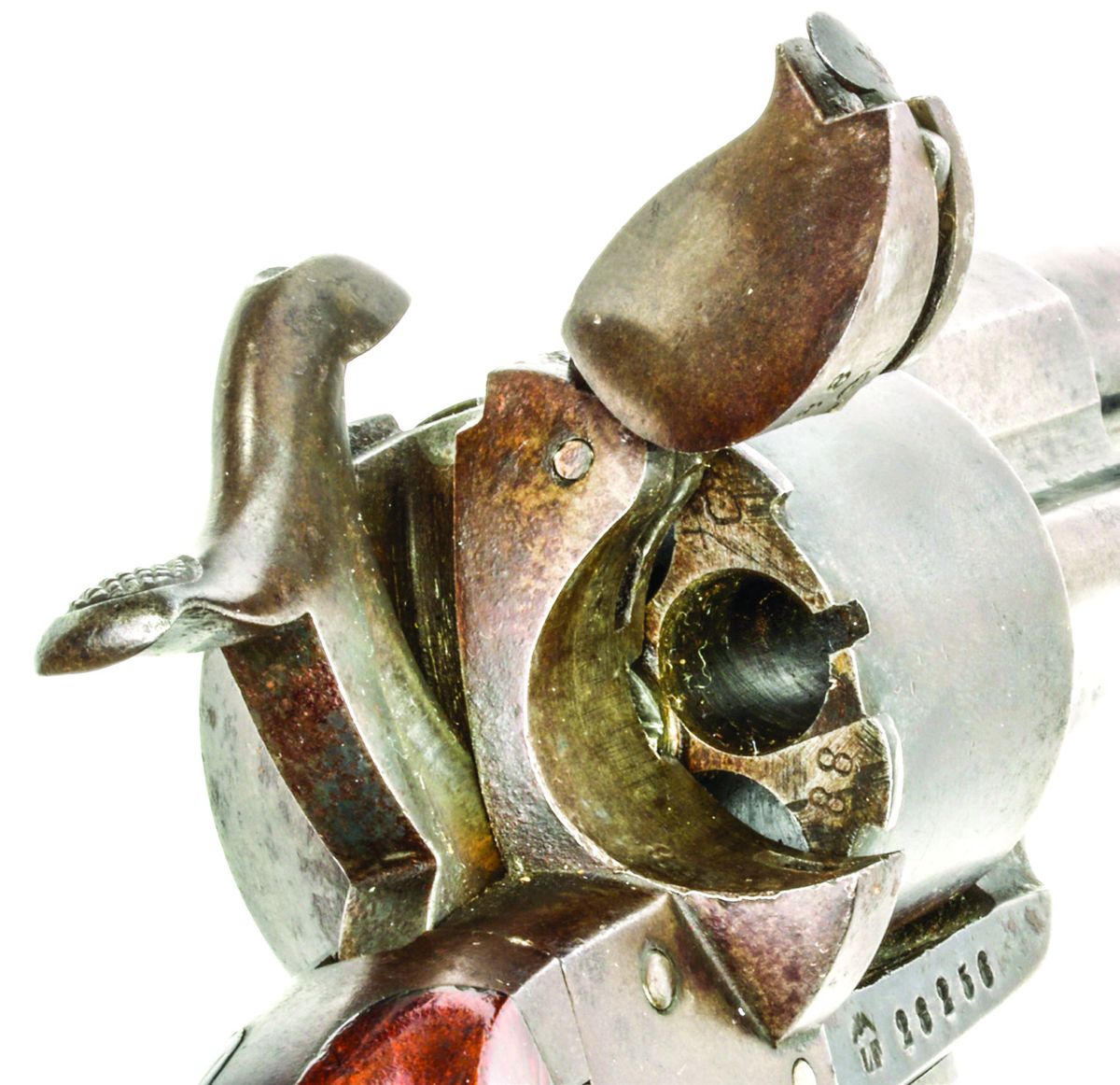
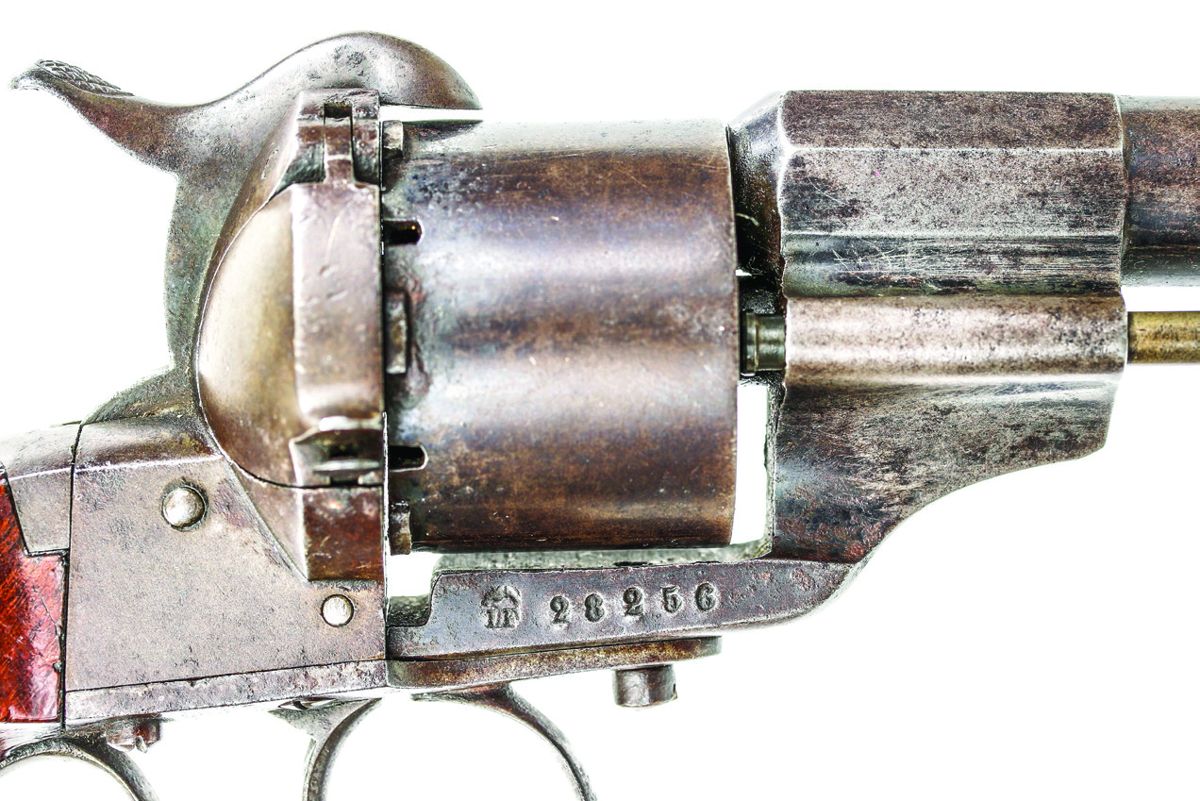
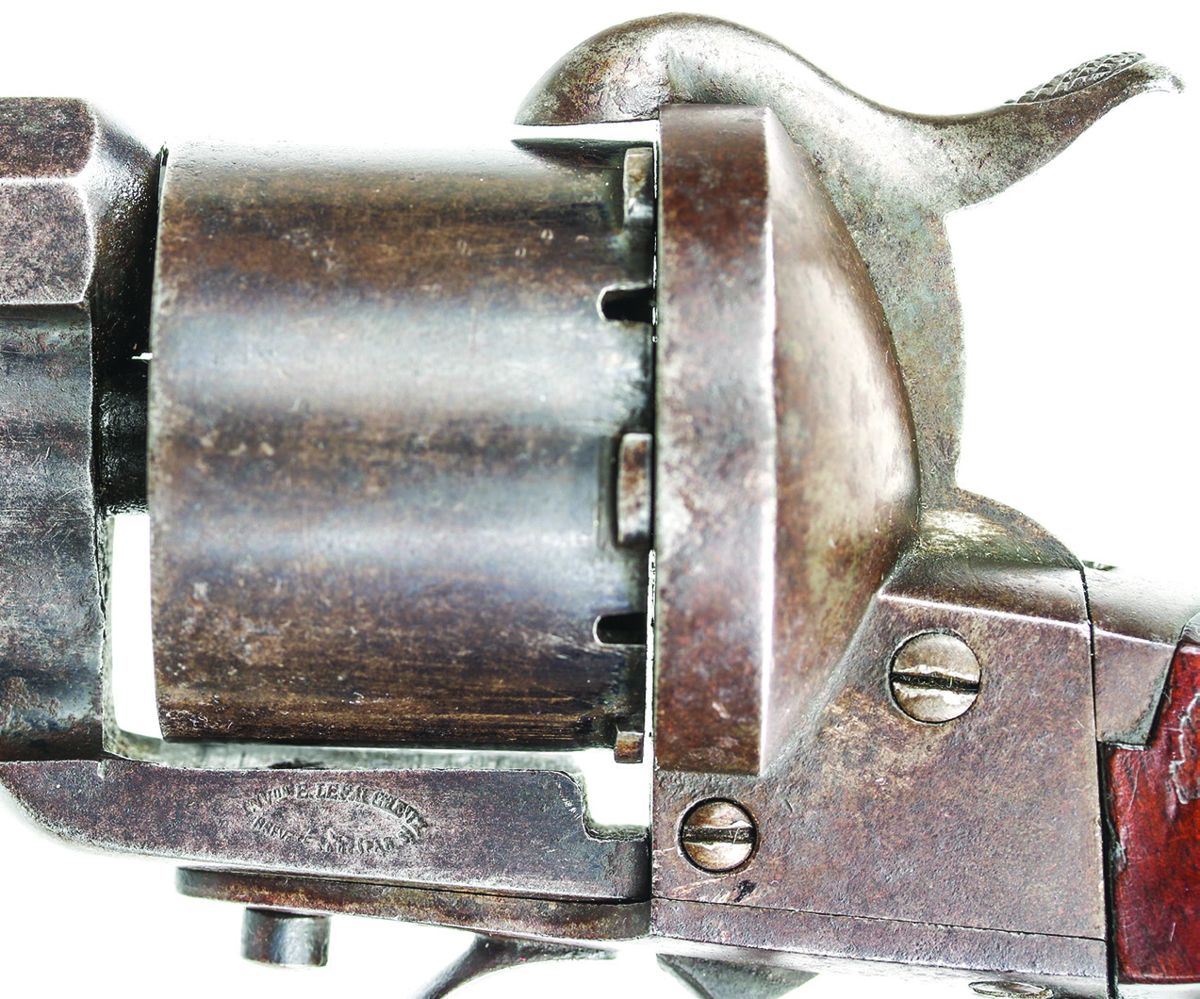
caliber .472k – 52,800 rounds.” This is very clear indication that the C.S. Ordnance Department was actively trying to keep ammunition available for a decent number of Lefaucheux revolvers. Using the theory that the Confederate Ordnance Department was trying to maintain an inventory of between 20 and 50 rounds per pistol, this indicates they were trying to keep between 1,056 and 2,640 pistols supplied from Selma alone. For the Civil War arms collector, the Lefaucheux revolver has always been an intriguing, but potentially hazardous purchase. The worldwide success and popularity of the design from the mid1850s through the 1880s and into the 1890s, especially in Europe, means that many (if not most) Lefaucheux revolvers on the market have absolutely no Civil War association. Collectors looking to acquire a legitimate piece that likely saw Civil War service, should limit themselves to Model 1854, single action, 12mm military pattern revolvers, preferably made by Lefaucheux in France and within the serial number range noted above. These guns are marked with the crowned “LF” makers mark of Lefaucheux on the lower right side of the frame, followed by the serial number. Belgian made examples are typically serial numbered on the left side of the frame. The left side of the frame of the French-made guns will also have a two line, arched cartouche that indicates that the revolver is of Lefaucheux’s “Brevette,” the French word for “patent.” Belgian made examples will usually have the patent mark in two lines on the left side of the barrel where it meets the cylinder. Lefaucheux-made guns will sometimes have retailer information on the barrel as well. The Belgian guns will invariably have Liège proof marks on the cylinder consisting of a star / EL / G in an oval. While it is certainly appears that at least some Belgian made M-1854s were delivered for Civil War use, they cannot be verified and documented the way the French made guns can. It should also be noted that Lefaucheux revolvers saw use with numerous countries other than France, including Spain, Denmark, Russia, Sweden, Italy and Switzerland. Revolvers with any markings indicating military service with a foreign country can be immediately discarded as possible Civil War imports as can any of the Spanish examples marked “Eibar.” Additionally, while many dealers offer smaller caliber, double action pin fire revolvers for sale in 9mm, 7mm and even 5mm, their Civil War association, if any, is limited to private purchase revolvers carried from home by soldiers in the field. While a handful of extant period images shows soldiers with saw-handled, double action pin fire revolvers, they are certainly the exception and not the rule. One of the handful of smaller pin fire revolvers with ironclad provenance is on display at the Vicksburg National Military Park. The gun was recovered from wreck of the ironclad USS Cairo. The gun was obviously a personally owned weapon carried by one of the sailors on the ship. Tim Prince is a full-time dealer in fine & collectible military arms from the Colonial Period through WWII. He operates College Hill Arsenal (www.collegehillarsenal. com), a web-based antique arms retail site. A long time collector & researcher, Tim has been a contributing author to two major book projects about Civil War era arms including The English Connection and an upcoming book on southern retailer marked and Confederate used shotguns. Tim is also a featured Arms & Militaria appraiser on the PBS Series Antiques Roadshow.