
Through The Lens
Go Shoot All The Yankees!
By Stephanie Hagiwara · Originally published May 2017 · p. 7
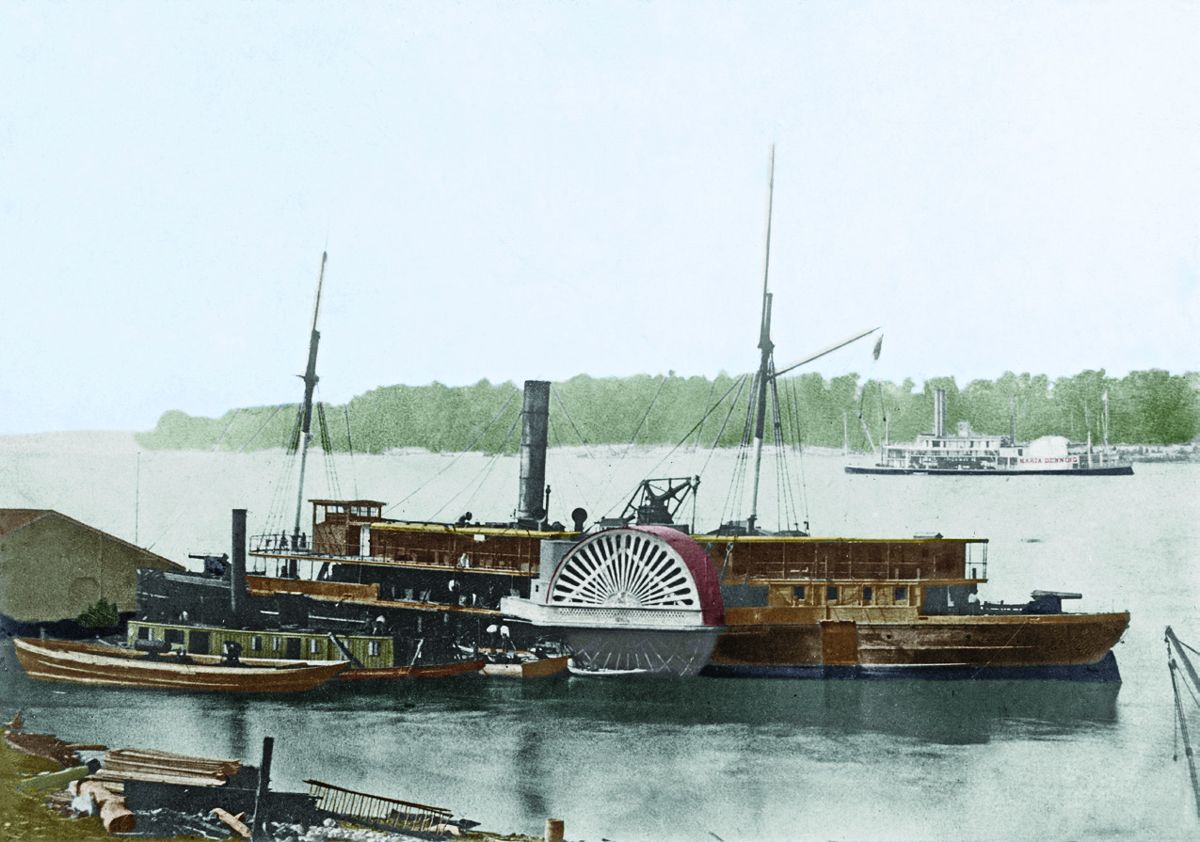
“Boys, give ‘em the best you’ve got! We ain’t dead yet!” Bill Hoel, pilot USS Cincinnati It was dangerous to travel the Mississippi River before modern flood control. A trained pilot was needed to traverse the maze of sandbars, bends and tackle water level issues. Steam power enabled heavy ironclad vessels to travel upriver against the current but lacked the muscle to travel backwards in a pinch. As one solution to the challenges of river combat, civilians on both sides came up with using rams to sink the enemy’s ships, while remaining outside the naval chain of command. Civilian Captains J. E. Montgomery and James Townsend created the Confederate River Defense League. Montgomery would loosely lead experienced riverboat pilots and captains, who would each independently command a lightly armed, cotton clad paddleboat turned into a ram. Separately, under Gen. M. Jeff Thompson’s command, would be men handling the fire power. Montgomery’s primary objective was clearing the Mississippi of Union ships. In the spring of 1862, at Fort Pillow, Tenn., about 30 miles north of Memphis, Tenn., a mortar boat from the Federal Western Gunboat Flotilla was tasked with sending 13-inch shells into the stronghold. “Every half-hour during the day,” a seaman later wrote, “one of these little pills would climb a mile or two in the air, look around a bit at the scenery, and finally descend and disintegrate around the fort, to the great interest and excitement of the occupants.” On May 10, as the crew of the USS Cincinnati was scouring her decks, Montgomery’s eight rams rapidly steamed up river to attack at Plum Point Bend near Fort Pillow. The CSS Gen. Bragg headed straight for her as the Cincinnati fired her 32-pounder shells. “But on she came,” said Seaman Elliot Callender. The Bragg and the Cincinnati came together with a horrific crash. The Bragg tore a 12-foot chunk out of the Cincinnati’s hull, flooding the magazine. “Give her another broadside, boys!” bellowed U.S. Commander Roger Stembel. Stuck together, the Bragg now had a huge hole from the cannon fire. “Board the enemy!” ordered Stembel, just as the Gen. Sterling Price rammed the Cincinnati in the fantail and she began to sink. “Haul down your flag, and we will save you,” the rebels called. The response - “Our flag will go down when we do!” The cheering men fired the last of her dry ammunition as the Cincinnati managed to beach herself on a sandbar as she went down. “The crew scrambled atop the wheel; ‘and now,” said Callender, ‘perched like so many turkeys on a corn crib,’ they watched the rest of the action.” The USS Mound City was rammed by the CSS Gen. Van Dorn. Now sinking onto a sandbar, the Mound City swung the Van Dorn into the path of the USS Benton. The Benton used her fire power on the enemy’s rams, chasing them into the shelter of Fort Pillow, ending the hour-long battle. Montgomery’s victory proved it was possible to sink an ironclad. Or in this case two. On May 25, Beauregard pulled out of Corinth. On June 4, Beauregard ordered all troops out of Fort Pillow and Memphis. Thompson’s men had already left when Montgomery discovered there was enough coal for only one ship to depart Memphis. U.S. Col. Charles Ellet’s Ram Fleet arrived at Plum Point Bend. Ellet was a civil engineer who not only convinced U.S. Secretary of War Edwin Stanton that ramming would be effective in naval combat but that he, personally, needed to be in command, independent of the Navy. Joining him would be his seven brothers and nephews along with his nineteenyear-old son Charles. On June 5, Memphis residents strolling on top of the bluffs at dusk could see clouds of smoke heading downstream; hear “the belching wheezing clank of engines and the thrashing churn of dozens of paddlewheels” and knew that there would be a battle the next morning. In dawn’s early light, ten thousand people crowded the bluffs to witness a repeat of the victorious Battle of Plum Point Bend. Montgomery had met with his captains. They could choose to scuttle their vessels or they could fight. The captains chose combat with 28 light cannons. The Federal ironclads, with 68 cannon, most of them large caliber heavyweights, headed downstream, stern first. Montgomery’s vessels waited, two abreast midstream. Although Thompson’s gunners were gone, his namesake ram fired the first shot. The Benton returned fire as the ironclads steamed backward with the rams behind. “Round out and follow me! Now is our chance!” Ellet yelled to his brother Albert. To the cheers of Union seamen, Ellet’s swift rams weaved their way passed the ironclads. Ellet’s Queen of the West and the Col. Lovell raced towards each other. When the Lovell lost power, the current turned her broadside to the Queen. The Queen smashed into her, almost cutting her into two. “The crash was terrific,” Ellet wrote, “everything loose about the Queen … tables, pantryware, and a half-eaten breakfast were overthrown and broken by the shock.” The Sumter then rammed the Queen, freeing her from the Lovell. As Ellet inspected the damage, Sumter’s Quartermaster shot him in the leg. The CSS Gen. Beauregard and the CSS Gen. Sterling Price aimed for the Monarch following in the Queen’s wake. The Monarch raced between the two Confederate vessels. The pair crashed into each other, destroying the Price’s sidewheel. The Monarch swung around, ramming into Beauregard’s side. From the bluff, the onlookers groaned as the Confederate smokestacks sank from view. As the battle turned, the Bragg and Van Dorn turned to flee. The Bragg grounded on a sandbar and was captured by the Federals. The Van Dorn was the only ram to escape. Both Ellet and fleet commander Charles H. Davis sent a request to the mayor of Memphis to surrender the city. Ellet tasked his son with exchanging the Confederate for the Union flag atop of the post office. Pranksters closed the trapdoor to the roof during the act. The mayor swiftly alerted Federal troops to release them. Davis wrote to his wife, “Thank God for this great success. If the gunboats had fled before me, as their speed easily enabled them to do, they would still have been a thorn in our side. Now they can give us no further trouble; and, moreover, the blockading force of the river by the rebels is destroyed.” On June 23, U.S. Gen. Ulysses Grant arrived and made Memphis his headquarters. Davis was promoted to a flag officer. Between his wound and catching measles, Ellet died on June 21. His brother Alfred was appointed Brig. Gen. of the Mississippi Marine Brigade, which was placed under U.S. Navy command. The Memphis newspaper, The Daily Appeal, evacuated their presses with the garrison troops and continued publication. On June 10, a letter was published from a lady who relates that there was, “…. not a single instance of a Memphian greeting the enemy cordially, if I may except that of my little three-year-old boy. Yesterday he was standing on the sidewalk and a squad of Yankees passed by him. The little rascal ran in among them and in the most cordial manner shouted at the top of his lungs, ‘Howdy, soldier! Howdy, soldier!’ Shaking hands with half a dozen of them, who seemed delighted at such a warm demonstration of sympathy – the first they had met with since landing on our bluff. But while in the midst of his hand-shaking he screamed out ‘Now go shoot the Yankees! Go shoot all the Yankees! Shoot the Yankees!’ It was funny to see the change that came over their smiling faces; and the people the sidewalks: who witnessed the scene, broke out into a big laugh. Our citizens are extremely anxious to get Southern papers, that we may have at least one grain of truth to rely on.” Sources: • To Retain Command of the Mississippi: The Civil War Naval Campaign for Memphis by Edward B. McCaul • Ellet’s Brigade: The Strangest Outfit of All by Chester G. Hearn • The Civil War: A Narrative – Fort Sumter to Perryville by Shelby Foote • http://www.historic-memphis.com/memphis-historic/civil-war-memphis/civil-war-memphis.html Stephanie Hagiwara is the editor for CivilWarinColor.com and Civil War in 3D.com. She also writes a weekly column for HistoryinFullColor.com that covers stories of photographs of historical interest from the 1850’s to the present. Her articles can be found on Facebook, Tumblr and Pinterest.
Brig. Gen. Alfred W. Ellet Colorization © 2017 civilwarincolor.com courtesy civilwarincolor.com/cwn (Library of Congress)