
Fort Lincoln: Guarding The Largest Prison Camp In The North
By Joe Bordonaro · Originally published May 2017 · pp. 16–17
Before the Civil War, Point Lookout, located at the confluence of the Potomac River and Chesapeake Bay on the southernmost point of Maryland, was a summer resort. During the Civil War it became an entirely different type of place. In 1862, Hammond General Hospital was built on Point Lookout as a Union hospital. “The hospital was constructed on pilings and had 16 buildings arranged like the spokes of a wheel with four small buildings in the center. It was completed in the spring of 1863. Hammond Hospital could handle 1,400 patients. Union casualties were transported by water on steamers.”1).
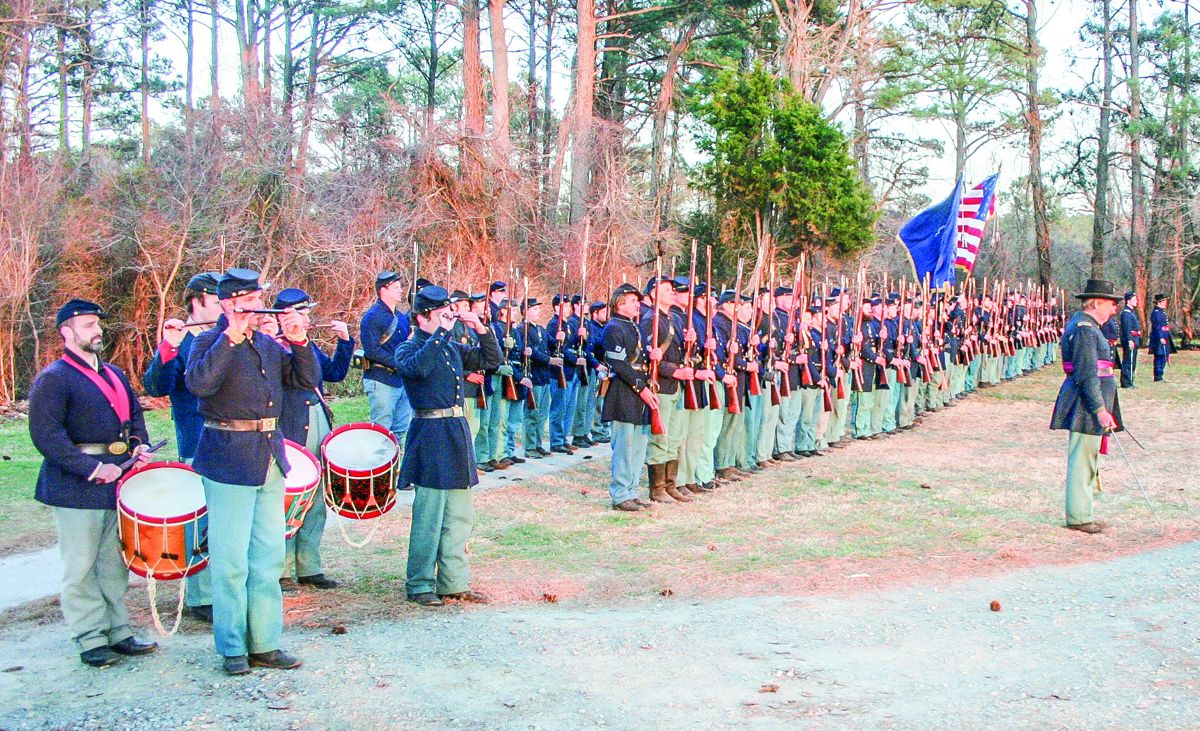
Standing at attention for the Dress Parade.
In 1863, a Confederate prison camp was built near the hospital. Named Camp Hoffman, eventually over 52,000 Confederates passed through its gates. Over 4,000 never left alive, victims of wounds, poor health, poor sanitation, scanty rations, and poor housing. Barracks were never built; all the prisoners were issued tents. Three earthen walled forts were built to provide protection against any Confederate attempt to free the prisoners in the nearby prison camp.). A diary entry by Sgt. Bartlett Yancey Malone, 6th N. C. Inf. illustrates the suffering of the prisoners, stating that on the night of Jan. 1, 1864, the cold was so intense that five men froze. The
same diary entry states that the next day two men were so hungry that they caught a rat, cooked it, and ate it.2 In 1864 a raid on the camp was planned by one of Confederate Gen. Jubal Early’s subordinates during his raid on Washington, D.C. General Bradley T. Johnson planned to free the prisoners, arm them, and march them on Washington, D.C., in conjunction with Gen. Early’s attack on that city. His plans were discovered by Union authorities, however, and, learning of this, Gen. Johnson canceled the plans Most of the prison camp and the forts have been reclaimed by the Chesapeake Bay, but part of one fort survives and has been partially rebuilt. This was Fort Lincoln where a living history event took place on the weekend of March 10-12, 2017. The organizer of the event, Michael Clarke, has been reenacting the Civil War for 17 years. He has been a member of the Liberty Rifles since 2004 and this living history group led the event, but it was a collaboration of many different groups, including the Constitution Guard, the Coffee Coolers Mess, a group from the Independent Volunteer Rifles, the Hannibal (John Peterson) Guards, Fort McHenry Fifes &
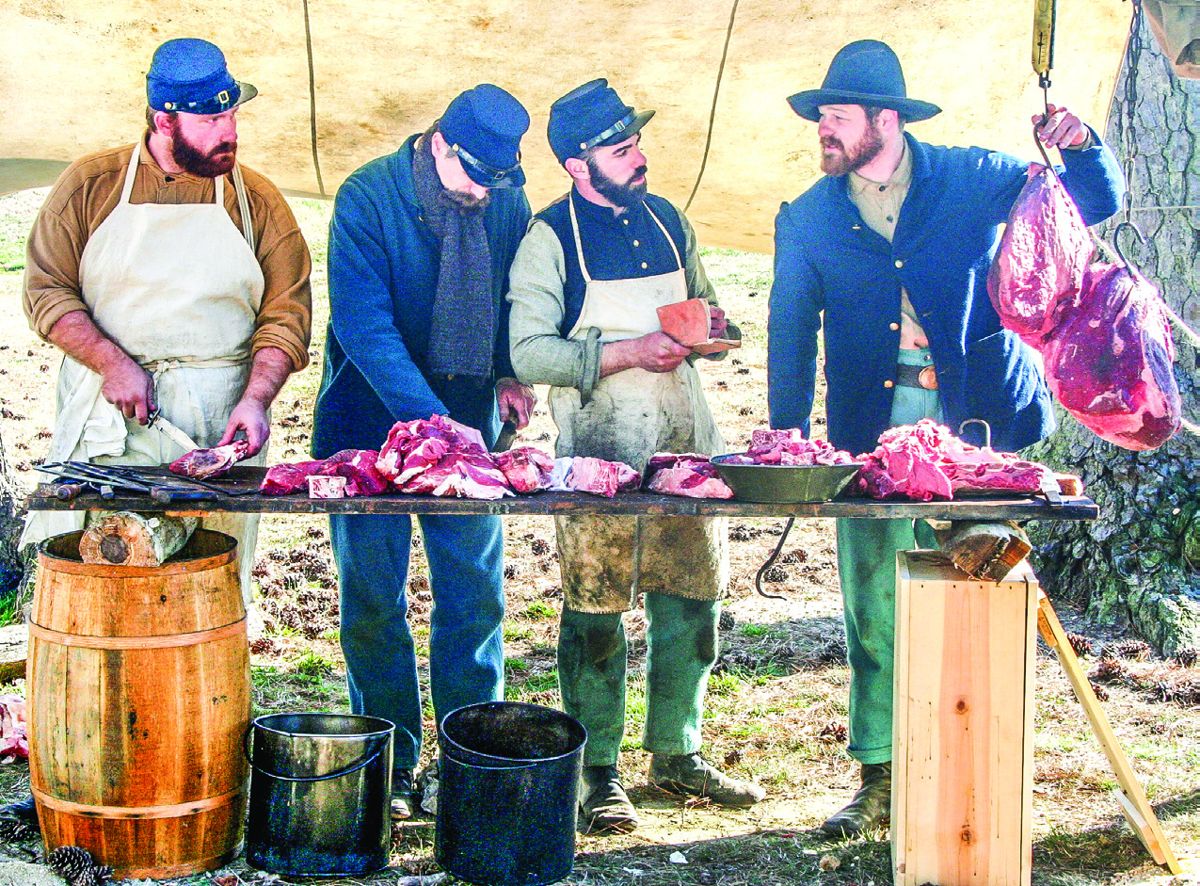
Saule Goode’s (portrayed by John Peterson) Oyster Bar is patronized by Matt Mickletz.
Drums, Camp Chase Fifes and Drums, and a sutler. Saule Goode (John Peterson). There were approximately 130 attendees. John Peterson describes his creation and presentation of sutler “Saule Goode”: “The first appearance for my sutler impression was in 2010 at the Champlain Valley Historical Reenactors Shelburne Crossroads event. Since then the impression has grown, requiring an upgrade to a larger wall tent. This is an impression, not a money-making operation. At events, I set up in the soldiers’ camp, not on Sutler Row. At most events I dole out samples for which I do not charge, such as crackers, cheese, and pickles as well as lemonade for both reenactors and the public. At full immersion events, such as the Soldiers’ Life Experience at Point Lookout or Camp Griffin Winter Quarters, I provide a wider range of consumables that are “purchased” by the boys with printed sutler chits. I have based my impression on a combination of period images, letters, diary entries that mention sutlers, sutler account books,
Hugh Goffinet on guard duty.
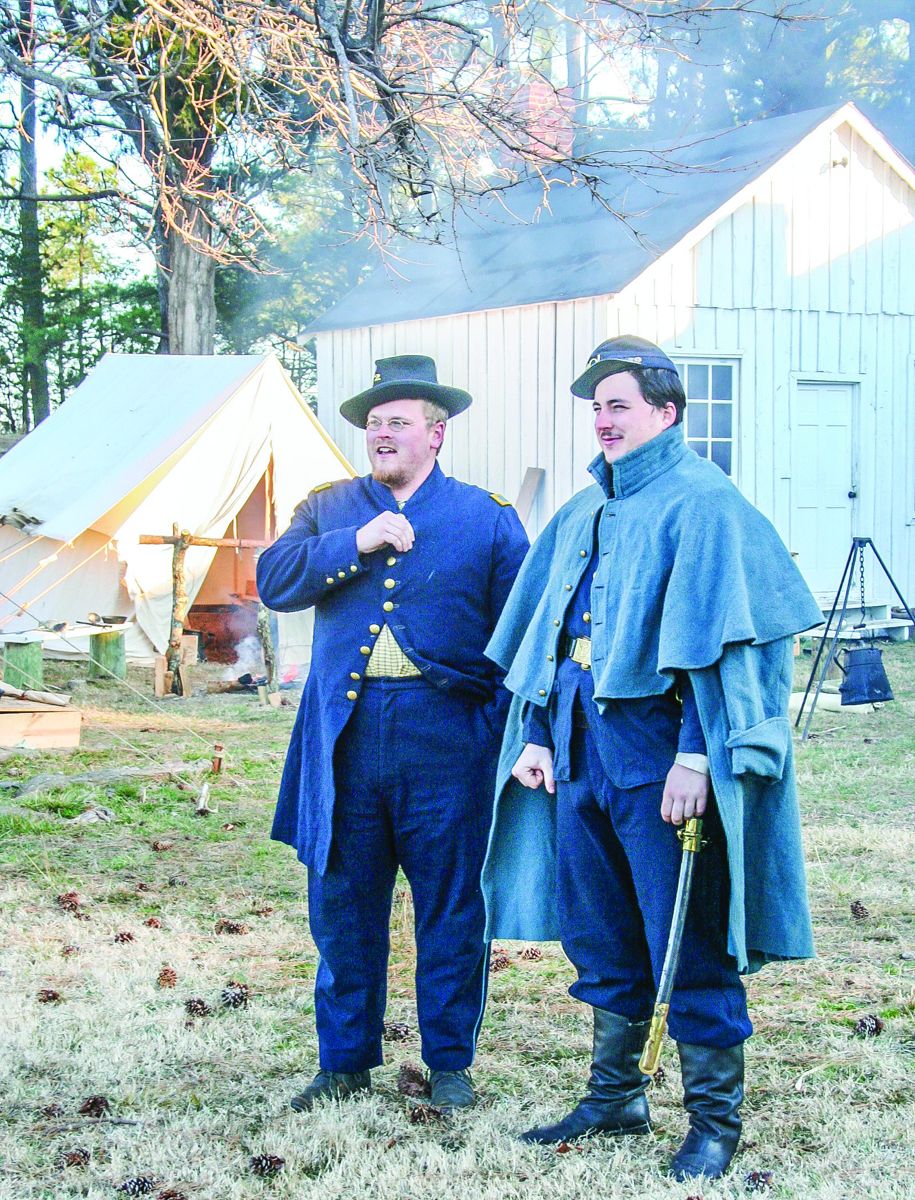
Thomas Grott gets a haircut from Eric Hector. and other sources. Although most of the non-consumable items on display are not actually for sale, I strive to create a setting that authentically portrays a sutler’s store right down to stocking the boxes on shelves with a combination of original and reproduction items like cutlery, combs and brushes, handkerchiefs, buttons, etc.” According to Mr. Clarke, “Fort #3 at Point Lookout State Park has four buildings within the original fort site. The buildings were reconstructed using U.S. Army Corps of Engineer drawings and include a barracks building, officer quarters, and a guard building. Each building has a wood stove, with the exception of the barracks, which has 3. We also have a 100% hand sewn wall tent and a 100% hand sewn Sibley, as well as an additional Sibley tent. The Sibleys were needed to house overflow from the barracks. Each had functioning stoves to keep the men warm.” The goals of the “Soldier Life Experience” were, again according to Mr. Clarke, “…to do an event focusing on the 99% of what Civil War soldiers did, that is to say, camp, drill, eat, drill, fatigue details, drill, lounge around writing letters and having fun with your comrades, etc. The emphasis was on authenticity, eliminating all modern anachronisms, and seeing how far we can push the envelope in terms of an immersive style event.”
Endnotes: 1. http://www.waymarking.com/waymarks/WMBP12_Hammond_Hospital_U_S_Civil_War_Point_Lookout_MD 2. http://docsouth.unc.edu/fpn/malone/malone.html.
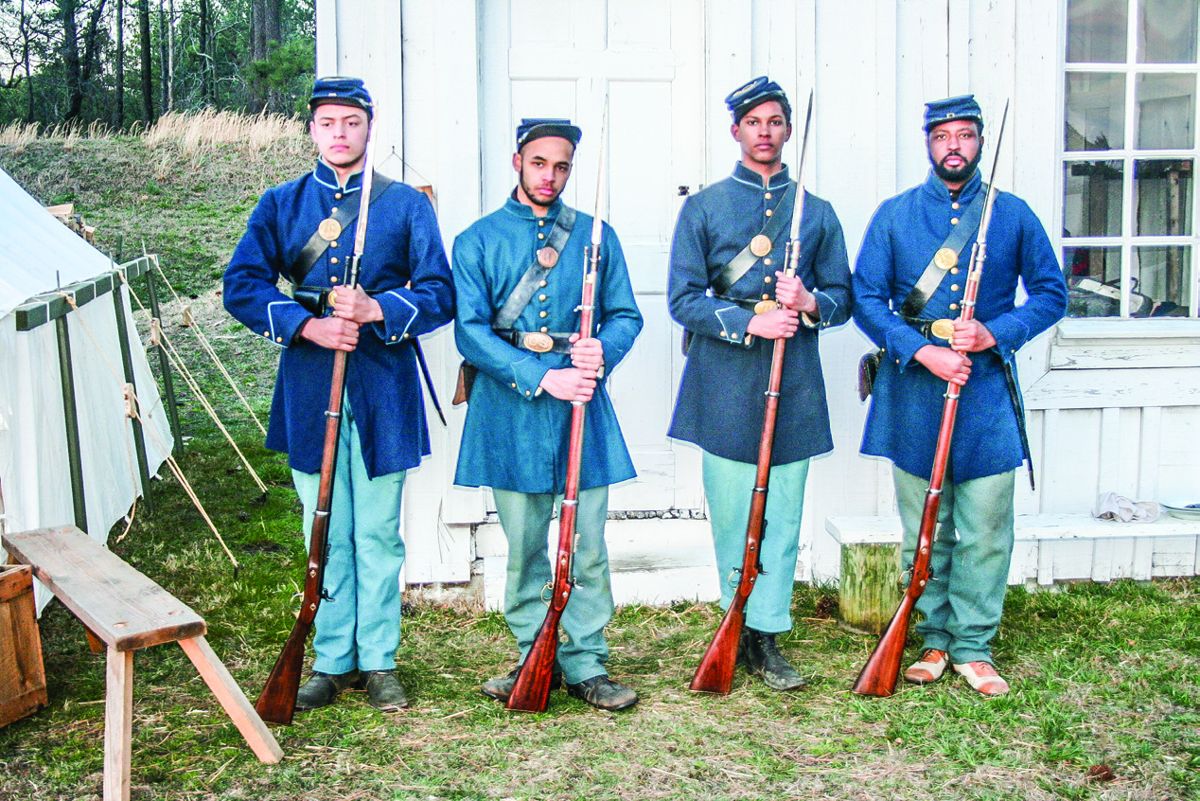
Jordan Bonardi, Noah Shiffer, Hugh Goffinet, and MarvinAlonzo Greer prepare to go on guard duty. (John Peterson)