
Book Reviews
Book Reviews — May 2017
Originally published May 2017 · pp. 24–31
Civil War News book reviews provide our readers with timely analysis of the latest and most significant Civil War research and scholarship. Stephen Davis, Civil War News Book Review Editor. Email: [email protected]
The Confederate Soldiers of Rockbridge County, Virginia A Roster. By Robert J. Driver Jr. Photos, 360 pp., 2016, McFarland, www.mcfarlandpub.com, $49.95. Reviewed by Keith Bohannon
Readers of Civil War News familiar with the Virginia Regimental Series published by H.E. Howard might recognize the name Robert J. Driver Jr., author of some of the best volumes in that series. Lt. Col. Driver, a retired Marine, has also written several other books on Maryland Confederate units. Driver’s unit histories always exhibit extensive research, including useful block quotes from soldiers’ letters, diaries, and memoirs, as well as impressive rosters that contain a great deal of biographical information. In The Confederate Soldiers of Rockbridge County, Driver provides a comprehensive roster of all known Confederate soldiers, sailors and marines from Rockbridge County, Virginia, or those who served in units raised there. The roster also includes men who were alumni of Washington College and the Virginia Military Institute and lived in Rockbridge before or after the Civil War. As many readers undoubtedly know, both of these institutions are located in Lexington, the county seat of Rockbridge. The roster in The Confederate Soldiers of Rockbridge County provides a wealth of biographical details about thousands of men who served in famous units that fought under “Stonewall” Jackson and Robert E. Lee, including the Rockbridge Artillery, the 4th and 27th Virginia Infantry Regiments of the “Stonewall Brigade,” and numerous commands. Driver’s bibliography reveals the depth of his research into city and county records, census schedules, university, state, and national archives, pensions, compiled service records, newspapers and other sources. The book also includes dozens of photographs, many of them previously unpublished and in private hands. While many of these images are of veterans taken after the Civil War, there are also numerous wartime images which will appeal to those interested in Confederate uniforms.
Keith Bohannon teaches history at the University of West Georgia. He is the author of numerous essays, including a recent one on Confederate engineering operations in the 1864 Overland Campaign which appears in Gary Gallagher and Caroline Janney, eds., From Cold Harbor to the Crater (University of North Carolina Press, 2015).
After Gettysburg: Lee Retreats, Meade Pursues. By Joe Mieczkowski. Maps, photos, illustrations, notes, index, 154 pages, 2017, PediaPress, pediapress.com. $21.80 softcover Reviewed by Thomas J. Ryan
This unconventional examination of the post-Gettysburg period provides concise descriptions of Confederate Army of Northern Virginia and Union Army of the Potomac operations during the latter months of 1863. Included are sketches of selected military officers participating in these engagements. The editor of this work is Joe Mieczkowski, a Licensed Battlefield Guide at Gettysburg National Military Park. He compiled it to answer the question “whether or not [Maj. Gen. George G.] Meade could have made the wound he had inflicted [on Gen. Robert E. Lee’s army at Gettysburg] a mortal one…[?]” He relied primarily on well-established secondary source material. After Gettysburg summarizes Gen. Robert E. Lee’s retreat from Gettysburg, and Meade’s efforts to track him down before his army crossed the Potomac River. It provides brief accounts of a number of post-Gettysburg engagements, including at Fairfield, Monterey Pass, Williamsport, Boonsboro and Funkstown. Under the heading “Meade Pursues,” it discusses later battles at Manassas Gap, First and Second Auburn, Bristoe Station, Buckland Mills, Second Rappahannock Station and Mine Run.
Portrayed as “notable individuals” are William H. French, John D. Imboden, William E. Jones, Hugh Judson Kilpatrick, John Sedgwick, J.E.B. Stuart, and Gouverneur K. Warren, with Stuart receiving particular attention. All were Union or Confederate general officers who served during this period. LBG Mieczkowski, in response to the question he raised in the introduction (i.e., whether Meade could have inflicted a mortal wound on Lee’s army during the post-Gettysburg period), highlights Meade’s slow pursuit of Lee, and his missed opportunity to fortify Fairfield a few miles west of Gettysburg. This he believes would have prevented the retreating Army of Northern Virginia’s movement through Monterey Pass over South Mountain, and left Lee the option “to either fight [his] way through Fairfield while its rear was exposed to the Army of the Potomac or take his entire army though the Cashtown Pass, a much more difficult route to Hagerstown.” However, the writer counters criticism of Meade for “alleged timidity” and deference to his cautious subordinates by citing that his army was exhausted, and the pursuit was “physically demanding.” Rather than reaching a specific conclusion regarding Meade’s effectiveness,
Mieczkowski presents the facts and allows the reader to decide. There are a number of imprecise statements and a few inaccuracies in the commentary, but generally the information is reliable. Succinct statistical charts and small-scale maps are included, as well as notes, sources, and an index. Essentially, this publication serves an introduction to the generalship of Meade and Lee during a series of engagements in the immediate post-Gettysburg period, and the latter half of 1863. The seven biographical sketches are an added feature. Although Civil War specialists may find this handbook useful as an orientation to the featured engagements, it is geared more for readers new to the subject who can learn from the information provided and the source material referenced. Thomas J. Ryan is the author of the multiple award-winning Spies, Scouts, and Secrets in the Gettysburg Campaign (2015). With Richard R. Schaus he is writing a new book titled Eleven Fateful Days in July 1863: Meade Tracks Lee’s Army after Gettysburg, due out in 2018.
Images of America: Civil War Graves of Northern Virginia. By Charles A. Mills. Photo illustrations, 127 pp., 2017, Arcadia Publishing, arcadiapublishing. com, $21.99. Reviewed by Meg Groeling
Images of America is a wellknown trademark of Arcadia Publishing. Each volume in this extensive collection is about a single subject, and lavishly illustrated with images accurate for the period from both the Library of Congress and the author’s personal collection. Civil War Graves of Northern Virginia is no exception. Because northern Virginia was an area of so much carnage during the Civil War, gravesites in the state are many and varied. Charles A. Mills, author of numerous books on the history of northern Virginia and producer of the cable TV show Virginia Time Travel, begins with Alexandria, the first city in Virginia to be placed under Federal occupation (May 24, 1861). It is especially important that the grave of James Jackson is included in this book, as few have seen images of it. Jackson was the proprietor of the Marshall House Hotel, and shot Union colonel Elmer Ellsworth in a much-celebrated incident involving a large Confederate flag. Jackson was shot as well, and both men died on the scene. The Ellsworth-Jackson story is accurately covered by Mills, and is a welcome addition to any history of the area. The Battle of First Manassas (Bull Run) has generated several iconic series of photographs, many of which are featured in Civil War Graves of Northern Virginia. Of special interest are the ones that contain two small boys in Confederate uniforms. These are Samuel and Joseph, the sons of John and Martha Thornberry. The boys tagged along with photographer George Barnard as he took photos almost a year after the battle. Additionally there are many photos of small graveyards in the surrounding area, as well as those associated with the Henry House. Mills’ accompanying text complements the photos beautifully. Chapter Three, “Fairfax County,” begins the discussion of the reinterment movement in Virginia. So many bodies were left unburied or buried in mass graves after the many battles in the state that, after the war, it became an imperative of the remembrance movement to disinter and rebury these remains. The journey of Major General Phil Kearney’s body from Chantilly, Virginia, to New York and then back to Virginia (he is buried at Arlington) is highlighted, as are the efforts to recognize the common soldier at Pohick Church. Graves of unknowns at Falls Church also receive mention. Along with the places that are well known, such as the Fairfax Cemetery and Arlington, Mills has included many words and images of small, sometimes singular, plots honoring both Confederate and Union soldiers. He also writes about Jermantown Cemetery. Established in 1868, this little gem holds the remains of African Americans who could not be buried in segregated cemeteries like the one in Fairfax City. It is a pleasure to see so many of these smaller places given attention in this book. No book on gravesites in Virginia would be complete without at least a nod to Arlington National Cemetery. Mills gives readers a brief history of the place, followed by excellent images of some of the more famous Civil War graves located there. He closes his remarkable little book by reminding us of the deaths of the last Union and Confederate veterans, and the last formerly enslaved person. It is a fitting way to end this journey through the past, told with honor and respect by Charles A. Mills. Meg Groeling is the author of Aftermath of Battle: The Burial of the Civil War Dead (2015) and a regular contributor to the Emerging Civil War blog. She is currently working on First Fallen, a new biography of Colonel Elmer Ellsworth, the first Union officer to die in the Civil War.
Stepdaughters of History: Southern Women and the American Civil War. By Catherine Clinton. Notes, index, 144 pp., 2017. Louisiana State University Press, lsupress.org. $27.50 hardcover. Reviewed by Tracy J. Revels
Many aspects of the Civil War remain challenging to historians. Stories of southern women, especially African American women, are mired in academic debate. Catherine Clinton’s Stepdaughters of History: Southern Women in the American Civil War is a clarion call for more research and better writing in this field. Clinton’s work is a collection of essays on the state of Civil War women’s history. While northern women do receive some mention, southern women, both white and African American, are the primary focus. Three essays (drawn from the author’s Walter Lynwood Fleming lectures) comprise this slender volume: one on writings by and about Confederate women, one on the ways in which Confederate women challenged gender restrictions during the war, and a final essay on how the “Mammy” stereotype has worked to obscure the lives of African American women from the antebellum period to the present day. Clinton delves into the debates about these areas and discusses much of the recent work by noted historians. These essays bring to light the problems historians face in trying to tell the stories of southern women, and how anyone seeking to explore this field must navigate the minefields of Lost Cause politics, memoirs that may be more fiction than fact, a lack of sources for minority women, and rampant sexism in a field that still tends to assign roles to historical women based on dichotomies:
angel or devil, weakling or heroine, good mother or sinful prostitute. Whether popular writers or academic historians, many authors, in Clinton’s estimation, have trouble getting at the real humanity of southern Civil War women and finding ways to acknowledge their accomplishments. Clinton’s work is useful to the student of southern and Civil War women’s history in that it provides a keen historiographical survey of the field. Clinton works her way through the “moonlight and magnolia” writers, identifies the historical conundrums that published diaries present, and rips apart the Mammy stereotype with relish. Anyone preparing for doctoral exams would be hard pressed to find a better review text. Unfortunately, this strength for an academic reader makes the book less appealing to the general reader. The title is misleading; this is not a consideration of southern women so much as it is an exploration of historical writing about them. The simple addition of “essays” to the title would have been welcome. Lacking a clear narrative, and wandering through the literature on the subject (often with asides about Clinton’s own prolific work in the area), the book offers little for those seeking to understand the day-to-day lives of women in the Confederacy. In her introduction, Clinton reveals that publishers long for a female Battle Cry of Freedom. While demurring from writing it herself, she has essentially thrown down the gauntlet for other historians. It is time for a great narrative of women in the war, a narrative that encompasses all of the outstanding research on war and gender of the past fifty years. But if this future book is to succeed in breaking apart stereotypes and incorporating the voices of all women, not just the ones who left behind publishable diaries or have become famous through biographical accounts, it must be written in a style accessible to the enthusiastic reader, rather than a strictly academic one. Tracy J. Revels is a professor of history at Wofford College in Spartanburg, SC. She is author of Grander in Her Daughters: Florida’s Women During the Civil War (2005) and the recently released Florida’s Civil War: Terrible Sacrifices (2017). She will be speaking at the Mercer University Press Symposium on the Civil War in September (see ad in this issue).
Plotting to Kill the President: Assassination Attempts from Washington to Hoover. By Mel Ayton. Photos, notes, bibliography, index, 328 pp., 2017, University of Nebraska Press/ Potomac Books, www.potomacbooksinc.com. $32.95.
Reviewed by Robert L. Durham
While presidential assassinations have had a lot of paper devoted to them, assassination attempts were much harder for Mel Ayton to research. He gives excellent, succinct accounts of the three actual assassinations which occurred, but found it more difficult to investigate the unsuccessful tries. Presidents and their security guards kept these attempts secret as much as possible. They thought that to make these tries public would only lead to copycat attempted assault on presidents, Ayton culled newspaper articles, government reports, Library of Congress records, National Archives documents, presidential libraries, and memoirs by presidents, bodyguards and Secret Service agents. Surprisingly, despite the many attempts at assassination, the U.S. gave little thought to providing protection for the highest office in the land. Most crackpots, or cranks, were simply escorted out of the White House or taken to insane asylums if they proved to be hard to handle. Threatening letters to the presidents were usually ignored. A uniform system of bodyguard protection was not made available; for Abraham Lincoln’s inauguration, a private detective agency, the Pinkertons, was hired. Many times the president’s secretary, valet, or some other personal servant doubled as guard. One reason the presidents themselves did not request, or even cooperate with, bodyguards was because it was believed that only European monarchs stood in need of such protection. The United States was a democratic republic—citizens would not think of such a thing as assassination. This was another reason why attempts usually went unreported; an assassination attempt would be proof that the U.S. Executive Branch was not immune to such shenanigans. The Secret Service was not established until after three presidents had been killed in office. Even then, it was not originally created for the protection of the president, but to prevent counterfeiting. The officers of the Secret Service would sometimes post agents for presidential protection, but Congress became perturbed because the Service was not funded for these extracurricular duties. It was only late in presidential history that a separate office of the Secret Service was established specifically for the safety of the president. Even when guards were posted in the White House or assigned to accompany the presidents when going for a walk or ride, the chief executives often went out of their way to shake their bodyguards or bypass the White House police. Reading this book, it seems that some of the presidents almost had a death wish. Plotting to Kill the President is a good read and I have few negative thoughts on it. One thing I didn’t like was that while the presidents are treated chronologically, within the chapters on the individual presidents, the accounts jump around quite a bit. I didn’t find this hard to follow but it was a little disconcerting at times. Although not a Civil War book, per se, I recommend it to anyone wanting to find out how Abraham Lincoln’s security compared with other presidents before and after him. I also recommend it to everyone wanting a good read. Robert L. Durham has been a devoted Civil War buff for many years. He has written several articles for publication, and is currently working on the battle of Richmond, Ky.
A Tour Guide and History of Col. John S. Mosby’s Combat Operations in Loudoun County, Virginia. By Donald C. Hakenson and Charles V. Mauro. Illustrated, bibliography, index, 238 pp., 2016. HMS Productions, Inc., hmshistory.com, $30.00 softcover. Reviewed by Jeffry D. Wert
The northern Virginia counties of Loudoun and Fauquier comprised the heart of “Mosby’s Confederacy.” From this base for more than two years, Mosby’s Rangers operated against enemy units eastward toward Washington, D.C., and to the west across the Blue Ridge in the Shenandoah Valley. As the war lengthened, the fame of their exploits increased in both the North and in the South. John S. Mosby received permission from Major General Jeb Stuart to conduct partisan operations in the region at the end of 1862. Mosby had chosen wisely for such raids and attacks, as Federal units and wagon trains traversed the area frequently. Mosby’s initial successful forays brought in more volunteers until he had enough men to form Company A, 43rd Battalion of Virginia Cavalry in June 1863. When not on raids, the Rangers boarded with civilians in “safe houses.” These civilians not only hid and fed the Confederates, but often alerted Mosby and his men to the presence of enemy troops in the area. The Rangers could not have conducted their operations without the assistance of the local populace. From the winter of 1863 until the summer of 1864, Mosby centered his raids primarily to the east toward the national capital. Consequently, the Rangers clashed frequently with Federals in Loudoun and Fauquier counties. Lying closer to Washington, Loudoun County witnessed more of the engagements during these months. This new tour guide and history by a pair of veteran Mosby historians contains 91 sites, with additional 17 sites of graves of Mosby’s men. Not all of the sites are related directly to the partisan command. The authors arrange the guide chronologically. There are no driving directions, but the authors list the latitude and longitude coordinates for the houses and other buildings. The authors have endeavored to include all the known sites in Loudoun County associated with Mosby and his men. At least ten per cent of the sites have little, if any, relation to the partisan unit. Some of the sites only consist of photographs of historical markers. The most detailed accounts are on major encounters between the Rangers and Union cavalry—Miskel’s Farm, April 1, 1863; Loudoun Heights, January 10, 1864; Anker’s Shop, February 22, 1864; and Mount Zion Church, July 6, 1864. All of them were Ranger victories, except Loudoun Heights, where Mosby suffered one of his worst defeats, with the death of seven men. The book is replete with photographs, one of its major appeals. The descriptions of events are straightforward, but the narrative seems rather overwrought in places. There are no footnotes or endnotes, so the sources for each event are not specifically known. This tour guide would be difficult to use on a driving tour. It could require preparation with the GPS locations. Nevertheless, this is an enjoyable read, and the photographs are most welcome. Many of the sites are on private property and in out-of-way places. The authors have done their work well. Jeffry D. Wert is the author of several Civil War books, including Mosby’s Rangers (1990). He is writing a new study of northern industrialists during the conflict.
Thunder at the Gates: The Black Civil War Regiments that Redeemed America. By Douglas R. Egerton. Maps, photos, notes, index, 488 pp., 2016, Basic Books, www.basicbooks.com, $32. Reviewed by Jonathan A. Noyalas
Several months after President Abraham Lincoln signed the Emancipation Proclamation and opened the door for recruitment of African Americans, the New York Tribune reported that “the great majority” of the North’s white population believed African American soldiers “will prove cowards.” Those African Americans who answered that first call to arms in the North in the spring of 1863—the men who enlisted in the 54th and 55th Massachusetts Infantry and 5th Massachusetts Cavalry— knew they had to prove the naysayers wrong. While much has been written about the African American experience in the Civil War era in recent years, few books offer as compelling a narrative about the hardships endured, obstacles overcome, and service rendered by those three regiments than Douglas Egerton’s latest volume. Egerton’s exhaustively researched and impeccably written history offers a remarkably detailed chronicle. Egerton masterfully recounts the 54th’s and 55th’s service in South Carolina and Florida and the 5th’s wartime experience in Virginia. While Egerton’s battle descriptions are powerful, what makes the author’s examination of the fighting at places such as Battery Wagner and Olustee even more compelling is his analysis of how these engagements, whether defeat or victory, spurred African American enlistment and eliminated any doubt as to the fighting ability of African American soldiers. This book, however, does much more than merely recount the combat experiences of three African American regiments. Although the men of these regiments displayed heroic fortitude in battle, the author reminds us that what makes the efforts of these three Massachusetts regiments so remarkable is that they confronted obstacles which their white counterparts never had to face—pay inequality, the incessant fear of being enslaved or executed if captured by Confederates, or the struggle to constantly prove their worth. The author is careful to point out that while the men who served in these regiments faced constant barriers, their enlistment also created hardships for family members—especially if killed. While the author notes that the “death of a son or husband was tragedy enough for American women in the year after 1861,” Egerton cogently argues that the hardships endured by the families of African American soldiers killed in combat became magnified. In many cases, Egerton argues, the men who comprised these regiments were “the youngest, strongest males, and the future of the family”; once they were gone families left behind had to take drastic measures to avoid “a descent into poverty.” Among the heart-rending stories Egerton recounts is the case of Sarah Vorhies, whose son Isaac, a soldier in the 54th, succumbed to dysentery in July 1863. With no one left to support her, Sarah hired herself out as a servant at the rate of $5 per month to make ends meet. Keeping current with an emerging trend among Civil War regimental historians, the author examines what happened to the veterans of these regiments after the war’s guns fell silent. In addition to highlighting the success of some such as Stephen Swails (who was elected president pro tem of the South Carolina senate in 1872), Egerton provides a succinct examination of the ways in which veterans of these three Massachusetts units remembered and commemorated their service. Egerton’s volume—which was rightfully awarded the 2017 Gilder Lehrman Lincoln Prize—is not only a beautifully written book, but an inspiring one. Egerton, as do all of the greatest historians, sees a lesson that people in the present can glean from the experiences he recounts in this splendid study: never cower in the face of adversity, always look forward and be persistent in the pursuit of right. Prof. Jonathan A. Noyalas is the director of the McCormick Civil War Institute at Shenandoah University in Winchester, Virginia. He is the author or editor of eleven books on Civil War-era history, including Civil War Legacy in the Shenandoah: Remembrance, Reunion, and Reconciliation (History Press, 2015).
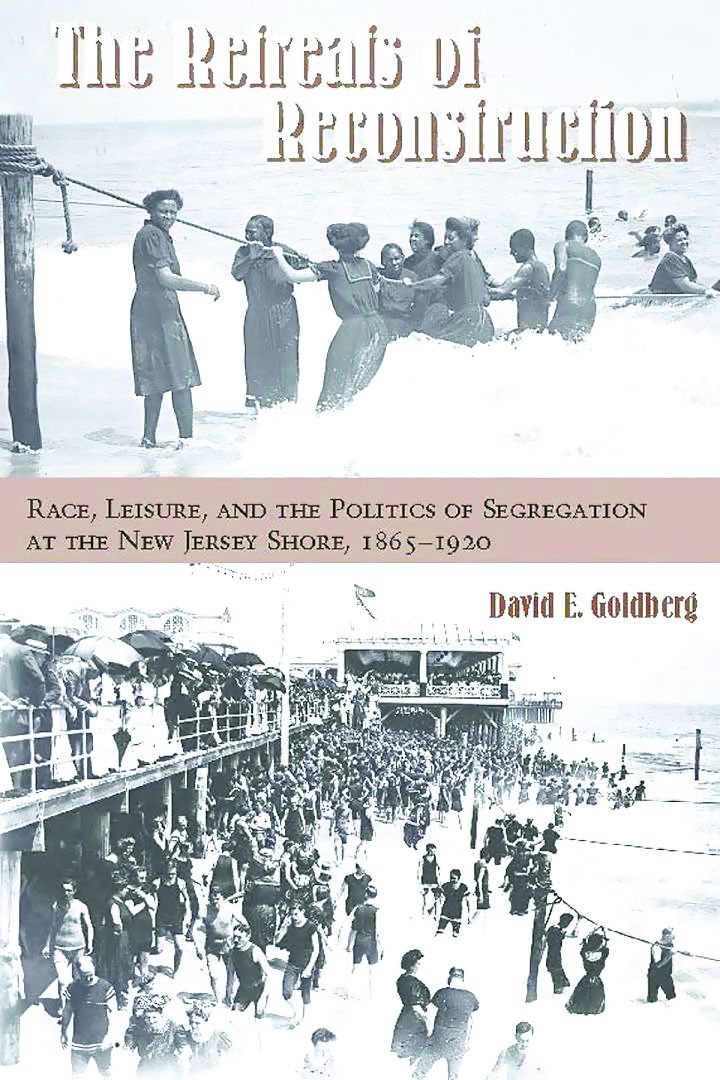
The Retreats of Reconstruction: Race, Leisure, and the Politics of Segregation at the New Jersey Shore, 1865-1920. By David E. Goldberg. Illustrated, notes, bibliography, index, 190 pp., 2017, Fordham University Press, fordhampress.com, $28.00. Reviewed by Wayne L. Wolf
David Goldberg uses a case study approach of Asbury Park, New Jersey, to demonstrate how economic forces and cultural dynamics contained desegregation and prolonged the life of Jim Crow in this resort community. In fact, Jim Crow legislation can be viewed as a product of market forces where business and political leaders accepted the theory of free labor and consumerism to promote economic advancement rather than social integration. Asbury Park was thus envisioned as a resort that could shield tourists, black and white, from civil rights agitation and social disorder so characteristic of Reconstruction. Black citizens lobbied for access to the leisure of the New Jersey shore as an economic right, not an intrusive claim to social privilege. They felt these rights were guaranteed by law and promoted by a free market. Black rights concerning consumer choice were thus pitted against social preference, public opinion and political expediency.
By the 1880s, Black activists were beginning to utilize tactics to integrate Asbury’s places of amusement, beaches and shops that would foreshadow the civil rights movement of the 1950s and 1960s. Boycotts of businesses, worker walkouts from hotels, spending confined to black businesses, political pressure and increased demands for infrastructure improvements upset the boundaries of Jim Crow. The conflict of these tactics of the civil rights movement with a segregated consumer marketplace led to the decline of the Boardwalk empire and its unattractiveness to white and black patrons alike. This book is admittedly outside the traditional genre of Civil War history. Yet the civil rights strategies used in the Reconstruction Era and beyond can also be seen in antebellum slave resistance. Frequent charges by slave owners that chattels were purposely engaging in work slowdowns, that strict laws were necessary to prevent an integrated society, and slave escapes from harsh working conditions were commonplace. Furthermore, they foreshadowed the same tactics used in the 20th Century civil rights era. For the Civil War historian who wishes to explore the social aspects of a society altered by war, or analyze how America coped with integrating postbellum society, this well researched, readable and scholarly look at the challenges of individuals, businesses and political entities is useful. Likewise, for readers who wish to explore the connection of consumerism, leisure and integration in the Reconstruction Era, this book is recommended. Wayne L. Wolf is Professor Emeritus at South Suburban College in South Holland, Ill., and the author of numerous Civil War books and articles. His recent research focuses on editing and publishing original Civil War soldiers’ letters and diaries which tell the story of the common soldier in wartime.
Psychological Consequences of the American Civil War. By R. Gregory Lande, M.D. Notes, bibliography, index, 256 pp., 2016. McFarland, www.mcfarlandpub.com. $35 softcover. Reviewed by Daniel A. Pollock, M.D.
In the past 20 years, Eric Dean, James Marten, David Silkenat, Lesley Gordon and other historians have used a variety of archival materials to produce in-depth studies of U.S. Civil War veterans’ debilitating psychological responses to combat exposure and other wartime experiences. Their responses anticipated by a century or more the heavy mental health toll taken on many U.S. veterans who served in the Vietnam War or subsequent conflicts in the Persian Gulf, Iraq, and Afghanistan. These historians have not ventured estimates of the extent to which their findings of enduring psychological wounds among some veterans are indicative of the post-war experience of Civil War veterans in general. Indeed, many of their accounts explicitly and wisely demur on that point. Formidable obstacles—among them incomplete understanding of the representativeness of study samples, plus sparse and difficult-to-interpret primary source materials—have been strong deterrents to general statements about the magnitude and distribution of psychological ill effects among those who served in America’s bloodiest conflict. Independent scholar R. Gregory Lande in The Psychological Consequences of the American Civil War adds to the growing body of work about the psychological afflictions which plagued numerous Union and Confederate veterans. Dr. Lande’s concise survey includes interpretations of homesickness, nostalgia, sadness and suicide, intemperance, crime, and the psychological roles of Spiritualism and patent medicines. It reflects his professional experiences as a military psychiatrist and his extensive research in popular publications, professional journals, census records, soldiers’ letters, and other materials from the Civil War era. His narrative accounts of the hardships and misfortunes of individual veterans are well told and placed within the larger context of the Civil War’s aftermath, when the war’s psychological legacy was only dimly understood. Dr. Lande reports that other historians have explored the same source materials he used to investigate the Civil War’s lingering effects, but adds that his study differs in scope and analysis. He might have mentioned another important departure: The Psychological Consequences of the American Civil War goes well beyond previous assessments in boldly asserting that the war’s emotional aftermath “can be estimated in terms of the misery that infected society” and amounted to “a virulent contagion that rapidly spread across America, leaving in its wake a depressed and demoralized segment of the population.” Dr. Lande describes the postwar era in starkly dystopic terms, concluding that the emotional turmoil produced by the Civil War “contributed to decades of mayhem, misery, and malevolence on a scale unprecedented in America’s short history.” The evidence that Dr. Lande presents to substantiate his claims about a nationwide “tsunami” of problems is far from compelling. He cites numerous poignant incidents and tragic endings culled from reports in contemporary mass circulation publications, and a more limited set of official statistics such as suicide rates from 1860 through the mid1880s. However, other historians who have studied the Civil War’s psychological casualties have treated some of the same source material with greater circumspection, recognizing the risks of over-reliance on compilations of anecdotal information reported in the popular press, or lending too much credence to official causeof-death records. A prime example is David Silkenat’s study of suicide, debt and divorce in Civil War-era North Carolina. Silkenat eschewed the use of state and national suicide records because of their unreliability during the years he studied. Although Dr. Lande cites Silkenat’s work, he does not address concerns about the reliability of 19th century vital statistics. More broadly, Dr. Lande would have benefited from more extensive engagement with recent scholarship, much of it seemingly overlooked in The Psychological Consequences of the American Civil War.
Daniel Pollock is a Medical Epidemiologist at the Centers for Disease Control and Prevention (CDC) in Atlanta, GA. His initial work at CDC was a study of postservice mortality among U.S. veterans following their service in the Vietnam War. His longstanding historical interests include Atlanta and the Civil War, about which he has written for Emory University’s on-line journal Southern Spaces: https://southernspaces.org/2014/ battle-atlanta-history-andremembrance.
Independence or Annihilation: Campaigns of the 60th Virginia Regiment of Infantry. By William L. Caynor, Sr. Maps, photos, footnotes, sources, 735 pages, 2016, Civil War Collectibles LLC, Butternut WI, www.60thvirginiaregiment.com. Reviewed by H. V. Traywick Jr.
This is an unusual work that takes an interesting approach to the history of a regiment in the War of 1861-1865. Far more than a recitation of the campaigns, battles, leaders and events pertaining to the service record of the 60th Virginia Regiment, this is a living document of human interest. The author in effect opens a portal in time and introduces the reader to various members of the unit, while integrating them, with interesting personal vignettes, into the broader narration of the times, both before and during the war. The 60th Virginia was comprised of men from the counties that now lie on either side of the Virginia – West Virginia border. As such they faced in battle some of their kinsmen and neighbors who served in Union units from West Virginia, making for them – as the author notes – a war that was truly “brother against brother.” The regiment served throughout the war, including Jubal Early’s Valley Campaign of 1864. In February of the last disastrous winter of the Confederacy – with the Valley burned by Sheridan, with Lee’s starving but defiant army under siege at Petersburg, and with Sherman burning and pillaging his way up through the Carolinas—the spirit of the men of the 60th Virginia remained undaunted. In “A Message from the Army of the Valley of Virginia,” they unanimously adopted resolutions that justify the title of this book. In Article I they resolved: “That in the beginning of this revolution we volunteered in response to the first call of our country to battle for the sovereign right of self-government, and that, after four years of terrible war with the savage foe who seeks our subjugation, we are still firm in our determination to achieve our independence or to perish nobly struggling for it.” The book’s large number of images of these men – some in uniform, but many taken long after the war was over – show that they were no “snowflakes” in need of safe spaces when their fortunes turned against them. They were men of iron and of solid character. In fact, Mr. Caynor’s book might well be considered as much a character study of the soldiers of the 60th Virginia Regiment as a history of its campaigns. The first half of the book is comprised of the war narrative, while the second is a treasure trove of the rosters of the individual companies, with biographical sketches of most of the men. In the back of the book the names are listed alphabetically, with rank and company, to make it easy for anyone wishing to locate any given individual in the roster. The obviously enormous and detailed research that has gone into the production of this work shows the unmistakably personal connection the author has to his subject. He is a descendant of some of the men who served in the 60th, and one can tell that his thorough, comprehensive and scholarly research has been a labor of love. H. V. Traywick Jr., is author of Empire of the Owls: Reflections on the North’s War against Southern Secession (2013); Virginia Iliad: The Death and Destruction of “The Mother of States and of Statesmen” (2016); A Southern Soldier Boy: The Diary of Beaufort Simpson Buzhardt (2017), as well as other works.
Albert C. Ellithorpe, The First Indian Home Guards, and the Civil War on the TransMississippi Frontier. Edited by M. Jane Johansson. Maps, photos, notes, index, 280 pp., Louisiana State University Press, www.lsupress.org, $45 cloth. Reviewed by Jeff Patrick
Several years ago, history professor and author M. Jane Johansson of Rogers State University (OK) decided to edit the journal of Albert Chapman Ellithorpe, who served as an officer in one of the most unique units in the Union Army. In the process of researching this fascinating individual, she located his long forgotten newspaper letters and official correspondence. The result is this impressively edited collection of material from the still underappreciated war fought west of the Mississippi. Ellithorpe, a white businessman, journalist, inventor and politician, was “part of a unit that uniquely and successfully allied three races in the task of defeating the Confederacy”—the First Indian Home Guards. Composed of eight companies of Creeks, two of Seminoles, and a small number of African-Americans from both tribes, the First Indian Home Guard regiment was mustered into service in May 1862. With Ellithorpe as a first lieutenant, the unit helped rout a Confederate force at Locust Grove, Indian Territory that July. Later that year, after Ellithorpe’s promotion to major, the regiment took part in the important battles at Cane Hill and Prairie Grove, Arkansas. Although his combat narratives are valuable, Ellithorpe documented much more than several set-piece battles of the Trans-Mississippi theater. An articulate and perceptive observer, Ellithorpe’s reports about wartime conditions in the
Trans-Mississippi, the plight of African and Native Americans, the talents (or lack thereof) of various Federal commanders, and the nature of guerrilla warfare in the region are equally insightful. In addition, Ellithorpe documented the divisive regimental politics that bedeviled him through much of his military career. He preferred charges against his lieutenant colonel and other officers in the regiment, and became caught up in the political maneuvering that often plagued regiments in both armies. In December 1862, Ellithorpe left the First Indian when he received a commission as lieutenant colonel of the 5th Indian Home Guards, a unit that was never fully organized. Discharged in August 1863, he returned to the field in early 1864, accompanying an expedition into the Choctaw Nation. Later that year, as the editor of the Leavenworth Daily Conservative, he served with General James Blunt during Confederate General Sterling Price’s raid through Missouri and Kansas. This is an important work for those seeking to understand not only the war in the Indian Territory, northwest Arkansas, and southwest Missouri, but the critical role played by Native American units in that region. Dr. Johansson has performed an extremely valuable service for Civil War historians by assembling and interpreting the rare writings of a commander of “loyal Indians.” Jeff Patrick is the librarian at Wilson’s Creek National Battlefield. The Ellithorpe journal is part of the battlefield’s museum collection. Mr. Patrick is currently working on a study of the 2nd Kansas Colored Infantry.
Pickett’s Charge: A New Look at Gettysburg’s Final Attack. By Phillip Thomas Tucker. Maps, photos, notes, index, 472 pp., 2016, Skyhorse Publishing., www.skyhorsepublishing.com, $27.99 hardcover. Reviewed by Christopher Army
Perhaps it is an understatement to say many books have been written on the battle of Gettysburg. It would certainly be an undertaking to account for all of them. An argument could be made that most of these books have been written about or include some aspect of General Robert E. Lee’s attack on July 3rd, known as “Pickett’s Charge.” A reader of Dr. Phillip Thomas Tucker’s book expecting a “new look” at this famous action of the battle is likely to be quickly disappointed. Advertised as offering “a fresh new interpretation,” Tucker’s thesis is a rehash or slight variation of earlier work put forth in Tom Carhart’s “Lost Triumph,” some 10 years prior to this publication. The overall supposition is that Lee’s plan called for “2 high tactical hands to play that were not available to him on July 1-2,” the use of Pickett’s fresh division of 6,000 men to mass in front of Meade’s line and supported on the right and left. Concurrent with the frontal assault, 6,000 veteran cavalrymen led by General J.E.B. Stuart were to be placed on the left side of the Confederate line. Stuart’s mission would be to get into the rear of the Union Army and arrive on the back side of Cemetery Hill at the precise time the Confederate breakthrough was taking place. A concentrated fire of Confederate artillery would provide the needed support, thus creating what the author terms as a Napoleonic “blitzkrieg” attack. In fact, the author goes a bit further to suggest that Lee created a “novel tactical dimension” to Napoleon’s concept by having Stuart’s troops ride around Meade’s right to gain the Army of the Potomac’s rear, “before turning west to smash into the copse of trees sector from the rear and thousands of more troops were to follow.” The author admits the “greatest challenge of fulfilling Lee’s master plan was precise timing and proper coordination,” so the natural question one must ask is “was this Stuart’s mission?” Robert E. Lee states in his official report “the general plan was unchanged.” His mission on July 2nd and July 3rd was one of “dislodgement.” If he could garner his forces and dislodge the Union Army from Cemetery Hill then he could use Stuart to initiate the “pursuit force”—a much more mobile pursuit force than Lee had available to him on July 2nd. Stuart’s official report reveals his specific mission by stating, “had the enemy’s main body been dislodged, as was confidently hoped and expected, I was in precisely the right position to discover it and improve the opportunity.” Nowhere in Stuart’s report is there any indication or expectation that his troops were to arrive at the point of penetration as laid out by Lee. Tucker wants us to believe that Stuart would have the copse of trees in his sight as he debouched onto East Cavalry Field. Tucker’s lack of understanding of sight relationships on the battlefield leads one to believe that he has not spent much time on the actual field itself. Tucker admonishes modern historians for not understanding Lee’s offensive effort and leading readers to believe the attack was the “height of folly.” Modern scholarship, in most cases, reads otherwise, including such works as Gettysburg: A History for the People, by John D. Cox (2013). Pickett’s Charge at Gettysburg: A Guide to the Most Famous Attack in American History (2015) by James A. Hessler and Wayne Motts is an excellent resource to understand the various aspects of the charge but also includes incredible maps and photos along with a walking tour for those desiring to walk the ground. Gettysburg: Day Three by Jeffry Wert (2001) is a strong tactical-level study of the fighting on July 3. The Campaign of Gettysburg: Command Decisions (2012) by Lt. Col. William Hewitt, USA (Ret.) is an in-depth study of Lee’s options and command decisions for the battle. Eric Wittenberg’s Protecting the Flank at Gettysburg (2012) offers a detailed study of Stuart’s actions on East Cavalry Field. Last Chance for Victory by Scott
Bowden & Bill Ward (2001) is a work often cited in Tucker’s book. All of the aforementioned works agree on “dislodgement” as the ultimate goal of the charge. Once Tucker is through laying out his thesis and using repetition to hammer it home, he switches gears and offers the reader a tactical study using “wartime letters of the common soldiers.” We are led to believe these accounts have never been seen before. While there are some relating to Irish soldiers and Virginia Military Institute graduates involved in the attack, several of the accounts can be found in other works. Included in the book are some nice photos of some of the participants, many which are not published elsewhere and are a nice tie-in to the participant accounts. Tucker comments, “Lee’s sprawling formations consisted of an ad hoc mixture of diverse commands with varying levels of experience in terms of combat and leadership, conditions and temperaments.” Perhaps the author should have used this statement as the basis of his thesis and given us an extension of the work done by the late Dr. Richard Rollins in Pickett’s Charge! Eyewitness Accounts (1994), thus enhancing Gettysburg historiography. The book suffers from editing errors, as in the case of Union General John F. Reynolds, whose time of death on July 1 is variously given as around 10 a.m. but also as after 12:15 p.m. Officers’ ranks that change from page to page can easily confuse the reader. Similar to Lee’s want of staff work at Gettysburg, Tucker’s lack of a good editor permeates the work. The book also suffers from inadequate maps. Included are four maps recycled from Brad Gottfried’s Maps of Gettysburg (2007). The reader would have benefited from fresh cartography, tied to Tucker’s thesis to show Stuart’s participation in Lee’s July 3rd plan. A wise man once said if someone read a single book on Gettysburg they would understand the battle, but if they read more than one they would be confused. Let’s hope a novice reader does not start on a path of Gettysburg scholarship by reading Tucker’s work. Christopher Army is a Licensed Battlefield Guide at Gettysburg. He also serves as the Chairman of the Adams County Historical Society in Gettysburg.
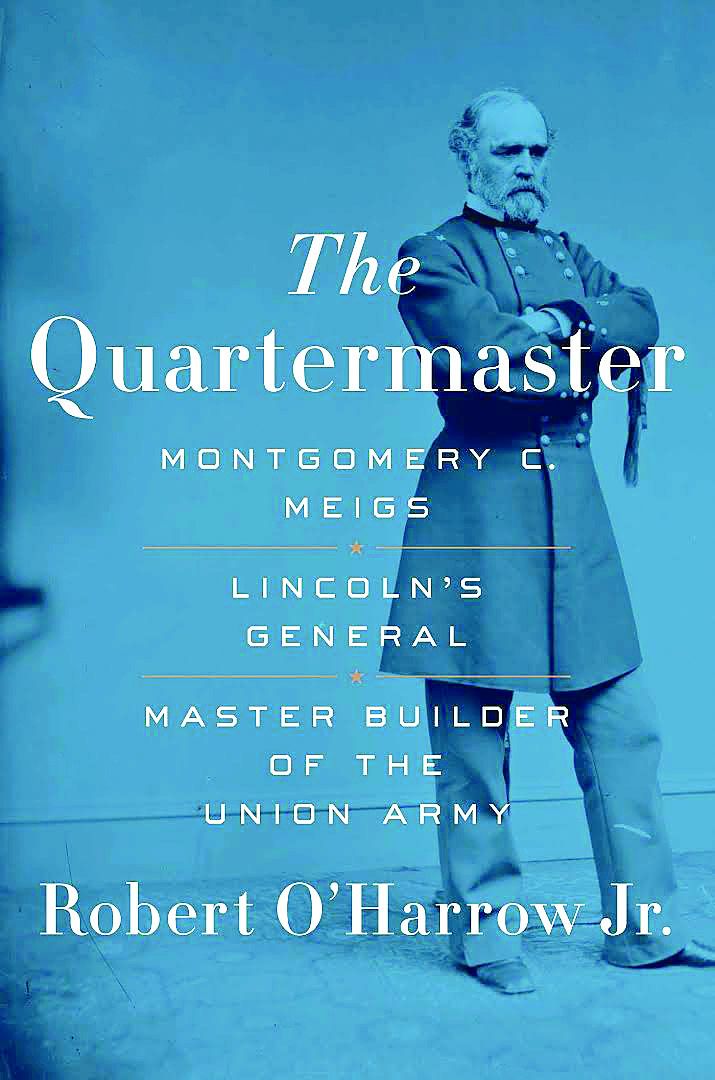
The Quartermaster: Montgomery C. Meigs, Lincoln’s General, Master Builder of the Union Army. By Robert O’Harrow, Jr. Photos, notes, index, 304 pp., 2016, Simon & Schuster, www.simonandschuster.com, $28.00 Reviewed by Greg Biggs
For whatever reason, the study of the Union supply effort lags far behind works that examine the Confederate side of logistics. Railroad manager Herman Haupt has a couple of biographies and a memoir. A few books cover regimental quartermasters mainly through letter collections, and a fine book details the efforts of a young Union supply officer in Nashville, but other than that (and a few works on Union railroads and some general studies of the Quartermaster Corps), that’s it. Montgomery Meigs, the brilliant and mercurial Quartermaster General, however, has just been made the subject of a third modern biography which can now be added to the overall study of Union logistics. Robert O’Harrow’s The Quartermaster is a fine place to begin to learn about this amazing and very interesting man. Born in Georgia but raised in Pennsylvania, Meigs did not start his military career in logistics; he was a West Point-trained engineer (fifth in the Class of 1836) and as such took part in what these engineers did; build America. From infrastructure to harbors and forts, West Point engineers fanned the nation supervising projects. Accordingly, Meigs rubbed shoulders with other great engineers like Robert E. Lee, Joseph Totten and Alfred Rives. Ever seeking to expand his knowledge, Meigs studied the famous French military engineer Vauban who influenced his work when designing fortifications around the nation. Meigs took over the aqueduct project to bring fresh water to Washington
City, accomplishing the work with great skill, all the while fighting with contractors and those who sought to get rich from such government projects. Meigs then oversaw the work on the U.S. Capitol building, again clashing with those he felt were short-sighted or doing things for themselves rather than country. Meigs worked for Secretaries of War Jefferson Davis and John Floyd, the latter seeking to move him aside so he could place his own cronies into projects that Meigs was supervising. Meigs never backed down from confrontation even with superiors, and O’Harrow teaches us much throughout the book about this characteristic. An interesting portion of the book has Meigs facing Lincoln’s first Secretary of War, Simon Cameron, who opposed Meigs’ (now a colonel) being placed in charge of the Quartermaster Department. Lincoln intervened and Meigs got the appointment, yet Meigs’ honesty would later cause problems. Exchanges between Meigs and his superiors/ adversaries make for some of the best material in this work. The author cites a myriad of sources to support the statements of those involved. Meigs took control of the department and over time brought it to the majestic level it would achieve, without which the Union simply could not win the war. Millions of men needed food, shoes, uniforms, weapons and other supplies in addition to river, rail and ocean transportation and Meigs supervised it all with his drive and zeal. Meigs remained angry with former Army officers with whom he served but now fought for the Confederacy, a notion that the author brings up several times. Clashing with Congress, the War Department and an often lack of funds kept Meigs on his toes but he persevered and succeeded. At war’s end, Meigs oversaw the demobilization of the Army as well as the creation of national cemeteries to bury the Union dead with dignity and properly marked graves. Postwar, Meigs worked on a museum for the Smithsonian, a new building for the Pension Bureau and other projects. His interest in classical European architecture and science entered into his designs, which were quite novel for the time. He died from influenza in 1892 at the age of 75 and his funeral featured people from the military, Smithsonian and the National Academy of Sciences among others. He was interred at Arlington Cemetery in a sarcophagus which he had designed bearing the words, “Soldier, Engineer, Architect, Scientist, Patriot.” Author O’Harrow does not delve deeply into any one aspect of Meigs’ career but, rather, uses a more fast-paced style of writing. He offers enough to show the man, what shaped him and how he accomplished things, while weaving into the narrative the interesting events and people of Meigs’ time. You feel his anger, his disgust, his heartbreak (when his son was killed) as well as his patriotism. O’Harrow’s experience as a newspaperman aids in making for one very entertaining and enjoyable read. The only complaint is how he prepared his footnotes; rather than using the traditional numbers mode, the author uses quote segments. Those who watched Ken Burns’ Civil War documentary will well recall when Shelby Foote claimed the war produced two true geniuses; Abraham Lincoln and Nathan Bedford Forrest. He missed a couple, in this reviewer’s opinion, and one of them was Montgomery C. Meigs. Indeed, a huge case can be made that Union victory was due to his Herculean efforts supplying the Federal army during the war. It was nothing short of genius. This new biography helps to get him into the modern spotlight that he so richly deserves. Greg Biggs, of Clarksville, Tenn., is an expert on Civil War flags and also speaks widely on logistics in the Western theater.