Baseball In Confederate Salisbury Prison
By John A. Punola · Originally published May 2017 · pp. 32–33
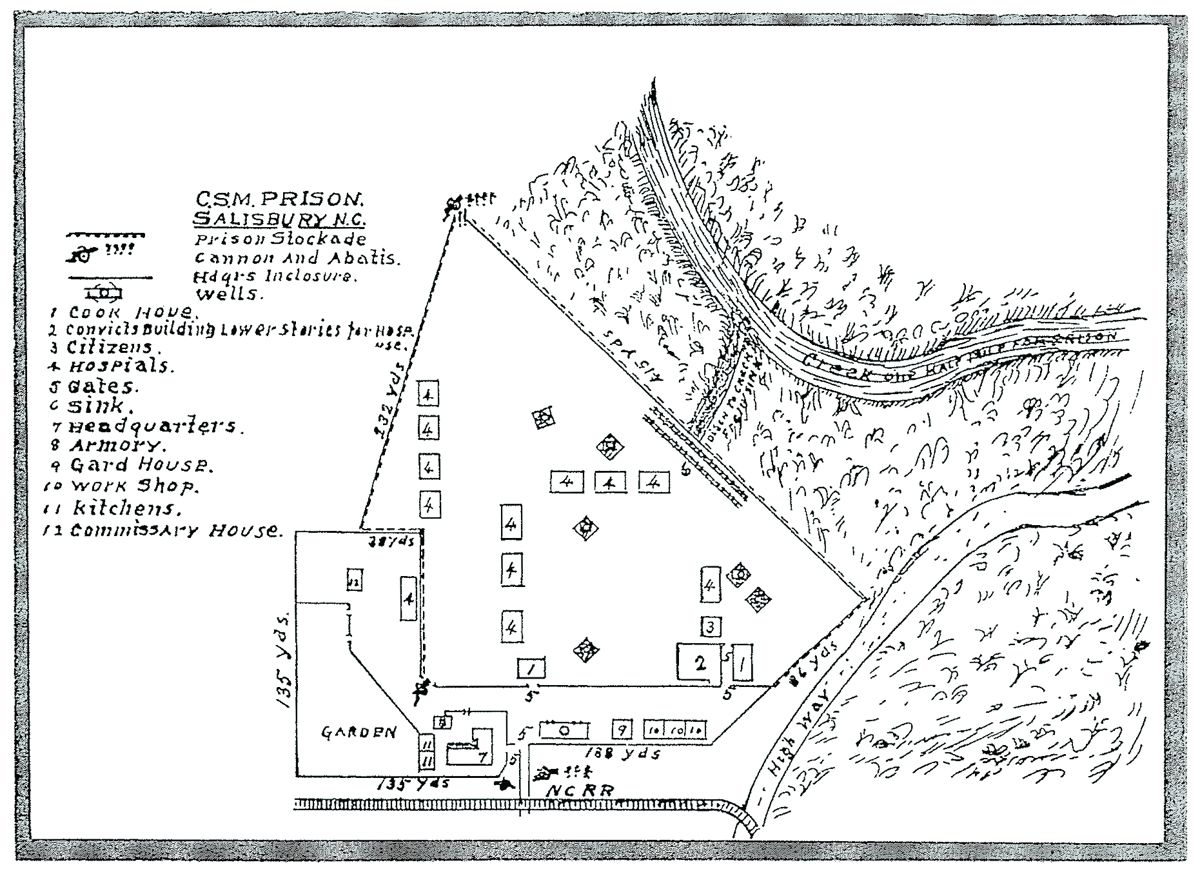
There have been numerous stories and books written about the terrible living conditions that Union prisoners of war faced in Confederate prisoner camps, notably, at Andersonville, Ga., during the Civil War. Sadly, the longer the war raged, the worse conditions became at prisoner camps, both in the South as well as the North. The huge influx of prisoners in the latter stages of the war led to severe overcrowding, fewer available rations, and deplorable death totals from various diseases and lack of medical supplies plus personal care Amazingly, there was one Confederate prisoner camp that stood out as a model camp, where Union prisoners enjoyed playing baseball while they awaited prisoner exchanges. Weather permitting; the prisoners enjoyed a daily game of baseball, pitting Union units against each other, with boisterous inmates cheering on the players. That prison was in Salisbury, N.C., a town with a population of only 2,400. Townspeople often visited the prison to watch the baseball games. The site of the prison was an eleven acre parcel of land that formerly was a cotton factory built in 1840. The Confederate government converted it into a prisoner camp in the latter part of 1861, and Union prisoners began arriving shortly thereafter. Salisbury prisoner camp was similar to other camps in the South and North; they were converted warehouses, etc., altered to house a thousand or so prisoners. The war was expected to last maybe six months to a year, hence large camps were not envisioned. The first lot of Union prisoners, totaling one hundred twenty soldiers, was brought in by train on Dec. 9, 1861. The arrival of the prisoners caused plenty of excitement in Salisbury because up to that date no one in Salisbury had ever seen a genuine, live Yankee. So there was plenty of interest and curiosity upon their arrival. The prisoners were quartered in the large brick building that measured about 100 by 40 feet, containing three stories above a basement. Some Union soldiers were permitted to venture into Salisbury and walk about. Others inside the compound strolled about aimlessly and cheerfully thru the grounds or chatted and rested in their quarters. Many had tattooed the Stars & Stripes on their arms, whittled on various toys, or enjoyed a casual cigar. On Dec. 26, 1861, the second shipment of Union prisoners arrived, an additional one hundred seventy-six soldiers. The flow of prisoners continued to trickle in, and on Feb. 7, 1862 eighty more prisoners were added to the camp. The new arrivals were captured at various battle locations in Virginia, North Carolina and Kentucky. By the middle of March 1862, the population had grown to nearly 1,500. It should be pointed out that during this period, 1862, prisoners received reasonable rations and were well treated. It was also a time when the fledging Confederate government treated the prisoners in accordance with an abundance of resources and a feeling that a prisoner exchange agreement would soon take effect, offering hope to the captives that their confinement could be a short stay. During the early part of the Civil War, 1861 and 1862, the Salisbury Prison held a fairly low, manageable number of prisoners, and baseball was an activity that kept the prisoners busy with a good athletic pastime. At that time of the war, baseball was a popular and expanding game in the North, but was relatively unknown in the South. Initially it was a curiosity to the guards, but they eventually took great interest in Yankee baseball. The period leading up to and during the Civil War was a time of rapid growth in baseball and numerous organized teams were formed. The greatest interest was in the New York and northern New Jersey area, with the first competitive game between a team from New York and a team from Hoboken, N.J. It was played in Hoboken, June 19, 1846, and New York won, 23-1. In 1857, sixteen New York area teams formed the National Association of Baseball Players and baseball rapidly expanded to other parts of the North. From that time to 1865, the number or organized teams grew to 100; by 1867 it had reached 400. Little wonder when northern boys left home to serve in the army it was only natural that baseball went with them. Baseballs and other equipment could be found in many knapsacks. In May 1862 more prisoners arrived at Salisbury Prison. It was a time of joy and optimism for the newly arrived Union troops because they believed they were going to be exchanged and would be returning to their Northern homes fairly soon As part of the festivities, newly arrived prisoners from New Orleans scheduled a baseball game vs. prisoners taken at Tuscaloosa, Ala. The event went off as planned and the game ended in an 11-11 tie. There is reference to the “factory boys” getting skunked three times. It is possible the “factory boys” may have been Confederate guards who joined in.
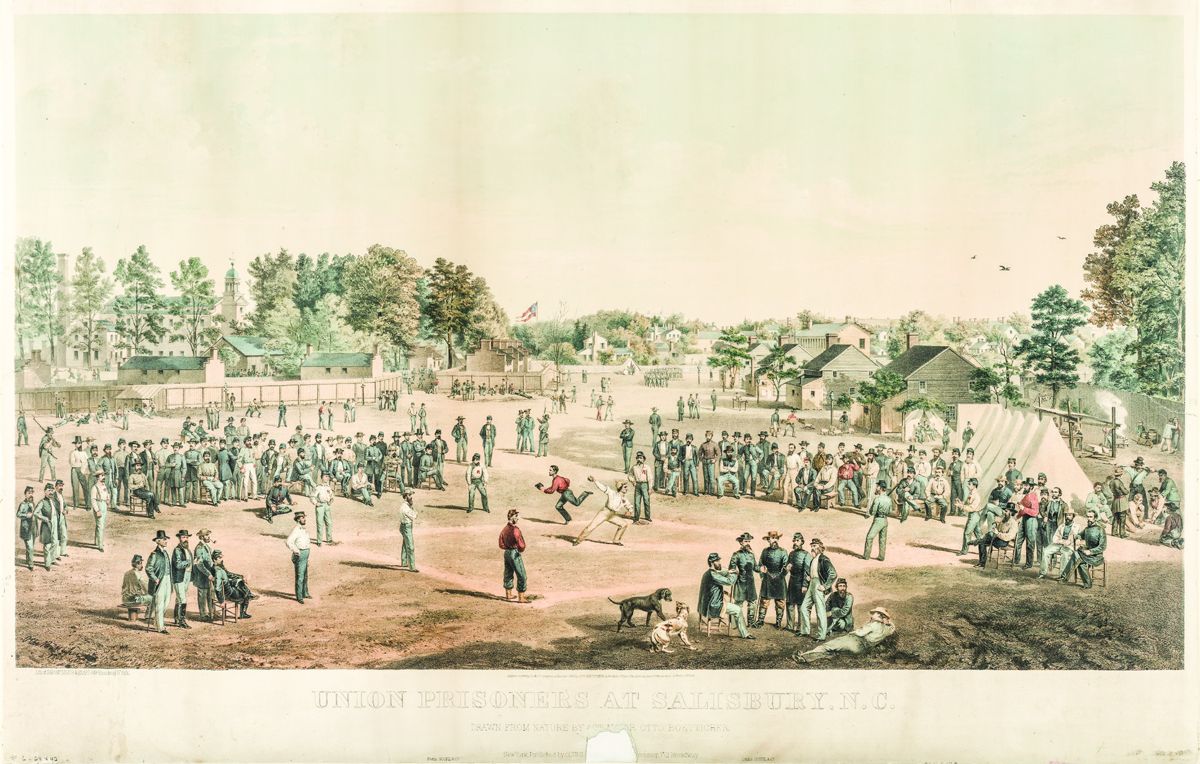
The prisoners wrote down specific rules for baseball games which read as follows: 1. Uncivil language, ungentlemanly behavior, spitting, cursing or any actions that offend a lady are not tolerated, with a penalty of a fine of up to a week of wages. 2. After scoring a run, a base runner must report to the score keeper for the run to count. 3. Infielders should play several steps in front of their base. The shortstop plays inside the baseline but may play on either side of second base. Outfielders play in the center of their position, shaded neither to left or right; they can play in or out according to the batter’s ability. 4. The first batter called to the plate in the following inning is the person in the batting order after the player who made the last out, even if the last out was made by an advancing base runner. 5. No bunting or sliding allowed. 6. At the end of the game there is a sharing of good fellowship which includes fine liquors and cigars. There is a famous lithograph drawn by a Union prisoner that show a baseball game at Salisbury Prisoner of War Camp. Major Otto Boetticher, who served with the 68th N.Y. Volunteers, was a prisoner at Salisbury during 1862. His stay at the prison was short lived, as he was exchanged for a Confederate officer on Sept. 30, 1862. Boetticher returned to his home in New York and, since he was a commercial artist by trade, he drew the famous scene of prisoners playing baseball inside the Confederate prisoner camp. When you look at the illustration, you can surmise that Boetticher was not an active player, but a spectator. His illustration shows players in various stages of playing baseball, but the field and dimensions are not accurately defined. Looking closer, the scene resembles a city park, not a place of confinement. But he was there and drew what he saw. The original print is displayed at the Baseball Hall of Fame in Cooperstown, N.Y. During 1861 and 1862, the population at Salisbury Prison stayed at a manageable level, and inmate baseball flourished. The year 1863 saw an upsurge in captives for both sides, and the heavy increase in prisoners sealed the end of baseball at Salisbury. The presence of Union baseball at the camp introduced baseball to new enthusiasts in the South and the sport grew and thrived after the end of the war. As the bloody war continued in 1863, prisoner rates for both sides greatly increased, and prison camps quickly became over crowded far beyond their original design; this quickly brought terrible suffering, starvation, exposure to the elements and unchecked diseases, with little or no medical staff or supplies. Like all other prisons in North and South, massive overcrowding was prevalent until the end of the war. Sadly, the good conditions at Salisbury could not be maintained and large numbers of Union prisoners died. The prison population at Salisbury Prison ballooned to 15,000, five times the original capacity of 3,000. With a few exceptions, prisoner exchange had ceased, and the ability of the South to properly care for and feed the prisoners was collapsing, in part because there were wide spread food shortages throughout the South. Eventually the Union army reached Salisbury and the 15,000 prisoners became part of a prisoner exchange agreed upon in February 1865. All prisoners were out of the prison by the early part of March. In mid April, Union General Stoneman had Salisbury Prison burned to the ground destroying any existing evidence that might have been saved. A large number of the Union prisoners brought into Salisbury Prison during 1864 came from Maine and Pennsylvania. In 1907 the Pennsylvania legislature approved building a monument in the Salisbury National Cemetery to honor Pennsylvania men who were prisoners held at Salisbury. With considerable fanfare, the monument was dedicated on Nov. 16, 1908. The state of Maine built an impressive monument to honor its native sons; it was dedicated on June 1, 1908. The monument was constructed of granite from Maine quarries and is topped by a soldier with a rifle. The monument stands in memory to men of all services who died during the Civil War. Prisoners who died were buried in one of eighteen trenches. The prisoners were buried without clothing and merely laid into the trenches in layers then covered with soil. There is an historical association in Salisbury that has vast information on the life and times of the prison. If you wish to further knowledge about the Salisbury Confederate Prison, you can contact Ed and Sue Curtis who are active officers in: The Salisbury Confederate Prison Assn. P. O. Box 5093 Salisbury, NC 28147-0088 Phone: 704-637-6411 If you can find time to make the trip to Salisbury, there is a nice museum and the national cemetery, plus other historical events scheduled during the year.