Inspection, ARMS!
Webley Wedge Frames
By Tim Prince · Originally published March 2017 · pp. 12–13
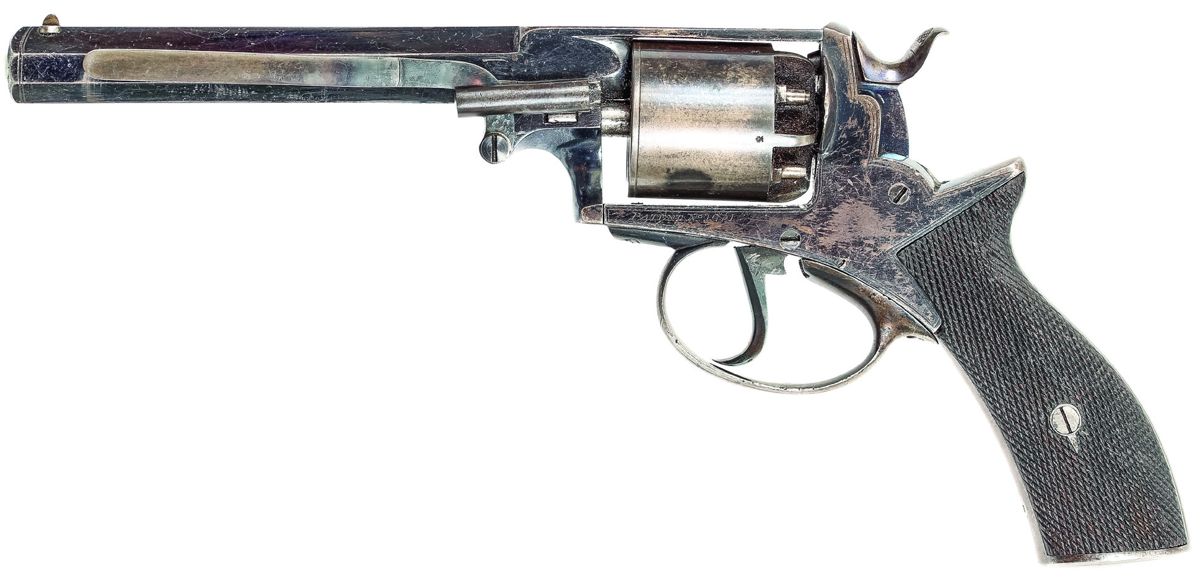
The English Webley “Wedge Frame” double-action percussion revolver was the primary competitor to the popular Adams and Tranter patent revolvers of its day. The guns were produced from the late-1850s through the mid-1860s and provided less expensive alternatives to the two most prominent English revolver makers. The primary cost savings was in the use of a two-piece frame and barrel design, like that used on Colt revolvers, with the two parts held together via a “wedge.” Adams and Tranter revolvers utilized one-piece frame/barrel assemblies forged from a single piece of iron and were much stronger and less prone to breakage and wear with age. The one-piece design could not “shoot loose” with repeated use, as wedge secured two-piece revolvers could. The wedge frame design itself is attributed to Birmingham gun maker Philip Webley, although Webley himself appears to have manufactured few of the guns. The simplified double-action lock mechanism typically encountered in these revolvers is usually of the Joseph Bentley design; these guns are sometimes referred to as Webley-Bentley revolvers, even though they were produced by many Birmingham gun makers and are often unmarked. The Webley wedge frame that has the highest level of Civil War association was a very well made revolver with an action more akin to the Beaumont-Adams than the Bentley style double-action only mechanism. These guns had a top strap over the cylinder to reinforce the frame, a feature missing from most Webley-Bentley patterns. The revolvers were typical of large bore English double-action revolvers in that they usually had five-shot, rather than six-shot cylinders. Most of these Webley style guns had numbered cylinder chambers, and are usually marked with Birmingham commercial proofs between each chamber. The revolvers are usually encountered with octagon barrels that tend to vary slightly in length between 6 ¼” and 6 ¾” and are usually chambered in the popular English 54-bore, about .442 caliber. The finish was universally blue on the barrels and frames with cylinders either blued or case hardened. Most examples appear to have had blued hammers, but some examples seem to have had bright hammers. Grips are typically checkered walnut of the two-piece variety, rather than the one-piece grip found on Adams, Tranter and Kerr revolvers. As previously noted the action of these revolvers is more akin to the Beaumont-Adams lockwork and would be considered a conventional double action today. The revolvers could operate as a standard double action by pulling the trigger, which rotated the cylinder, cocked the hammer and released it, all with one long, heavy trigger pull. The action also allowed more precise shooting. By thumb cocking the hammer and firing in single action mode, a lighter trigger pull was available, enhancing potential accuracy. In typical English revolver style, the cylinder only locked up completely when the trigger was pulled completely back (in double action mode) or when the hammer was locked in the fully cocked position (single action mode). This eliminated the need for a spring actuated cylinder stop in the bottom of the frame, a feature typical of contemporary American guns like the Colt and Remington. While some Webley “wedge” style guns utilized a Colt style, under barrel loading lever, others used the decidedly English pattern lever, like the Kerr Patent lever found on many Adams revolvers. Top strap markings on the Webley pattern revolvers vary greatly. Extant examples of these Webley Wedge Frame revolvers are known with no markings on the top strap, simply marked LONDON, and with names such as P WEBLEY & SON, D. BENTLEY PATENT and J. ADAMS (with and without LONDON). In some cases, the retailer (or maker) name is found on the frame and not on the top strap. A handful of examples of similar pattern English double action revolvers are known with pre-war Southern retailer marks, usually from New Orleans. New Orleans seems to have been a major source for imported English revolvers prior to the Civil War and extant examples include retailer marked guns by
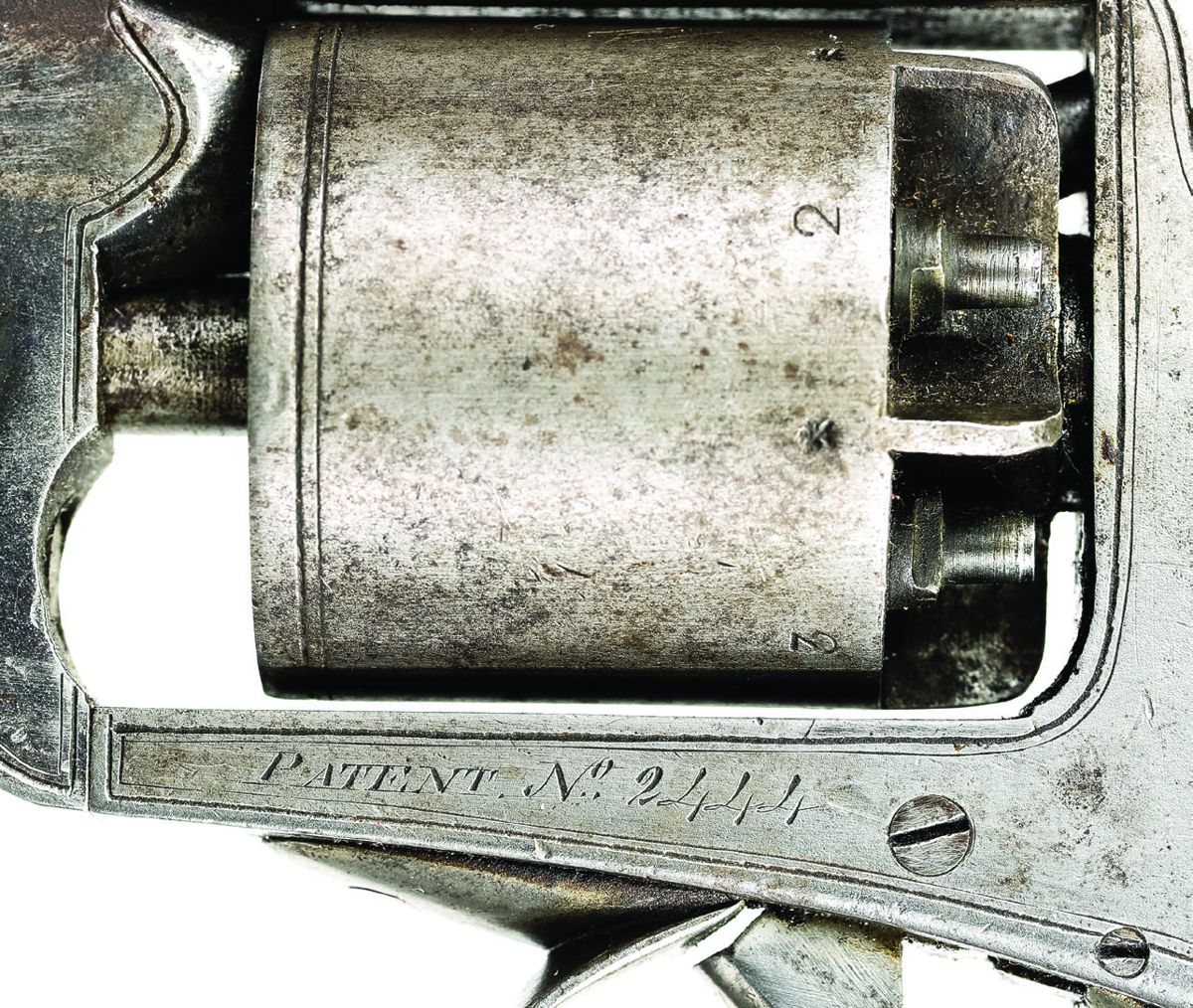
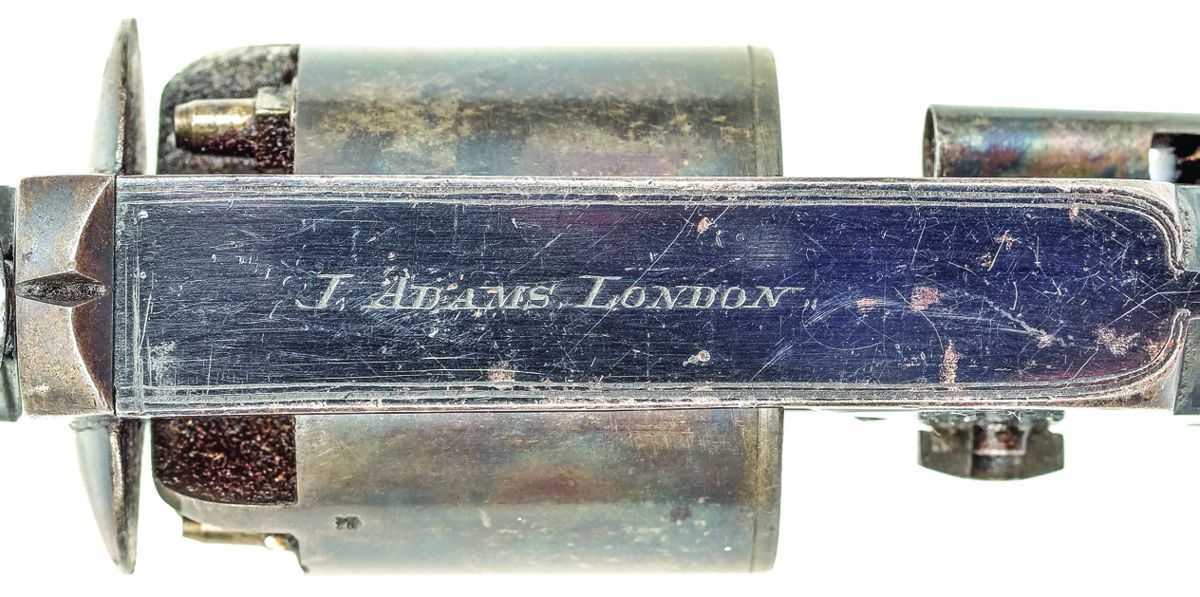
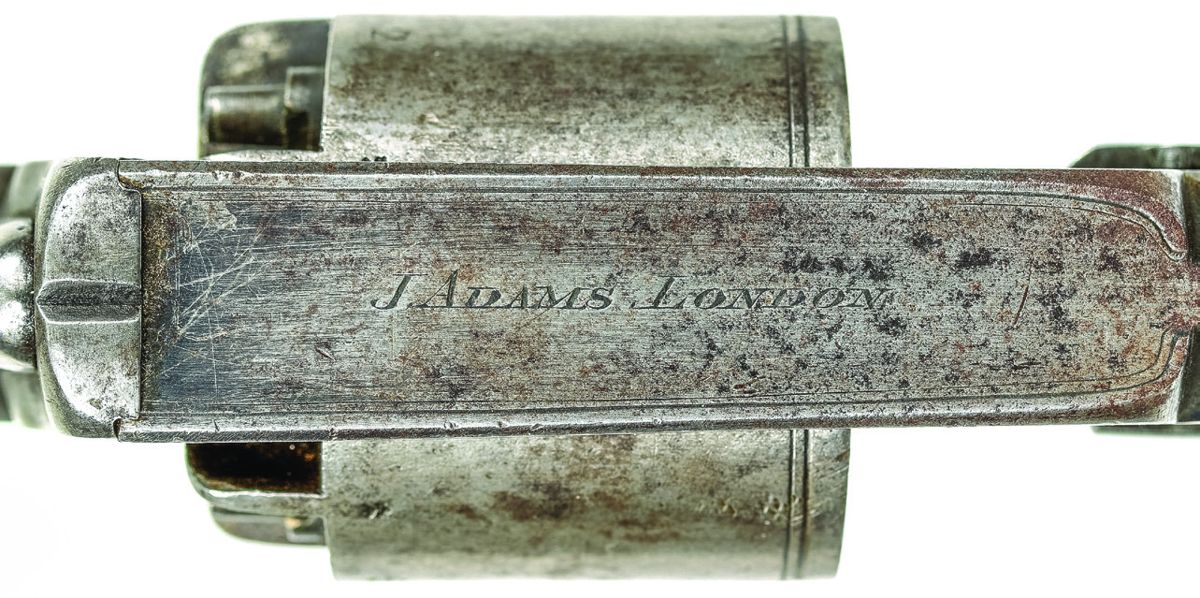
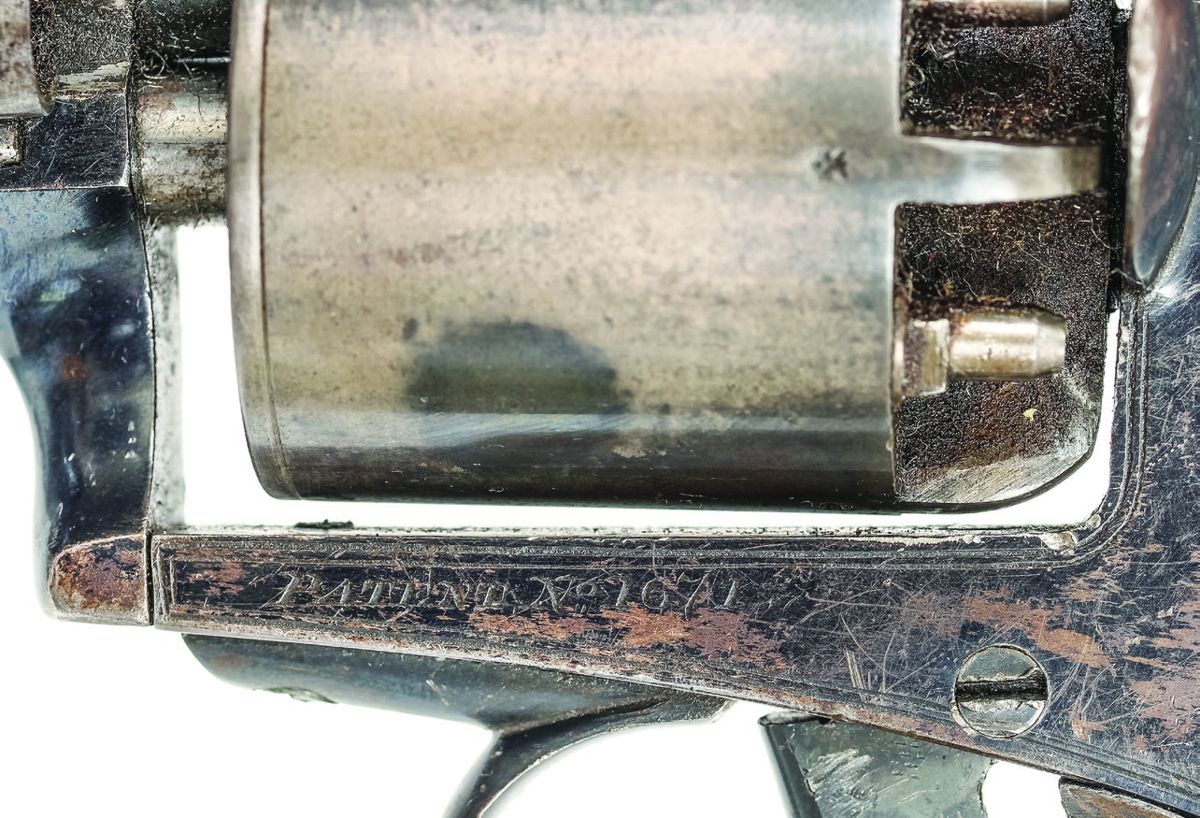
Thomas Bailey of New Orleans. At least three variations of Bailey’s mark are known on Wedge Frame revolvers. Depicted here are two examples of Webley Wedge Frame Revolvers marked J ADAMS LONDON. John Adams appears to have been the cousin of Robert Adams and not his brother as is so often believed. Extensive research into English census records done by Chamberlain & Taylerson in their exhaustive study Adams’ Revolvers lays out this theory quite convincingly. John worked with Robert and on his own, and apparently worked closely with Birmingham gunmakers as well, often retailing arms made there under his own name. He had been employed at the London Armoury Company with Robert, and when Robert left L.A.C., so did John. John held a patent for a double action percussion revolver design, the Model 1857, but this revolver apparently saw minimal production. In this case, his name on the topstrap simply indicates that John Adams of London was the gun’s retailer, not its maker. The lower left side of one revolver’s frame is engraved PATENT No 1671 and the other is engraved PATENT No 2444 below the cylinder. The only other markings are the previously noted retailer marks on the top straps and the Birmingham commercial proofs on the cylinders and barrels. In both cases the “patent number” might be considered a serial number, but appear to have been patent tracking numbers for the paying of patent royalties. A comparison of the two revolvers shows minor differences in overall appearance, grip angle and type of loading lever. The earlier gun (#1671)
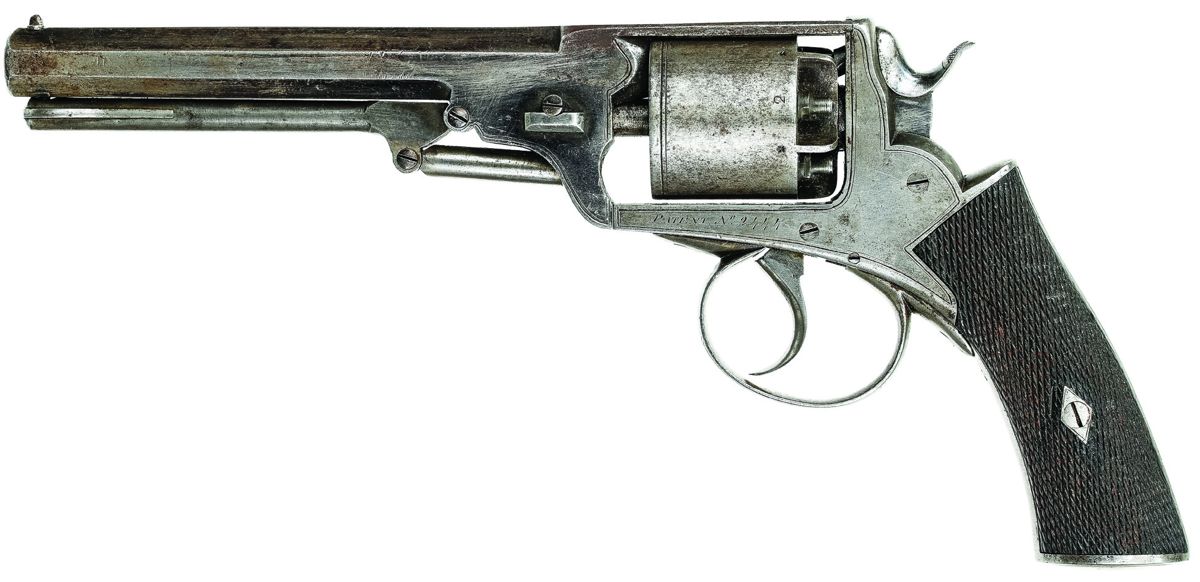
has a Kerr style lever, while the later gun (#2444) has a Colt style lever. While it had been considered at one point that the types of loading levers may have indicated an evolutionary change (one type early, one type later), a review of extant examples and serial number data suggest that the Kerr levers appear on both early and late production guns while Colt levers appear on middle range serial numbers. This suggests further that the Webley patent was assigned to the various makers or retailers in blocks, as serial numbers had been during the early days of Adams revolver production. Since Bentley marked guns and J Adams marked guns tend to appear in clustered number groups, it may be reasonable to assume that the differences in loading levers maybe be more a result of the makers’ (or contractors’) preference, rather than any indication of design evolution. These reliable and reasonably priced double-action revolvers were popular export items during the mid-19th century and were available for sale around the world. Confederate purchasing agents appear to have acquired these revolvers, as they were much less expensive than the competing Adams, Tranter and Kerr patterns. The Pratt Roll, an inventory list of revolvers that details fifteen handguns in the possession of Company H of the 18th Virginia Cavalry in July 1864 lists three Webley and/or Bentley revolvers, as well as four guns of “unknown” pattern. The remaining revolvers listed are seven Kerr’s patent revolvers and two Tranter pistols. The Bentley numbers on the list are 3111 and 3221, while the Webley revolver is number 5054. This indicates that even in this small sample of C.S. used revolvers, 20% were of the Webley and/or Bentley patterns. Since the average company grade officer would probably not be familiar with the names and patterns of English revolver manufactures (other than possibly Adams and Tranter), I have a feeling that the guns were identified by the maker or retailer name on the topstrap. This suggests that #3111 and #3221 were likely “D Bentley” marked Webley wedge frame revolvers, and #5054 was probably a P. Webley marked wedge frame. The “unknown” revolver with serial number 3563 was almost certainly a wedge frame revolver as well, but with no retailer mark on the top strap. The “unknown” revolvers with serial numbers 33,609 and 36,604 were almost certainly Adams patent revolvers, with blank top straps as well. While there are no direct Confederate central government contracts known for this pattern of revolver, some Confederate correspondence exists that suggests the more reasonably priced double action revolvers (in both 80 bore and 54 bore) were purchased primarily by speculators for importation to the Confederacy. It appears that most of these guns were imported through Mexican or Texas ports and many saw use in the Western Theater and the Trans-Mississippi Theater. It is believed that the revolvers delivered by Nelson Clements (who had a contract to deliver 5,000 revolvers to the Houston Quartermaster) were of the wedge frame pattern. A handful of guns that appear to have been part of his deliveries are known, and they are in the low 2,XXX serial number range. Obviously, numbers both above and below that point could be potential Clements contract arms as well, due to the size of the order.
Additionally, examples of Webley Wedge Frame double action revolvers exist with Confederate provenance. These include several well-documented examples in museum collections. The gun of Colonel John Smith of the 20th Ala. Inf. (ex-Bond collection) is one example, as is one reported to be engraved to General William Mahone. Both pistols are in the Museum of the Confederacy collection to the best of my knowledge. Another Webley Wedge Frame revolver, formerly in the famous Richard Steuart Collection, resides at the Virginia Historical Society in Richmond. Additionally, the Webley Wedge Frame revolver (#5553) is identified to Captain George Russell, the quartermaster of the 47th Tenn. Inf. While certainly not as wellknown and as widely recognized as the Adams, Tranter and Kerr patent revolvers, the Webley Wedge Frame percussion revolver certainly saw Confederate use during the American Civil War. For any serious collector of the war’s secondary martial handguns, a Webley Wedge Frame revolver is certainly worth acquiring and displaying along with your other import revolvers. Errata: Last month’s article dealt with Confederate imported Enfield pattern artillery carbines and discussed the fact that, to date, the highest known inventory number on a Confederate inspected example was 1482. Well, just prior to publication of that issue a new, previously unknown example came to light with the inventory number 2272. This certainly indicates the theory that only 1,500 numbered guns were acquired is wrong and increases the potential number of inventory marked artillery carbines to at least 2,500. This is one of the things that I love most about research; you are always learning something new. As each new piece of the puzzle is discovered, our knowledge about the past increases. As I did last month, I encourage collectors with inventory numbered Enfield pattern arms to contact the publisher to make sure their items are included in our comprehensive research data base. Tim Prince is a full-time dealer in fine & collectible military arms from the Colonial Period through WWII. He operates College Hill Arsenal (www.collegehillarsenal. com), a web-based antique arms retail site. A long time collector & researcher, Tim has been a contributing author to two major book projects about Civil War era arms including The English Connection and an upcoming book on southern retailer marked and Confederate used shotguns. Tim is also a featured Arms & Militaria appraiser on the PBS Series Antiques Roadshow.