
The Watchdog
Don’t Forget Us: Erastus Winters And The Sultana
By Craig L. Barry · Originally published March 2017 · p. 11
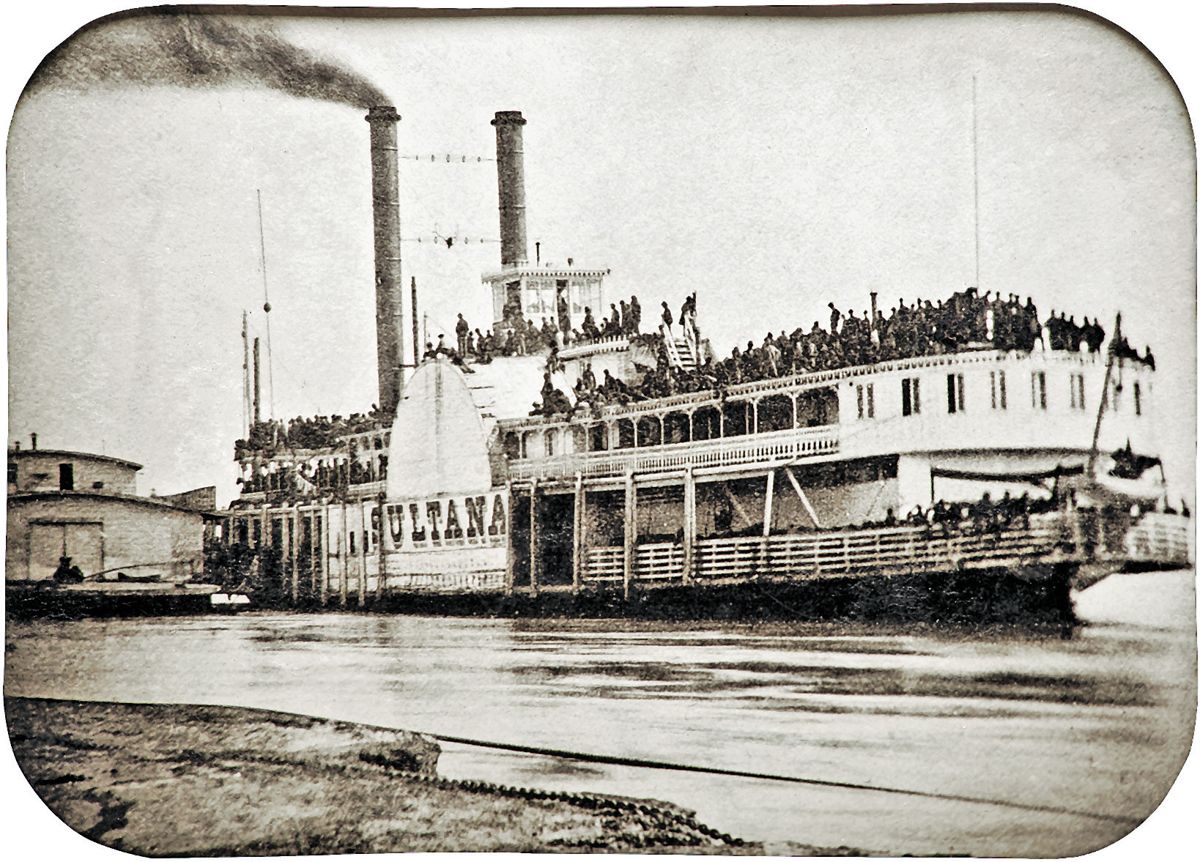
“Minnie balls would strike the ground with a dull thud near us, or go singing over our heads like bees on the wing. We were ordered to unsling knapsacks, and place them in a pile, and get ready for business.” Erastus Winters 50th Ohio Volunteer Infantry, Co K at Perryville, Ky., Oct. 8, 1862 There are a number of Civil War diaries which contain memorable first person accounts, peppered with important observations that lend excellent insight into Civil War military life. This is certainly true of The Civil War Memoirs of Erastus Winters, 50th OVI Company K, (Cold River Publishing 2011, edited by Lee Ann Newton). These are the recollections of an ordinary man who finds himself in some extraordinary circumstances during his four year stint with the U.S. Army during the Civil War. Winters story is chronicled in good detail and virtually all in his own words, with minimal editorial revisions. For example, after some unremarkable early guard duty watching railroad crossings and bridges, the 50th OVI finds itself fighting at Perryville, going into action behind the 80th Indiana in Oct. 1862. His observations quoted in the heading confirm what history records of the hard fighting there. This is perhaps to be expected and can also be found in any number of other Civil War memoirs that chronicle the observations of the survivors as well as the ups and downs of Army life. As the war marches on, however, his fortunes take a turn for the worse. Corporal Winters finds himself trapped between Union and Confederate lines at the Battle of Franklin, Tenn. Suddenly, he is a Confederate prisoner of war, ironic in and of itself given that the battle was such a lopsided Union victory. He almost escaped capture but wandered in the darkness of night into what he thought was another group of Union stragglers. As it turns out they were Confederates and Winters was recaptured, along with other soldiers from his unit. Winters finished out the last few months of the war at the Cahaba prison near Selma, Ala. A plucky sort not easily discour-
aged, of his time as a prisoner Winters notes, “A something within me seemed to say: ‘Do not give up; do not despair; bear your burdens bravely; keep in good heart and spirits; you shall yet be welcomed back into the family circle.’ Many of the poor boys did not have this hope within them and gave way to grief and homesickness, and the trials and hardships that came to them soon took them over the Dark River of Death.” Records indicate that between 142 and 147 Union prisoners died at Cahaba Prison, mostly due to unhygienic conditions and the lack of a sanitary water supply. If the records are to be trusted, the death rate at Cahaba was the lowest of any Civil War prison camp so perhaps Winters was fortunate to be sent there instead of somewhere like Andersonville in Georgia. Upon his parole from Cahaba at the end of the war, Winters was sent to Vicksburg, Miss. No doubt thinking his long ordeal was finally over, his luck was about to take a turn for the worse. Winters was booked on the infamous steamship Sultana with other paroled Union soldiers from Cahaba and Andersonville headed for discharge at Cairo, Illinois. The captain of the Sultana allowed the ship to be packed to several times its capacity of 376 passengers and crew. In Memphis, barrels of sugar were put in the ship’s cargo area, adding to the weight. Some accounts contradict that saying the sugar was off-loaded at Memphis and replaced with a fresh load of coal for the boilers, but whatever the case, the ship was beyond all doubt grossly overloaded. Exact numbers are probably not possible to ascertain but there were an estimated 2,427 people on board. Most were paroled Union soldiers weakened by their ordeal as prisoners of war but there were also civilians on board. It was a recipe for disaster. A few miles north of Memphis, the Sultana’s patched up, leaky boiler exploded. Passengers not instantly flung overboard by the explosion had to make the decision to go down with rapidly burning ship or brave the cold waters of the Mississippi. Only 700 survived the disaster, including Erastus Winters. Of the incident, Winters recalls, “No artist, I care not how clever he may be with his brush, can paint a picture as full of horrors as the picture that was painted on my memory, that April morning, 1865.” Most people are familiar with the sinking of the Titanic after striking an iceberg 47 years later, but very few are as well acquainted with the Sultana, which remains the worst maritime disaster in American history. The sinking of the Sultana on April 27, 1865, got very little media coverage either at the time or in the years since. This is probably because several other newsworthy events took place during that month which superseded it. First and foremost, Lincoln was assassinated two weeks prior to the Sultana disaster and most front page news was focused on that Also in the news during April 1865, Lee surrendered at Appomattox; there were manhunts for John Wilkes Booth and Confederate President Jefferson Davis. These still fail to explain the general lack of attention paid to the disaster. Perhaps as a nation, America was exhausted from all the bad news? A Memphis newspaper editorialized afterwards: “This is but a drop to the vast ocean of suffering that this ‘cruel war’ has caused.” All that could be about to change. In the last twenty years there have been some excellent books on the Sultana, including The Sultana Tragedy: America’s Greatest Maritime Disaster by Jerry Potter. There is a great line in the book where Potter remarks on the “common men forgotten by history.” Potter’s work in turn proved a prime source for the documentary by Sean Astin and Mark Marshall called Remember the Sultana. Mark Marshall said the purpose of the documentary is to familiarize people with this relatively unknown story and to “honor the memory of the Sultana dead.” Lastly, the Sultana Disaster Museum in Marion, Ark., opened its doors last year in an interim facility which houses a detailed replica of the steamboat as well as photographs and other historic artifacts. “We are in the beginning stages of planning for a permanent museum, and are close to retaining a firm for architectural and exhibit design services,” said Michael Demster, president of the Marion Chamber of Commerce. “We have received some nice seed money, but will need to raise more to get the museum worthy of the Sultana.” As Erastus Winters reminded the readers of his Civil War memoirs, “Don’t forget us.”