
Book Reviews
Book Reviews — March 2017
Originally published March 2017 · pp. 26–34
Civil War News book reviews provide our readers with timely analysis of the latest and most significant Civil War research and scholarship. Stephen Davis, Civil War News Book Review Editor. Email: [email protected]
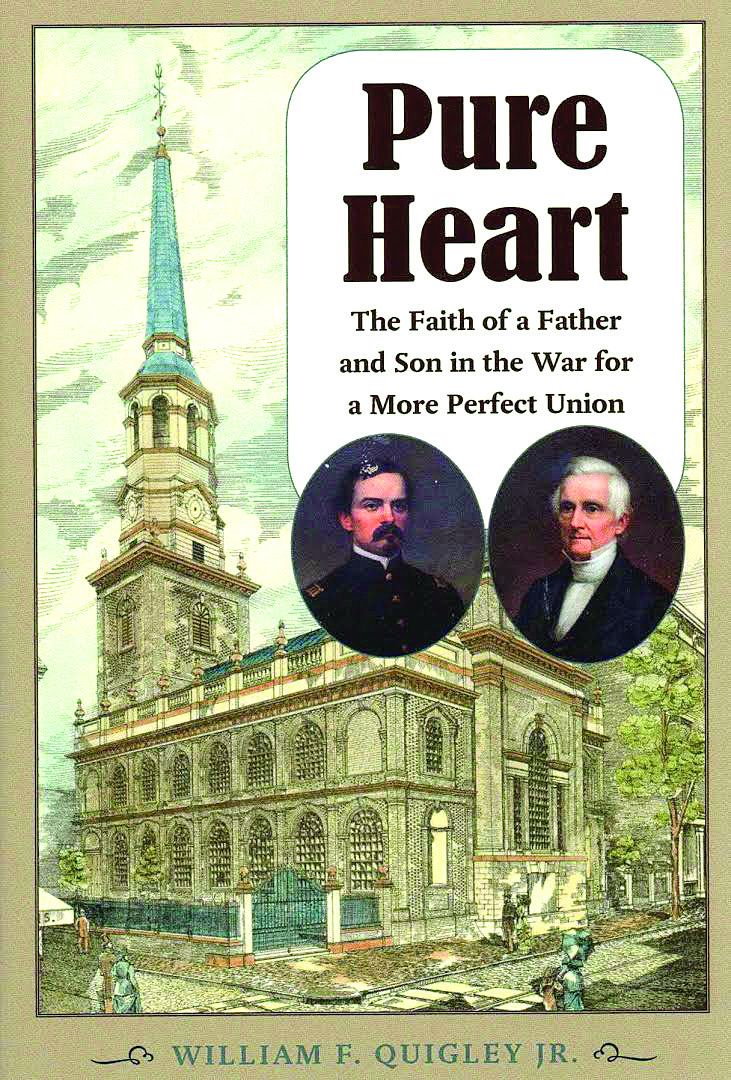
Pure Heart: The Faith of a Father and Son in the War for a More Perfect Union. By William F. Quigley Jr. Illustrations, maps, notes, bibliography, index, 416 pp., 2016, Kent State Univ. Press, www.kentstateuniversitypress. com, $39.95. Reviewed by Paul R. Taylor
The Civil War is remembered by many as a clash of Northern and Southern armies waging bloody war across the nation’s landscape. Less well known to casual readers is that the Northern home front faced its own, less bloodstained civil war over the conflict’s legitimacy, fighting methods, emancipation, and who should shoulder its weaponry. Those heated debates raged in town halls, newspaper editorials, saloons, and even churches all across the loyal North. In Pure Heart: The Faith of a Father and Son in the War for a More Perfect Union, author William F. Quigley Jr. examines how the Reverend Benjamin Dorr, rector of Philadelphia’s historically famous Christ Church, strove to hold his politically divided congregation together amidst these often racially-charged debates. Perhaps no Northern city seethed with more wartime racial animus than Philadelphia, which was highlighted in Dorr’s Episcopal Church by the southward departure of Dorr’s assistant minister (and former President John Tyler’s son) over the war’s course. In telling this quasi-biographical tale, Quigley’s narrative serves as a microcosm of the larger conflicts both within the Northern home front and across Southern battlefields. The book’s core source material is a cache of wartime letters from Dorr’s son, William White Dorr, to his father that were discovered in the mid-1990s. Twenty-four-year-old William Dorr enlisted as a lieutenant in the 121st Pennsylvania Volunteers in the summer of 1862 when Union morale had plummeted due to growing losses, emancipation, and economic worries. Young Dorr and his regiment saw action at Fredericksburg, Gettysburg and the Wilderness. His letters to his father reporting on what he saw along with his regiment’s actions paint a visceral portrait of the war’s horrors. Then-Captain Dorr was killed in action at Spotsylvania on May 10, 1864. His memorial at his father’s church remembered him as both a Christian martyr and patriot. William Dorr’s fight to hold his beloved Union together on Virginia’s battlefields echo that of his father’s efforts to do the same within his church. Though he had fervently prayed that war might be avoided, Reverend Dorr stood in solid support of Lincoln and Union once the rebellion began and even after losses began to mount, including his son. Dorr preached moderation – what the author describes as the “sensible center”—as he rejected both regions’ radicalism due to what he perceived as the hubris inherent in both positions. Reverend Dorr successfully navigated his church through the turbulent debates that often ripped apart other congregations and families. His forbearance and charitable spirit earned him the praise of both political allies and those who had opposed the Lincoln administration. When Dorr passed away in 1869 at the age of 73, it seemed as if much of Philadelphia turned out to pay respect to the man who had led “The Nation’s Church” for decades. Quigley has expertly woven a parallel timeline synthesis of home front division and battlefield experience, told primarily through the letters and diaries of Benjamin Dorr, William Dorr, and their mostly elite, white contemporaries. The author laments that the lack of African-American voices within his book is due only to their relative scarcity within extant primary sources. The book is punctuated by a father and son’s love for Union and each other. Not only is this a superb scholarly work, but the book’s production values adhere to the publisher’s consistent high standards. Sewn cloth binding, quality paper, twenty-eight illustrations and thirteen high-quality maps complement an insightful book that should find a home within any Civil War home front studies library. Paul Taylor is an award-winning author of six books pertaining to the Civil War era. His next book is titled The Most Complete Political Machine Ever Known: The North’s Union Leagues in the Civil War and will be published by Kent State University Press in early 2018.
“If I Am Alive Next Summer”: The Civil War Letters of Captain Charles Robinson Johnson of the 16th Massachusetts Infantry, “The Iron Sixteenth.” Edited by Albert C. Eisenberg and Michael Hammerson. Illustrated, photos, map, notes, appendices, bibliography, index, 265 pp., 2015, Heritage Books, www. [email protected], $29.50 softcover. Reviewed by Richard J. Blumberg
History is usually perceived as a boring series of dates and events to memorize in order to pass an exam. However, it’s far more important than most people realize. In the age of social media, the written word is quickly becoming a thing of the past. As a result, researchers may encounter great difficulties learning about our current culture, language, customs and social values since much of our life stories are now reduced to texts and emails. Eisenberg and Hammerson, the editors of this work, emphasize the importance of this concern while chronicling the life of Captain Charles Robinson Johnson. “If I am Alive Next Summer” receives a strong endorsement from one of the most prolific writers on the Civil War, William C. “Jack” Davis. The endorsement is well deserved for a variety of reasons. Two of the most significant are: it provides a partial regimental history of the 16th Massachusetts Infantry Regiment; and it provides a snapshot of the mannerisms, language, customs and social etiquette of mid-nineteenth century America. This collection of letters is different from most for several reasons: 1) Captain Johnson provided his wife specific instructions about saving the letters; 2) the unit Captain Johnson served in was involved in many of the major Eastern theater battles up to and including Gettysburg; and 3)Captain Johnson was a literate man keenly aware of both his civic and military duties as a unit commander. Some letters, addressed to his father, directed how monetary affairs on behalf of his soldiers should be handled. The majority of the letters are to his wife Nellie. It’s interesting to note that he usually closed these letters with “Yours affectionately” rather than “Love,” which we use in present-day correspondence. The letters also provide insight into his role as a unit commander. Many letters addressed duties of being the “Officer of the Day.” Others dealt with the obstacles of raising new units during the time the Union forces shifted from three-month enlistments to terms of longer duration. While many correspondence collections from Civil War soldiers exist, this one is especially worth reading. Clear photographs, detailed battle maps and a variety of interesting appendices help make this book unique in both story and subject. Richard Blumberg is a past president of the Houston Civil War Round Table
Abraham Lincoln and Liberal Democracy. Edited by Nicholas Buccola. Notes, index. 256 p., 2016, University Press of Kansas, www.kansaspress.ku.edu, $35 hardcover, $17.95 paperback. Reviewed by Frank J. Williams
These essays are from the Frederick Douglass Forum on Law, Rights, and Justice Conference on “The Political Thought of Abraham Lincoln,” held at Linfield College, in McMinnville, Oregon. The editor, in his introduction, indicates that Lincoln was not a political philosopher as such, but a philosophical pragmatist in “word and deed” – grappling with many philosophical political questions such as the basis for “popular sovereignty” advocated by his long-time political rival, Stephen A. Douglas. For example, are there limits on majority rule? And how should we “revere the law” that Lincoln advocated in his Springfield, Illinois Lyceum speech in 1838? Contributor John Burt, in “Prosperity and Tyranny in Lincoln’s Lyceum Address,” described Lincoln’s elocution of several themes that would become the paradigm of Lincoln’s political philosophy in later speeches without the same superfluous oratory that he used in his “Perpetuation of Our Political Institutions” speech. Lincoln thirsted for stable and reliable political institutions that would encourage reverence for the laws. Michael Zuckert, in “Providentialism and Politics: Lincoln’s Second Inaugural Address and the Problem of Democracy,” views the best inaugural address in America’s history as the ultimate statement in Lincoln’s career as a public speaker. Most books on the Second Inaugural Address rightly praise it and focus on its theological phrasing and meaning. In “Lincoln and the Ethics of Emancipation: Universalism, Nationalism, Exceptionalism,” Dorothy Ross discusses the ethical depth of Lincoln’s evolution to emancipation as a war policy. To her, the history of emancipation has been “gradual, halting, but [a] growing triumph of universal liberal and Christian principles.” Nicholas Buccola defines the August 21, 1858 debate between Lincoln and Douglas in “What if Honest Abe was Telling the Truth? Natural Rights, Race, and Legalism in the Political Thought of Lincoln.” In this first of seven debates for the U.S. Senate seat, Lincoln declares that he had “no purpose directly or indirectly, to interfere with the institution where it already existed.” And then further along in his statements during this debate and those that follow he disingenuously disembowels this promise. Lincoln’s election to the presidency in 1860 raised questions about Lincoln and the young Republican Party. In “The Vital Element of the Republican Party: Antislavery, Nativism, and Lincoln,” Bruce Levine grapples with defining Lincoln politically and what he and his Republican cohorts truly stood for. “Lincoln’s Competing Political Loyalties: Antislavery, Union, and the Constitution” by Manisha Sinha presents an appealing account on the paradox of Lincoln’s antislavery feelings. While Lincoln writes, “I have always hated slavery, I think, as much as any abolitionist,” he was not, of course, an abolitionist, as none then could be elected dog catcher. But what this really reflects is evidence of Lincoln’s pragmatism, moderation, and philosophical temperament. Allen Guelzo believes that Lincoln’s Emancipation Proclamation is the most “sweeping presidential action in American history.” His essay, “Four Roads to Emancipation: Lincoln, the Law, and the Proclamation” describes the proclamation’s impact for not only Lincoln’s generation but for every subsequent generation. And finally, Steven B. Smith in “Abraham Lincoln’s Kantian Republic” believes that Lincoln “represents the high-water mark of the American experiment.” These essays demonstrate that while Lincoln may not have been considered a political philosopher, he did in fact struggle with many of the most challenging questions in politics. We see a paradox in Lincoln in which he is both “naturally antislavery,” yet vows to defend pro-slavery laws. He defends the little people but has trouble dealing with democracy’s excesses. In conclusion, these essays give a fuller dimension of the greatest living political actor than many other volumes. Frank J. Williams of Providence, R.I., is founding chairman of The Lincoln Forum.
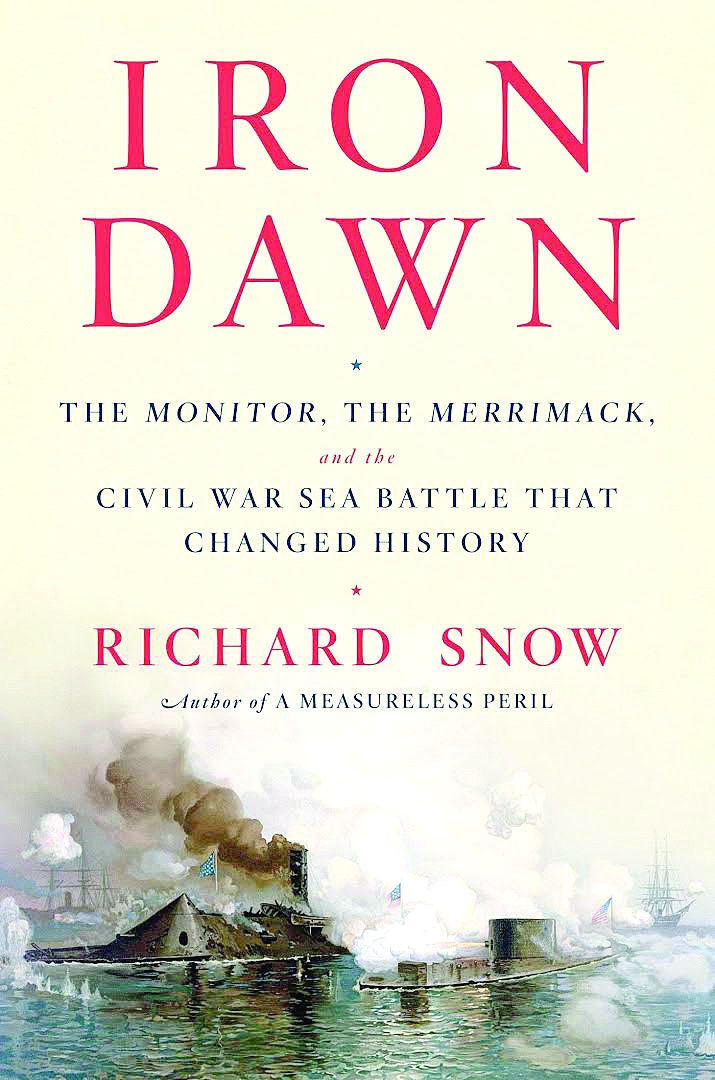
Iron Dawn: The Monitor, the Merrimack, and the Civil War Sea Battle that Changed History. Bibliography, illustrations, photographs, maps, index. 395 pp., 2016, Scribner, www.simonandschuster.com $30.00. Reviewed by Joseph A. Derie
This is another retelling of the story of the events leading to the history-changing battle between the USS Monitor and the CSS Virginia, formerly the USS Merrimack, and their final fates. The volume also discusses the personalities and background of the leading characters in the drama. Civil War buffs will, of course, fault the author for not referring to the CSS Virginia throughout the book. He cites using Merrimack because that’s the way the battle has gone down in history. He also cites Capt. Edward L. Beach USN (ret.) naval historian and author of Run Silent, Run Deep. Captain Beach believed that “the outcome of the Civil War had decided, along with greater matter, the proper name of the ironclad.” Still, the vessel fought and died as the CSS Virginia and the U.S. Navy can be considered to have given her up when it burnt and scuttled her when wrecking the Norfolk Navy Yard. Furthermore, capturing warships and renaming them is as old as naval warfare itself. During World War II the Japanese captured the USS Stewart (DD-224), damaged and sunk in a drydock in the early days of the war. Raised, repaired and refurbished, the IJN renamed it Patrol Boat 102. She saw action as an escort and was involved in the sinking of the USS Harder. The Royal Navy and the Kriegsmarine did the same with captured submarines. U-570 became HMS Graph and HMS Seal became U-B. There is a considerable bibliography as the author has mined the sources. Unfortunately, there are no footnotes and, at times, an inquiring reader would wish there were. Certainly a reader would like attribution of the comment that Lt. Catesby ap Roger Jones, CSN, executive and ordnance officer of the CSS Virginia had a “bad brush with a (US Navy) Retirement Board … because of rumors about his fondness for young men.” The author points out very well how the battle (as the Duke of Wellington commented on the Battle of Waterloo) “was a damned near run thing.” As in much of history, there are many if’s, and the author touches on them. If the Merrimack’s officers had disobeyed orders and taken her down the Elizabeth River and across the bay to lie under the guns of Fort Monroe (not Fortress Monroe, as the author refers to it throughout). If the CSS Virginia had been finished earlier; if it had had solid shot the day of the battle with the USS Monitor. If the USS Monitor had been finished later or had sunk while underway to Hampton Roads (that chapter in the book is titled “The Short, Bad Voyage”). One remembers she was a bad sea boat and later did sink off Cape Hatteras. Civil War buffs will find nothing new in this retelling. However, it is well written and interesting, an excellent retelling of the battle for the general readers who might be interested in and want to learn more about this battle and its participants. CAPT Joe Derie is a longtime Civil War buff with a special interest in Civil War naval history and the Civil War in the West. He is a retired USCG officer and a licensed officer of the Merchant Marine, currently self-employed as a marine surveyor and marine accident investigator in Portland, OR.
The Battle of Charleston and the 1862 Kanawha Valley Campaign. By Terry Lowry. Maps, photos, appendices, end notes, bibliography, 479 pp., 2016, 35th Star Publishing, www.35thstar. com, $34.95. Reviewed by Lawrence K. Peterson
The 1862 Kanawha Valley Campaign is one of the lesser known and often ignored campaigns of the Civil War. When Virginia voted to secede from the United States and formally join the newly established Confederacy, not all of the state’s citizens were in favor of that vote. Especially in the northwestern counties, sentiment ran against disunion. Eventually, in 1863 those counties formed the state of West Virginia. In that area, the Kanawha Valley provided many resources, particularly salt, for the side controlling it. Accordingly, in August and September of 1862 Confederate Brig. Gen. Albert G. Jenkins led a force into the Kanawha Valley. Jenkins’ raid quickly became a concern to the Union. Union troops in the District of the Kanawha under the command of Col. Joseph Lightburn prepared to resist. However, another contender for the valley would quickly appear. After a disagreement with Maj. Gen. Thomas J. “Stonewall” Jackson, Maj. Gen. William W. Loring was given command of the Army of Southwestern Virginia, consisting of some 5,000 Rebel soldiers. Loring advanced north, then northwest into the Kanawha Valley and fought Lightburn at
Find us on Facebook facebook.com/CivilWarNews the battles of Fayetteville, Cotton Hill, Montgomery’s Ferry, and Charleston on September 13. Winning these small battles forced Lightburn out of West Virginia briefly, labeled as Lightburn’s Retreat. Brig. Gen. Jacob D. Cox, now in command of the Kanawha District, led the Kanawha or Charleston Expedition in October which successfully recaptured the valley; it remained under Union control for the rest of the war. Author Terry Lowry has produced a tremendously detailed account of the Kanawha Valley Campaign of 1862. As a noted historian of West Virginia, Lowry has been able to access innumerable records concerning this campaign. When possible he utilizes the many diaries and other records of participants in order to let them give the reader the gist of how they felt or viewed a particular situation. Sometimes these accounts disagree with each other. Lowry expertly weaves such primary sources into his narrative of events as they unfold. Be forewarned that this is an extremely detailed version of the campaign. For the reader interested in details, this is likely to be the standard for which any other books of this campaign will have to measure up. Because of the tremendous number of names, places, and events, it is understandable why an index is not included, as it would be lengthy. However, it would be helpful as would a large map covering the entire area, including many points of interest not shown on the otherwise excellent maps which are included. For the reader interested in this campaign, Lowry’s excellent background information on the many participants and, when available, their pictures bring to life the characters on both sides. He includes many additional photos of structures and landscapes as they looked then and now. The appendices include detailed lists of casualties. While the battles involved are comparatively small, nonetheless they deserve the attention to detail which Lowry renders. This is an excellent history.
Lawrence K. Peterson is the author of Confederate Combat Commander: The Remarkable Life of Brigadier General Alfred Jefferson Vaughan Jr. (University of Tennessee Press, 2013). A retired airline pilot, he is president of the Rocky Mountain Civil War Round Table.
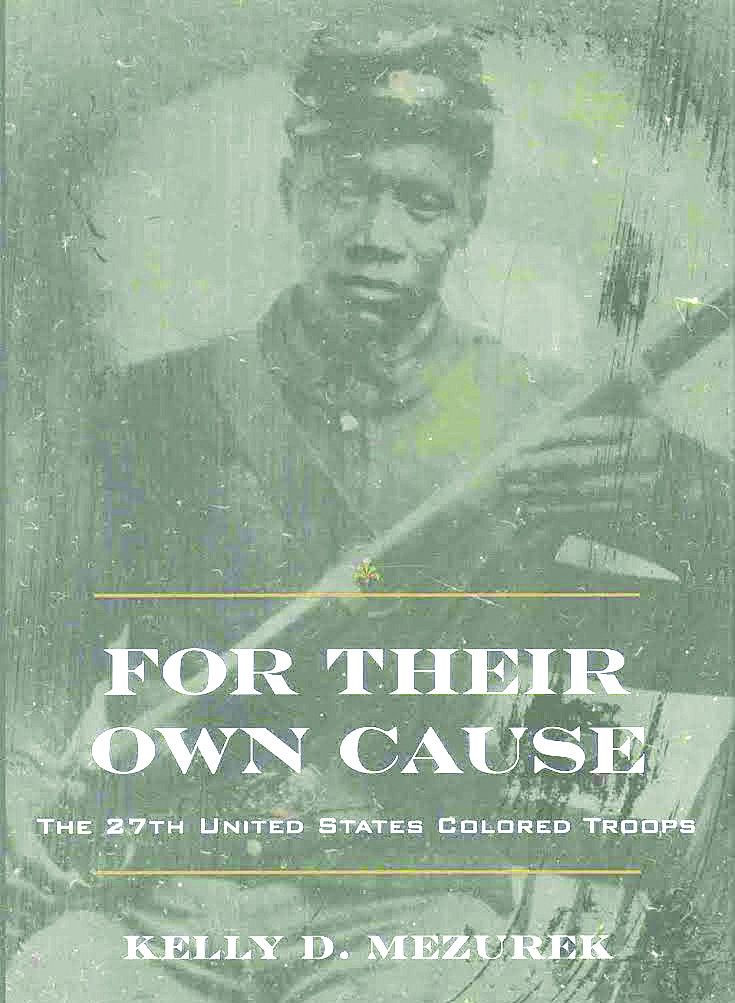
For Their Own Cause: The 27th United States Colored Troops. By Kelly D. Mezurek. Maps, photos, notes, bibliography, index, 368 pp., 2016, Kent State University Press, www.kentstateuniversitypress.com, $37.95. Reviewed by Jonathan A. Noyalas
Twenty years after President Abraham Lincoln signed the final Emancipation Proclamation, Frederick Douglass informed an audience that he feared the contributions which approximately 180,000 African American soldiers made to the Union war effort would eventually fade from American consciousness. “As the war for the Union recedes into the past,” Douglass stated, “and the negro is no longer needed to… stop rebel bullets, he is in some sense of less importance.” While Douglass’ observation proved correct for many years, a host of historians in recent decades, including James B. McPherson and Dudley T. Cornish, have made certain that the important contributions of African Americans to Union victory received their due. Now, with this first-ever history of the 27th United States Colored Troops, Kelly Mezurek adds her name to that distinguished group. Mezurek, a history professor at Walsh University, does an admirable job of chronicling the 27th USCT’s history from being mustered into service in the spring of 1864, through training at Camp Delaware, to combat experience at Petersburg and Fort Fisher, and occupation force in North Carolina. While Mezurek masterfully traces the regiment’s service, this book offers more than a record of battles, marches, campaigns, and camp life. Her study largely uses the 27th USCT as a microcosm to bring clarity to broader issues experienced by African Americans during the Civil War era. For example, Mezurek begins the book with a thoughtful assessment of the conditions African Americans endured in Ohio—the state where the 27th USCT was raised—prior to the conflict. Although they lived in a free state, Mezurek shows that many of Ohio’s African Americans were relegated to status as second-class citizens, with “most schools” excluding African American children. The author also uses the regiment’s experience to sharpen understanding of how African American soldiers coped with a wide array of obstacles in the Union army: racial prejudice, lower pay, and greater relegation to manual labor than their white counterparts. Additionally, the story of the 27th demonstrates that some who enlisted in the regiment did so for reasons other than ideological. While some USCT regiments were largely filled with recruits who were once slaves and hoped the conflict would result in slavery’s destruction, the author points out that bringing about slavery’s demise did not provide motivation for a number of the 27th’s recruits. Some, such as Moses M.A. Jones of Akron, enlisted for the financial bounty, while sixteen-year old William Scott joined because he wanted to be rid of his parents. Mezurek, unlike some regimental historians, takes the regiment’s story into the postwar years. Like so many of their comrades who served in USCT regiments during the conflict, the author notes that when the 27th’s veterans returned to Ohio after war’s end many wondered what the freedom and rights they helped win actually meant. While some such as Akron’s Richard Jones enjoyed a lucrative tailoring business after the conflict, the large majority of those who had served with him struggled to find suitable employment and enjoy any form of equality. Although USCT veterans confronted seemingly insurmountable obstacles after the conflict Mezurek, building on Barbara Gannon’s groundbreaking The Won Cause (2011), shows how some of the 27th’s veterans attempted to improve their condition through membership in the Grand Army of the Republic. Although they were not equal to whites, Mezurek rightfully asserts that as veterans and members of the GAR, the regiment’s survivors belonged “in a separate sphere from other Northern African Americans.” This excellent volume does more than breathe life into a once forgotten regiment; it offers a powerful glimpse into the obstacles confronted, hardships endured, and contributions made by African Americans in our Republic’s defining moment.
Prof. Jonathan A. Noyalas is the director of the McCormick Civil War Institute at Shenandoah University in Winchester, Virginia. He is the author or editor of eleven books on Civil War era history including Civil War Legacy in the Shenandoah: Remembrance, Reunion, and Reconciliation (History Press, 2015).
Battle of Wills: Ulysses S. Grant, Robert E. Lee, and the Last Year of the Civil War. By David Alan Johnson. Photos, end notes, index, 317 pp., 2016, Prometheus Books, www. prometheusbooks.com, $28.00 hardcover. Reviewed by Gould Hagler
In May, 1863, Lee’s Army of Northern Virginia won a remarkable victory over the Army of the Potomac at Chancellorsville. A year later, the two armies clashed again on the same battleground. In the Battle of the Wilderness Federal and Confederate losses were comparable with those suffered at Chancellorsville. The fighting and the immediate results were similar; the aftermaths differed dramatically. In 1863 Hooker retreated; Lee seized the initiative and invaded the North. In 1864, in spite of his losses, Grant forged ahead; Lee never again controlled events. The sanguinary campaigns of the following year, the slugfests and sieges which ended the war in Virginia and doomed the Confederacy, are recounted by David Alan Johnson in Battle of Wills. In this narrative Johnson also examines the reasons Grant prevailed, focusing largely on the personalities and decisions of the leaders. The story moves back and forth between April 9 and the preceding battles which led to the meeting in Wilmer McLean’s parlor. We also travel between Grant’s headquarters and Lee’s as Johnson relates events from the two points of view. Moving from the somber events at Appomattox to the fierce combat that preceded Lee’s surrender is an effective dramatic technique, though some of the transitions are abrupt and may at times confuse the reader. Alternating the scene between Grant’s HQ and Lee’s also adds to the book’s appeal, even at the expense of some minor repetitions. Lee and Grant are so wellknown that no book can contain significant new information on the antagonists. However, Johnson does relate an amusing anecdote about Grant that is new to this reviewer. Some feared that the general might seek the presidency in 1864. Grant allayed these concerns. “When this war is over I intend to run for mayor of Galena,” Grant said, “and, if elected, I intend to have the sidewalk fixed up between my house and the depot.” Lee also had a sense of humor, and Johnson recounts his habit of referring to General Hooker as “Mr. F.J. Hooker.” Lee probably never made jokes about Grant as he did about Fighting Joe. The book does contain a few slips (such as the confusion between the Stonewall Brigade and Jackson’s corps) but these minor errors do not amount to serious flaws. In some places the writing could be livelier and less wordy. Moreover, phrases like “some damned clerk” and “scared the hell out of everybody” seem too colloquial for a work of history. The author concludes with an interesting summary of how the two generals’ reputations have changed with changing times and with a solid explanation of how the actions of both generals on April 9 helped the two warring peoples re-unite and reconcile. Many readers of CWN will be well-acquainted with many of the works in the bibliography, especially the secondary sources on which the author relies heavily. For them, Battle of Wills will contain little that is new. For readers less schooled in Civil War history, the book provides an account of the war’s final year in the Virginia theater that is concise, accurate and readable. Gould Hagler is the author of Georgia’s Confederate Monuments: In Honor of a Fallen Nation (Mercer University Press, 2014) and is a frequent contributor to Civil War News.
The Colonel and the Vicar. By Edward Rayner. Appendices, bibliography, notes, 330 pp., self-published, www.amazon. com, $19.99 softcover. Reviewed by Joseph Truglio
This is another family history in an ever-growing genre of Civil War history. The author, Edward Rayner, researched his family ancestry and came upon these two forebears. What is unique is that they are first cousins on opposite sides of the conflict. One is an Englishman and clergyman, and the other a Massachusetts soldier. The story begins with a brief history of the origins of the family. Henry, the American, is born in Boston, in 1833 and Francis is born in Newfoundland, resettling in England in 1851. The story is told in segments back and forth between characters This allows the reader to follow the progress of each man in an easy manner. Henry joins the Union army, the 20th Massachusetts Infantry, early in the war and participates in the battle of Ball’s Bluff. He is transferred back to Boston and serves as a recruiting officer. He returns to the 20th and serves in the Peninsula Campaign of George McClellan. He is promoted to major and assigned to the 39th Mass. Inf. He spends much of his time in Washington and is then sent back to Boston for more recruiting duties. He finally returns to duty in the Petersburg
Campaign in late 1864. Henry is wounded at Gravelly Run, has his leg amputated, and dies on June 6, 1865. Despite Rayner’s research, the details of his service are sketchy at best. I would have liked to learn more of this man but there was not much available. As to Francis, there is much more to tell. He is an Episcopal minister and an ardent Confederate supporter and anti-abolitionist. He is also an accomplished enthusiast of the sea and naval operations. He founds St. Peter’s Church in Belsize Park, England. This church is a seat of pro-Confederate activities and the rector is one of the leading activists in helping Confederate agents gain access to English ship building concerns. As this story unfolds, we are given much history of the times and activities on the various battlefields. I found this a bit distracting as I was more interested in the personalities themselves. I make the presumption that there was not a lot of background available. Much more is presented on Francis and his activities and I found his dealings with Confederate agents the more fascinating text. Overall this is an interesting tale on activities not readily discussed. As to self-published books, they are in need of stronger editing. This is a minor criticism and should not deter you from enjoying this book. That aside, this is a worthy effort, especially if you have interest in Englishmen’s participation in the war and their assistance in helping the Confederate Navy obtain ships. Joseph Truglio is president of the Phil Kearny Civil War Round Table in Wayne, NJ.
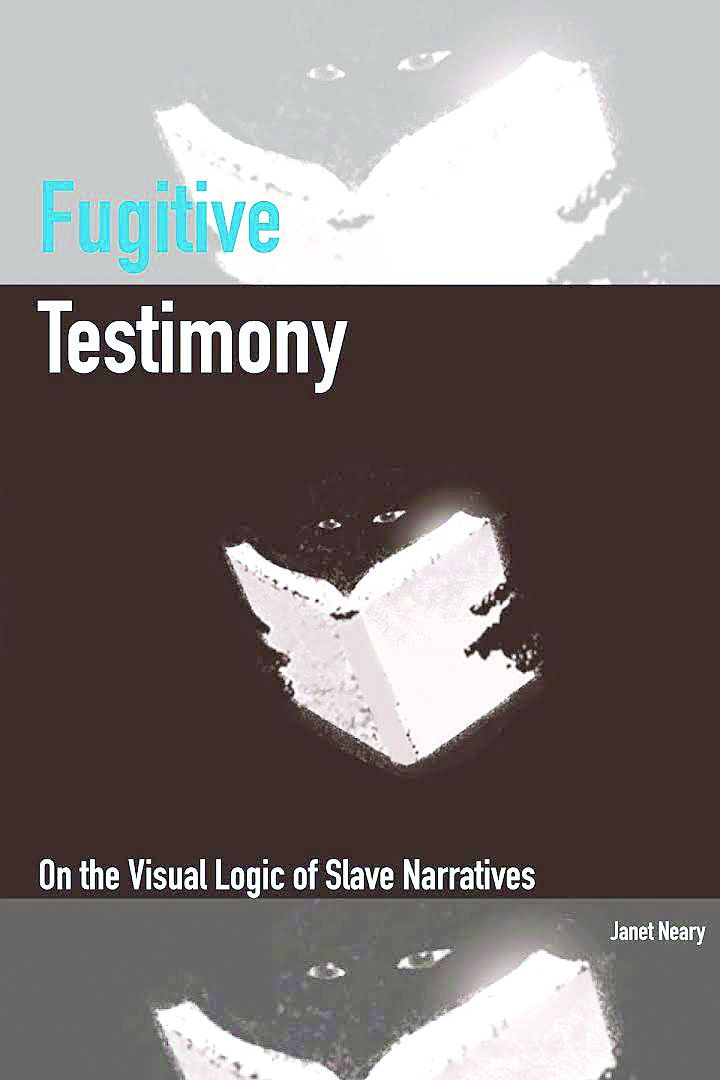
Fugitive Testimony: On the Visual Logic of Slave Narratives. By Janet Neary. Illustrated, notes, index, 222pp., 2017, Fordham University Press, fordhampress.com, $27 softcover. Reviewed by Wayne L. Wolf
Janet Neary dissects four slave narratives—Behind the Scenes, Running a Thousand Miles for Freedom, Twelve Years a Slave, and the Narratives of Henry “Box” Brown—to validate her concept of representational static. Representational static draws attention to the forces that produce and convey visual images of enslavement as well as the authenticating devices utilized to validate slave narrative in the minds of a mostly white abolitionist audience. In any slave narrative the ex-slaves must be both the object and subject of their own narrative, in essence contending there can be no understanding of slavery and racial violence unless personally experienced. The selected narratives provide eyewitness testimony for the abolitionist case against slavery and encode ex-fugitives’ ideas within the narratives with meanings beyond the apparent verbiage.
The author, frequently a collaborative abolitionist, uses the narrative to promote abolitionist philosophy while making a case against the brutality of slavery and for the humanity of the slave. While only 58% of slave narratives published between 1845 and 1870 had an author who was a real black person, all of the narratives claimed to access the innermost thoughts and feelings of slaves. Thus, all of the narratives refuted the vision of Southern slave contentment as well as the political and social structure of Southern society. The narratives became a black anti-slavery message wrapped in a white story told to destroy slavery. Neary’s thesis of representational static is designed to expand on previous studies, e.g., Glenn Ligon’s Narratives and Runaways and Kara Walker’s Narratives of a Negress. Neary postulates that language shapes the way a slave, and slavery itself, is perceived, and refutes the antebellum contention that black experience needs white authentication. The slave narrative thus becomes a brief narrative infused with double meanings and visual shorthand images necessary for the reader to understand the abolitionist message, a task thought impossible by written words alone. Neary draws on an extensive volume of primary research to build her case for looking beyond the mere words of slave narratives to their hidden visual imagery and double meanings. While she makes a convincing case for this search for hidden messages of abolitionist editors, she must be careful not to put words and meanings into the mouths of the slave “authors” that are a modern understanding of slavery, racism and racial division far beyond what the 19th Century author envisioned.
For the Civil War scholar this book impels one to at least contemplate the innuendos inherent in slave narratives, realize the aim of abolitionist ghost writers and question which view of antebellum South society bears the closest vision of reality. For researchers focused on the political and social dynamics of Southern society, this text is recommended. Wayne L. Wolf is Professor Emeritus at South Suburban College in South Holland, Ill. He is the author of numerous Civil War books and articles including Two Years Before the Paddlewheel and is currently researching and writing of Gen. John Corson Smith and his role in the Battle of Atlanta.
Lt. Spalding in Civil War Louisiana: A Union Officer’s Humor, Privilege, and Ambition. By Michael D. Pierson. Maps, photos, notes, index, 208 pp., 2016, Louisiana State University Press, www.lsupress.org, $38.00. Reviewed by Lawrence Lee Hewitt
Lt. Spalding in Civil War Louisiana may prove inimitable. A single communiqué written by a junior officer of no distinction with no mention of a single battle or famous individual led Michael Pierson “to embark on what seemed at first to be a foolhardy project; to write an entire book about one letter.” Given this and the number of original works being published today, even the most dedicated Civil War enthusiast might decide to overlook this volume. Though admittedly not for everyone, many might be surprised to learn what they missed, especially those interested in author John William De Forest, a junior officer from Connecticut who fought beside Spalding during the siege of Port Hudson. Twenty-two-year-old Stephen Foster Spalding of Company B, 8th Vermont Infantry, wrote the lengthy letter to James S. Peck on July 8, 1862, while stationed at Algiers, Louisiana. Peck, a civilian residing in Montpelier, had graduated from the University of Vermont with Spalding in 1860, and the two men had roomed together their senior year. Spalding interjects short stories amid his own emotional reactions, and the combination illuminates his views about ambition, race, gender issues, fear, death, and premonitions. Much of the letter’s distinctiveness, bountiful humor, and cryptic innuendos can be attributed to its recipient being a close friend rather than a spouse, parent, or sibling. The longest story is about Spalding’s celebrating Independence Day in New Orleans by consuming more alcohol than humanly possible and visiting two brothels. Thoroughly researched, enlightening, and lively written, this is microhistory at its best. Pierson does a notable job defining Spalding’s position in his time, a member of the elite by lineage, wealth, gender, and race-all of which shaped him into a stern disciplinarian of troops and a harsh man in dealings with women and freedmen. Like most U.S. Army officers sent to Louisiana in 1862, Spalding was a Democrat little concerned with emancipation. A charter member of a society that “ran on misrepresentations of one’s experiences, talents, and background,” if he lied, “he did so as part of a national epidemic of résumé padding.” With but three weeks of artillery training in the 7th New York Infantry, his promotion from private clearly illustrated “just how jury-rigged the whole Union war effort was in the fall of 1861.” Spalding served more than two years before seriously engaging the enemy. His performance, along with his company’s, may have fallen short during their attack on Port Hudson on May 27, 1863, not uncommon among the Union troops assaulting. Nonetheless, Spalding, shouting “Forward, Eighth Vermont!” led from the front, inspiring his troops during the assault on June 14 before falling dead. Pierson points out the similarities as well as differences between Spalding and his comrade George N. Carpenter, who published the History of the Eighth Regiment Vermont Volunteers, 1861-1865 in 1886. Spalding described the arrival of
Union soldiers in New Orleans as “a peaceful event” rather than a hostile confrontation as depicted in accounts written in the 1880s (including Carpenter’s). The only shortcoming of this work is the lack of annotations of items the letter mentions not directly related to its author. Despite their absence, Pierson accomplished his goal: he managed to write a solid book based on a single letter. He placed Spalding in the context of his time, detailing the role of a junior officer within the military bureaucracy and meticulously interpreting his ultimate sacrifice.
It was, the regimental historian concluded, “as good a death as a Civil War officer could hope for.” Lawrence Lee Hewitt’s Port Hudson, Confederate Bastion on the Mississippi figured prominently in Pierson’s account of Spalding’s performance during the siege. Hewitt’s current book projects include photographs of Civil War Port Hudson and biographies of General Richard H. Anderson and Admiral David Glasgow Farragut. Recently, he spoke to the Lake County (IL), Pineville (LA), and Cobb County (GA) Civil War Roundtables.
Unconditional Unionist: The Hazardous Life of Lucian Anderson, Kentucky Congressman, by Berry Craig and Dieter C. Ullrich, 2016, 224 pp., softcover, illustrations, index, McFarland, www.mcfarlandpub. com, $35. Reviewed by Walt Albro
Lucian Anderson of Mayfield, Ky., was one of only two congressmen from that state who, despite residing in heavily pro-Confederate districts, voted on January 31, 1865, to approve the 13th Amendment to the Constitution, which abolished slavery. The actions of these two congressmen amounted to political suicide. The other congressman, George H. Yeaman of Owensboro, tried to run for re-election and was defeated. Anderson knew that he had no chance of re-election, so he did not even bother to try. (Two other Kentucky congressmen also voted for abolition, but they easily won re-election from pro-Northern districts.) Anderson not only ruined his political career but he also risked his life and the lives of his family. Even before the 13th Amendment vote, Anderson had repeatedly been threatened with bodily harm because of his Unionist views. Considering these risks, why had Anderson voted against his own self-interest? This first-ever biography of Anderson attempts to answer the question. Anderson’s early life made him an unlikely convert to abolitionism. His father, who was a slaveholder, was revered as the founder of Mayfield, the county seat of Graves County, which is located in Kentucky’s southwest corner, abutting Tennessee. The area was largely inhabited by residents who were pro-secessionist and pro-slavery. Anderson became a successful lawyer and served one term in the state House of Representatives. One behavior that foreshadowed his later actions was his fierce political independence. In the 1860 national election, he was anti-Republican and pro-slavery. But when the war broke out the following year, he supported the North’s effort to preserve the Union—but not to abolish slavery. In 1862, the local Democratic congressman, Samuel L. Casey, endorsed Lincoln’s Emancipation Proclamation, which, again, amounted to political doom. The Democrats refused to re-nominate Casey in 1863 and selected Anderson instead. Anderson won, primarily because Union occupation troops barred pro-secessionist voters from casting ballots.
In November 1863, before Anderson could depart for Washington as a new congressman, 500 Confederates from Tennessee crossed the border and raided Mayfield. About 100 of the raiders surrounded Anderson’s house and abducted the congressman-elect. The Rebels used bloodhounds to track down and kill several other Unionists. The Confederates escaped to Tennessee, taking Anderson with them. Within several weeks, Anderson was exchanged for a pro-secessionist Missouri congressman who had been detained by Union troops. Raiders returned to Mayfield the following year and burned down Anderson’s house. Anderson gradually became identified with the Unconditional Unionist faction of the Unionist Party. This faction supported the war effort so intensely that it accepted the option of abolition if it was seen as necessary in order to win the armed conflict. During his term, Anderson first attempted only to protect the interests of slaveholding Unionists. Over time, he endorsed compensated emancipation for loyal slaveholders, but only if the Kentucky legislature eliminated slavery. In a speech to the Union League, Anderson said that there would be no peace that he would regard as peace “until the dark spot, the black institution of slavery, was wiped from every state of this government.” Finally, when the 13th Amendment was introduced in the House, he voted for it in spite of shrieks of protest from his pro-slavery district. The book is valuable not only as a biography of Anderson but also as a guide to the convoluted politics that dominated Kentucky during the war. One weakness is that the work depends entirely on newspaper accounts and public records for information. There are no entries from Anderson’s personal papers, diaries or private letters, which leaves a portion of the story untold. The reason for this shortcoming is understandable: apparently all of Anderson’s papers were burned during Confederate attacks on his Mayfield house. Despite this unavoidable deficiency, the book sheds light on an unheralded and largely unappreciated man of principle who was ahead of his time. Even today in Mayfield there are no plaques or monuments in his honor. Walt Albro is an editor and writer residing in Rockville, Md.
The 18th New York Infantry in the Civil War: A History and Roster. By Ryan A. Conklin. Maps, photos, chapter notes, bibliography, index, 487 pp., softcover, 2016, McFarland & Company, Inc., www.mcfarlandpub. com, $39.95. Reviewed by Robert L. Durham
This volume is one of the better regimental histories I’ve had the privilege of reading. Ryan Conklin did an amazing amount of primary research to put this together. There are no anonymous soldiers in this book, or raw statistics; Ryan puts a name, and often a face, to the infantrymen who lived the War. This book has a lot of photos, including pictures of many of the fighters of the 18th. The 18th New York was one of the first regiments mustered for three years. They were sent to Washington to help guard the city from possible Confederate invasion. Stationed in Alexandria, the 18th helped build the ring of protective forts around the capital. They lost their first casualties in an unnamed skirmish as they marched toward their first real battle, at Bull Run. There, they were in the holding column at Blackburn’s Ford. These men saw heavy fighting on the Peninsula but were too late to participate in the blood-letting of Second Bull Run. Their largest contribution to the war was at Crampton’s Gap prior to Antietam. They shared, with the rest of the Army of the Potomac, in the battles of Antietam, Fredericksburg, the Mud March, and Chancellorsville (the second Battle of Fredericksburg and Salem Church). They mustered out in June 1863, their three years-service having expired. However, the men who joined the regiment after their original muster-in, believing they would get discharged with the rest of the regiment, got a rude awakening when they discovered they still had to serve out their three-year terms. This was in contradiction to the promises made by the recruiters. These men were transferred to the 121st New York Regiment. Many of the men who served in the 18th went on to serve in other regiments, and Conklin tells of their further service. This volume contains some fantastic photographs, and maps that show where the 18th served in the various battles it played a part in. My favorite is the map for the Battle of Crampton’s Gap, which is presented at a regimental level. As I read the book, I was especially struck by the steady shrinkage of the regiment due to sickness, casualties and desertions. Many of their casualties came when they were forced to lie under heavy artillery fire, without a chance to even fight back. That took an extraordinary amount of courage. Some of the sentence structure is a little odd at times, and the book contains the usual number of misspelled words in this new world of spell check and no editors (for example, “passed” instead of “past” is used numerous times.) This does not detract from the value of this volume. I recommend it to anyone desiring to read a great regimental history of a heroic regiment. The worth of this work will become readily apparent; it deserves a reading by anyone interested in this regiment or in the campaigns of the Army of the Potomac. Robert L. Durham has been a history buff all his life, mainly American Civil war, Old West and Napoleonic. He has had several articles published, the most recent of which appeared in the December issue of Civil War News. Bob is currently working on articles on the battles of Reams Station, VA and Jonesboro, Ga.
The Life of a Union Army Sharpshooter: The Diaries and Letters of John T. Farnham. Edited by William G. Andrews. Illustrated, photos, endnotes, 335 pp., 2016, Fonthill Media, www. fonthillmedia.com, $39.95.
Reviewed by John Foskett
The title of this book is somewhat misleading. John T. Farnham was indeed a member of a New York infantry unit styled as the 1st New York Sharpshooters, which was recruited in October, 1862. But this unit never achieved regimental strength. Instead, its four companies became a battalion which throughout its three-year term was attached to various infantry commands. Nor did Farnham’s experiences involve much in the way of sharpshooter training or employment, beyond sporadic (and not entirely successful) target practice. All that said, this is a unique and strongly recommended collection of Farnham’s diary entries and periodic letters/reports to his hometown newspaper, The Brockport Republic. Local historian William G. Andrews has compiled these diary entries and letters/reports into a volume which contains a wealth of information on topics not usually found in similar published primary accounts. Farnham worked as a typesetter and compositor for local newspapers before the war and was a highly literate, observant, and disciplined diarist. With the exception of an apparently missing diary for the period June 1, 1864 – October 10, 1864, Andrews has transcribed daily entries for all but two days of Farnham’s military service. In addition, he has included Farnham’s correspondence to the Republic, some of which covers the missing diary months of summer, 1864. Farnham’s unit did encounter combat, notably as part of the remnant of the Army of the Potomac’s illustrious Iron Brigade during the Overland and Petersburg campaigns in 1864-65. Farnham, however, spent a substantial amount of time in military hospitals for various illnesses and was a brigade clerk during the 1864 campaigns before being posted in spring 1865 to the Adjutant General’s office in Washington, D.C. What is lacking in battle accounts is more than compensated by the trove of information Farnham recorded about his activities. Farnham’s extensive time spent at the Chesapeake Military Hospital in Hampton, Virginia during summer 1863, sheds light on conditions which were far less primitive than Civil War students have come to expect about hospitals. In addition to their relatively sanitary living circumstances, he also describes his service as the hospital librarian. Prior to that, he had served with his unit in the successful defense of Suffolk, Virginia against troops detached from the Army of Northern Virginia under James Longstreet. During Farnham’s ensuing absence from his unit, he still managed to record information about the brief (June 25 – July 4, 1863) campaign on the Virginia Peninsula by troops from Fort Monroe under the command of General John Dix. These events have received scant attention in many sources, overshadowed by the Chancellorsville and Gettysburg campaigns. The diary entries also illuminate matters of daily soldier life which have not found their way into many books. For example, Farnham obsessively recorded what he paid for various items of food, clothing and other necessities, as well as luxuries such as reading materials. Farnham also was a faithful attendee at plays when he was assigned to Washington. In addition, he exhibited an almost Forrest Gump-like propensity for bumping shoulders with prominent historical figures. Insistent at one point on landing a job with the War Department, Farnham made his way to a White House reception and shook Abraham Lincoln’s hand. He encountered Ulysses S. Grant on multiple occasions and came across Vice President Andrew Johnson while taking a walk. On the evening of Lincoln’s assassination, Farnham was attending a play at the Grove Theater when it was interrupted by an announcement. He then made his way to the front of Ford’s Theater and later secured a cutting from the shirt which Lincoln wore. Farnham’s entries also contain interesting details about the 1864 presidential election and the process of the soldier vote, in which he was involved. Ordinarily the inclusion of so many daily entries would be cause for skepticism. This is especially the case because Farnham’s correspondence to the Republic generally amounted to a more coherent recap of the material in his diaries. But the wealth of informative material in these entries justifies their inclusion. If there is a basis for criticism it lies in the annotations. These are unhelpfully set forth as endnotes; are sporadic in coverage, leaving many names and events unexplained for the casual reader; are unsourced; and apparently rely uncritically on “Google” and “Wikipedia”. As is unfortunately the practice with too many Civil War publications today, there are no maps relating to Farnham’s entries. There also appears to be no surviving photograph of the diarist, since none is included. Andrews’ compilation will give the reader insights into a wide range of interesting facts regarding daily soldier life which have rarely made their way into print in one source. We have a surfeit of primary accounts covering battles and the usual mundane facts of military service. Farnham’s diaries and correspondence are therefore a worthwhile addition to any Civil War library. John Foskett is a practicing attorney in Boston with a lifelong interest in the Civil War. He is descended from Isaac Foskett, who served for three years in the Engineer Battalion with the Army of the Potomac. In addition to numerous book reviews, he has given a Civil War Roundtable presentation on the subject of Civil War field artillery tactics.