
Are Confederate Monuments A Problem?
By Philip Leigh · Originally published March 2017 · p. 21
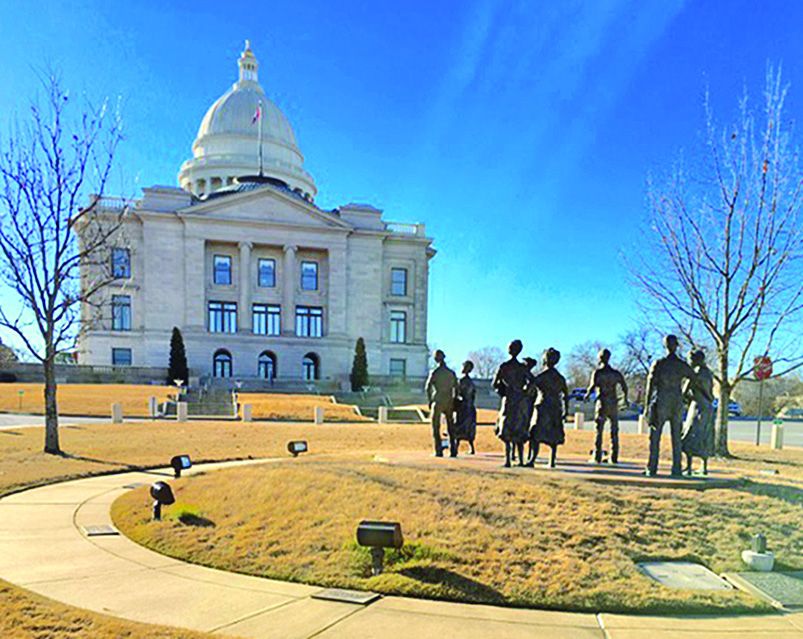
According to a May 5, 2016 Washington Post article, Confederate monuments are a “problem” that needs to be fixed. Nonetheless, destroying Confederate monuments - or “reinterpreting” them with qualifying remarks cast in bronze—under the guise of political correctness is a bad idea for three reasons. First, the history of the South’s evolving society is made more apparent by adding new shrines to honor more recent leaders than by destroying or “reinterpreting” old ones. Moreover, the region has independently demonstrated an inclination to do so without any moral instruction from The Washington Post. There are, for example, memorials to Martin Luther King in Atlanta, Memphis, Montgomery, and Austin, as well as countless MLK-named roads and schools across the South. As pictured in this article are statues to the nine black teenagers who integrated Little Rock’s Central High School in 1957 were erected on the grounds of the Arkansas state capitol in 2007. The same grounds include two Confederate statues put up in 1905 and 1913, respectively: one for the ordinary Rebel soldier and one honoring the women of the Confederacy. Second, as Alexander Dumas (whose mother was a slave) put it, “The difference between patriotism and treason is a matter of dates.” Similarly, qualifications for political correctness fluctuate. Consider, for example, the possibility that future feminists might demand monuments to Martin Luther King be destroyed because he was persistently unfaithful to his wife. Consider also that a future hypothetical misogynistic society might demand that Arkansas remove the statue to Confederate women, which was erected without any edification from the modern feminism. Third, condemning Confederate monuments because of the atavistic racial attitudes among the people of that time begs the question of whether the policy should also apply to statues for Northern historical figures. Consider the Lincoln Memorial. A couple of months before he announced the preliminary Emancipation Proclamation on September 22, 1862, Lincoln met at the White House with African-American leaders and urged that blacks leave the country. He even arranged congressional funding for their emigration. Addressing his guests Lincoln said: “You and we are of different races. We have existing between us broader differences than exist between almost any other two races. Whether it is right or wrong I need not discuss, but this physical difference is a great disadvantage to us both, as I think your race suffer very greatly, many of them by living among us, while ours suffer from your presence. In a word we suffer on each side. If this is admitted, it affords a reason at least why we should be separated.” Adding new monuments for more recent admired leaders while keeping the old ones in place provides a tangible record of how our society evolved. It will be lost by tearing down the old ones.
Phil Leigh was born in Little Rock, Arkansas and has mostly worked as a computer industry stock analyst. He holds a Bachelor of Science in Electrical Engineering from Florida Institute of Technology and an MBA from Northwestern University. He can be reached at Phil_Leigh@ me.com or 813-368-0764. His books can be purchased from www.Amazon.com. Search for “Philip Leigh”.