Through The Lens
A Wicked Fellow
By Stephanie Hagiwara · Originally published March 2017 · pp. 6–7
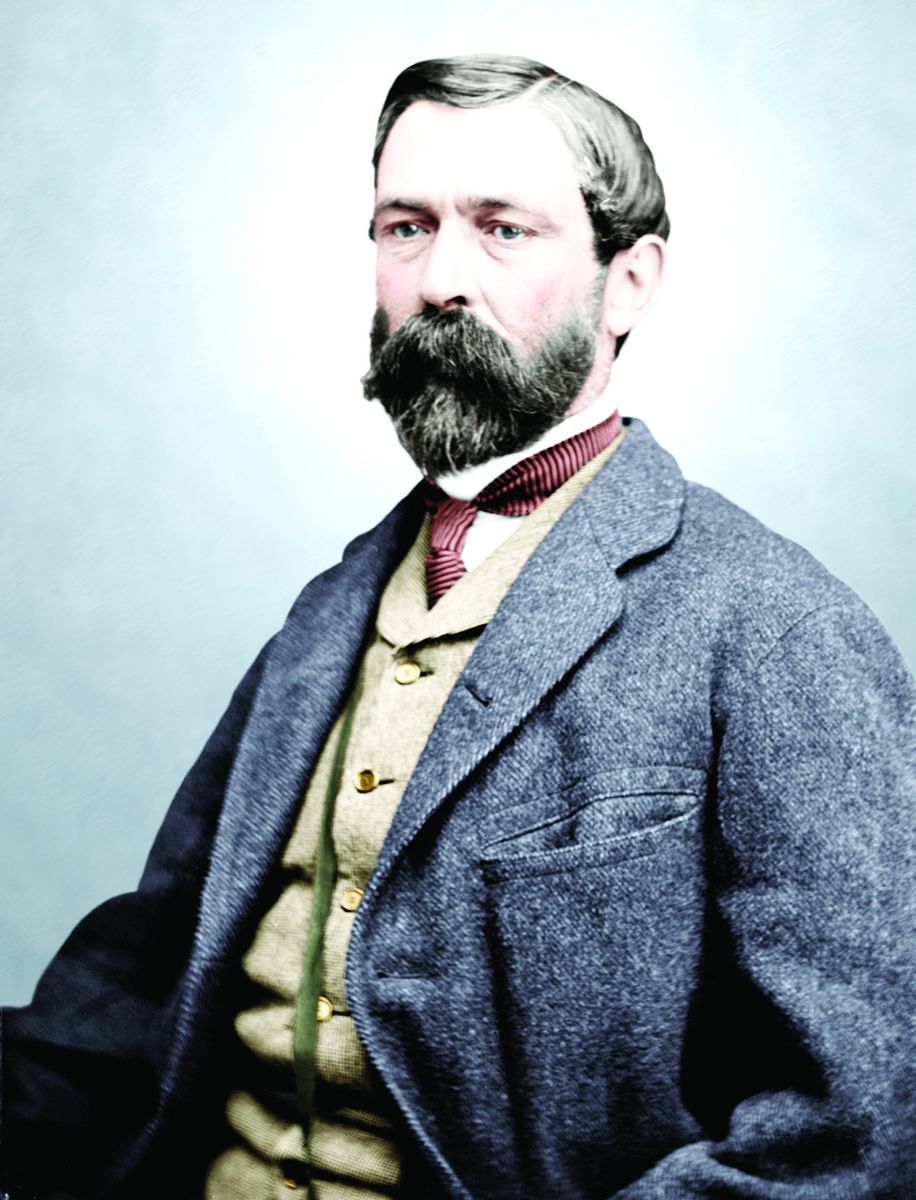
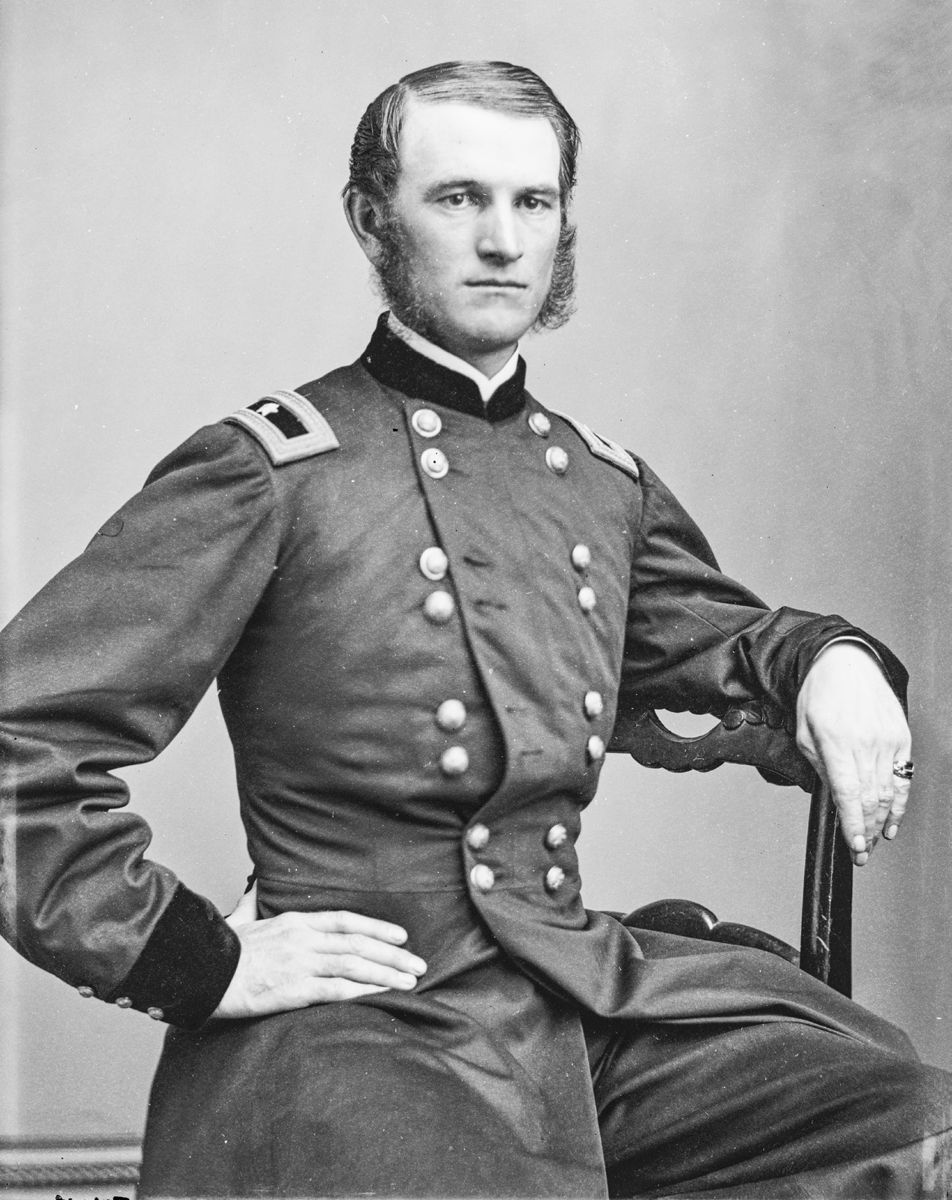
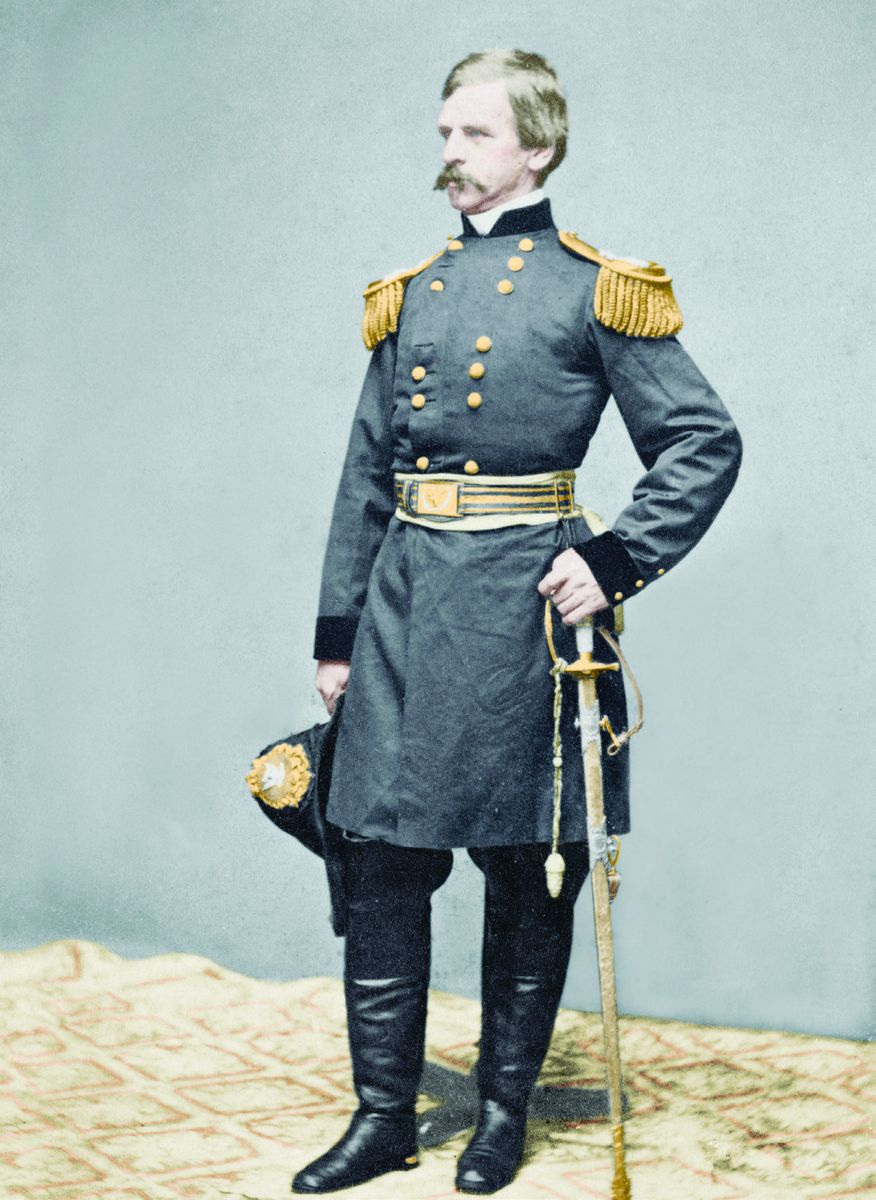
“Action, prompt, vigorous action, is required. While we are deliberating the enemy is marching. King James lost three kingdoms for a mass. We may lose three States without a battle.” C.S. Gen. Richard Taylor. On July 4, 1863, Vicksburg, Miss. surrendered to Gen. Ulysses S. Grant. Napoleon III of France installed Maximilian I as Emperor of Mexico on April 10, 1864. Due to public opinion, Lincoln’s military attention in the West turns to Texas. The tantalizing prospect of capturing cotton for northern mills, opening the path for cotton growers using paid labor and discouraging France from moving northward, led to the ill-fated 1864 Red River Campaign in Louisiana. It was a deceptively simple plan. Federal forces would move up the Red River to Shreveport, La., before moving on to Texas. Adm. David Porter’s fleet of gunboats would provide firepower. U.S. Gen. Nathaniel Banks would lead 20,000 troops along with an additional 15,000 men from Gen. William Sherman to combat land forces while Gen. Frederick Steele’s troops would swoop down from Arkansas to join the attack in Shreveport, La. Standing in their way was military historian and the youngest Maj. Gen. in the Confederate Army—Richard Taylor. Taylor was the only son of the national hero of the Mexican–American War, General and President Zachary “Old Rough and Ready” Taylor. His late sister, Sarah, was C.S.A. President Jefferson Davis’s first wife. Taylor, a wealthy Louisiana planter, may not have attended West Point but he did attend Harvard and Yale. Taylor gained practical experience serving with both Gen. Richard Ewell and Gen. Thomas “Stonewall” Jackson in the Shenandoah Valley, Va. On their first meeting, Jackson noted that Taylor didn’t seem to have any stragglers. “You must teach my people; they straggle badly,” requested Jackson. Later that evening Jackson questioned Taylor about his marching strategies. Both men were impressed with Taylor’s knowledge of military history, strategy and tactics. It was Jackson who recommended his promotion to Major General. Aware that reading tales of battle was not the same as actual experience, Taylor “early adopted two customs, and adhered to them throughout the war. The first was to examine at every halt the adjacent roads and paths, their direction and condition; distances of nearest towns and cross-roads; the country, its capacity to furnish supplies, as well as general topography, etc., all of which was embodied in a rude sketch, with notes to impress it on memory. The second was to imagine while on the march an enemy before me to be attacked, or to be received in my position, and make the necessary dispositions for either contingency. My imaginary maneuvers were sad blunders, but I corrected them by experience drawn from actual battles, and can safely affirm that such slight success as I had in command was due to these customs.” Taylor’s self-imposed homework included refraining from “the most villainous habit” of cussing while giving orders. While fighting to regain Winchester, Va., “and, forgetting Jackson’s presence, [Taylor] ripped out, ‘What the h—are you dodging for? If there is any more of it, you will be halted under this fire for an hour.’ The sharp tones of a familiar voice produced the desired effect, and the men looked as if they had swallowed ramrods; but I shall never forget the reproachful surprise expressed in Jackson’s face. He placed his hand on my shoulder, said in a gentle voice, ‘I am afraid you are a wicked fellow,’ turned, and rode back to the pike”. Banks, on the other hand, was appointed a general due to his political experience as Speaker of the U.S. House of Representatives. Instead of attending West Point, he had left school at fourteen to work as a bobbin boy in a textile mill. Banks expanded his education by reading extensively and his orator’s skills by forming a debate club. He was smart and brave but Banks’s focus was on winning the White House not the war. Up the Red River traveled Porter’s gunboats with Banks’s troops marching on the road alongside. At Grand Ecore, La., the road struck off away from the river. Instead of a reconnaissance, to save time Banks consulted Pilot Withenbury. Pulling out his maps, Withenbury suggested an inland road that left the river. Perhaps to protect his own cotton, he neglected to mention a road with corn and cattle in abundance that ran nearer the river. Banks blithely set off, his troops and baggage stretching over twenty miles from front to rear. Taylor and C.S. Gen. Edmund Kirby-Smith were arguing about where to send their limited troops. Just past Mansfield, La., three roads crossed, one of which led back to the Red River. Taylor wanted to attack before Banks reached Mansfield. Kirby-Smith advocated sending troops to block Steele’s path to Shreveport. On April 8, as Kirby-Smith dithered, Taylor prepared for battle. His medical officer was instructed to ready local homes for the wounded. He positioned Gen. Alfred Mouton on the east side of a large clearing with Gen. Thomas Green’s cavalry on the south side. Taylor’s Louisiana and Texas troops were chomping at the bit, anticipating Banks arrival. By 4:00 pm, daylight was burning and Taylor was done waiting. He gave Mouton the signal to charge. U.S. Gen. Thomas Ransom sent five regiments to deflect the oncoming Confederates. Among the first to fall was Mouton. “Taylor sat on his black horse watching the battle, a cigar in his mouth and one leg thrown across the saddle.” He directed the cavalry to attack the enemy’s rear and Gen. John Walker’s men to charge and turn the Federal’s left flank. The Texans rushed in “like a cyclone” said a Northern soldier, “Yelling like infuriated demons.” Ransom, outflanked, ordered a retreat into the woods where reinforcements held the Confederates back for an hour. “Suddenly there was a rush, a shout, the crashing of trees, the breaking down of rails, the rush and scamper of men,” wrote newspaper reporter John Russell Young. “… I turned to my companion to inquire the reason of this extraordinary proceeding, but before he had the chance to reply, we found ourselves swallowed up, as it were, in a hissing, seething, bubbling whirlpool of agitated men.” Banks attempted to stem the tide, riding into the pandemonium. “Form a line here,” he called to some of his men, “I know you will not desert me.” The men dashed by abandoning all their gear. Wagons blocked the road as teamsters cut the mules out of their traces and fled. Two miles from the battlefield at Pleasant Grove, U.S. Gen. William Emory managed to halt the fleeing men to make a stand “along the eastern side of a ravine through which ran a small stream”. The Confederates were hot on their tail, determined that the enemy would not control the only water source in the area. “There was some sharp work, but we persisted, the enemy fell back, and the stream was held, just as twilight faded into darkness,” wrote Taylor. “Twenty-five hundred prisoners, 20 pieces of artillery, several stands of colors, many thousands of small arms, and 250 wagons were the fruits of victory in the battle of Mansfield.” For Banks, the battle was the beginning of the end of the Red River Campaign. Sources: • O. R., XXXIV, Part i, p. 522 • Taylor, Richard. Destruction and Reconstruction: Personal Experiences of the Late War • Johnson, Ludwell H. Red River Campaign: Politics and Cotton in the Civil War • “Red River Expedition,” Report of the Joint Committee on the Conduct of the War, 38th Cong., 2d Sess., 11, 5. Pp. 285-287 Stephanie Hagiwara is the editor for Civil War in Color.com and Civil War in 3D.com. She also writes a weekly column for History in Full Color.com that covers stories of photographs of historical interest from the 1850’s to the present. Her articles can be found on Facebook, Tumblr and Pinterest.