
The Death And Burials Of The Rt. Rev. Lt. Gen. Leonidas Polk, C.S.A.
By Stephen Davis · Originally published June 2017 · pp. 18–20

How many Confederate generals were killed in action? Fifty. How many Confederate chaplains lost their lives in the service? Forty-one. How many Episcopal bishops who were also Confederate generals were killed during the war? One: Leonidas Polk, who lost his life June 14, 1864—the subject of our special report in this June issue.
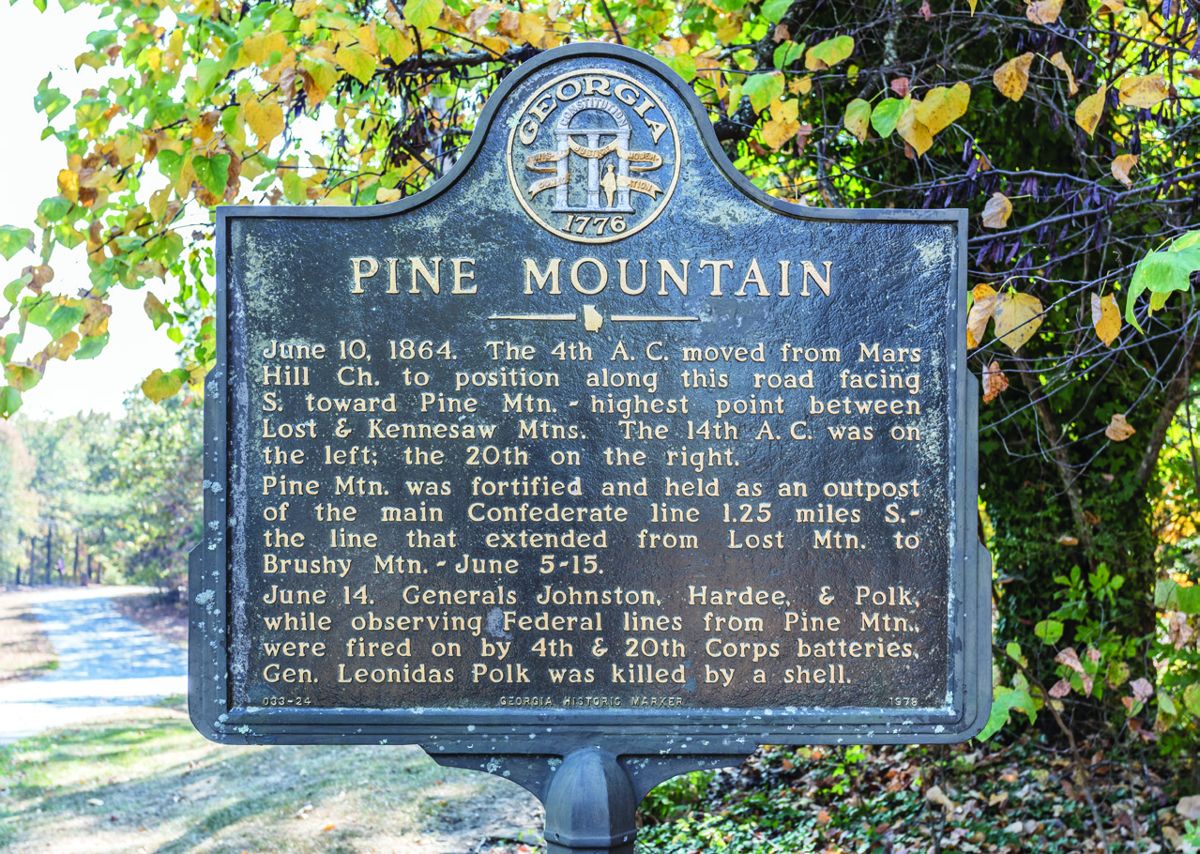
Polk was born in North Carolina in 1810. West Pointer, Episcopal priest, planter and bishop of Louisiana, he was appointed major general at the start of the war by his friend Jefferson Davis. Leaving the capitol after meeting with the president, someone called out, “What! you, a bishop, throw off the gown for the sword!” to which Polk answered, “No, sir, I buckle the sword over the gown.” Polk commanded troops in the Mississippi Valley that eventually became part of the Army of Tennessee. He served as corps commander under Bragg, and was promoted to lieutenant general in October 1862. Sent to Mississippi after Chickamauga, Polk returned to the Army of Tennessee in May 1864, leading a corps under Gen. Joseph E. Johnston, then in north Georgia. By mid-June, the Confederates had fallen back before Maj. Gen. William T. Sherman’s forces to north of Kennesaw Mountain, some twenty miles from Atlanta. About 11 a.m. on the morning of the 14th, Gen. Johnston, Polk and Lt. Gen. William J. Hardee were atop Pine Mountain, surveying the Federal position below. Capt. Rene Beauregard—son of the famed Creole general—commanded an artillery battery dug in on the mountaintop. Infantry support came from the Florida brigade of Col. William S. Dilworth. Dilworth warned the officers that the enemy artillery had their range and to watch out. Sure enough, down below, Gen. Sherman himself spotted the officers atop Pine and ordered nearby guns to fire a few salvos. The Fifth Indiana Battery Light Artillery, commanded by Lt. Alfred Morrison, opened up, sending 3-inch caliber Hotchkiss shells toward the top of Pine Mountain. Dilworth was pointing out the Yankee lines when things got hot. “I had scarcely got down from the parapet when a solid shot from the enemy’s battery came over our heads,” Dilworth remembered. He urged the generals to move back from the crest. Hardee did so, joining Col. William D. Gale, Polk’s son-in-law and ADC. Johnston started walking toward them, but Polk tarried, apparently wanting one last look.
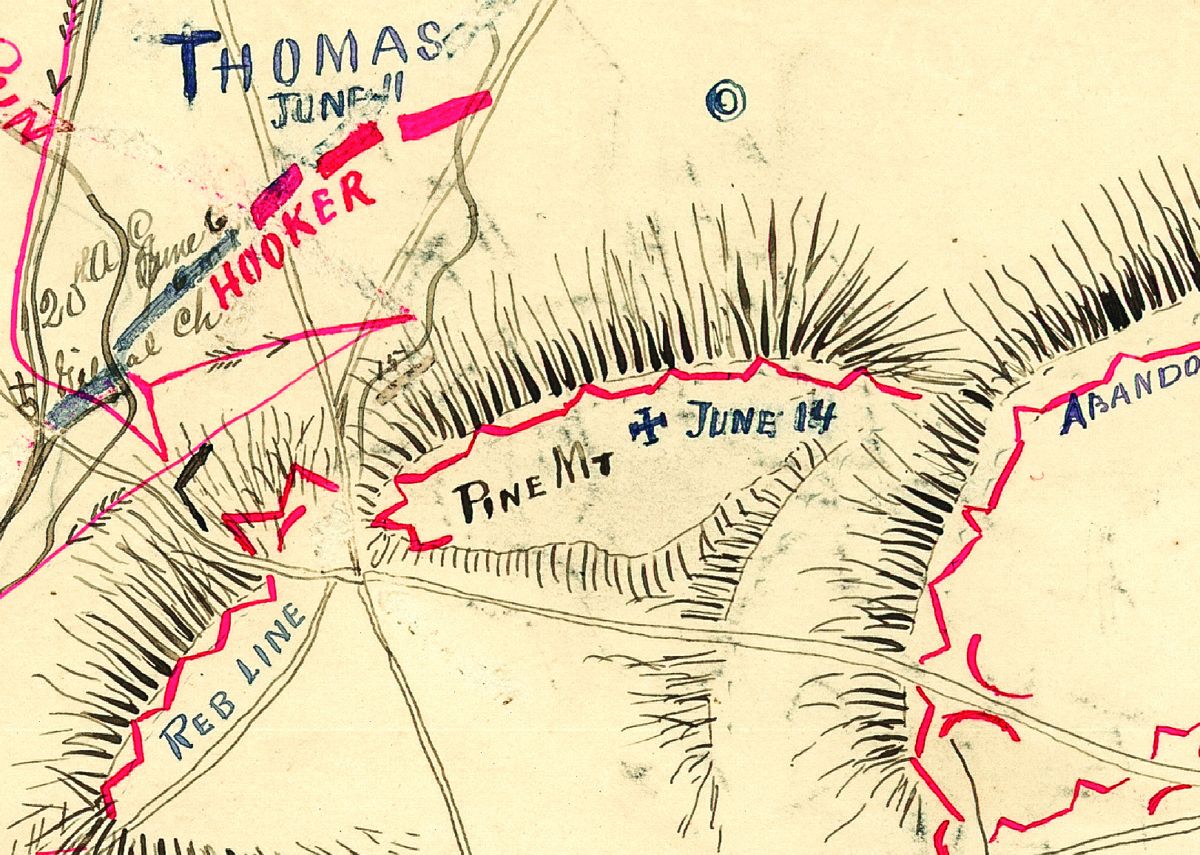
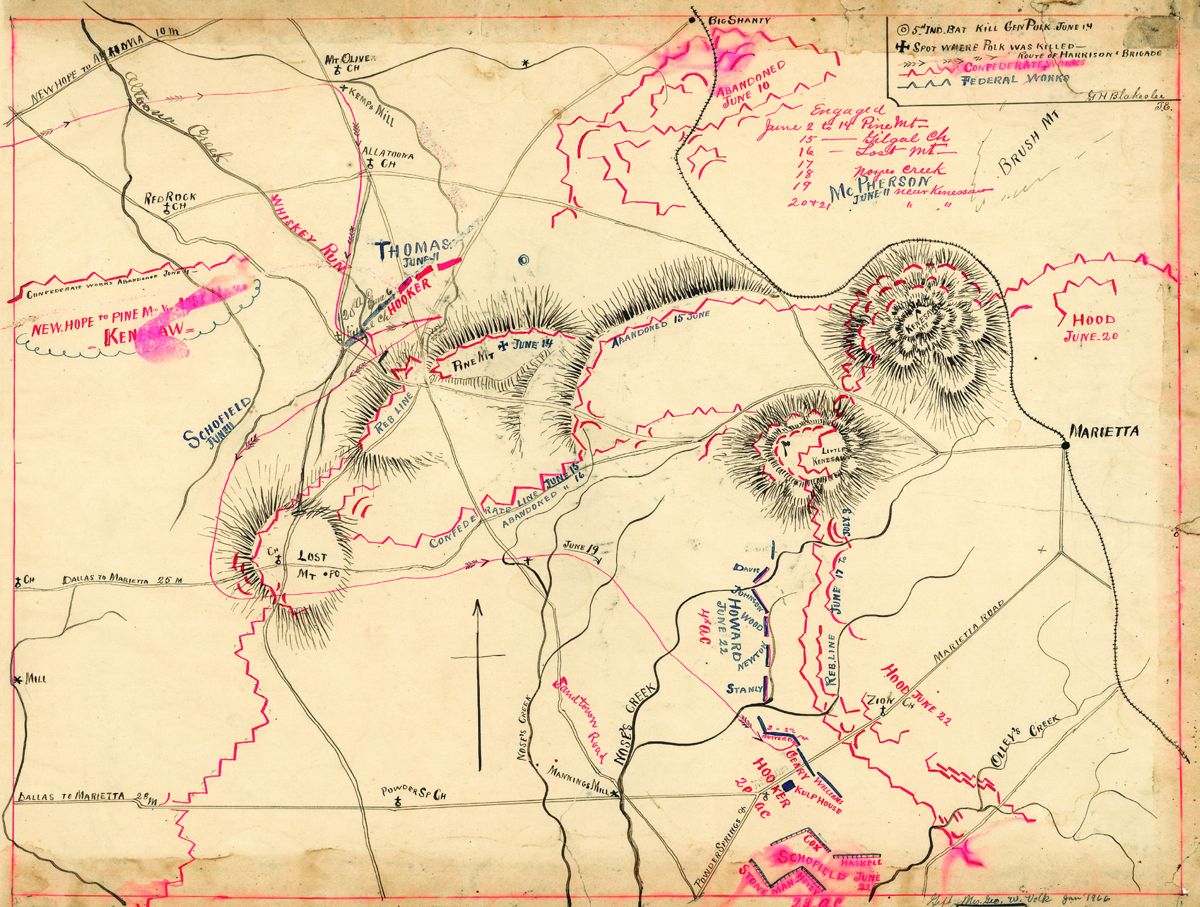
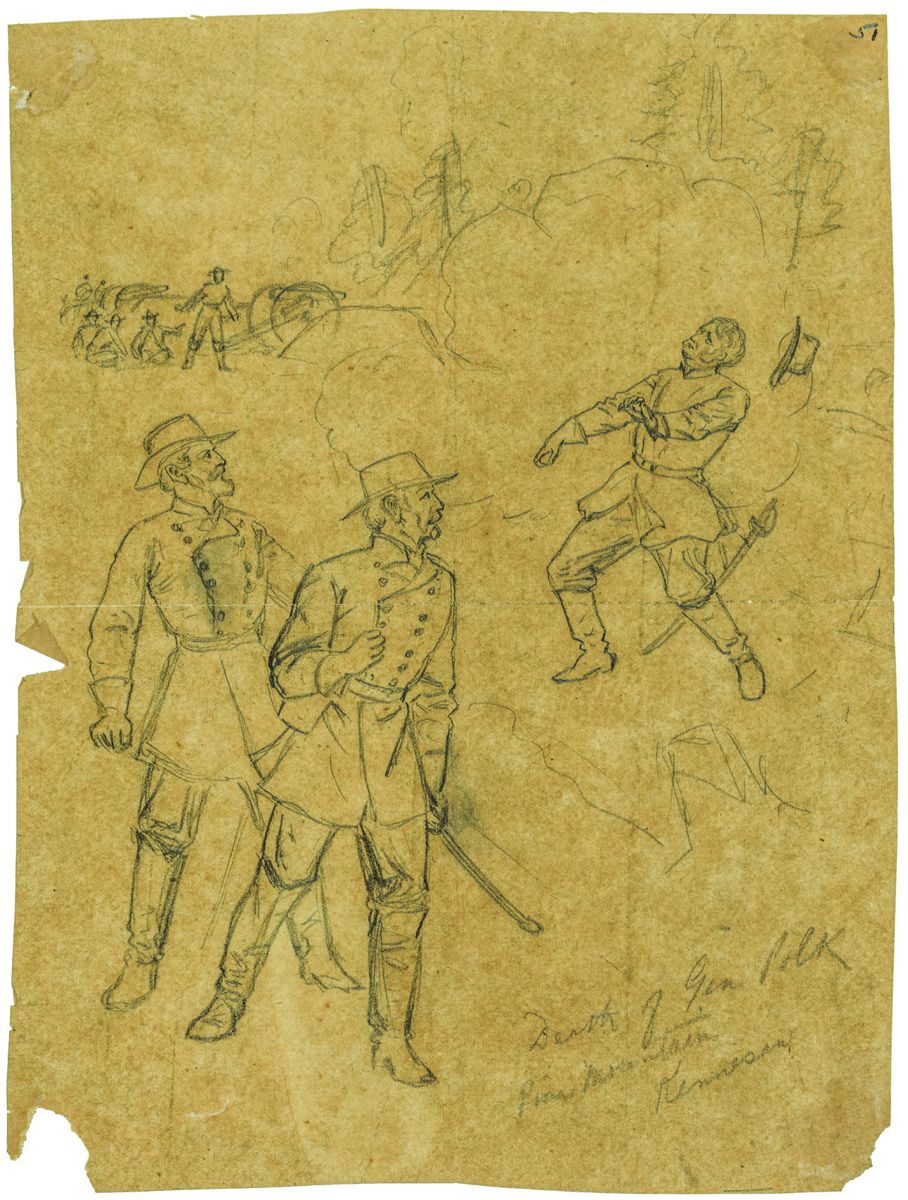
Just then, a Northern artillery projectile struck and killed the bishop-general. It passed completely through his chest, breaking first his left arm then his right, before striking a tree and exploding. Polk was dead before he hit the ground. Colonel Gale and Lt. Aristide Hopkins, another staff officer, ran up to the general’s mangled body. So did Hardee and Pen and ink sketch map of northwestern Cobb County, Georgia, showing the “route of Harrison’s Brigade,” Confederate and Federal works, battlefields, roads, railroads, churches, drainage, and relief by hachures. Also depicted are the locations of the “5th Ind. Bat. [that] kill[ed] Gen. Polk, June 14” and the “spot [indicated by a cross] where Polk was killed.” (Library of Congress)
Johnston. “My dear, dear friend,” the former grieved; “little did I think this morning that I should be called upon to witness this.” A tearful Johnston laid his hand on Polk’s forehead. “I would rather anything but this,” he sobbed. Stretcher-bearers were called; they placed the general’s corpse on the litter and with staff officers headed down the mountain. Signal officers wigwagged a message: “Send an ambulance for General Polk’s body.” The wagon came up, and bore it to Marietta, the rail depot. From there a train carried the general’s remains into Atlanta. Within a few hours Sherman knew of Polk’s death. Union signal officers had cracked the Rebels’ semaphore code and intercepted the staff’s call for an ambulance. They sent the intelligence up the chain, allowing
Sherman to wire Washington, “We killed Bishop Polk.” Johnston too telegraphed his capital. “The army and the country this morning had the calamity to lose Lieutenant General Polk,” he announced, “who fell by a cannon-shot directed at one of our batteries.” Johnston had to announce the news to his army as well. “Lieutenant-General Polk fell to-day at the outpost of this army,” his order read; “in this distinguished leader we have lost the most courteous of gentlemen, the most gallant of soldiers.” Word spread quickly through the ranks. That night, Capt. Samuel Foster, a Texan in Maj. Gen. Pat Cleburne’s Division, was able to record details of the tragedy in his diary. The Rev. Charles T. Quintard, Episcopal chaplain-at-large for the Army of Tennessee (and physician), was among those at Atlanta’s downtown depot that evening, waiting for the train bringing Polk’s body. Quintard saw that it was taken to nearby St. Luke’s Church. Quintard had overseen construction of the spare wooden chapel that spring, when the city’s sole Episcopal worship-place started to overflow on Sundays. The general’s body, cleansed and in dress uniform, covered by a cross of white flowers, lay in state that night. The next morning, June 15, thousands of soldiers and civilians queued outside St. Luke’s, waiting to file past the casket. “Many, very many,” remembered a young girl years later, “paused long enough when the casket was reached to stop…and take a leaf, or a flower, or twig” from the white magnolia blossoms which had been banked by the coffin. Their aroma filled the sorrowful room. At noon Dr. Quintard delivered a eulogy in what would eventually be the first of Leonidas Polk’s three funeral services. Meanwhile staff officers contacted the general’s family. Polk’s son in Montgomery was telegraphed; Col. Gale went to Asheville to get Mrs. Polk and her daughters. But where to bury the bishop? Logic dictated New Orleans, home of Polk’s Episcopal diocese. The Crescent City, though, was then in enemy hands. It was decided that the Diocese of Georgia should be entrusted with Polk’s interment. The bishop of Georgia, the Rt. Rev. Stephen Elliott, made arrangements for the bishop-general to be laid to rest in Augusta, where Elliott was rector of St. Paul’s Church. Quintard oversaw transport of the casket to the railway station, escorted by Polk’s staff, several Confederate generals and citizens. It arrived in Augusta the morning of June 16 and was taken to St. Paul’s, where it lay in state for two days. The general’s remains were then consigned to a lead coffin and removed to Augusta City Hall while arrangements were made for an ornate funeral to be held on June 29. President Davis was invited to attend, but he had to decline, sending instead a warm note of condolences. When the date arrived, everything was ready. That morning at City Hall soldiers solemnly placed the general’s coffin in a hearse heaped with flowers and draped by the “Stainless Banner” of the Confederacy. A procession led by Augusta Mayor Robert May wended through the city toward St. Paul’s. With businesses closed, crowds lined the streets as the procession passed by, bands playing somber airs. A full regiment of infantry with horsemen and artillery provided the honor guard. Among the dignitaries in the long column was none other than Lt. Gen. James Longstreet, who happened to be in Augusta, still recovering from his Wilderness wound. Once at the Episcopal Church, Bishop Elliott officiated in services featuring hymns and scripture. The highlight was Elliott’s sermon, in which he reviewed Polk’s life as priest and soldier, extolling his virtuous character, and castigating the Yankees. The bishop warned “ye Christians of the North” of the judgment they would Pre-war image of Polk.
someday receive at the hand of Christ. Before “that awful bar where your brute force shall avail you nothing,” the bishop summoned them “…in the name of that sacred liberty which you have trampled under foot; in the name of the glorious Constitution which you have destroyed; in the name of our holy religion which you have profaned; in the name of the temples of God which you have desecrated; in the name of a thousand martyred saints, whose blood you have wantonly spilled; in the name of our Christian women whom you have violated; in the name of our slaves whom you have seduced, and then consigned to misery.” “And there I leave justice and vengeance to God,” Elliott concluded. So many people thought highly of his remarks that they were published as a pamphlet.
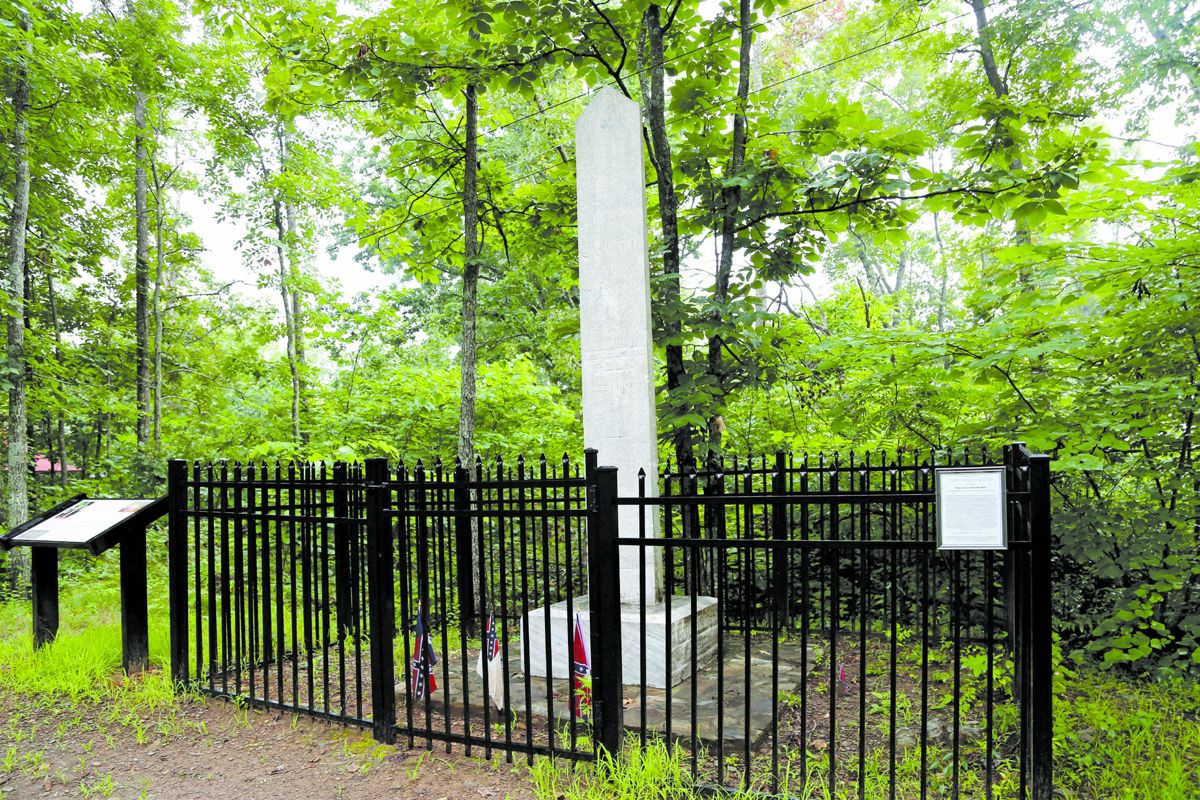
Polk Monument on Pine Mountain.
Polk’s coffin was lowered into a tomb beneath the floor of St. Paul’s; Gen. Longstreet aided in the ceremonial throwing on of earth. Elliott announced that the diocese of Georgia would care for Polk’s “sacred dust” until such time as his own, that of Louisiana, could. But that would take years, as it turned out. In the meantime, Polk’s wife Frances

died in 1875; she was buried in Augusta alongside her husband. A few years later a brass plaque was embedded in the chancel railing: “A.D. 1889 In memory of Rt. Rev. Leonidas Polk June 14 1864 and his wife Frances A Devereux April 16 1875 at rest beneath this chancel.” There’s another memorial to General Polk, one with which Civil Warriors are much more familiar. It’s the monument on the crest of Pine Mountain in Marietta, Ga. A generation after the war, one J. Gid Morris, a Confederate veteran living in Marietta, determined that Gen. Polk should have a monument at the site of his death. Morris and his wife raised the money and on April 10, 1902, with appropriate ceremony, a twenty-foot marble shaft was unveiled atop the mountain. On its north side, facing the direction of Sherman’s lines, the inscription invokes Caesar’s boast about his Gallic conquest. Morris, the good old Reb, added a taunt to the Yankees. Back then, it was thought that during the war 600,000 Southerners had served in the Confederate army, battling 3 million Yankees until they succumbed to exhaustion. Hence Morris’ chiseled gibe: “VENI VIDI VICI with 5 to 1.” The other side of the shaft explains that on June 14, 1864, “on this spot,” Polk was killed by a cannon shot that “crashed through his breast.” Today, although the site is on private property, the landowner allows respectful visitors to trek to Morris’ monument. As bonus, they can see three of the four earthen embrasures that protected Rene Beauregard’s battery back in 1864. When Stephen Elliott took charge of his fellow bishop’s remains “until such time as his own diocese shall be prepared to do him honor,” no one could have guessed that eighty-odd years would pass before that time came, in 1945 during the final days of World War II. Mitchell Tyler, sexton emeritus at St. Paul’s, whom I interviewed decades ago, remembered when the call came to remove Polk’s remains from the church crypt. In the bishop-general’s coffin he found nothing more than some teeth and dust—“all would have fit in a cigar box.” Those remains, and those of Mrs. Polk, were transported to New Orleans and at long last received by the Diocese of Louisiana. On May 2, 1945, at Christ Church Cathedral, six Episcopal bishops participated in Leonidas Polk’s last funeral. The Rev. Frank A. Juhan, Chancellor of the University of the South in Sewanee, Tenn. (which Polk had helped establish), gave the sermon, looking over the royal purple robes which draped the Polks’ caskets. Then, much as had been done at St. Paul’s in 1864, the remains were lowered beneath the chancel floor. Today’s visitor to Christ Church in New Orleans will find the burial place marked by a large stone in the cathedral floor (south choir aisle). Ornately etched is the inscription: Leonidas Polk 1806-1864 First Bishop of Louisiana 1841-1864 and his wife Frances Ann Devereux 1807-1875. There we have it: three services of eulogy, two interments, one monument. Not bad for a Confederate general whom historians today regard more highly as a spiritual and moral leader for the Confederacy than as a talented army corps commander. Steve Davis of Atlanta is a regular contributor to Civil War News and is the Book Review Editor. His book, A Long and Bloody Task: The Atlanta Campaign from Dalton through Kennesaw Mountain to the Chattahoochee River May 5-July 18, 1864, was published as part of Savas Beatie’s Emerging Civil War paperback series. The companion volume, All The Fighting They Want: The Atlanta Campaign From Peachtree Creek To The City’s Surrender, July 18-September 2, 1864, has been published this Spring.