Critic's Corner
Soldiering: The Civil War Diary of Sgt. Rice C. Bull, 123rd New York
By Stephen Davis · Originally published June 2017 · pp. 28–29
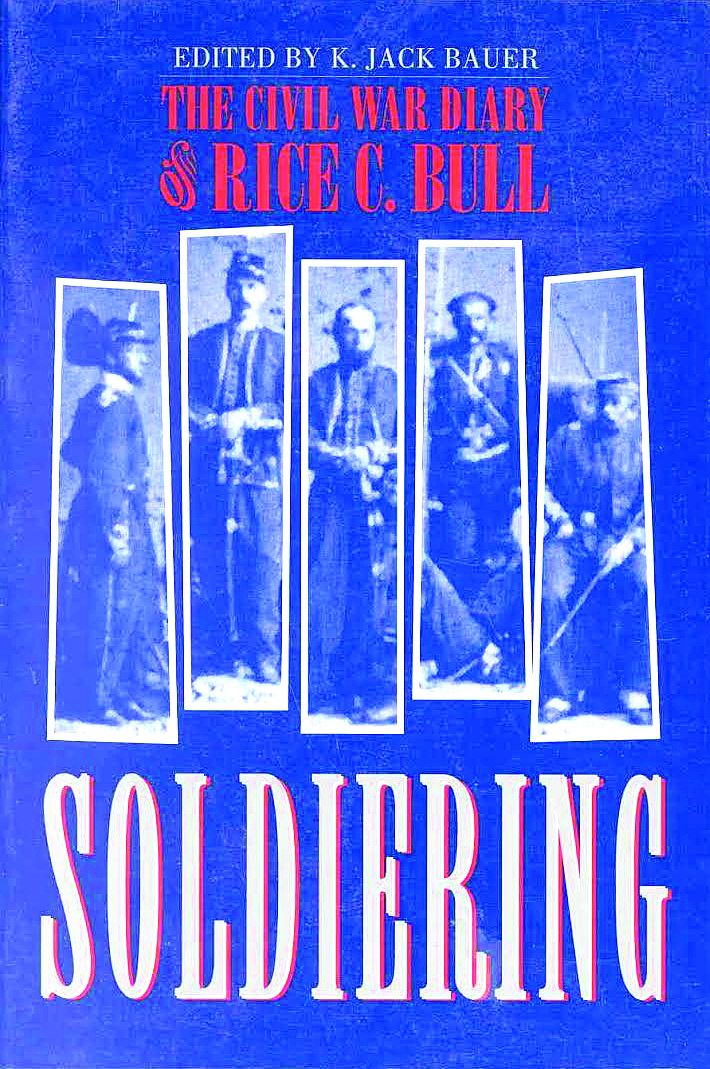
In My “Critic’s Corner” column last September I featured the uniquely interesting memoir of Union soldier Rice C. Bull. Bull served throughout the war in the 123rd New York Infantry, from its organization in August 1862 to mustering out in May 1865. Written fifty years after the war, but based on his wartime letters and diary, Bull’s reminiscence was donated by descendants to the historical society of Troy, N.Y. A professor there, K. Jack Bauer, learned of the document and saw to its publication as Soldiering: The Civil War Diary of Rice C. Bull (San Rafael CA: Presidio Press, 1977). Bull fought with his regiment at Chancellorsville, where he was wounded and captured, then was transferred west with it to become part of Maj. Gen. Joseph Hooker’s XX Corps. My article last fall highlighted Bull’s observations during the Atlanta Campaign at such length that I ran out of space. “Maybe I’ll pick it up in another column,” I wrote, “and finish the story.” That’s where we pick up, after the Federals’ two and a half month-occupation of Atlanta, and the start of Sherman’s 60,000man March to the Sea, Nov. 16, 1864. “The March was made with ease and really enjoyed by all after our stay in camp,” Bull declared. Indeed, Sherman’s orders called for his columns to cover only about fifteen miles a day, hardly an arduous pace. Orders also specified how the troops would forage for food along the march-route. This, Bull confessed, “was not work I desired,” adding that he “had no heart in seizing the property of the plantation owners,” but when foragers brought in provisions, Bull indulged like everyone else. They had plenty to eat for the first two weeks, but pickings got scarcer when Sherman’s army entered the piney woods area near Savannah. He noticed few private houses burned, and these, according to Bull, were by accident from cotton and gin fires. He knew that bummers sometimes took people’s property other than food, “but I do not think such action was common.” Working from his diary, Bull described the Federals’ march to Savannah with fascinating vignettes of fighting Wheeler’s cavalry and encountering civilians in towns they marched through. At Sandersville, “like the other towns we passed through, the populations that remained consisted mostly of old white people and children and Negroes, the Negroes our only friends.” Of the enemy they encountered, Bull opined, “the Confederates seemed to have lost their vigor. The rank and file of their Army seemed disheartened.” Near Millen was found Camp Lawton, the POW camp set up to receive the Andersonville prisoners. The Rebels had abandoned it, and there was nary a soul around - the Federal prisoners had all been removed. “They must have nearly all lived underground,” Bull writes, “for they seemingly had not tents or blankets in order to have any cover from storms.” “The whole enclosure within the stockade was dug up,” Bull adds; “as I looked at these dens I did not wonder there were so many graves outside of the stockade.” The inmates at least had good water; he had to concede, after seeing the nearby spring. As he and his comrades neared Savannah, Bull judged, “taken as a whole, we had not only been successful but it was an enjoyable march.” Then, after Lt. Gen. William J. Hardee’s Confederates evacuated the city on December 20, “Savannah was left to the terrible Sherman Yankees.” The New Yorker’s last forty pages trace Sherman’s march through the Carolinas. Everything you’ve heard about Sherman’s men in South Carolina is true, at least according to Bull. After noting that some soldiers had wrecked the plantation manor of a prominent secessionist, he writes, “the grudge held against South Carolina and her people by many soldiers was very intense; many times they ruthlessly destroyed property when they heard it belonged to an active secessionist.” “They wished such people,” he reasoned, “to suffer for their responsibility in bringing upon our country the Civil War.” He marched through several towns which had been burned, including Robertville and Loudenville. After noting that in Winnsboro “all the stores were completely gutted and many of the private houses were badly dealt with,” the New Yorker offered something of a condescending judgment, “the town had first been occupied by some of our western troops who did not seem to have any scruples or make any exceptions in their work of destruction.” Bull does not comment on the burning of Columbia; his division did not march through the city. But there’s more of what you’ve heard: “Everything in the way of supplies, cotton, grain, corn, etc., not taken for use by the Army was burned. This included cotton gins, outbuildings, sheds, and storehouses; many dwellings would accidentally catch fire, especially when the owners were not there to look after them.” With no effective enemy force to fight, the Federals’ hardest work was corduroying roads during frequent rainstorms. “Our greatest enemy in this campaign was rain,” he wrote at one point. Soaked through, trying to sleep, Bull records that the men kept their shoes on; “we did not dare take them off for fear they would shrink so much they could not get them on in the morning.” The men showed wear from the long march. All the rain damaged their uniforms. “Our clothes were in bad condition,” Bull wrote on February 28. “They had been wet and dry so many times they had shrunk out of shape and were worn out; our shoes were nearly gone.” Unless they reached a supply base soon, Bull reckoned, “we would have no pants or shoes.” Even food supply was sometimes a problem. Occasionally the wagons only offered coffee and sugar, so the troops depended on their foragers. When local cornmeal replaced hardtack rations, the men still sometimes went without breakfast; boiling the meal took longer than the officers allowed. “We were about famished at times” (Sunday, March 5). “We were short of rations again,” Bull wrote on March 8; “I can hardly wonder at that; it was such a wretched country with few houses.” Even the foragers at some points may have shown a little heart, as Bull described the local residents as “a starvedlooking lot.” “It was a crime to take their food from them.” The diarist recorded at least once seeing men eat corn stolen from the army’s mules. Yet the troops retained their humor. Once, when crossing a stream named Puppy Creek, “they barked like dogs.” Jim Backus, one of Bull’s buddies, opined on one evening of particularly pinched subsistence, “If I had the contents of my mother’s swill pail tonight, you can bet that I would rob the pigs of their supper.” Finally, as Sherman’s columns marched farther into North Carolina, there were Johnnies to fight. The battle of Averasboro, March 16, 1865, was deemed by Bull a small affair, and indeed it was. Boatner gives casualties of 678 Federal, 865 Confederate. A far worse travail, according to Bull, was having to pull wagons out of the mud the next day. One is struck by the absence of hatred, even harsh feelings, when Bull writes about the enemy. After the battle of Bentonville, he marched past “fifteen unburied Confederate soldiers,” and pitied their grieving families back home. The sight prompted him to engage in a bit of philosophizing. “There should be some way to settle political differences without slaughtering human beings,” he offers, in a statement which sounds like that voiced by soldiers in all wars (I’m thinking just now of Paul Baumer in All Quiet on the Western Front). Approaching Goldsboro, Sherman’s men witnessed the unravelling of the Confederate army. On the morning of March 22, “Uncle” Joe Young (“Joe is the oldest man in our Company,” Bull noted, at 43 years old) brought in two Johnnies, “fully armed and equipped.” Young was on picket post, saw the two Rebs wandering about, and hallooed them over. “They seemed to have had all the war they wanted and willingly came in and surrendered to old Joe.” Bull asked his comrade how he managed to pull off the capture. “I surrounded them,” Joe replied. On April 12, with his forces near Smithfield, General Sherman had an order read announcing Lee’s surrender in Virginia. “It would be impossible for me to describe the scene that followed,” Bull observes. “The men went wild, ranks were broken, and shouting and crying, the men in their joy hugged and kissed each other. Never have I witnessed such happiness.” After this hubbub, Joe Johnston’s surrender on April 26 passed with barely a comment by the diarist. From Raleigh, Sergeant Bull and his comrades marched to Washington for the Union army’s Grand Review. They passed by some of the Virginia battlefields on which they had fought years earlier, and Bull reflected on what it all meant. “Hardly any of us were soldiers by choice,” he wrote, but “the work they had started out to do was done, the Rebellion was over and the Union saved.” On the day of their discharge, June 8, 1865, the feelings of the men, who had shared their terrors and travails, their bonds of camaraderie and endurance, were bittersweet. Bull closed his memoir perfectly: “it was hard to separate and say goodby, one with the other; but we shook hands all around, and laughed and seemed to make merry, while our hearts were heavy and our eyes ready to shed tears.” Steve Davis of Atlanta is a regular contributor to Civil War News and is the Book Review Editor. His book, A Long and Bloody Task: The Atlanta Campaign from Dalton through Kennesaw Mountain to the Chattahoochee River May 5-July 18, 1864, was published as part of Savas Beatie’s Emerging Civil War paperback series. The companion volume, All The Fighting They Want: The Atlanta Campaign From Peachtree Creek To The City’s Surrender, July 18-September 2, 1864, has just been published this Spring.