
Confederate Secret Service
By Joan Wenner, J.D. · Originally published June 2017 · p. 22
Intelligence gathering during the Civil War by both sides had the same goals; basically determine as best as possible each other’s activities, and disrupt or entirely thwart those operations. There were a number of ‘firsts’ in the Civil War and although using spies had always been a part of warfare, unique to this war was the creation of special ‘secret’ agencies within the governmental and military structures of both the Union and the Confederacy.
The Confederacy’s Secret Service Gordon Jones, Senior Military Historian and Curator of the Atlanta History Center wrote, “Yes there was a loosely organized Confederate “secret service” which was especially active in Canada promoting raids and other disruptive activities in Union territory.” As examples of several perhaps lesser known instances he explains, “Some escaped Confederate prisoners pulled off a bank heist in St. Albans, Vt.; there were fires set in New York City; a doctor attempted to infect Union troops by shipping them clothes worn by yellow fever victims (nobody knew it was spread by mosquitoes, unlike smallpox); John Wilkes Booth and Dr. Samuel Mudd supposedly had ties to groups; and there was also quite a bit of similar activity aided and abetted by sympathetic northern ‘Copperheads’ in the summer and fall of 1864, just before the election.” In a book authored by Kate Clifford Larson, she claims John and Mary Surratt, as early as 1861, years before the Booth connection, had revealed themselves as ardent Southern sympathizers. He used his position as local postmaster and the strategic location of their newly purchased tavern for assisting in the illegal distribution of letters
Civil War Antique Shop
Buy and Sell Fine Antiques & Civil War Items Steven E. Heller 231 Juniata PKWY East• Newport, PA 17074 Phone: 717-567-6805 • Email: [email protected] www.CivilWarAntiqueShop.com
Heller’s Antiques
John Wilkes Booth. (Library of Congress) and contraband smuggled to and from Virginia, which their son continued upon the father’s death in 1862. The area was well known for its large number of Confederate agents who, for the most part, successfully avoided Union authorities for three years while providing support to Richmond’s war effort. Historical records confirm the Confederate Congress assembled to write a permanent Constitution allowing less power than the U.S. Federal government to the new government, while the states not unexpectedly retained slightly more. The respected historian Robert H. Jones wrote that on February 4, 1861, thirty-seven of the thirty-eight delegates chosen by the seceded states of Alabama, Florida, Georgia, Louisiana, Mississippi and South Carolina met in Montgomery, Ala., to form a new nation because the individual states had never intended to set themselves up as small independent countries adjacent to the United States. In March 1861, after legislation established the War Department a month earlier, and one day before the provisional government was established, the Confederate Army was created and organized, and its ‘secret service’ branch formed.
Mary Elizabeth Jenkins Surratt. (wikipedia.org) By the early 1862, the southern War Department was issuing specific orders for various cities including Norfolk and Portsmouth, Va., to “imprison persons against whom there is well-grounded suspicion of disloyalty.” Monitoring supposed threats, ferreting out spies and those individuals suspected of giving “aid, countenance or counsel or encouragement to the enemy” along with conducting “secret missions” were critical functions for the stabilizing the Confederacy. At the outset the Confederacy’s P.G.T. Beauregard had written President Jefferson Davis proposing a “detailed strategic plan” be prepared though Davis warned of the unpredictable moves by the North noting, “The present position and unknown purpose of the enemy require that our plan should have many alterations.” Spies in Washington and news reports would soon make many Federal intentions known. One of the South’s early recruiters for skilled and courageous men for the Secret Service Bureau of the Signal Corps, the communications network lodged within the War Department, was the Governor of Virginia. Recorded instances of the Confederacy’s Canadian operations and foreign agent activity elsewhere are plentiful. Also under the umbrella term Confederate ‘secret service’ were the Torpedo Bureau, Submarine Battery Service, Navy Battery Bureau and others. Even a special commando-type unit was organized in 1864, but by then time was running out. Library of Virginia archived papers of one Confederate soldier and Maryland secessionist, Vincent Camalier, note his joining the Secret Service Bureau and serving throughout the war. There are also records of Major William Norris, the Signal Corps chief, who mentioned Camalier’s importance in the espionage service to the Confederate cause. Norris was an 1840 Yale graduate who, in the winter of 1860, volunteered as a civilian aide to Brig. Gen. John Magruder who tasked him with establishing a system of signals on the Virginia Peninsula and across the James River. A Confederate naval officer, John A. Curtis, according to his reminiscences, was assigned to an expedition to free prisoners from the Union prison camp at Point Lookout, Md. Curtis also served as acting master of the CSS Tallahassee in 1864 and, “by war’s end was part of the Confederate secret service working around Fortress Monroe.” One rather interesting official report was sent to Major Norris in April 1864 by a Confederate torpedo boat commander who reported that, “General Grant was at Fort Monroe on last Friday reviewing the troops and inspecting the fortifications. He left there for Norfolk on Saturday. Four thousand wheelbarrows were landed at Fort Monroe on last Friday; their destination as yet unknown. It is reported and believed that active operations are being made for an early advance on Richmond by the three ways mentioned before in my last report.” Just a month earlier, a citizen ‘spy’ had written Confederate Secretary of War James Seddon that, “The enemy have constructed at Point Lookout a number of large boats with sixteen oars for some secret expedition.” He further advised a neighbor of his had been captured crossing the Potomac and put to work as a prisoner “with a great number of hands in muffling oars for these boats, but none seem to know the destination of the boats.” Dr. Charles Elisha Taylor was a Richmond native who joined the Confederate army in 1861 and served in the Signal and Secret Service Bureau in that city, His extensive papers reside in the manuscript collection at the University of Virginia Library, Charlottesville. Taylor related, for example, that the Yankees were as shrewd as they were at signaling tricks and how native Virginian Maj. Gen. Jubal Early, had “cunningly availed himself of diversion.” A modern day researcher notes Taylor detailed the arduous duties that fell to the lot of the brave men in the Confederate Signal and Secret Service branches and the use of ciphers in their fouryear battle to keep open the line of communications within the Southern cause in the North and abroad. In one manuscript Taylor named Thomas A. Jones, a Maryland farmer who operated as a Confederate agent writing, “It was Mr. Jones who helped John Wilkes Booth to cross the Potomac River five days after the assassination of President Lincoln.” Southern newspaper correspondents frequently received “authentic intelligence” from the field, a great many reports being delivered to the Richmond Daily Dispatch. Included for instance were reports from Confederate General, and Virginia governor, Henry A. Wise; coincidentally he was also Union General George Meade’s brother-in-law. As the final days of the war approached, it is said most official records relating to the so-called ‘secret service’ were burned before the evacuation of Richmond, thus only glimpses remain in various archives of the Confederacy’s overall clandestine and destructionist operations and activities. For further reading: Come Retribution: The Confederate Secret Service and the Assassination of Lincoln, by William A. Tidwell, James O. Hall and David Winfred Gaddy, and Tidwell’s April ‘65: Confederate Covert Action in the American Civil War, University Press of Mississippi, www.upress.state. ms.us.
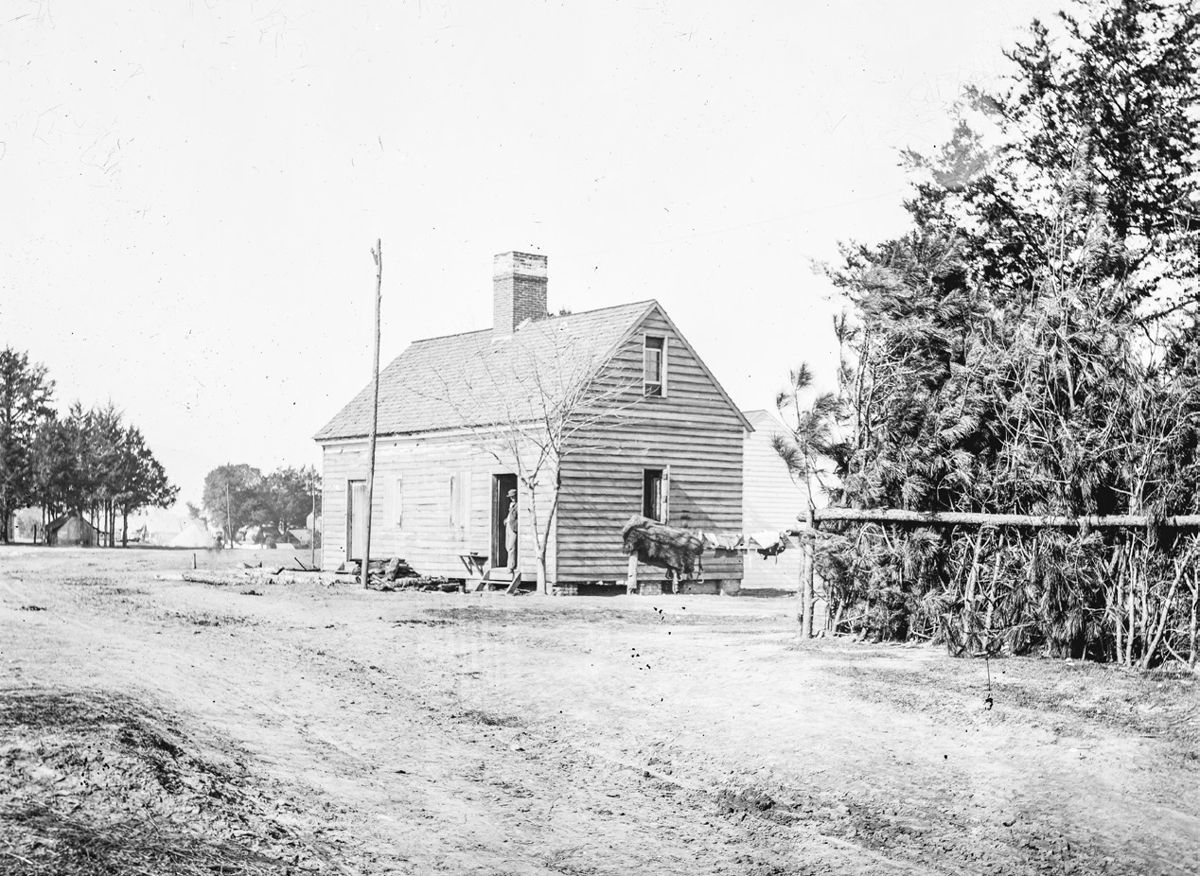
Confederate Secret Service Headquarters,unknown location in Virginia.