
Book Reviews
Book Reviews — June 2017
Originally published June 2017 · pp. 24–32
The Immortal Imagination: The 22nd North Carolina Infantry Regiment in War and Peace. By John Sheehan and Keith Millman. Index, 89pp., 2016, M.T. Publishing, www. mtpublishing.com, $39.95 hardcover. Reviewed by Gordon L. Jones
Ever since Tony Horwitz’s Confederates in the Attic (1998), the usually private world of Civil War reenacting has been periodically visited by people who find themselves enchanted by the notion of time travel and the dedicated enthusiasts who supposedly believe in it. The curious newcomers temporarily “embed” themselves in a reenacting unit (in this case, the 22nd North Carolina) in exchange for the unit’s cooperation in producing a selfadmiring book. Here, the authors attempt a slightly different angle: not only marching and “fighting” (with borrowed gear), but also making tintype images of the participants and recording interviews as to why they do this. The authors’ stated purpose is to “deepen the connection between contemporary Americans and their historic past for educational purposes.” It’s a noble effort (I really liked the interviews), but in the end there is obviously no such thing as time travel. While some of these reenactors look the part (see the cover), most don’t (too old, too plump, and please lose the modern glasses). That, and an introductory text cramming the origins of the war (“resource acquisition”), North Carolina’s role in it, the Lost Cause, “the sociological imagination,” and other topics into thirteen convoluted pages will simply not convince the average contemporary American to fork over $39.95 to buy this book. It will, however, serve as a lovely keepsake for the 22nd North Carolina. Dr. Gordon L. Jones is Military Historian and Curator at the Atlanta History Center. He began reenacting in 1981.
Civil War News book reviews provide our readers with timely analysis of the latest and most significant Civil War research and scholarship. Stephen Davis, Civil War News Book Review Editor. Email: [email protected]
A More Civil War: How the Union Waged a Just War. By D.H. Dilbeck. Notes, bibliography, index, 224 pp., 2016. University of North Carolina Press. www.uncpress.org. $34.95. Reviewed by David Woodbury
Many texts have focused on the unspeakable violence and destruction of the Civil War as evidence that it ushered in a new era of “total war,” particularly in the way it expanded to target civilians and private property. Other essential studies, most notably Mark Grimsley’s, The Hard Hand of War (Cambridge University Press, 1995), and Mark E. Neely’s The Civil War and the Limits of Destruction (Harvard University Press, 2007), have tempered that assessment by highlighting, among other things, the significant restraint shown by and limits imposed upon Federal forces in enemy territory. D.H. Dilbeck, in A More Civil War, aims to bring another dimension to our understanding of how the war was fought, and to offer a better understanding of how Federals reconciled support for such savage destruction with their notion of conducting a “just war.” While Grimsley and Neely thoroughly chronicle Union military restraint, Dilbeck maintains that their volumes fall short of explaining exactly why that restraint was manifested. It is the philosophical, spiritual, and legal underpinnings of that restraint, codified in April of 1863 with the Lieber Code, that the author especially endeavors to illuminate. The Lieber Code outlined the limits to conduct in war, as befits a civilized Christian society, and yet a just war demanded severe prosecution to ensure an expeditious resolution. The idea is expressed in simplest terms in article 29 of the Code itself: “The more vigorously wars are pursued, the better it is for humanity. Sharp wars are brief.” Of particular interest here is the profile of Francis Lieber, and the evolution of his thinking on the rules of war. The Code, issued with Lincoln’s signature as General Orders 100 and entitled, “Instructions for the Government of Armies of the United States in the Field,” was authored by a man who felt keenly the horrors of war, having three sons in uniform. One of his boys was killed fighting for the Confederacy, and another was maimed in the service of an Illinois regiment. As I read this book, it occurred to me that I had never seen a photo of Francis Lieber, who plays such a monumental role in the “civil” part of the title. I was surprised the publisher did not include one (for interested readers, you can quickly find a portrait of Lieber online at the Library of Congress site, from their BradyHandy Collection). A More Civil War is well organized and deeply researched, with ample notes and an impressive bibliography. It breaks new ground to the extent that it adds fresh furrows to the field plowed by Grimsley and Neely, and that’s a meaningful contribution. David Woodbury was a contributing author and cartographer for The Library of Congress Civil War Desk Reference, and is the editor of Talking About History: Historians Discuss the Civil War.
Collecting Historical Autographs: What to Buy, What to Pay, and How to Spot Fakes. By Ron Keurajian. Illustrations, 416 pp., 2016. McFarland, www.mcfarlandpub. com. $45 softcover. Reviewed by Kimberly Brigance
When asked to review Collecting Historical Autographs, I had little idea that the world of autograph collecting was more than purchasing names on paper; it is, in fact, the ultimate detective match pitting wily forgers and clue hunting collectors. According to the author, most autograph seekers are trusting sheep, gobbling up fakes and forgeries as quickly as they are produced. Luckily, Ron Keurajian is prepared to shepherd his readers to more authentic pastures.
By taking readers through the step-by-step process of how a signature is created, Keurajian gives us an understanding of the collecting field and eventually the forgery process. An overly simplified example of his method gives a quick idea of the breadth of his knowledge. The base of an autograph, the very paper, holds many clues to its origin in time. Be it linen, corn husk or wood pulp, a quick feel and examination under light will reveal its age. A good forger can acquire old paper. Ink has been made with many compounds through the centuries. Carbon and iron gall are just as telling as chemically based modern ink. A good forger can use old ink recipes. Alas, ink and paper fade over time creating rich patinas. A good forger can recreate aging with modern chemicals. Provenance and authentication both can be faked. On this point Keurajian is so skeptical that he questions the authenticity of the Rosetta Stone—a bit much, I believe, but his point remains: collectors must use all their detective skills and not rely on a single authenticating method. In the end, Keurajian asserts that it is impossible to completely replicate a signature. Its stops and starts, hesitations and pressure points are as unique as a fingerprint. By copious researching of a person’s signature from youth to old age, it is possible to develop the feel for the autograph as fully as if it were a photograph of the person. To aid readers not willing to dedicate a lifetime to studying one autograph, Keurajian has created a richly illustrated reference guide that can assist even the most novice collectors in separating the true from the fake. His book is written in a casual style which encourages research and hands-on examination. By using his easy-to-understand explanations of autograph trickery and following his examination hints, even the newest collectors should feel more confident when beginning this popular hobby. I believe Collecting Historical Autographs will be an asset to the field, and looked upon as a trusted guide for decades to come. Kimberly Brigance of Atlanta is an accredited member of the International Society of Appraisers (ISA), specializing in Civil War militaria and memorabilia. Her article, “Your Civil War Collection— Weighing the Options,” appeared in the September 2016 issue of Civil War News.
American Civil Wars: The United States, Latin America, Europe, and the Crisis of the 1806s. Edited by Don H. Doyle. 272 pp., 1 Notes, index, 272 pp., 2017. University of North Carolina Press, www.uncpress.org. $27.95 paperback. Reviewed by Timothy J. Orr
American Civil Wars is a collection of eleven essays exploring what editor Don H. Doyle calls the “Crisis of the 1860s.” Instead of viewing the U.S. Civil War as a distinct event to which the rest of the world responded, Doyle and his essayists reveal the ways in which America’s dreadful conflict became enmeshed in the Atlantic World’s larger transnational crisis. Over the tumultuous decade, European and Latin American nations became embroiled in a series of rebellions, uprisings, invasions, and emancipations. These eleven essayists contend that the crises of the 1860s were not coincidental, but inextricably interconnected. Although the Civil War tended to propel the Atlantic World’s other violent events, they say, it was unalterably entangled in the important imperial rivalries that determined the fate of the Americas. The essays in American Civil Wars emphasize three distinct themes. The first five essays describe Europe’s connections to the Crisis of the 1860s. The next four essays describe the crises of the Spanish-speaking world, and the last two essays focus on the Atlantic World’s emancipations. All eleven essays are clearly-worded, well-researched, and interesting. Taken together, the contributors make a convincing case that a “Crisis of the 1860s” truly existed; however, it is still unclear what forces held that crisis together. In his introduction, Doyle suggests that three transnational threads connected the various disputes: the potential collapse of slavery, the uncertain future of republicanism, and the constant jockeying for international dominance by rival empires. As helpful as Doyle’s suggestions are, his essayists do not always lead the reader to the same conclusion. That is to say, transnational forces did not unite all the major disputes of the 1860s. At various points, the essayists make it easier to see vast differences between the crises than sweeping similarities. The two essays focusing on emancipation are a case in point. Both contributors believe the U.S. Civil War triggered strong abolition movements in Cuba and Brazil, but they also reveal fundamental differences in each nation’s experience. Matt Childs’ essay convincingly argues that Cuban slavery mirrored the path taken by the American South. Prior to their moments of emancipation, both Cuba and the Southern U.S. matured into a “Second Slavery,” an updated nineteenth-century version of the peculiar institution, stronger and more profitable than the colonial slave systems from the previous centuries. In Cuba and in the Confederacy, abolitionists extinguished slavery, but only with the help of violent military action. Second Slaveries were so powerful, only armies operating under emancipationist policy could topple them. Meanwhile, in Rafael Marquese’s essay on emancipation in Brazil, abolition took a less revolutionary step. Although several important factors contributed to slavery’s eventual extinction there, in general, it died a slow, legal death through the bloodless 1871 Free-Womb Law. Doubtless, a slave in Brazil would not have seen his plight as having much in common with the more radical emancipationist measures taken elsewhere in the Atlantic
World. In short, American Civil Wars is more of a magnifying glass than a microscope. Quite often, the book’s distant focus helps the contributors establish connections between seemingly divergent national histories, but one might argue that they have, at times, set their observation platform too far back, drawing connections where none exist. Although this is an excellent example of international history, Civil War buffs will not find too much of interest. After all, the topics are a bit outside their usual comfort zone of battlefields, generals, and politicians. However, this is a great collection and it should not be ignored. I’d recommend it to those who wish to expand their vision of the Civil War to consider its significant international dimensions. Particularly, I’d recommend Howard Jones’ essay, “Wrapping the World in Fire,” which challenges the commonly-held assumption that Lincoln’s announcement of the Emancipation Proclamation prevented Britain and France from intervening in the Civil War. Those nations, Jones says, stayed out of the Confederate rebellion not because emancipationist impulses held them at bay, but because it benefited their imperial agendas to remain neutral. Cleverly revisionist, Jones reminds readers that imperialism too often trumped abolitionism when European rulers made crucial foreign policy decisions. Shocking as it sounds to American ears, not every European believed the U.S. Civil War would decide the fate of the world. Anyway, these essays provoke thought aplenty, which is what any good book should do. For those with any interest in the history of international relations, give American Civil Wars a shot. Timothy J. Orr teaches at Old Dominion University in Norfolk, Va. and has a Ph.D. in Civil War History from Penn. State.
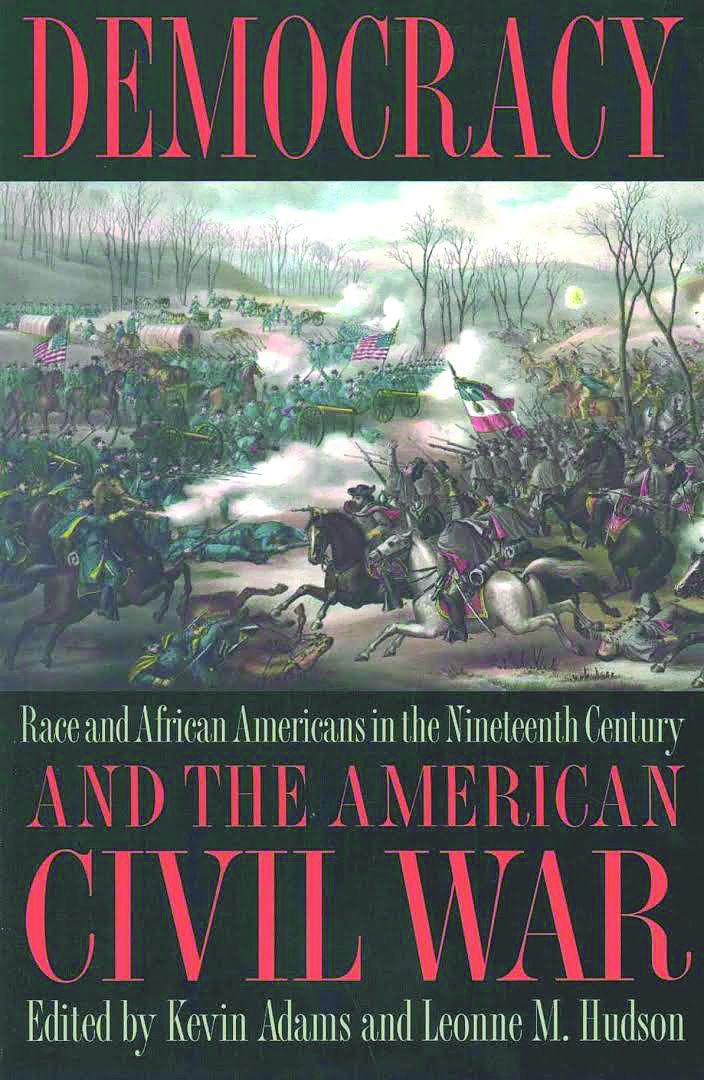
Democracy and the American Civil War: Race and African Americans in the Nineteenth Century. Edited by Kevin Adams and Leonne M. Hudson. Index, 120 pp., 2016, Kent State University Press, www.kentstateuniversitypress.com, $24.95. Reviewed by Jason M. Frawley
In April 2012, Kent State University held its Thirteenth Annual Symposium on Democracy, a “forum for scholarly discussion on the meaning of democracy in a pluralistic society” that “emphasizes the promotion of civil discourse and the prevention of violent confrontations.” This theme reflects the university’s regular commemorations of the 1970 Kent State shootings. Organized by historians Kevin Adams and Leonne Hudson, the 2012 program focused on the topic of “Democracy and the American Civil War” in recognition of the 150th anniversary of “the most devastating war in the history of the nation.” Presenters included Mitchell Snay of Denison University, John David Smith of the University of North Carolina at Charlotte, J. Matthew Gallman of the University of Florida, Mark Grimsley of Ohio State University, Stanley Harrold of South Carolina State University, and Fay A. Yarborough of Oklahoma University (now at Rice University). The substance of that conference resulted in the publication of Democracy and the American Civil War: Race and African Americans in the Nineteenth Century, a collection of essays focusing “on the unifying themes of democracy and race during and after the Civil War.” Included are essays covering the successes and failures of abolitionism (Harrold), Abraham Lincoln and the United States Colored Troops (Smith), the place of men and women of African descent in the Cherokee Nation of Oklahoma (Yarbrough), the origin of and use of posse comitatus during Reconstruction and the Civil Rights Era
(Adams), and the repression of African Americans by the White Leagues of Louisiana in the postwar period (Snay). Admittedly, reviewing essay collections is more challenging than reviewing a traditional monograph, given that one often finds voices of varying quality, or a collection that includes filler and stretches beyond the editors’ stated criteria. Democracy and the American Civil War does not suffer from this traditional flaw, as the collection offers well researched, well written, and unique perspectives on the interplay between race and democracy before, during and after the Civil War. The editors and authors have crafted a substantive compilation of essays that bridge a number of important gaps in the historiography of the Nineteenth Century. Granted, not everyone will agree with the overall intentions and tenor of the book, and some may even wonder about the absence of the some of the symposium’s participants. For example, one might question the editors’ commitment to focusing the collection on America’s democratic traditions while ignoring its fundamental republicanism. Also, references to Ferguson, Missouri, the case of Michael Brown, and the validity of complaints regarding police brutality and profiling in modern America may be off-putting to some readers, especially given the current cultural climate regarding controversies over #backtheblue and #blacklivesmatter. Finally, pieces by J. Matthew Gallman and Mark Grimsley are conspicuously missing from the included essays. As two of most recognizable names in Civil War Era studies, their absence from the book is notable, and one wonders how their contributions might have affected the overall impact of the collection. Even in their absence, however, the essays which do appear in Democracy and the American Civil War offer an impressive array of scholarly views regarding the relationships between race and political ideology during America’s Middle Period, and they fit in well with the field’s current affinity for social and cultural projects.
Jason M. Frawley, Ph.D., is a history professor at Tarrant County College, Northwest Campus, in Fort Worth, Texas. His research interests include the relationship between Confederate soldiers and Union civilians during the Gettysburg Campaign. He is currently editing the letters and diary of a member of the 27th Iowa Volunteer Infantry.
The Ultimate Guide to the Gettysburg Address. By David Hirsch and Dan Van Haften. Full color images, charts, notes, index, 64 pp., 2016, Savas Beatie, www. savasbeatie.com, $14.99 paperback. Reviewed by Joe Bordonaro
President Trump and President Lincoln share some things in common. They were both elected to office without gaining a majority of the popular vote. They were both dark horse candidates who upset the political culture of their day. They both came to power at a time when the United States was experiencing deep political divisions. And they both were not expert at making off-the-cuff comments that were well reasoned. In fact, President Lincoln grew increasingly less enthusiastic about making any comments in public at all unless he had prepared those comments ahead of time. President Trump may come to the same realization at some point, as very few people have the ability to give well reasoned speeches on the spur of the moment. So it seems natural that President Trump might wish to study President Lincoln’s speech-making techniques. Surely he should not be ashamed to learn from a master of the craft. Happily, there is at hand an outstanding primer on political speech-making. Based on President Lincoln’s magnificent “Gettysburg Address,” it was written by noted attorney David Hirsch and mathematician Dan Van Haften. Attorneys are, or should be, students of presenting clear, logical speeches. The fact that Mr. Van Haften is a mathematician becomes more relevant to the purpose of this book when you learn that President Lincoln used his knowledge of Euclidean geometry to develop his speech-writing skills. In this form of geometry, proofs are developed through a six-stage process that include six elements: enunciation, exposition, specification, construction, proof and conclusion. The authors show how these elements were used by President Lincoln to structure his “Gettysburg Address.” They point out that after learning of this technique, some modern politicians and public speakers have made their most effective speeches by using this six-element approach. Included in this group are Barack Obama, Newt Gingrich, and Bill Clinton. As is probably already clear to the reader of this review, this book is not aimed at the casual reader of Civil War history. Nor is it designed to appeal to those who seek to read about the battle of Gettysburg, although, of course, President Lincoln’s speech was designed to explain the purpose of the battle to the American public. This book would be incredibly valuable, however, to anyone involved in public life in any role that requires them to engage in public speaking. The book is very short, but it requires careful study. It is written in such a clear, logical way that I am sure that those who read The Ultimate Guide will be able to learn from it, and improve their public speaking skills, whether in a speech to the local school board or an address to a joint session of Congress. Joe Bordonaro is a retired teacher and a current member of the editorial and photography staff of the Civil War News. His most recent articles for the News include stories on the Lincoln Day celebration in Philadelphia, the Washington’s Birthday celebration in Harpers Ferry (April issue), and a report on an encampment at Point Lookout, Maryland, site of the Civil War prison camp (May).
The Battle of Glendale: Robert E. Lee’s Lost Opportunity. By Douglas Crenshaw. Photographs, maps, notes, appendices, bibliography, index, 173 pp., 2017. The History Press, www.historypress.net. $21.99 softcover. Reviewed by Christopher L. Kolakowski
The Seven Days Battles outside Richmond, Virginia, between George McClellan’s Army of the Potomac and Robert E. Lee’s Army of Northern Virginia are a dramatic watershed in the Civil War. Many studies of the battles from June 26 to July 1, 1862, tend to focus on the entire campaign, but recently several authors have selected a specific day for special attention. This book, about the Battle of Glendale (also known as Frayser’s Farm) on June 30, falls into this latter category. Douglas Crenshaw has set a difficult task for himself: describe a moving fight that is one of a much larger series of actions in the Seven Days Battles. He rather briskly moves into the Seven Days and through the campaign to June 29, then discusses Glendale and the preceding battle of Savage Station in considerable detail. Quotes from participants enliven the story in several places. A Richmond native, Crenshaw knows the terrain and the area well. A glance at his bibliography and acknowledgments demonstrate his strong use of the resources at Richmond National Battlefield Park to research and understand the action. He is to be commended for his diligent research. All that said, the book disappoints. It is one thing to know the action, but quite another to distill a mass of research into a coherent and accessible narrative. Crenshaw often gets bogged down into detail and frequently fails to provide adequate context. His analysis is superficial and often incomplete; as an example, his discussion of the armies’ structure leaves out two of the Union corps commanders (one of whom, Samuel P. Heintzelman, played an important role at Glendale) and those leaders he does discuss are often described in one word or with information about what they did later in the war. The book also lacks a detectable thesis, beyond the subtitle. There are many fine illustrations, and maps by Hal Jesperson add much, although the placement of some could have been better. Appendices give the order of battle for each side and biographical sketches of some of the participants, although the latter are duplicative of the main text. For anyone interested in Glendale and the Seven Days, Stephen Sears’ To the Gates of Richmond remains one of the best accounts. Glendale itself still awaits a definitive study. Christopher L. Kolakowski works as a historian in Norfolk, Virginia. He is the author of four books on the American Civil War and World War II, and is a contributor to the Emerging Civil War blog.
The Illustrated Encyclopedia of Weaponry From Flint Axes to Automatic Weapons. By Chuck Wills (In association with the Berman Museum of World History). Illustrated, photos, 320 pp., 2016, Thunder Bay Press, www.thunderbaybooks.com, $19.99 soft cover. Reviewed by Tim Prince
This book attempts to cover several thousand years of weapons history with only 320 pages of pictures and text. When a book tries to treat such a huge topic it often falls quite short, and this one is no exception. The book was written in association with the Berman Museum of World History, and some of the shortcomings appear to be a result of trying to use images of items in that museum’s collection instead of more appropriate items to illustrate certain types of weapons. The book is divided into five roughly chronological sections, with numerous subsections. They are: I Prehistoric & Ancient Weapons (4500 BC to 100 AD), II The Origins of Warfare (100 to 1500), III Early Modern Warfare (1150-1850), IV War, Defense and a Changing World 18th & 19th Century and V The World At War—20th Century & Beyond. As the focus of this periodical is the Civil War, I will focus most of my comments on the sections that deal with the 19th century and the American Civil War. Four of the “chapters” in section IV, totaling six pages, deal directly with the American Civil War. This is not a lot of space, but is certainly enough to show the primary weapons of the American Civil War. Twelve images of guns, four of knives and two of bayonets are used. Sadly, out of the eighteen pictures, only ten different items are shown. One picture of a cut-down U.S. M-1816 cone-in-barrel conversion musket is used three times and across all six pages! The images of a Savage Navy revolver, a LeMat revolver, a post-Civil War Gatling Gun, an Austrian M-1854 bayonet and a pair of bowie knives are all used twice! This is a waste of valuable space, and the choices of “representative examples” are odd. The cut down 1816 conversion is used as a center spread on all three pairs of pages in the section, and is apparently the best offering they could find to represent a “Springfield Musket”; an M-1861 would have been a much better. On the next page this same gun is captioned as an example of a conversion musket used early in the war, which is correct, but a full-length version would have been a better choice. On the last pair of pages the same image is used a third time and the caption suggests that the gun is a Maynard Conversion (which it is not) and goes on to confuse Maynard altered muskets with 1st Model Maynard carbines and rifles that were acquired by Southern states during late 1860 and early 1861. Wrong picture, wrong caption, wrong information, all on one page. Sadly, on page 207 a 1st Model Maynard is pictured in a chapter on “Weapons of the American West,” which would have been better suited for use a few pages earlier. There are numerous similar examples of captioning errors like this, including one on page 181 that refers to Colt’s “Navy” series of revolvers in “.44 caliber,” a caliber no Colt “Navy” was ever produced in. In general, the text provided by the author is accurate and provides basic information. The captions, however, leave much to be desired in terms of accuracy. It appears that whoever provided the captions knew very little about weapons. This same person was likely involved in the layout of the book, and placed a picture of a British Martini-Henry rifle on pages 212-213, in the “Bolt Action Magazine Rifles” chapter.
In fact, none of the guns pictured on these pages are magazine-fed, and only one of the four has a bolt! Similar issues plague the chapter on “Percussion Weapons,” which includes pictures of cartridge firearms and flare pistols. Even the proofreader let the book down, missing that the second chapter in Section IV was entitled “Pepperboxs and Ferringers” in the table of contents, rather than “Derringers.” Spell check should have caught that. All the above issues suggest sloppy editing and a lack of proofreading or peer review. Overall the author does a good job providing basic information, but is hamstrung by poor layout, horrendous captioning and an over-reliance upon items in the museum collection (and stock internet images) rather than the most appropriate items to illustrate the points. There are some very nice early weapons pictured, and if you have an interest in these, you might want to add the book to your library. If your main interest is in 19th century or Civil War weapons, your money will be better spent on numerous other books that cover the subject more accurately. Tim Prince is a regular columnist in Civil War News, as well as a contributing author to The English Connection: Arms, Material and Support Furnished to the Confederate States of America by Great Britain, and the forthcoming book Confederate Shotguns and Southern Agent Marked Shotguns.
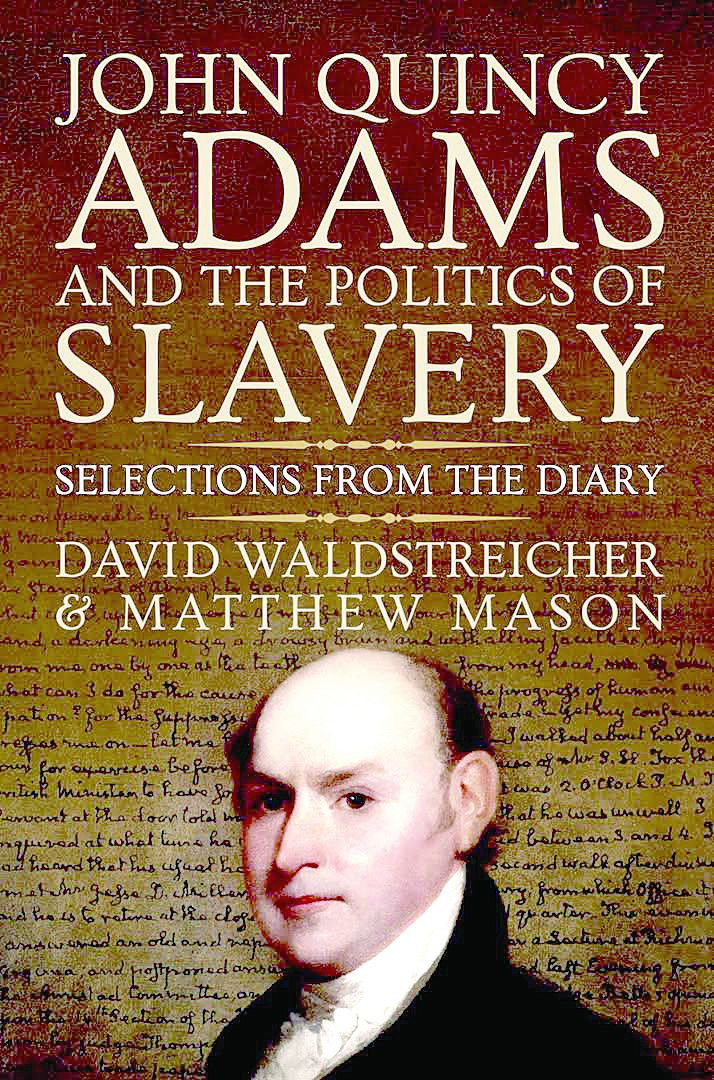
John Quincy Adams and the Politics of Slavery: Selections from the Diary. By David Waldstreicher and Matthew Mason. Index, 308pp., 2017, Oxford University Press, www.oup.com/us, $29.95 hardcover. Reviewed by Wayne L. Wolf
John Quincy Adams, son of a President, ambassador, senator, secretary of state, congressman and the 6th President of the United States, kept one of the most extensive diaries of any political figure of his time. In this volume, spanning the years 1785 to 1846, the editors extract voluminous excerpts from that diary to trace Adams’ evolution on the issue of slavery. Adams went from seeing slavery as a political problem that could be managed by wise political elites to the cause of America’s divisive sectionalism which would eventually spell division and fratricide. Adams’ sense of duty to country overshadowed his personal dislike of human bondage. Initially, he felt that slavery, or any other divisive issue, must not foster sectional antipathy and threaten the Union. Thus, even through his Presidency, he kept aloof from the slavery issue. Only after his 1828 defeat for reelection, which he blamed on a proslavery coalition, did his private abhorrence of slavery begin to slowly become his public position. Adams then began to see every issue before Congress, e.g., the admission of Arkansas and Texas, the gag rule, and the tariff question as tainted by the specter of slaveholders’
increasing power. Slavery was clearly becoming a dangerous political issue that slowly propelled Adams into the anti-slavery column, but he was not yet an abolitionist. He became, in his words, “a patient abolitionist,” believing slavery should be abolished gradually, with the consent of the Southern states as constitutionally required. It was becoming clearer to Adams, however, that the country was dividing along lines of either free or slave power. Slavery to Adams was the defining issue of the first half of the 19th century and would eventually be settled by war, not political compromise. Waldstreicher and Mason have deftly used the diary, with extensive editorial explanation, to place the anti-slavery crusade in Adams’ own words. Recent studies such as Sean Wilentz’s The Rise of American Democracy: Jefferson to Lincoln and David Walker Howe’s What God Hath Wrought: The Transformation of America use the diaries to either mock Adams and his politics or tangentially deal with the slavery question in the context of the democratic ideals which Adams expounded. This volume uses Adams’ own words to reveal both his private thoughts and his public political pronouncements. For these reasons, the book offers both scholars and researchers a trove of valuable data to understand the overriding influence of slavery on antebellum America. This book is highly recommended both for its scholarship and readability in analyzing how the slave question led to the Civil War. It likewise leaves largely unanswered the question of whether the Civil War could have been avoided by compromise. Civil War historians can use Adams’ struggle with his moral and political positions to ponder their answer to this ongoing enigma. Wayne L. Wolf is Professor Emeritus at South Suburban College in Illinois and the author of numerous books and articles on the Civil War, including The Last Civil War Scout (with Jack Simmerling, 1995). He is currently editing the journals of Union Brevet Brig. Gen. John Corson Smith.
The Sharpshooters: A History of the Ninth New Jersey Volunteer Infantry in the Civil War. By Edward Longacre. Illustrations, notes, bibliography, index, 432 pp., 2017, Potomac Books/University of Nebraska Press, nebraskapress.unl.edu. $34.95 hardcover. Reviewed by Evan McLaughlin
Edward Longacre’s The Sharpshooters is an incredibly detailed book, chronicling the combat history of New Jersey’s Ninth Volunteer Infantry. Its expansive scope covers the unit’s formation, combat experience and journey home after the war. The regiment saw combat in the eastern theater of war, starting in North Carolina and continuing into Virginia. It is remarkable to trace the Ninth’s maturity and combat acumen, developed from the first shots fired at Roanoke Island through the battle of Cold Harbor. Primary source research is one of this book’s greatest strengths. Longacre’s careful consideration of newspaper articles, personal letters and diary entries is laudable. Because of his research, the reader gains critical insight into life as a soldier in the Ninth. As a credit to his research and historical method, Longacre explains how the Ninth New Jersey earned its nickname, the “muskrats,” from multiple origins. Perhaps some readers could find fault with the author’s level of detail and his fairly dense text. However, Longacre seamlessly integrates each quotation into his narrative, reflecting a great amount of primary source research in such sources as the Newark Daily Mercury and the Belvidere Intelligencer. A reader interested in the life of the common soldier will certainly enjoy this book. Longacre captures the essence of Civil War soldiering, warts and all, chronicling every dimension. He includes recruitment, training, traveling, boredom, combat and recovery in unflinching detail. In one particularly striking incident, Corp. Samuel J. Dilk dramatically rescues an African American cook who was stranded by high seas on a sinking troop transport off the North Carolina coast. Indeed, Longacre’s book is replete with these vignettes, which together add nuance and humanize the Ninth’s soldiers beyond the typical combat narrative. As a point of pride for New Jersey residents, Longacre describes a shooting competition between Berdan’s sharpshooters and the Ninth, in which the “muskrats” are rumored to have beaten the famous regiment of expert riflemen. Because the Ninth New Jersey’s service record is varied and copious, readers will find the book’s maps particularly helpful. For instance, inlets on the North Carolina coast, such as Hatteras Inlet, are particularly complex; the map of these is critically important to better understand troop movements and the placement of defensive positions. Portraits and illustrations assist the reader to match faces with the names of commanders frequently mentioned throughout the book. The picture of the monument dedicated to this Federal unit is particularly impactful given that it is found in New Bern, North Carolina—not New Jersey. All serious Civil War historians will recognize Longacre’s copious research and appreciate the detailed service record he narrates. This book is especially recommended for anyone interested in New Jersey history and the Ninth’s contribution to the Union war effort. Evan McLaughlin, valedictorian of his Muhlenberg College class, is a member of Phi Beta Kappa and a social studies teacher at Mountain View Middle School in Mendham, New Jersey. He is also New Jersey’s 2014 James Madison Memorial Foundation Fellowship recipient.
Joshua Lawrence Chamberlain and the Petersburg Campaign. By Dennis A. Rasbach. Illustrations, maps, 248 pp., 2016. Savas Beatie, savasbeatie.com. $29.95 hardcover. Reviewed by David A. Galli, M.D.
On June 18, 1864, Colonel Joshua Lawrence Chamberlain of the 20th Maine Infantry Regiment, hero of Little Round Top at the battle of Gettysburg, was grievously wounded in the battle of Petersburg. A bullet had ripped through his urethra before settling near his left hip. Fearing that his wound would be fatal, Maj. Gen. G.K. Warren urgently telegraphed Maj. Gen. George Meade, who forwarded the plea to Lt. Gen. Ulysses Grant that Chamberlain be rewarded for his sacrifice by a promotion to brigadier general. Almost miraculously, Chamberlain survived, to eventually serve as governor of Maine and president of Bowdoin College. While the when and what happened of his Petersburg experience has never been in doubt, the precise where his battlefield wounding took place is the subject of this investigative historical work by Dr. Dennis Rasbach. Anyone who has visited a Civil War battlefield is familiar with landmark signs indicating the location of a pivotal event. A century and a half later, visitors can close out the noise of cars and people snapping photos to mentally return to moments both heroic and horrible. Unfortunately, while a sign may look authoritative, determining a location of events is subject to human error, and many of the markers at Civil War military parks may be inaccurate. As Allen Guelzo illustrates in his acknowledgments at the beginning of Gettysburg: The Last Invasion, soldiers’ reflections on the battle may be tainted by confusion or forgetfulness. Dr. Rasbach is a surgeon, and a meticulous student of the Civil War. He had been studying the actions of his great-grandfather, a soldier in the 21st Pennsylvania Cavalry, when he became interested in the wartime exploits of Chamberlain. But the more he studied, the more he became concerned about the validity of Chamberlain’s postwar claim of being wounded while approaching a portion of the Petersburg battlefield known as Rives Salient. Rasbach confronts this claim by noting the obvious fact that Chamberlain may not have fully understood the scope of the Petersburg battlefield, and that shortly after arriving on the scene he had been gravely wounded. He also points out that Chamberlain did not visit the Petersburg battlefield again until 1882, around 18 years after his wounding, and that the area had changed during the long interim. Rasbach points out that Chamberlain cemented the Rives Salient as the location of his wounding as fact in his memoir. From there legend became reality as historians throughout the 20th century repeated Chamberlain’s assertion. But a curious Rasbach decided to do something seemingly no historian apparently did for over a century. Rasbach would not swallow the settled truth, and made a study of maps and reports of battle from both Union and Confederate veterans of Petersburg. By a process of reviewing the contemporary data of several different men, with different perspectives of time and place in relation to Chamberlain, and mapping their reported activities, Rasbach was able to conclude an entirely different location for his near-fatal wounding, almost a mile away. This ultimately led to a unique happening: the state of Virginia moving the commemorative sign to a new location. So why do all of this work, and who cares exactly where on the Petersburg battlefield Joshua Lawrence Chamberlain was wounded? If Chamberlain made an error in recollecting exactly where he was on the field of combat, it certainly does not change the respect we should have for the bravery of Colonel Chamberlain, who would suffer for the next fifty years before finally succumbing to a wound-related infection in 1914. But Dennis Rasbach’s book and his methods actually make a much bigger point. What makes Rasbach’s Chamberlain significant is its focus on the truth. And if history is a discipline rather than a retelling of legends, then truth must be its aim. As Rasbach wisely says, “If history is to be meaningful, it must be accurate.” His methodology is very detail oriented, and at times this book is confusing as Rasbach digs deep into primary source material. But this also proves another point that Rasbach brings up, and serves as a lesson for all historians: the need to question what is assumed to be fact. Dr. Rasbach does this indeed with this fantastic book. Dr. David A. Galli is a private practice physician in St. Louis and has a longtime interest in the Civil War.
Recaptured Africans: Surviving Slave Ships, Detention, and Dislocation in the Final Years of the Slave Trade. By Sharla M. Fett. Illustrations, tables, notes, bibliography, index, 290 pp., 2017, University of North Carolina Press, www.uncpress. org, $35 hardcover. Reviewed by Salvatore Cilella
It has been said that we humans seek knowledge for either information or confirmation. Fett’s book on Recaptured Slaves is groundbreaking and firmly places itself in the category of entirely new information. In the mid-19th century, Frederick Douglass posed the insightful proposition:
“A slaveholding Government cannot consistently oppose the Slave-trade; it is the logical and legitimate deduction of slavery— and the one is as hateful as the other. They are twin monsters, both hatched in the same polluted nest.” The so-called suppression of the Atlantic slave trade, the recapturing of Africans bound on slave ships for America and their return to their homeland is the subject of this tiny corner of American history. Fett’s book is a micro-history of a completely neglected area of study. It focuses on 2,000 Africans whose voyage to American slavery was interrupted by the United State Navy and returned to Africa. The author asks penetrating questions about their interpersonal relations, their ethnicity, their impact on the heated conversations going on in America at the time concerning slavery, abolition, and of course, race. Fett explores the fate of the “passengers” of four illegal slaver ships: the Echo in 1858 and the Bogota, William, and Wildfire— in all, 2,000 souls. The author details the conundrum of U.S. Naval authorities concerning the Africans. Were they slaves? Should they be turned over to the eager-for-more-free-labor, Southern states? Should they be returned? If so, where?
Fett specifically uses the word “recaptured,” as she says, because it is a more apt “descriptor of the social experience of slave ship rescue” and a useful “metaphor for the conflicting representational claims made on the bodies of slave ship refugees.” The author chronicles the equally brutal existence of the Africans once “liberated” from the slave ships. Rather than zeroing in on legal battles and naval encounters, she highlights the impact of the recapture experience on the enslaved. Playing into the narrative was the 19th Century racism, euphemistically called “slave trade ethnography.” In one exceptionally degrading example of ethnographic exploitation, private boat companies in Charleston, S.C., offered sightseeing tours to Fort Sumter where locals were able to view 300 native Africans who were captured from the Echo not as victims of the slave trade but “as ‘native’ specimens of Africa,” like animals in a zoo. Alternatively, the trip back to Africa, in which Fett has followed the original 2,000 Africans from the four ships, was as harrowing as the captured phase. Only 1,000 souls survived the second transAtlantic return trip to Liberia. Adding insult to injury, many of the “recaptives,” although landing on their home continent, were strangers in a strange land, for Liberia was not their home, not their family, and certainly not their tribe. This powerful micro-history, as the cliché goes, “breaks new ground,” at least for this reviewer. One aspect of this well researched book reminds one of the most dangerous cliché in scholarship: “History repeats itself,” a phrase that should be banned from the English language. Instead, this book lends itself to the more nuanced, “History is a mirror.” Until the Federal Government could formulate a national policy before the war, “recaptives” were held in detention camps at Key West, Florida, and Charleston. And this was 43 years before Guantanamo Naval Base in Cuba was established and more than 143 years before Gitmo was used as a “detention” center for another group of individuals. Remarkable. Salvatore Cilella is the retired President and CEO of the Atlanta History Center. He is the author of Upton’s Regulars: The 121st NY Volunteers in the Civil War (2009) and the editor of The Correspondence of General Emory Upton, due out this July from the University of Tennessee Press.
Sex and the Civil War: Soldiers, Pornography, and the Making of American Morality. By Judith Giesberg. Photos, illustrations, notes, bibliography, index, 152 pp., 2017. University of North Carolina Press, https://www.uncpress.org. $29.95 hardcover. Reviewed by Gould Hagler
Accounts of armies’ movements and their clashes on the battlefield are a mere beginning to the study of war. Nations and peoples go to war, not just their soldiers. Chaplains and religious revivals, hospitals and medical treatment, factories and farms, horses and railroads, foreign affairs and the home front—you name it, people study it. Judith Giesberg, professor of history at Villanova and “trained in the history of gender,” has focused on “women’s experiences of war and the consequences of the war to soldier families and others on the home front.” She has to her credit several works on these subjects and in February 2017 she added this latest book to her oeuvre. Sex and the Civil War is the latest in a series based on lectures delivered at the George and Ann Richards Civil War Era Center at Penn State. In this small book we learn about erotic literature, art and photography as they existed in the mid-nineteenth century. As the story moves into the Civil War, we see what the Union soldiers saw and read what they read. The post office was very efficient and the sutlers very entrepreneurial: Giesberg writes that “there seems to have been no shortage of obscene materials available and widely circulated among and to soldiers during the Civil War.” One incident related by Giesberg is the story of a Massachusetts colonel court-martialed in 1862. He was accused of various wrongs, including hitting a soldier and sneaking out of camp to visit “a disreputable woman.”
What makes the story fit into the book is the charge that he read passages from Fanny Hill to the privates in his company. A considerable part of the eleven-day trial was spent on this last charge. We learn that the book was widely circulated in the regiment and (for the benefit of those less literate) that the edition in question was amply illustrated. Perhaps the most interesting part of the Sex in the Civil War is the story of Anthony Comstock, the famous anti-obscenity crusader. During the war he served in a Connecticut regiment (on rather tedious duty in St. Augustine). He was troubled by (and tempted by) the obscene materials available in camp. As a postwar postal inspector, Comstock boasted of confiscating tons of objectionable material sent via the post. Yes, tons. Sex and the Civil War ties the pornography to various other themes: male bonding in a military culture, class biases, abolitionist and anti-abolitionist literature, abortion and contraceptives. In the story of Comstock’s troubled army life we read about a “personal crisis in masculinity” and “crisis in gender.” Sex and the Civil War provides a well-grounded analysis of some less-studied aspects of the war. Giesberg dedicates the book to her sons, apologizing for any embarrassment they may suffer because their mother wrote a book on porn. She needn’t worry. If any of the lads’ friends see the book they will find the pictures very tame and the writing very scholarly. Gould Hagler is the author of Georgia’s Confederate Monuments: In Honor of a Fallen Nation (Mercer University Press, 2014). His new book on Alabama’s Confederate monuments is to be published by Indiana University Press.