
Battle Of Richmond, Kentucky
By Robert L. Durham · Originally published June 2017 · pp. 14–16
On 31 July 1862, Maj. Gen. Braxton Bragg met with Maj. Gen. Edmund Kirby Smith at Chattanooga, Tenn. Bragg commanded in Miss., with headquarters at Tupelo, and Smith in Eastern Tenn., with headquarters at Knoxville. Their objective was an invasion of Central Tenn. and Ky. Their command structure was weak; although Bragg out-ranked Smith, each would have independent command until their forces linked in Ky., at which time, Bragg would take command. In one of the greatest rail movements of the Civil War, Bragg moved his troops from Miss. to Chattanooga.1 This was the beginning of the Confederacy’s Kentucky Campaign. On August 28, Gen. Bragg crossed the Tennessee River at Chattanooga. He headed north toward Louisville, Ky. In support of Bragg’s advance, Smith led his forces north from Knoxville.2 Smith’s first objective was to cut off the Union troops at Cumberland Gap and force their surrender. Learning that the Federal position was too strong to assault and a siege was out of the question, he moved on toward the rich blue grass country, entering the state at the small town of Barboursville. Per Kenneth Noe, Kirby Smith never intended to cut off the Union troops at the Gap. He decided in Knoxville that he would march directly into Ky. Upon learning of Kirby Smith’s advance, Bragg changed his objective to Lexington, Ky., where he planned to rendezvous with Smith.3 There was a severe drought in Ky. that summer, so the march north was exceptionally difficult for the Rebel soldiers. Capt. Frank T. Ryan spied a woman standing in a cabin doorway and asked her “how far ahead will it be before we find a stream of water?” The lady of the house, a Union sympathizer, answered, sarcastically, “I guess you will find it in the Ohio River.” “Little did she think that we would eventually find water and drink of it from the Ohio River.”4 “About ten o’clock that night we were turned into a large field where the bushes and briers were nearly as tall as one’s head, growing along the banks of the creek. I have often wondered why it was that more of us were never snake or spider-bitten. . .although we were turned into all kinds of thickets at all hours of the night, the places where snakes, spiders, and other poisonous reptiles and insects naturally abound.”5
General Smith left Knoxville, crossed the Cumberland Mountains at Big Creek Gap, and reached the locality of Richmond, Ky. on Aug., 29, 1862. Cavalry scouts reported to him that a Union force was at Kingston, five miles south of Richmond, and appeared to be determined to arrest their progress. The Federal troops were commanded by Maj. Gen. William “Bull” Nelson but he was temporarily absent. In Nelson’s absence, they were under Brig. Gen. Mahlon Dickerson
Maj. Gen. William “Bull” Nelson. (Library of Congress) Manson. General Bragg had earlier sent Smith his best brigade commander, Brig. Gen. Patrick Ronayne Cleburne. Cleburne commanded a division, consisting of his own brigade, under Col. Preston Smith, and another brigade, led by Col. Benjamin J. Hill. The morning of Aug. 29, Kirby Smith ordered Cleburne to move forward on the Richmond road, and form the infantry advance. Col. John S. Scott led the cavalry, scouting
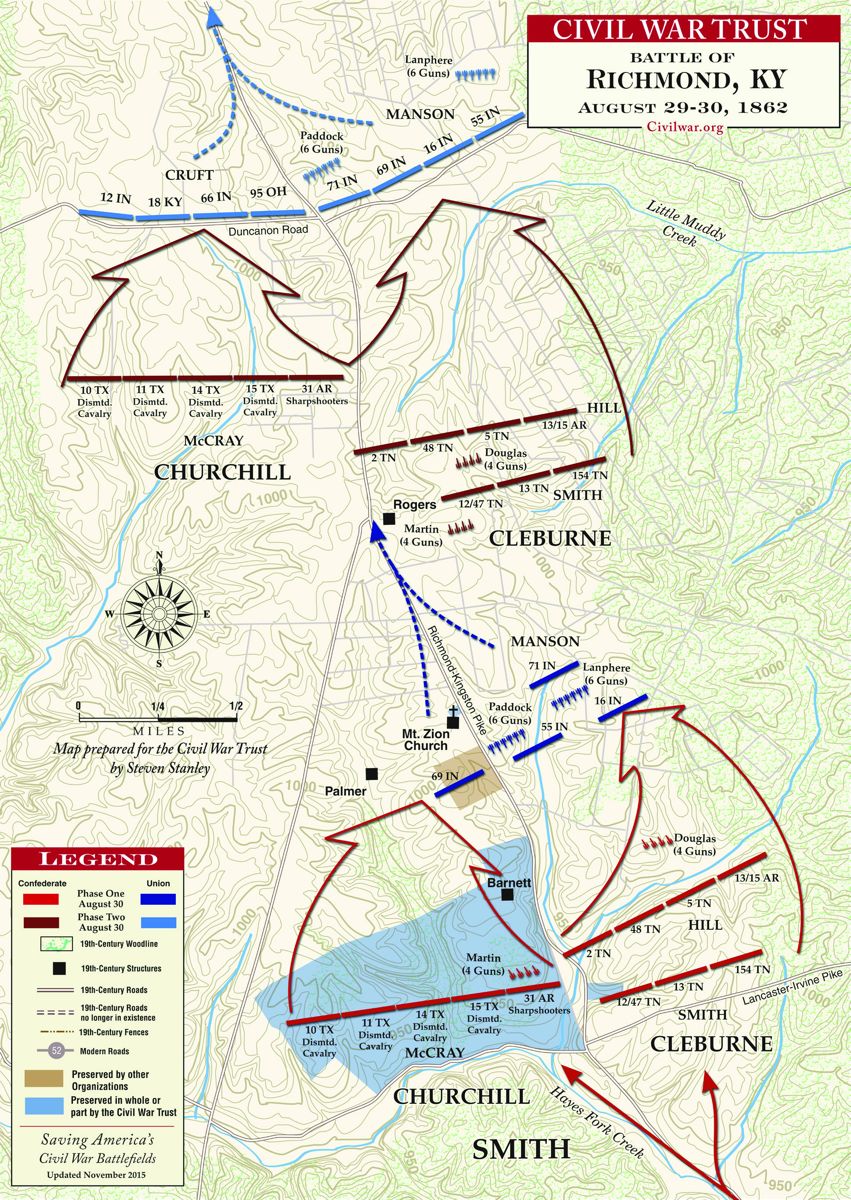
Patrick Ronayne Cleburne. ahead of Cleburne’s infantry. At 5 p.m., the enemy opened fire with artillery against Scott’s cavalry, and drove them back a short distance. The Yankees soon stopped their forward movement, and ceased their artillery fire.6 Colonel Scott informed Smith that the Union troops they faced were raw levies. They were thirty-day and sixty-day men, and this was their first battle. General Manson noted: “The troops … had only been in the service from ten to twenty-five days. Some of the regiments have never had a battalion drill and knew not what a line of battle was. They were undisciplined & inexperienced, and had never been taught in the manual of arms.” The Rebels were exhausted from their march but, knowing that he faced inexperienced recruits, Kirby Smith decided to attack. If the Yankees in his front pulled back to Lexington, he would have a harder time extricating them from the high bluffs over the Kentucky River. He sent his “hardest hitter,” Pat Cleburne, to open the assault.7 John Scott reported to Cleburne that the enemy was no longer pressing forward and the Rebel cavalry was camped in his front, which was well picketed. Not feeling confident that the Union force would not move against the Rebs again, Cleburne formed his men in battle line, facing the enemy positions. Shortly after getting into place, after dark, in the words of Cleburne: “Firing and yelling were heard in our front, and almost simultaneously a multitude of stragglers of Scott’s Cavalry Brigade, sick men, baggage wagons, servants leading horses came flying in the utmost consternation, closely pursued by United States cavalry, who were firing on them and yelling as though they were all excited with liquor. I re-formed my line, leaving the road clear, and when the [Union] cavalry got within twenty-five steps two companies of the 48th Tennessee fired on the enemy’s advance and checked it.” “Better a live dog than a dead lion.” Cleburne pushed forward a few sharpshooters, and the enemy was forced to retreat. General Cleburne’s men captured thirty prisoners; one wounded soldier was the only casualty on the Confederate side.8 At break of day on Aug. 30, Cleburne’s Division advanced against the Union forces. The Kentucky Buckner Guards Cavalry Company, under Capt. William L. Garnett, led the advance to feel out the Federal battle line. They found the picket line half a mile north of Kingston and their main line of battle 500 or 600 yards behind. They were about half-way between Kingston and Richmond.9 Col. Alfred J. Vaughan, commander of the 13th Tenn. Inf., reported:“By 8 o clock while marching up the road a shell from the enemy’s battery not far off came whizzing over the head of our advancing column and exploded high in the air. The Thirteenth with the other regiments of the brigade immediately deployed in line of battle on the right of the road, when Allen’s sharpshooters under command of Lieut. Creighton were sent forward and deployed as skirmishers, with instructions to feel the enemy and develop their position.”10 Cleburne’s Division was formed on the right of the Richmond-Kingston Pike, with the 1st Texas Arty., under Capt. James Postell Douglas, placed on a crest in front. They were followed closely by Cleburne’s Brigade, under Col. Ben Hill, behind the crest. Colonel Preston Smith’s Brigade, with the Marion Florida Lt. Artry., under Capt. John M. Martin, was posted behind the next crest. The 1st Ga. Cav. and part of the 3rd Tenn. Cav. were on the left flank, commanded by Col. James Jefferson Morrison. The 1st La. Cav. and the rest of the 3rd Tenn. Cav. covered the right flank.11 Douglas’ battery fired upon a squad of Union cavalry, who quickly dispersed, unmasking a Yankee artillery battery, which opened fire. Cleburne sent skirmishers out on the right flank and extended his skirmish line to the left across the pike. Martin’s battery was moved forward to a hill on the right of Hill’s Brigade where they opened fire. Gen. Kirby Smith ordered Cleburne not to bring on an engagement until Brig. Gen. Thomas James Churchill’s Division came up.12 For more than two hours, the fight continued as an artillery and skirmisher duel. Manson then pushed his Federal infantry against the Rebel right flank and drove in the skirmishers stationed there. Cleburne ordered the 154th Tennessee, from Preston Smith’s Brigade, forward, on the right of Hill’s brigade. A close fire fight started. Cleburne ordered the 13th/15th Arkansas, already on his original right flank, to move farther to the right to support the 154th Tennessee. A furious musket fire was concentrated against Cleburne’s right.13 At 1:30 p.m., Union Brig. Gen. James Jackson, commanding the 9th Ky. and 9th Penn. Cav., scouting for the Union troops, received the following dispatch, “They are fighting at Richmond. Proceed there at once.” Jackson was stunned at this news. Nelson had ordered Manson to avoid an engagement and fall back before any Confederate forces. Nelson planned to combine Manson’s forces with other troops he was raising. He intended to form a defensive line along the Palisades of the Kentucky River. This was a deep gorge and a good defensive position. General Manson did not receive the order to fall back until his men were already engaged.14 Cleburne decided that Churchill’s Division was in supporting distance, so he ordered Colonel Preston Smith to move the three remaining regiments of his brigade to the right of Hill. He instructed Smith to swing around the Yankee left flank and ordered Ben Hill to attack as soon as he heard Smith’s guns. General Cleburne then rode off to make sure Smith’s Brigade was getting into position and understood what he wanted. He then rode back to Hill’s Brigade. Col. Lucius
E. Polk, the commander of the 13th/15th Arkansas, was wounded and being carried to the rear. Cleburne stopped to speak to him, when he was hit with a Minié ball. The ball entered his open mouth, and exited through his cheek, or entered his cheek, and exited through his open mouth. In either case, five lower teeth were carried away by the ball, and he lost the power of speech. He turned the division over to Preston Smith (Col. Vaughan took over Smith’s Brigade.)15 Colonel Preston Smith said he: “moved the division forward on the right-hand side of the road toward Richmond…This engagement was spirited, the enemy contesting the ground stubbornly … on the left of the road and shelling my command as we advanced toward them through the open fields.” Col. Thomas H. McCray’s Brigade of Churchill’s Division, which had come up now, advanced on the left of the pike. “The order to charge being given, we made toward them [the Rebels] in a double-quick. As we approached their line of battle, the unmistakable ‘swish’ of the Minié ball could be plainly heard, and every now and then a man of ours would go down. Moving either to the right or left, as the case might be, to close up the space occasioned by our men falling out, either by death or wounds, we thus kept our perfect alignment; and the nearer we approached them, the thicker and faster the shot and shell came.” Manson’s Brigade, outnumbered nearly three to one and outflanked both right and left, fled.16 “The Federals, having relieved themselves of their blankets and extra luggage, left them all in a heap to one side… In following the retreating Federals we came across a pile of their plunder. Seeing an especially fine and handsome blanket … I selected this one, which was a regular Mackinaw, solid mouse color.”17 The Confederates stopped to refill their canteens and then pushed on. They caught up with the Yankees south of Richmond. Brig. Gen. Charles Cruft’s Union Brigade, which had just come up, was on the right of the pike, with Manson’s Brigade on the left. The Rebs attacked immediately and, after about ½ hour’s fight, the Federals “precipitately and in great disorder retreated again.”18 “It must have been about three o’clock in the afternoon when the Federals made their third and last stand, the spot they had selected for that purpose being in the little cemetery just at the outskirts of the town of Richmond, Ky. They sheltered themselves behind the tombstones. We had to approach them through a field of corn which was very tall and in full ear… We moved in line of battle through the cornfield, the sun shining in full force… Seeing that we steadily advanced toward them, after giving us two or three rounds, they broke into a deep run, showing that they were in a wild and ungovernable panic … Then it was that we charged them with a double-quick, killing, wounding, and capturing many of them.”19 Kirby Smith, in his official report of the battle, said: “Preston Smith, bringing up his [Cleburne’s] division at a double-quick, formed with wonderful precision and rapidity in front of the enemy’s center and left. Almost without waiting for the commands of the officers this division coolly advanced under the murderous fire … and drove them from the field in the greatest confusion.” Brig. Gen. Thomas J. Churchill reported, “For a time the contest was sharp and the rattle of musketry almost deafening, but again and for the third and last time the enemy fled in great confusion through the streets of Richmond.”20 Capt. John F. Baird of the 66th Ind. Inf. reported, “During the engagement in the grave-yard General Cruft’s horse received a ball in the jaw. The general dismounted when the enemy’s bullets were falling thick around him and examined the horse with that coolness that belongs to none but the brave.”21 General Manson and his staff were captured. Manson noted his “horse was killed and fell upon me, injuring me severely in the breast, and a short time afterward I was arrested by the enemy’s
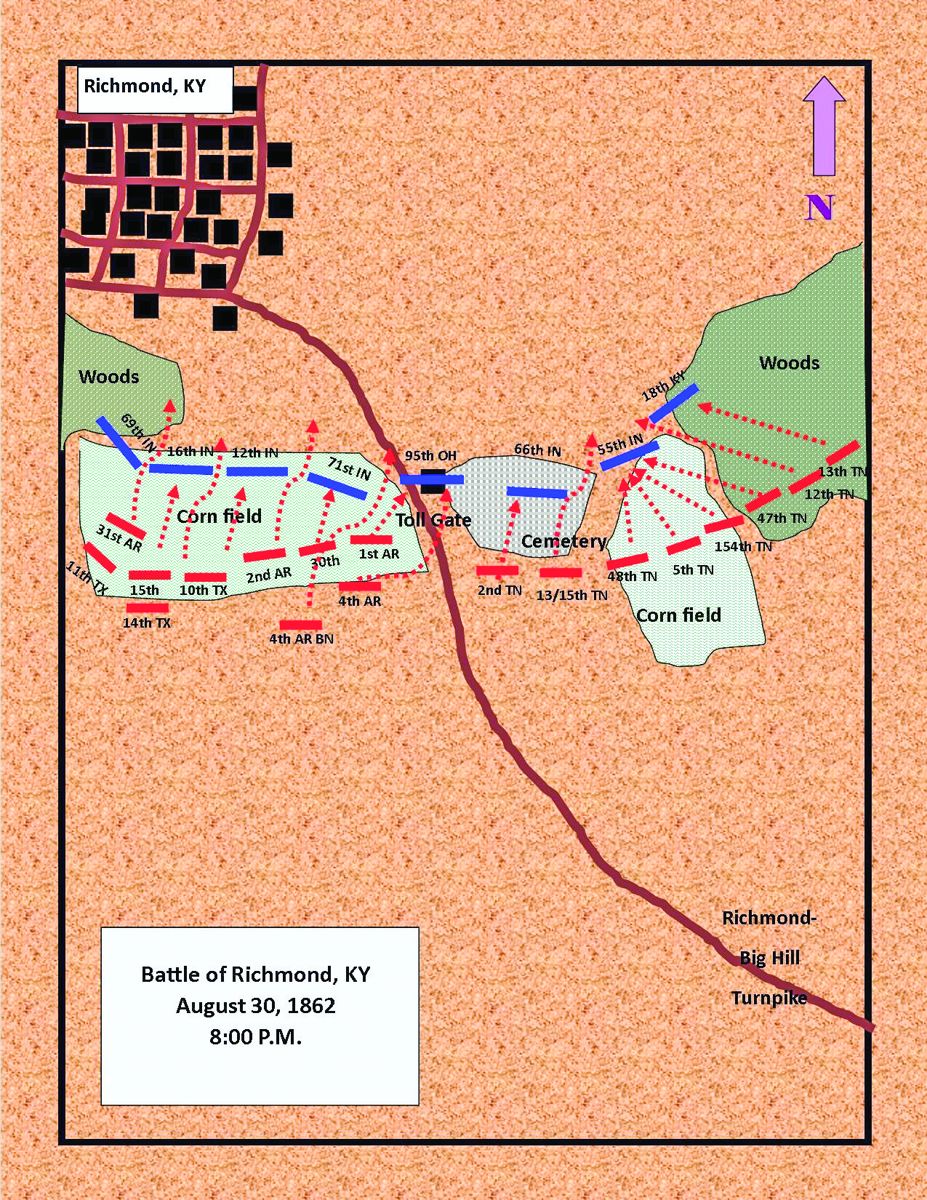
Gen. Edmund Kirby Smith. (Library of Congress) cavalry and made prisoner.” The Federals abandoned Richmond and all its stores to the victorious soldiers of Gen. Kirby Smith. “They had a great quantity of stores and munitions of war at this place. . .canned fruits of all kinds, condensed milk, . . cheese, and other edibles. They also had large quantities of clothing, shoes, hats, etc., all of which we put to good use.” The Rebel cavalry pursued about three miles, gathering prisoners. General Nelson arrived on the field in time to catch a bullet before being swept up in the rout. He escaped in the disorder, finally ending up in Louisville.22 General Cruft said: “The whole line broke in wild confusion, and a general stampede ensued. Both officers and men became reckless of all restraint or command and rushed pell-mell to rear, amidst a mass of horses, wagons, artillery, etc., in an utter rout… The enemy had flanked our line and passed large bodies of cavalry to our rear. These fell upon the helpless and demoralized mass of fugitives and either slew or captured them without much show of resistance.” Per Cruft, “The wonder … is that the latter fought so well for a whole day, could be twice rallied after being panic stricken and that any escaped slaughter or capture.”24 Colonel Vaughan claimed: “This was the most complete victory gained during the war in which the Thirteenth participated. Nothing escaped. All the enemy’s artillery, their artillery horses, their transportation, quartermaster and commissary supplies, together with all their camp equipage fell into the hands of the Confederates.”24 Private Byron Smith of the 1st Ga. Cav. left this account: “Our command moved to the rear of Richmond on the pike road toward Lexington, and went into a cornfield and formed a line of battle… The road was full of fleeing Yankee cavalry and one piece of artillery that had run the gauntlet. One of the boys on the extreme left of the company shot the lead horse through the neck, and that blockaded the road, so there was no more passing there. The driver on the lead horse was killed, mashed to death by the other horses.” Many Union troopers were captured in this ambush.”25
Captain Haynie, in command of a company in the 1st Ga. Cav., along with the rest of Colonel Scott’s Cavalry Brigade, was sent around behind Nelson’s command, to attempt to cut off their flight. Haynie became separated from his company and was captured by a Union regiment in full flight. He talked them into believing that they were surrounded by thousands of Confederate cavalry. The Federal colonel asked for advice, and Haynie told the colonel he should surrender to him, he was “a captain in the Confederate army, and I will carry you out safe.” The Federal colonel gave Haynie his sword. Tying a handkerchief to the end of the sword, Haynie marched them over to Colonel Scott. This is probably an exaggerated and apocryphal account but, in Haynie’s own words, “If I haven’t captured a whole regiment of Yankees there is no devil.”26 Of the two Union brigades, only 800 or 900 could be gathered up from the stragglers. Out of approximately 6,800, more than 5,300 were casualties, 4,303 captured or missing. The Confederates lost about 450 casualties of approximately 6,500 engaged.27 Union Captain C.C. Gilbert escaped capture and arrived in Lexington soon after the battle. “A few of the regiments were entire, and had preserved their organization and reached
Lexington in good order. Some arrived in fragments and others, a very few, seemed to have dispersed almost entirely. They were sent on to Louisville, leaving Lexington open to Kirby Smith, but many of them “took advantage of the confusion to go home.”28 The Battle of Richmond enabled Gen. Kirby Smith to march, with no more opposition, to Lexington, Ky. He established an outpost at Covington, across the Ohio River from Cincinnati. Eventually, Bragg’s Kentucky campaign led to the Battle of Perryville, Ky., but Smith was not present. This Confederate victory turned out to be a bare triumph, with Bragg abandoning the field, and retreating to Tennessee.
Bibliography
Buck, Irving A., Cleburne and His Command, 1985. Connelly, Thomas Lawrence, Army of the Heartland: The Army of Tennessee, 1861-1862, 1967. Cunningham, S.A., Founder, Confederate Veteran: Published Monthly in the Interest of Confederate Veterans and Kindred Topics. Duke, Basil W. and R.W. Knott, Conductors, The Southern Bivouac: A Monthly Literary and Historical Magazine, 1886. Johnson, Robert Underwood and Clarence Clough Buel, Editors, Battles and Leaders of the Civil War, Volume III. Noe, Kenneth W., Perryville: This Grand Havoc of Battle, 2001. Rowell, John W., Yankee Cavalrymen: Through the Civil War with the Ninth Pennsylvania Cavalry, 1971. Southern Historical Society Papers. The New York Times, “Disaster - Kentucky - Defeat Our Forces Under General Manson,” August 31, 1862. United States War Department, The War of the Rebellion: A Compilation of the Official Records of the Union and Confederate Armies, Series 1, Volume 16, Part 1, 1880-1901. Vaughan, A.J., Personal Record of the Thirteenth Regiment, Tennessee Infantry, 1897.
- Connelly, pp. 203-206. 2. Connelly, pp. 205-206. 3. Confederate Veteran, Vol. 26, p. 158, “The Kentucky Campaign and Battle of Richmond,” by Frank T. Ryan, Noe, p. 39. 4. Confederate Veteran, Vol. 26, p. 158, “The Kentucky Campaign and Battle of Richmond,” by Frank T. Ryan. 5. Ibid. 6. Buck, p. 104. 7. Connelly, p. 215. Confederate Veteran, Vol. 26, p. 160, “The
Kentucky Campaign and Battle of Richmond,” by Frank T. Ryan, OR, Series 16, Vol. I, Report of Brig. Gen. Mahlon D. Manson, pp. 914-915. 8. Buck, p. 105, Confederate Veteran, Vol. 26, p. 29, “In the Years of War,” by John C. Stiles. 9. Buck, p. 105, B & L, “Bragg’s Invasion of Kentucky,” by Joseph Wheeler, p. 4. 10. Vaughan, p. 20. 11. Buck, p. 106, Confederate Veteran, Vol. 30, p. 297, “Battle of Richmond, KY,” by Byron Smith. 12. Buck, p. 106. 13. Ibid. 14. Rowell, p. 75, OR, Series 16, Part I, p. 910, Report of Brigadier General James Jackson. 15. Buck, pp. 106-107, SHSP, Vol. 31, p. 153, “Sketch of Major-General Patrick R. Cleburne,” by William J. Hardee. 16. Confederate Veteran, Vol. 26, p. 159, “The Kentucky Campaign and Battle of Richmond,” by Frank T. Ryan, OR, Series 16, Part I, p. 914, Report of Brigadier Gen. Mahlon D. Manson, OR, Series 16, Part I, p. 947, Report of Col. Preston Smith. 17. Confederate Veteran, Vol. 26, p. 159, “The Kentucky Campaign and Battle of Richmond,” by Frank T. Ryan. 18. Ibid. 19. Confederate Veteran, Vol. 26, pp. 159-160, “The Kentucky Campaign and Battle of Richmond,” by Frank T. Ryan. 20. OR, Series 16, Part I, pp. 934935, Report of Maj. Gen. Kirby Smith, OR, Series 16, Part I, p. 941, Report of Brig. Gen. Thomas J. Churchill. 21. OR, Series 16, Part I, p. 925, Report of Capt. John F. Baird. 22. Buck, pp. 107-108, Confederate Veteran, Vol. 26, p. 160, “The Kentucky Campaign and Battle of Richmond,” by Frank T. Ryan. 23. Confederate Veteran, Vol. 26 p. 29, “In the Years of War,” by John C. Stiles, OR, Series 16, Part I, p. 922, Report of Brig. Gen. Charles Cruft. 24. Vaughan, pp. 21-22. 25. Confederate Veteran, Vol. 30, p. 297, “Battle of Richmond, Ky.” by Byron Smith. 26. Confederate Veteran, Vol. 7, p. 203, “Capt. Haynie Captured a Regiment,” by Haynie. 27. Buck, pp. 107-108, Connelly, p. 216. 28. The Southern Bivouac, “Bragg’s Invasion of Kentucky,” by C.C. Gilbert, p. 220. 29. Buck, p. 108.
Author Robert L. Durham is a retiree from DLA, where he was a computer specialists doing installations of communications systems for FMS countries. He is a long-time Civil War buff and has written numerous articles. He also is addicted to Old West and Napoleonic history.