
Confederate Liberation of Tar Heel Town Commemorated
By Bob Ruegsegger · Originally published July 2017 · p. 22
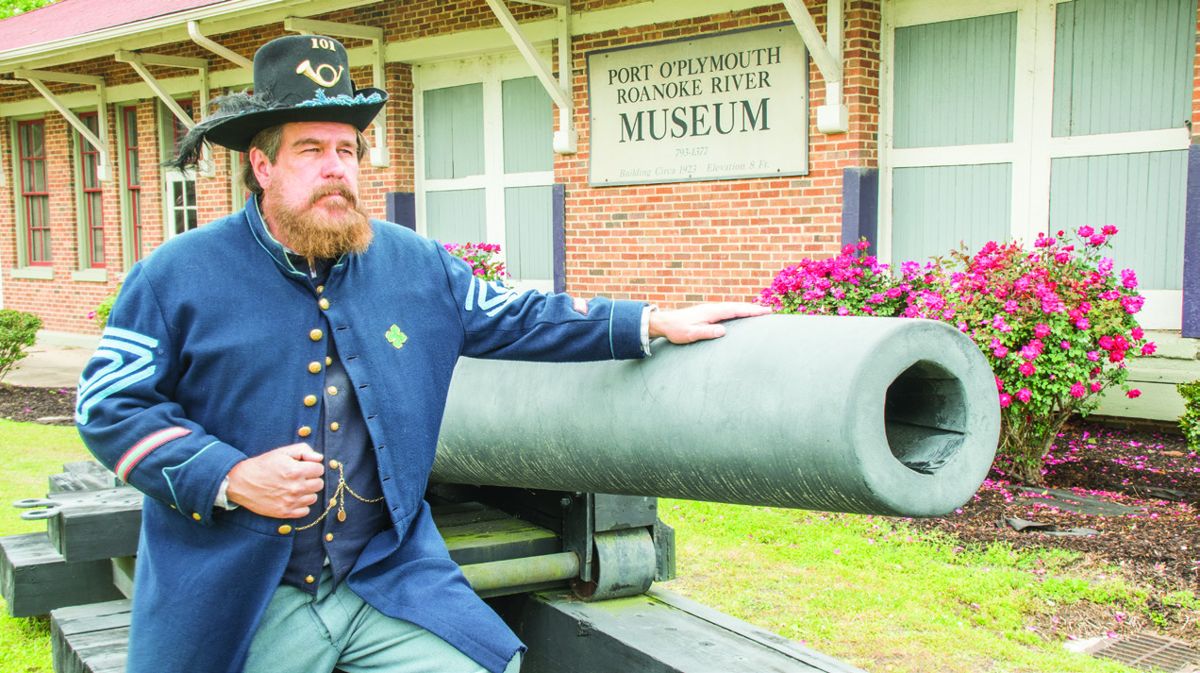
Hundreds of reenactors assembled on the grounds of the Port O’ Plymouth Museum on East Water Street along the Roanoke River to commemorate the Confederate victory over Federal troops under Gen. William H. Wessells in April 1864. The annual re-enactment has been going on for 27 years. It is a fundraiser for the museum that focuses on the entire history of Washington County, N.C. “Over the years, the Battle of Plymouth has become one of the dominant themes in the museum,” said Curator David M. Bennett. “It was the 150th anniversary of the Battle of Plymouth that caused the museum to move more in that direction.” When Confederate forces commanded by General Robert Hoke attacked the Port of Plymouth on the Roanoke River occupying Federal forces were forced to surrender. This southern waterfront town had been securely in the possession of Union troops for nearly two years. “Unfortunately, the Battle of Plymouth has been neglected by many Civil War historians,” Bennett noted. “It was one of the last major victories of the South during the war,” he said. “It also featured one of the Confederacy’s more successful ironclads of the war, the CSS Albemarle.” Many Confederate sympathizers regarded surrender of the town as welcome liberation. Those who had befriended the occupying Federal forces, and their ready money, regarded the town’s change of hands as considerably less than deliverance. For the 2,500 Union troops, the Plymouth Pilgrims, who surrendered, their ordeal was just beginning. They were marched to Tarboro, N.C., where they boarded trains headed for prisoner of war camps in the deep South. Many enlisted Union prisoners were held in wretched conditions
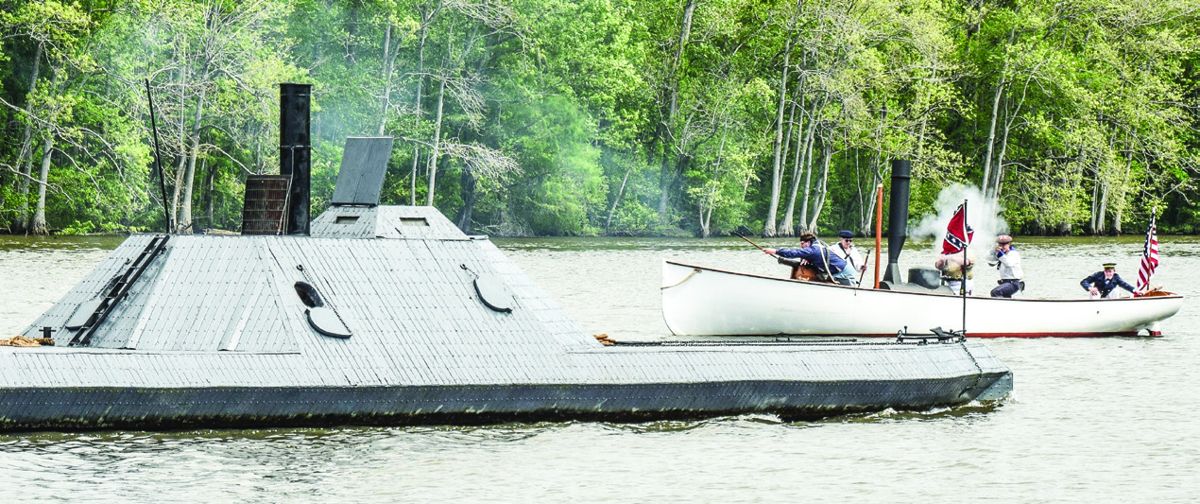
CSS Albemarle & Union Steam Launch Replicas of the CSS Albemarle and a Union steam launch engage on the Roanoke River. Small arms fire and small cannon aboard the Union vessel were no match for the 6.4-inch Brooke rifles aboard the ironclad. The Albemarle was built in a cornfield on the Roanoke River near Scotland Neck. This replica of the Confederate ram is 65 feet long and is powered by a 60 hp Suzuki outboard motor.
at Andersonville. Members of the Civil War Plymouth Pilgrims Descendants Society (CWPPDS) regard the annual commemoration at Plymouth as an especially important event, essentially an annual pilgrimage. Quartermaster Sargent Edward Nicholas Boots of the 101st Penn. Vet. Vol. Inf. was among the Union soldiers captured at Plymouth. He died in Andersonville. His descendant, Edward Boots of Pittsburgh, Penn., serves as president of the Society. “I’m here to represent and remember him. That’s the whole reason that we come,” said Edward Boots with the CWPPDS. “I want to make sure that not just my ancestor but all who served here are not forgotten.” Deborah Miller, another Plymouth Pilgrim descendant, has been making her annual pilgrimage from Warfordsburg, Penn., to Plymouth for 25 years to honor her ancestors.
Historical marker honoring Plymouth Pilgrims, a nickname given to the Union soldiers taken prisoner at Plymouth and transported to Confederate prison camps.
Deborah Miller holds a photograph of her ancestors Abraham and Isaac Rice who fought with Company B, 101st Pennsylvania Infantry Regiment. “I’ve been coming here for about 26 years. Every year is different,” said Miller. “It’s the experience itself. It’s the camaraderie. We come to walk in the footsteps of our ancestors.” (Bob Ruegsegger) “I have a few. Isaac and Abraham Rice were in Co. B, 101st Penn.,” said Miller. “I’m also related by marriage to Capt. Alexander Comphor. A fort here was named for him.” On the waterfront at the Port O’ Plymouth Museum a threeeighths scale model of the CSS Albemarle provides event visitors with a fascinating look at a representation of one of the most successful ironclads built by the Confederacy. During the Battle of Plymouth reenactment the CSS Albemarle “steams” along the Roanoke River to support Confederate forces. Smoke belches from her gun ports. Thunderous explosions echo across the river. The smell of black powder drifts through the air. “It’s actually a façade built over pontoons with a 60 hp, 4-stroke Suzuki outboard motor on it,” said Joseph Pugh, acting captain. “It’s roughly a three-eighths scale. This Ram Albemarle is 65 feet long, the size of the casemate on the original ram,” noted Pugh. “She’s a little sluggish, heavy with the façade and all. It handles alright.” Brigadier General Robert Hoke commanded three Confederate brigades at the Battle of Plymouth. He had distinguished himself with the Army of Northern Virginia. Hoke engaged
General Robert Hoke was the victor at Plymouth. Historian Bernhard Thuersam offered visitors insight into General Hoke’s character as well as his battle plan. “This was one of the Confederate’s best coordinated efforts of the naval and land forces,” said Thuersam.
Plymouth from the front initially and waited impatiently for the CSS Albemarle. When the CSS Albemarle came downriver and fired on the Union forts from the rear, Hoke went into action. He attacked the town from the west, east, and rear. He forced the Federal troops into Fort Williams in the middle of town. “This was one of the Confederate’s best coordinated efforts of naval and land forces,” said Bernhard Thuersam, a living historian. “Hoke knew that to be successful here he had to have the Albemarle,” he said. General Hoke captured a good deal of Union booty—sugar, flour, cannons, and rifles. Plymouth had been a main supply point for the North in its raids into North Carolina. Hoke, with the aid of the CSS Albemarle, had liberated the Federal stronghold in three days. His victory was applauded throughout the Confederacy. “It was a big event,” said Thuersam. “Hoke was a brigadier general until this victory. Jefferson Davis made him a major general.”
Descendants of soldiers and sailors engaged in the Battle of Plymouth are issued identifying ribbons. This Union ribbon belongs to Edward Boots. “It’s really special to come here to this place and walk where my ancestor walked and see the things that he saw,” said Boots.