
Inspection, ARMS!
Miles Greenwood’s Cincinnati War Effort
By Tim Prince · Originally published January 2017 · pp. 16–17
Miles Greenwood’s Cincinnati War Effort Last month, while talking about the some of the alterations performed on Austrian Model 1842 Muskets imported for use during the American Civil War, we mentioned the firm of Miles Greenwood. I thought this might be a good time to take a little bit deeper look into Greenwood’s contributions to the Union cause during the American Civil War. Miles Greenwood was an interesting entrepreneur in mid19th century Cincinnati, Ohio. He was born in New Jersey in 1807 and in 1832 he established the Eagle Ironworks along the Miami Canal in the Cincinnati area. The company quickly grew to be the largest ironworks in the mid-western United States, and the second-largest ironworks in the “western” United States. The company produced a wide array of everyday iron items including “pulleys, shutter lifts and catches, sash weights, spittoons, teakettles and tailor shears.” They even produced door knobs and door bells! In 1852 the Eagle Ironworks were destroyed by fire, a problem that would continue to plague Greenwood’s operations for decades to come. As a result of the fire, Greenwood, along with Cincinnati residents Abel Shawk and Alexander B. Latta worked to produce a reliable and fully functional steam fire engine. While steam fire engines had existed prior to the trio’s 1852 effort, the Greenwood lead team developed the most successful design yet conceived, and Eagle Ironworks produced the first truly successful steam fire engine which was immediately purchased by the city of Cincinnati and officially delivered on January 1, 1853. Greenwood’s efforts also helped Cincinnati to establish the first professional, paid fire department in the United States, replacing the somewhat unreliable volunteer force. The department came into being on April 1, 1853, and Miles Greenwood served as the first fire chief of Cincinnati. The success of Greenwood’s fire engine was so overwhelming that the citizens
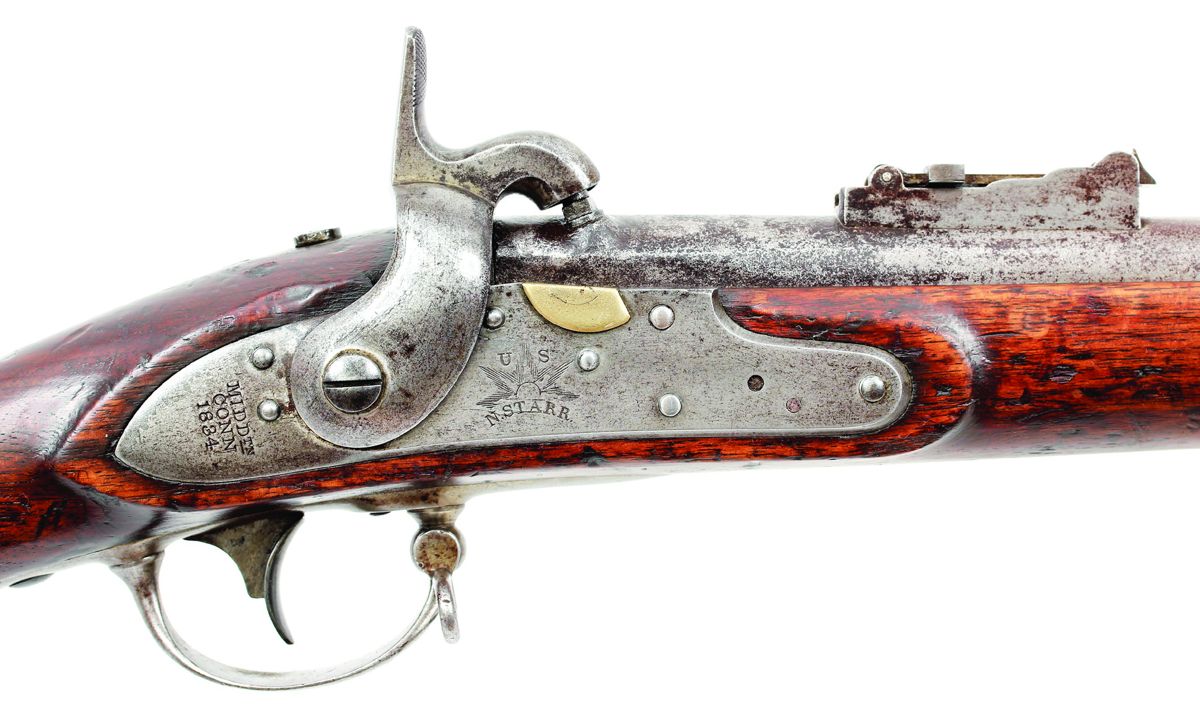
Overall view of an Ohio contract Greenwood altered, rifled & sighted U.S. M-1816 Type III musket by Starr. of Cincinnati raised the funds to purchase a second steam-powered fire engine in 1854. With the coming of the Civil War, Eagle Ironworks production shifted into high gear, with Greenwood focusing entirely on the Union war effort. One of his first military contributions was to manufacture a dozen iron anchors for pontoon bridges. It was reported that the ironworks produced the needed anchors in only twenty-four hours! This order came from General John C. Frèmont. Interestingly it would be Frèmont who was indirectly responsible for the Federal contract he received to alter 10,000 Austrian M-1842
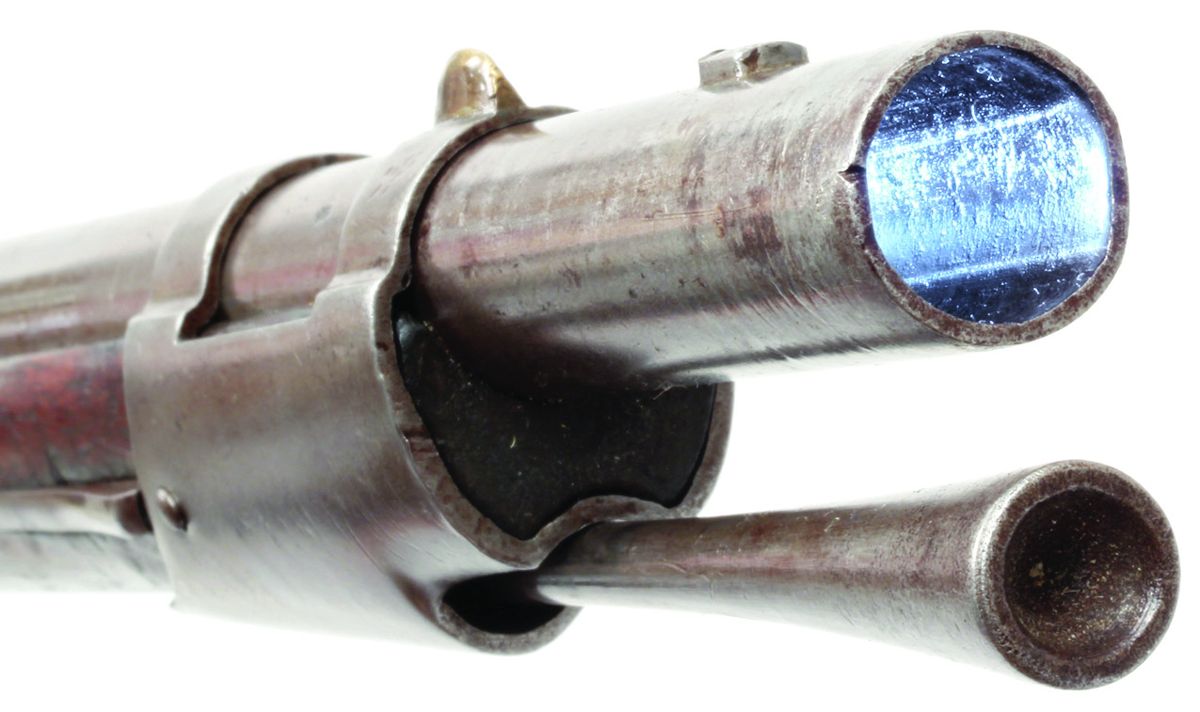
at the national level. Greenwood apparently had more success with the rifling of altered muskets, and a Cincinnati newspaper article noted that Greenwood’s altered .69 caliber muskets had better penetrating power than the standard .58 rifle muskets, with his altered guns being able to penetrate steel plates at a greater muskets to percussion via the distance than the .58 caliber “Belgian” or “cone-in-barrel” guns. The guns that Greenwood process during the fall of 1861. altered became known locally Greenwood was also contracted as “Greenwood Rifles,” and to rifle the Austrian smoothbore a number of early war Ohio muskets and add long-range, regiments went off to war adjustable rear sights. Earlier that carrying muskets that Greenwood year, Greenwood had undertaken had modified. “Greenwood to perform the same type of work Rifles” were carried by the 41st for the state of Ohio. Ohio, like Ohio Infantry at Shiloh and by (Tim Prince) percussion during the late 1850s when the Federal Government had undertaken that project in earnest. During the summer of 1861, a local newspaper noted that Greenwood was “rifling 3,000 smoothbore muskets per day”. While this is clearly hyperbole, it seems that the Eagle Ironworks was certainly burning the midnight oil to get the guns out the door as quickly as possible. Greenwood delivered his first 1,000 altered arms to the state of Ohio on July 24, 1861. By the end of the year, his company had rifled a total of 23,482 guns for the state of Ohio (16,918 M-1816 and 8,406 M-1842 muskets), and it is estimated that slightly less than 850 had the new rear sights added. When the additional 5,000 Austrian muskets are added to this total (the other 5,000 of the 10,000 he contracted to alter were sub-contracted to Hall, Carrol & Company for the work), it appears that Greenwood rifled some 28,482 guns during a roughly six-month period. This equates to an average of slightly less than 4,750 guns per month and just shy of 1,200 per week. While this is certainly much lower than the “3,000 per day” noted in the newspaper account, it does show that the company was working diligently for the war effort. In addition to altering, rifling and sighting muskets for the state of Ohio and the Federal
Government, Greenwood was also involved in the production of the first six Gatling Guns in 1862. However, another fire ravaged his factories (this time set by southern sympathizers), and the first six guns were destroyed, along with patent models, drawings, plans and samples. In fact, southern sympathizers managed to set his works on fire a total of three times during the course of the war! Greenwood’s other wartime manufacturing efforts included producing turrets for U.S. Navy iron-clad ships, as well as manufacturing cannon (both iron and bronze) and other material for the war effort. After the war, the Eagle Ironworks fell on hard financial times and eventually failed. Miles Greenwood served on the Cincinnati city council after the war and also served on the Cincinnati Railroad Board of Trustees. Miles Greenwood died of bronchitis on November 6, 1885, at the age of 78, but his name lives on as a strong Union man who put his all into the war effort to preserve the union. Tim Prince is a full-time dealer in fine & collectible military arms from the Colonial Period through WWII. He operates College Hill Arsenal (www.collegehillarsenal.com), a web-based antique arms retail site. A long time collector & researcher, Tim has been a contributing author to two major book projects about Civil War era arms including The English Connection and an upcoming book on southern retailer marked and Confederate used shotguns. Tim is also a featured Arms & Militaria appraiser on the PBS Series Antiques Roadshow.