
Louisville, Kentucky’s Confederate Monument Sold Down River
By Charles H. Bogart · Originally published January 2017 · p. 19
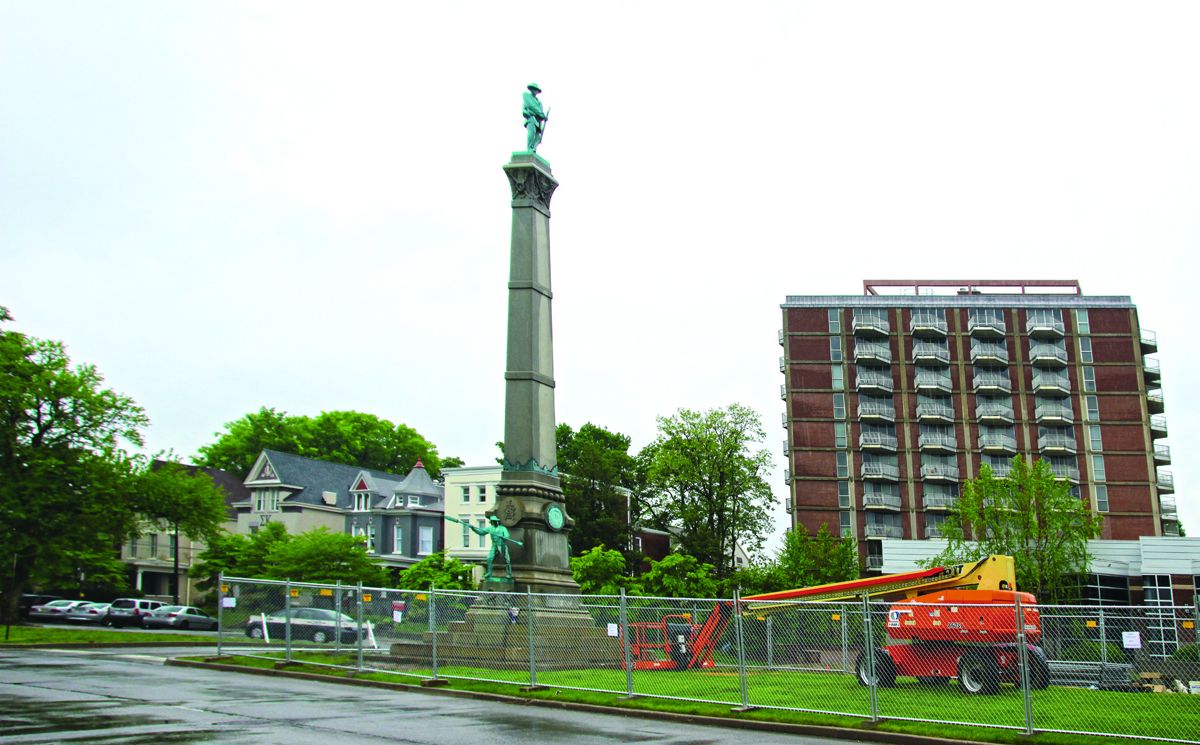
Louisville, Kentucky’s Confederate Monument Sold Down River By Charles H. Bogart Louisville Kentucky’s Confederate Memorial Monument, located within the campus of the University of Louisville, was taken down during the weekend of November 18-20 and transported 43 miles down the Ohio River to Brandenburg, Kentucky. The monument is to be reassembled at Brandenburg, site of General John Hunt Morgan’s crossing of the Ohio River during his great 1863 raid into Indiana and Ohio. The cost of the removal of the 70foot tall monument was $400,000 of which $350,000 was paid for by the University of Louisville and $50,000 by the city of Louisville. The city of Brandenburg has budgeted $10,000 to build a new base for the monument and hopes to use it to add to their Civil War tourist image.
During the removal of the Confederate Monument, a time capsule was found buried under the monument. The box had sat below the water table and, upon opening, it was found to contain a congealed brown mass of material. A contemporary newspaper reported that the box, at the time of the dedication, contained articles associated with “the South’s great men of her lost cause.” Among the items reported placed in the box were a cigar, scarf, a likeness of Lee, soldier badges and colors, several thousand dollars in Confederate money, and a photo of Susan Hepburn, monument chairwoman. The box will be turned over to the Filson Historical Society. The casual visitor to Kentucky, after observing that over 80 of Kentucky’s 120 county seats have a Confederate monument prominently displayed within their city limits, might assume that Kentucky was a Confederate state. Nothing could be further from the truth, as Kentucky was a Union state throughout the war, only joining the Confederacy in 1866 after the Federal government set the slaves free. Kentuckians, in order to show their fellowship with the former Confederacy, through the Daughters of the Confederacy erected during the 1880s and 1890s numerous monuments honoring their Confederate ancestors. In 1895, the largest Confederate monument in Kentucky was erected in Louisville. The idea of erecting a Confederate memorial monument in Louisville was born in 1887. However, the Ladies Confederate Memorial Association took until 1894 to raise the $12,000 needed to craft and erect the memorial. On July 30, 1895, the Louisville Confederate Memorial was dedicated with great fanfare on the outskirts of the city. However, during the 20th century, the site of the monument was slowly engulfed by the University of Louisville. The Confederate Monument that had been looked upon as a source of pride in the 19th century soon became a monument of contention in the 20th century. Both in 1921 and 1947 efforts were made to move the monument elsewhere within Louisville, but these efforts failed. Then in 2010, the University of Louisville began to agitate for the removal of the Confederate Monument to a site not in view of its campus. The University argued that the monument glorified those who sought to perpetuate slavery and was thus offensive to its faculty, staff, and students who sought to promote a fellowship of mankind. The controversy was initially quieted by using additional signage at the monument site to explain the monument’s place in the history of Louisville. However, in 2015, a movement again grew to remove the Louisville Confederate Monument from within sight of the University of Louisville. This agitation for the monument’s removal resulted in the city of Louisville promising to remove the monument before the running of the 2016 Kentucky Derby. The week before the running of the 2016 Derby the city of Louisville started to remove the monument. However, court suits entered into by both the Sons of Confederate Veterans and local historical preservation groups halted its removal. The court eventually ruled that Louisville could take down the Confederate Monument but only after they had located an outdoor place to redisplay the monument. Various locations for displaying the monument within Louisville were proposed by city officials, but all were vetoed by local citizens living in the proposed areas. The offer by the city of Brandenburg to prominently display the monument within their city was seized on by Louisville’s city council as an answer to their prayers because it would remove the monument from its city limits and potential future controversy.