
Book Reviews
Book Reviews — January 2017
Originally published January 2017 · pp. 28–46
– Reviews of Civil War Books –
Civil War News book reviews provide our readers with timely analysis of the latest and most significant Civil War research and scholarship. Stephen Davis, Civil War News Book Review Editor. Email: [email protected]
Views Of Gettysburg Battle Chaplains Good Account Of The War Summon Only the Brave! Commanders, Soldiers, and Chaplains at Gettysburg. By John W. Brinsfield Jr. Maps, photos, appendices, bibliography, index, 203 pp., 2016, Mercer University Press, www.mupress.org, $35. Reviewed by Sean A. Scott
Brinsfield examines leadership, broadly defined, over the course of the engagement. By weaving together firsthand accounts, official reports, memoirs and reminiscences, Brinsfield seeks to convey “something of the mood and spirit of the soldiers and commanders on each side.” The book unfolds chronologically and devotes its seven chapters to each army’s march to town, the three days of fighting, the immediate aftermath of battle, and participants’ personal reflections. The narrative primarily recreates military leaders’ decisions and then describes these orders’ effects through the eyes of chaplains. The 238 chaplains present during the battle not only provided spiritual leadership but assisted surgeons tending the wounded and, in a few cases for the Confederacy, even fought. As the editor or co-editor of two previous studies on Civil War chaplains (Faith in the Fight: Civil War Chaplains [2003] and The Spirit Divided: Memoirs of Civil War Chaplains: The Confederacy [2006]), it is not surprising that Brinsfield focuses on the opinions of chaplains at Gettysburg. On the Union side, he relies heavily on the writings of Catholic William Corby, Congregationalist Joseph Twichell, and Lutheran John Stuckenberg. Catholic James Sheeran and Episcopalian Peter Tinsley gave the most detailed Southern perspectives. With the exception of Tinsley’s diary, the other four men’s writings have been published previously. Perhaps no one epitomized more than Chaplain Twichell the noble humanity on display in the midst of indescribable suffering and loss. After three days of helping surgeons tend to Union soldiers, Twichell compassionately comforted Confederate wounded, many of whom had yet to receive any medical treatment. He developed such a close bond with one Southern youth who “possessed a most cheerful Christian spirit” that he brought him a bed and pillow and visited him often. Despite the different color of their uniforms, when his newfound friend died the Northern chaplain “buried him … and mourned for him sincerely.” Superb anecdotes notwithstanding, in my estimation the book’s lack of original research is its biggest disappointment. Only a handful of sources come from archives. Having compiled the names of all chaplains on duty during the battle, Brinsfield could have cast a wider net and utilized more unpublished accounts. For example, the diary and letters of Frank Morse of the 37th Massachusetts, housed at the Massachusetts Historical Society, may have proven beneficial. Furthermore, the National Archives holds numerous records related to chaplains and in all likelihood possesses documents relevant to this study. More problematic to my thinking, in several places Brinsfield relies on Wikipedia for information, oftentimes citing it as a source for biographical material on various generals. In one instance he pulls from the Wikipedia entry on Dorothea Dix a direct, undocumented quotation from nurse Julia Wheelock about helping wounded Confederate soldiers. A quick search on Google Books reveals the citation to be more or less accurately recorded (ellipses should have been included) from Wheelock’s 1870 memoir The Boys in White. However, Wheelock’s journal entry referred to her work after the battle of Fredericksburg, not Gettysburg. Reliance on more reputable sources and more thorough research would strengthen the book’s overall credibility and reliability for other scholars. Despite this methodological drawback, Brinsfield has capably interspersed several unique chaplain perspectives into the standard military account of the battle to produce an effective narrative. More importantly, he successfully achieves his goal of highlighting participants’ emotions and motivations. While it does not offer revelatory material to alter one’s overall perception of the battle of Gettysburg, Summon Only the Brave! is a useful addition to the literature. Sean A. Scott teaches at the Indiana Academy, a residential high school for gifted juniors and seniors in Muncie, Ind. He specializes in religion during the war and is developing a new course for his students on Abraham Lincoln.
Years In Montana Territory Yankees & Rebels on the Upper Missouri: Steamboats, Gold and Peace. By Ken Robison. Photographs, epilogue, endnotes, bibliography, 256 pp., 2016, The History Press, www.arcadiapublishing.com, $21.99 paperback. Reviewed by Richard J. Blumberg
Yankees & Rebels on the Upper Missouri: Steamboats, Gold and Peace. By Ken Robison. Photographs, epilogue, endnotes, bibliography, 256 pp., 2016, The History Press, www.arcadiapublishing.com, $21.99 paperback. Reviewed by Richard J. Blumberg.
What do the Montana Territory, fur trading, steamboats, outlaws, slaves, gold and peace have in common with the Civil War? Native Montanan Ken Robison explains it all in his latest work, Yankees & Rebels on the Upper Missouri. This is the third in a series of books exploring the lives and experiences of Montanans before, during and after the Civil War. Robison tells the story of the westward migration into the Montana Territory, especially along the upper portion of the Missouri River. During the war, the territory became a refuge of choice for those wanting to get away from the hardships of battle and harsh conditions on the home front. Additionally, the Montana Gold Rush of 1862 fueled migration to this area. The author’s experience as a retired Navy captain gives readers special insight into the structure of various types of vessels which plied the Missouri, as well as the commercial/military use of steamboats during the Civil War, which one might argue hasn’t received adequate coverage thus far. Robison’s work goes a long way toward filling this void. Steamboats were used as both personnel transports and cargo vessels. One of the bigger steamboat personnel transport operations ran along the Missouri River from St. Louis to Fort Benton, in the Montana Territory. This river, like many waterways, was also strategically important as a transport system connecting supply and distribution points for miscellaneous cargo in many key areas of the Civil War’s Western Theater. Each chapter of Yankees & Rebels on the Upper Missouri is carefully crafted as a stand-alone vignette covering a wide range of topics focusing on this geographic area. The book covers the antebellum, Civil War and postwar periods until Montana became a state in 1889. This gives readers insight into the history of Native Americans, fur trading, steamboats, farming and slavery, as well as the Montana Gold Rush. The author uses a balance of primary and secondary source documents. His research is enhanced by photographs from his own collection and artifacts from the Overholser Historical Research Center located at Fort Benton Mont., in the heart of the Upper Missouri area Robison writes about. Robison is passionate about the story he tells of his native state. His use of photographs and artifact descriptions is excellent. Readers will be quickly drawn to his easy-to-read narrative and attractive pictorial accompaniment. Richard Blumberg has served as President of the Houston CWRT and has spoken and written on a wide variety of subjects, with special interest in women’s roles and logistics in the Civil War.
Authors Set Civil War In Context Of Wars Ancient & Modern A Savage War: A Military History of the Civil War. By Williamson Murray and Wayne Wei-Siang Hsieh. Maps, notes, index, 616 pp., 2016, Princeton University Press, press.princeton. edu, $35 hardcover. Reviewed by Brian S. Wills
Almost from the outset, the authors of A Savage War assert their intention to “add our voices” to the effort to “restore balance to the history of the Civil War” which occurred in America from 1861-1865. In that effort, historians Williamson Murray and Wayne Hsieh bring different perspectives to their history of the war, ranging from the Peloponnesian War to various modern conflicts. In their interpretations the authors take issue with the importance of technology, yet stress the significance of rail and water transport for the ultimate Union victory. The authors are to be commended for the effort to restore “balance,” although one may question their connection of the South to Sparta and the North to the more refined Athens of Ancient Greek civilization. Futile Union assaults on Confederate positions at Marye’s Heights outside Fredericksburg would seem to be more comparable to the attacks of Sir Redvers Buller at Colenso in the Second Boer War than the charge at Balaclava in the Crimean War. Despite their placing of the American war in the context of other struggles in the ancient and modern world, A Savage War takes a relatively traditional approach to examining the Civil War. Occasionally, the chapters get muddled by comments based on factors to which the reader has yet to be introduced, but these discussions appear aimed more at those who have some knowledge of events from the outset. Modern references also confuse the larger points, as when the authors attempt to employ “a passionate soliloquy” from Vietnamese Gen. Võ Nguyên Giáp, without actually providing it, and then comparing his sentiments to those expressed by John F. Kennedy in urging the citizens of his nation to service. In a further effort to expand the appeal of the work, odd references emerge to films like “Glory,” or in the suggestion, however valid, that modern historians have engaged in “Monday-morning quarterbacking.” Certainly, the point is well made that contingency and chance, “the twin sisters,” mattered, but there is too much of a tendency to indulge in counterfactual speculation about what might have occurred in the war. Such an approach has popular appeal, but offers more in the way of distraction than insight. Numerous arguable points arise in the volume, such as the assertion that Abraham Lincoln’s call for volunteers in the wake of Fort Sumter had no special bearing on the response of Virginia and other border states concerning secession. The authors also contend that among the higher ranking Confederate generals in the West, “only Nathan Bedford Forrest distinguished himself” in comparison to the Union’s “minor army commanders,” George Thomas, John “Black Jack” Logan, Samuel Curtis, and James McPherson. Such phraseology skews the discussion away from prominent lower-level Confederate leaders who served effectively. Certainly Federals who faced the soldiers of Patrick Cleburne and Benjamin Franklin Cheatham, for example, would have felt that those officers merited recognition as formidable opponents. Perhaps strangest, for a volume on the “military history of the Civil War,” are the omitted or glancing references to small, but instructive engagements like Big Bethel in 1861, Shepherdstown in 1862, Orchard Knob in 1863 and Pickett’s Mill in 1864, as examples. The 1863 Suffolk Campaign boils down to one mission — responding to the movement of the Union 9th Corps — without taking into account the primary one of securing supplies for the Army of Northern Virginia. A diligent attempt to assess the Civil War by challenging broad assertions leads to unfortunate generalities of a different sort. Thus, John J. “Black Jack” Pershing warned Allied leaders that Germans must feel the effects of warfare in the First World War in order to dissuade them from attempting a second one, which the actions of Union forces in the Civil War managed to help the United States avoid through the thorough dismantling of the Confederacy. White Southerners would get the message in 1865 that later societies received in 1945 and consequently never “dared raise a real rebellion after the destruction wrought by Union armies in 1864 and 1865.” Yet, the “wounds of the conflict only began to heal in the 1960s and 1970s, when the white South finally began to rejoin the United States.” For all of the authors’ efforts to dismantle any validity for “Lost Cause” components, there is no acknowledgment that actions subsequent to the end of the formalized warfare of 1861-1865 represented a second Civil War that threatened the results of the first one. The authors’ greatest challenge is to reach conclusions that take into account the North’s advantages in resources while considering the Union leaders who put them to use. “Lee’s masterful fighting withdrawal” in the Overland Campaign “might have eroded the Union’s will to continue the war with a defensive strategy of attrition,” but did not in large measure because, as the authors assert convincingly, Grant had the resources to strike at Lee’s army and the will to use them. Murray and Hsieh maintain that only Joseph Johnston “seems to have had some glimmers that defensive operations offered up substantial possibilities of success at the strategic level,” when William T. Sherman had no intention of allowing that approach to dissuade him in his approach to Atlanta in 1864. Sherman could avoid Johnston’s strongest defensive positions and absorb his own losses in those instances when he tested them with assault. Furthermore, costly Confederate assaults at Dallas, Georgia, and Kolb’s Farm by Johnston’s troops demonstrated how little the “hope” of Johnston’s defensive endeavors would be allowed to “glimmer.” Bibliographically, while wanting to streamline their sources for a popular audience, the authors’ omission of standard works will prove troublesome for students in the classroom or scholars hoping to delve more deeply into aspects of the period. Essential examinations and biographical treatments of key figures are missing. Murray and Hsieh often appear content to rely on the memoirs of Ulysses Grant — an undisputed favorite — and William T. Sherman, despite legitimate concerns for any overreliance upon such sources. A Savage War may not represent the corrective to Civil War scholarship that its authors intended, but it builds on the important foundation that the North American conflict lay in a larger historical context which was not limited to the impact of technological innovation. Elements of both ancient and developing influences shaped events as generals maneuvered mass armies and grappled with the enemy while wrestling with logistical challenges. In this regard, the volume offers a provocative and original analysis. Brian S. Wills, Ph.D. is Director of the Center for the Study of the Civil War Era at Kennesaw State University. He is the author of numerous works relating to the American Civil War, including a new volume The River Was Dyed with Blood: Nathan Bedford Forrest and Fort Pillow.
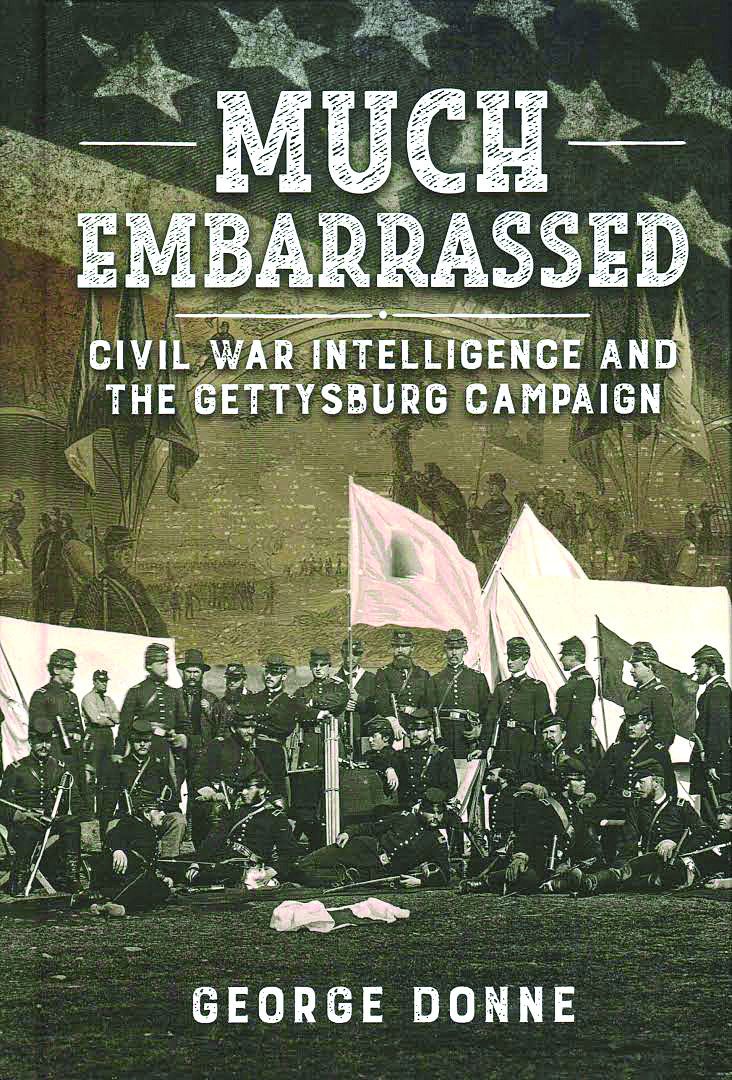
Federal Intelligence Was Superior To Confederates’ In Gettysburg Campaign Much Embarrassed: Civil War Intelligence and the Gettysburg Campaign. By George Donne. Illustrated, photos, maps, 201 pages, 2016, Helion & Company Limited, www.helion.co.uk, $49.95 hardcover. Reviewed by Thomas J. Ryan
The role and impact of military intelligence are critical aspects of Civil War history. Yet the yield on this subject has been limited, and the harvesters few. As a result, George Donne’s effort to amend this deficiency is welcomed. The title Much Embarrassed requires explanation. The author drew it from Gen. Robert E. Lee’s official report (dated January 1864 not “end of July” 1863) in which he stated, “the movements of the army preceding the battle of Gettysburg had been much embarrassed by the absence of the cavalry.” In 19th century military parlance, “embarrassed” meant “hampered” or “impeded,” rather than the modern connotation of “shamed” or “humiliated.” Donne specifies that the separation of Maj. Gen. Jeb Stuart’s cavalry brigades from the main army translated into a loss of Lee’s main source of intelligence during the battle of Gettysburg. The saga of Stuart’s adventures during the Rebel forces’ march northward from Virginia toward Pennsylvania is a central theme of this insightful examination of the disparity between Union and Confederate intelligence resources during the Gettysburg Campaign. The author narrates events from early June to mid-July. He describes the broad-based intelligence capability of the Union Army of the Potomac in comparison to woefully inadequate resources of Lee’s Army of Northern Virginia. To his detriment, Lee retained old-army methods learned during the Mexican War and frontier days of the 1840s and 1850s, and spurned modern techniques for gathering and communicating information about the enemy. Much Embarrassed illustrates intelligence operations during the Gettysburg Campaign as a progression from earlier engagements, including on the Virginia
Ed BEArss symposium: militAry lEAdErship
Based in Military history tour led by Ed Bearss of “George Washington Chambersburg, on the Frontier” with sites of the ill-fated Braddock Campaign Pa. of 1755 to Fort Necessity. Featuring Dr. Richard Sommers,
Chris Kolakowski, Wayne Motts, Greg Urwin, others…$445
Peninsula, Antietam, Fredericksburg and Chancellorsville as practiced by Lee on the one hand and Gens. George McClellan, Ambrose Burnside and Joseph Hooker on the other. Hooker’s establishment of an intelligence staff, the Bureau of Military Information (BMI), in early 1863 to support the Army of the Potomac is featured as key to Union success at Gettysburg. Donne takes Lee to task for his myopic mindset regarding intelligence operations, and his all-eggs-in-one-basket approach that primarily relied on a single source — the cavalry. This over-dependence came a cropper when Union intelligence operatives generated reports while the armies were on the march northward from Virginia. Stuart’s separation from Lee for several days prior to and during confrontation of the opposing forces at Gettysburg proved to be a handicap that Lee did not overcome. It should be noted, however, on June 28, Lt. Gen. James Longstreet’s spy, Henry Thomas Harrison, provided timely warning about approaching Union forces that preempted a threat to Lee’s vulnerable army, which was dispersed across Pennsylvania from Chambersburg to the Susquehanna River. The author holds a degree in military history from the University of Buckingham in England, and lives in Guildford, Surrey. This lucid analysis of Union and
CIVIL WAR TOURS April 6-9
sponsored by:
& MORE
Confederate intelligence-gathering functions, and services provided the respective commanders, is based on his master’s thesis. Although Donne highlights the U.S. Bureau of Military Information’s role in the Gettysburg Campaign, he did not consult the BMI files held at the U.S. National Archives and Records Administration. These documents are vital to understanding the full story. Several anomalies: the author labels Lee’s captured Special Order 191 during the 1862 Maryland campaign as SIGINT (signals intelligence); states that Brig. Gen. John Imboden commanded two cavalry brigades rather than one; places Lee’s provost guard, Maj. David Brigford’s 1st Battalion Virginia Infantry, with Lt. Gen. Richard Ewell’s advance corps; misidentifies BMI spy George S. Smith as Union Maj. Gen. Alfred “Pleasonton’s informant”; places Frederick and Middletown in Pennsylvania, not Maryland; and mentions that the Union army had six corps — it had seven. For all students of Gettysburg, Much Embarrassed is a mustread for its incisive rendition of the battle of wits which occurred between Union and Confederate commanders. Caution is given regarding the above anomalies
(and a few others). Nevertheless, this study enhances our knowledge of the critical, but oft neglected, intelligence operations aspect of the Gettysburg campaign. Thomas J. Ryan is the author of Spies, Scouts, and Secrets in the Gettysburg Campaign, winner of the Bachelder-Coddington Literary Award for 2015. His online-accessible “Civil War Profiles” column appears weekly in the Coastal Point newspaper, Ocean View, Del.
Is Candid And Insightful The Civil War Memoirs of a Virginia Cavalryman. By Lt. Robert Hubbard Jr. Edited by Thomas P. Nanzig. Illustrated, photos, maps, 328 pp., 2016, University of Alabama Press, www.uapress.ua.edu, $24.95 softcover. Reviewed by Jonathan A. Noyalas
After the Civil War’s guns fell silent, those who fought for and supported the Confederacy had to not only pick up the pieces which remained in the conflict’s wake, but attempt to make sense of the war and come to terms with why the Confederate nation collapsed. For many former Confederates the quest to make sense of the defeat compelled them to take up their pens and write about the war. For some, it took years for them to realize that writing would help sort out their wartime experience. But for Lt. Robert T. Hubbard Jr., of the 3rd Virginia Cavalry, the impulse to engage in the cathartic experience of memoir writing began several months after the surrender at Appomattox. Hubbard’s Memoirs, first released in 2007 and now available for the first time in paperback, has been made available to Civil War historians through the efforts of Thomas P. Nanzig, the author of several books, including a history of Hubbard’s regiment published in 1989. Nanzig has done a splendid job editing Hubbard’s Memoirs — he provides a concise biographical sketch of Hubbard and appropriately notes the text, but does not provide excessive commentary overburdening this rich account. The greatest value of Hubbard’s Memoirs is that it offers enormous insight into the operations of the 3rd Virginia Cavalry and to a degree the operations of Confederate cavalry in the war’s Eastern Theater. Hubbard’s “straightforward narrative” will aid historians in not only garnering a deeper understanding of the ebb and flow of such engagements as Aldie, Todd’s Tavern, Haw’s Shop, Guard Hill, Milford and Five Forks (a battle in which Hubbard was wounded), but also bringing clarity on how soldiers dealt with a battle’s outcome and coped with the loss of comrades. However, this volume offers much more. Hubbard’s postwar musings, enhanced by the editor’s inclusion of 16 wartime letters, offer insight into how soldiers managed with being away from loved ones, dealt with issues of rampant sickness, and pondered the war’s international dimensions. Additionally, Hubbard’s Memoirs offers much valuable insight into the complexities of what compelled him, a law student at the University of Virginia at the conflict’s outset, and those of his generation to support secession and enlist. This volume’s richness is magnified by Hubbard’s candid assessment of his superiors and foes. Although he admired Gen. Robert E. Lee, Hubbard criticized him as being somewhat overconfident. Throughout the memoir Hubbard heaps praise on various Confederate commanders, most notably Gen. Thomas J. “Stonewall” Jackson and Gen. J.E.B. Stuart, but at times finds admirable qualities in his battlefield counterparts, including George Armstrong Custer — a man Hubbard believed to be a “very brave officer.” Hubbard’s honest assessments extend to his fellow soldiers in the Confederate army. Unlike so many Confederate writers, after the conflict Hubbard did not see unending patriotic zeal permeating Confederate ranks until the war’s close; instead he saw the army’s “martial spirit” in “rapid decline” by the end of 1862. In fact, Hubbard believed that deteriorating morale compelled some of his fellow troopers to abuse their horses so that they would not have to fight and risk undue harm. This memoir, richly illustrated with maps tracing the 3rd Virginia Cavalry’s movement from their time on the Virginia Peninsula to the time of Hubbard’s wounding at Five Forks on April 1, 1865, should appeal to a wide array of historians interested in the war’s Eastern Theater, the life of Confederate cavalrymen, and soldiers’ perceptions of their superiors, comrades-in-arms, and enemies. Prof. Jonathan A. Noyalas is the director of the McCormick Civil War Institute at Shenandoah University in Winchester, Va. He is the author or editor of 11 books on Civil War era history, including his most recent Civil War Legacy in the Shenandoah: Remembrance, Reunion, and Reconciliation.
Black Powder Projectiles Encyclopedia Encyclopedia Of Black Powder Projectiles Found In North America; 1759 – 1865 Volume III. Confederate Rifled Projectiles. By Col. John Biemeck (Ret.). Black Powder Artificer Press. 2016. http://www.bpapress.com, $49.95 softcover. Reviewed by Peter A. Frandsen
The second installment of essentially the last word on North American black powder projectiles has arrived and because of the amount of information contained therein, the number of pages, and the heavy, high-quality glossy stock paper used, it weighs as much as any large caliber Civil War siege artillery projectile. It is 485 pages in length, contains 447 pages of illustrations, data charts and text explaining 650 Confederate and British rifle projectiles to include their history, patent numbers, usage, production, functioning, measurements, fusing, sabots, bursting charges, payloads, and more. It is the most complete and detailed listing of Confederate projectiles that has been published to date and includes many projectiles that are extinct with no known surviving specimens. It lists virtually every rifled projectile used by the Confederate service and many that have not been previously reported in any of the current books. It includes imported projectiles that are being sold as Civil War relics, which they are not. It also has a section on “Miscellaneous rifled projectiles,” Union and Confederate. This includes the German Krupp and French Enfold munitions which are often misidentified and sold as Armstrong projectiles. It details how they can be identified because they have different features and diameters. It also includes all known rifled canister, Confederate and Union, because they were similar and often used by both sides. It is safe to say the author knows more about such projectiles than the manufacturers or users did at the time. Nonetheless, the author appeals to anyone interested in the subject with new or correcting information to forward same to him. This is literally a oncein-a-lifetime opportunity to make this reference work as complete as humanly possible. The book is indexed and contains a thorough bibliography of all references (most published). And again, the author rightly and forcefully and repeatedly warns throughout against playing with or attempting to deactivate rounds of unknown origin or type because they can be extremely dangerous. A reference work of monumental proportions by an author with extensive military experience, it is a necessary addition to any military reference library and for anyone interested in 19th century artillery. The two volumes are available directly from the author, and if both published volumes are purchased together, a discount is given. Volume 1 will be published last. Peter Frandsen is a regular book reviewer for The Artilleryman, our sister publication. This review appears in the Winter 2016 issue of the magazine.
Detailed 5th Mass. Colored Cav. History The Fifth Massachusetts Colored Cavalry in the Civil War. By Stephen M. LaBarre. Illustrations, bibliography, index, 232 pp., 2016, McFarland & Co., www.mcfarlandpub.com, $29.95 softcover. Reviewed by Walt Albro
The history of the 5th Massachusetts Colored Cavalry reached its apex on April 3, 1865, when it became the first colored regiment to enter the defeated city of Richmond. The troopers, swelled with pride, wore neat uniforms and sat erect in their saddles. “Going through the city, we passed thousands of citizens, colored and white, who cheered and cheered us as we rode in triumph through the streets,” recalled one trooper. “They shouted, ‘God Bless You! We have been waiting for you and looking for you and looking for you for a long time.’” The event could be viewed as ironic. While the slaves saw the troopers as conquering heroes, some of the Northern military commanders had a more ambivalent attitude. In fact, as soon as the 5th’s moment of glory was over, the regiment was transferred out of Virginia — for fear of racial tension with local white residents. This regimental history pays homage to the bravery of the 5th’s enlisted men — most of whom were ex-slaves — who chose, despite the risks, to fight for their own liberation. It also casts light on the occasional shabby treatment of colored soldiers. The 5th, for example, was often underestimated and underutilized and frequently assigned to noncombat jobs involving manual labor. The troopers of the 5th were among 180,000 African Americans comprising 166 regiments who, starting in 1863, served in the Union Army. Most of the recruits came from border states or from Southern states occupied by Federal troops.
The 5th was unique in that it was the only colored cavalry regiment that recruited exclusively among Northern African Americans. For this and other reasons, the regiment acquired the reputation of being an elite, prestigious unit. The 5th was created at the same time as two other showcase colored units, the 54th and 55th Massachusetts Infantry Regiments. (The 1989 movie “Glory” was based on the history of the 54th Massachusetts.) The 5th Cavalry’s first commander was Col. Henry Sturgis Russell, a Boston Brahman raised in an abolitionist household. He was also a cousin of 54th Massachusetts commander Col. Robert Gould Shaw. Similar to other colored regiments, the 5th had mostly white officers. Many whites still believed that African Americans were not capable of being officers). While the top-ranking officers often had abolitionist sympathies, the same was not true for junior officers, who often volunteered strictly for the opportunity to receive a promotion. As a result, a degree of racial tension existed between enlisted men and junior officers. After training in a camp outside Boston, the 5th Regiment in May 1864 expected to go immediately into combat as a cavalry regiment. Instead, it was stripped of its horses and sabers and assigned as infantry in Maj. Gen. Benjamin Butler’s Army of the James, which was located at Bermuda Hundred, northeast of Petersburg. There, the regiment was used mainly for picketing and reconnoitering until June 15, 1864, when, along with several other colored regiments, it attacked and captured a Southern breastwork in the Petersburg defenses. After this, the regiment suffered another letdown when it was assigned to guard duty at Point Lookout, a Maryland prisoner of war camp on a promontory of the Chesapeake Bay. “The men’s morale would descend to a low point with the realization that the 5th Massachusetts Cavalry had been ordered there by General Butler to perform more menial tasks than that of a fighting soldier,” the author notes. The regiment was reassigned to the Petersburg trenches just days before the war’s end. In addition to its triumphal parade into Richmond, the 5th also had the honor of providing troopers to escort Lincoln’s carriage during a portion of his ride through the captured city. The author deserves commendation for his exhaustive research that uncovered personal letters and diaries as well as obscure documents and newspaper articles. He also tracked down photographs of most of the prominent people mentioned in the text. This book should serve as the most comprehensive compendium of the 5th Regiment’s war record for many years to come. Walt Albro is an editor and writer living in Rockville, Md. His column on a proposal to remove the Confederate monument there appeared in our August issue.
When Lincoln Came to Egypt. By George W. Smith. Illustrated, photos, 158 pp., 2016, Southern Illinois University Press, www.siupress.com, $20.50 softcover. Reviewed by Thomas J. Ryan
This book is clearly a paean to Abraham Lincoln — perhaps meant as a peace offering by the author to a fellow Illinoisan who during his lifetime received little political support in the southern part of the state known as “Egypt.” Written in the style of a series of essays, When Lincoln Came to Egypt — a reissue of George W. Smith’s book of 1940 — describes Lincoln’s occasional forays into Egypt to seek support for his candidacy for various political offices in the 1840s and 1850s. It is essentially a travelogue with details about dates, methods of travel, accommodations, persons visited, and the nature of Lincoln’s activities. Smith apparently wrote this book for readers who would be familiar with the general locality and subject matter; therefore, he provided limited explanation or clarification of some points. The author explains the geographic makeup of southern Illinois where the mighty Ohio and Mississippi rivers meet. Similarities of terrain features and commercial/agricultural potential of this area with the Nile River in Africa account for the “Egypt” connotation. Migrants into southern Illinois from states such as Kentucky and Virginia maintained adherence to the Southern way of living, which fostered empathy for the Democratic Party. As the slavery issue exacerbated relations between North and South in the mid-19th century, many in this region adopted “Copperhead” allegiances to states that eventually seceded to form the Confederacy.
Stephen Douglas, Lincoln’s friend and political opponent on more than one occasion, receives considerable attention. The author characterizes Lincoln as friendly to practically everyone he came into contact with, notwithstanding political differences. When Lincoln Came to Egypt is a refresher on the Kansas-Nebraska Act and the issue of slavery spreading into the Western territories. Smith praises Douglas for nurturing the bill through to passage, despite the political price he paid with slaveowners in the South when Kansas came into the Union as a free state. Considerable space is allotted the Lincoln-Douglas senatorial debates of 1858, with emphasis on logistics involved in getting the competing candidates to the Illinois towns where verbal jousting, mainly over the slavery issue, took place. The brief closing chapters summarize Lincoln’s presidential years and his “short sad career.” The prose is frequently anecdotal. A back cover blurb praises the book as “the culmination of fifty years of extensive research,” but provides no supporting evidence. The original publication did not include explanatory notes or list of sources. However, the author refers to sources in the text, such as letters and newspaper articles. Occasionally, he makes vague attribution (“another writer says”), or cites the name of an informant without further identification. Despite the book’s emphasis on the Southern Illinois geography and terrain, no maps are included. Assignment of this reissued volume to an editor for critique and annotation prior to publication would have been helpful. Lincoln aficionados who do not own a copy will likely want to add When Lincoln Came to Egypt to their collection. Despite its limitations, general readers will be enlightened by Lincoln’s interactions with the inhabitants of the least politically friendly area of his state.
Thomas J. Ryan of Bethany Beach, Del., is the author of Spies, Scouts, and Secrets in the Gettysburg Campaign (Savas Beatie, 2015).
— Books Reviewed In This Issue —
Page 28Summon Only the Brave! Commanders, Soldiers, and Chaplains at Gettysburg. By John W. Brinsfield Jr. Maps, photos, appendices, bibliography, index, 203 pp., 2016, Mercer University Press, www.mupress.org, $35. Reviewed by Sean A. Scott.
Page 29A Savage War: A Military History of the Civil War. By Williamson Murray and Wayne Wei-Siang Hsieh. Maps, notes, index, 616 pp., 2016, Princeton University Press, press.princeton. edu, $35 hardcover. Reviewed by Brian S. Wills.
Page 32Much Embarrassed: Civil War Intelligence and the Gettysburg Campaign. By George Donne. Illustrated, photos, maps, 201 pages, 2016, Helion & Company Limited, www.helion.co.uk, $49.95 hardcover. Reviewed by Thomas J. Ryan.
Page 34The Civil War Memoirs of a Virginia Cavalryman. By Lt. Robert Hubbard Jr. Edited by Thomas P. Nanzig. Illustrated, photos, maps, 328 pp., 2016, University of Alabama Press, www.uapress.ua.edu, $24.95 softcover. Reviewed by Jonathan A. Noyalas. Page 35Encyclopedia Of Black Powder Projectiles Found In North America; 1759 – 1865 Volume III. Confederate Rifled Projectiles. By Col. John Biemeck (Ret.). Black Powder Artificer Press. 2016. http://www.bpa-
press.com, $49.95 softcover. Reviewed by Peter A. Frandsen. The Fifth Massachusetts Colored Cavalry in the Civil War. By Stephen M. LaBarre. Illustrations, bibliography, index, 232 pp., 2016, McFarland & Co., www.mcfarlandpub.com, $29.95 softcover. Reviewed by Walt Albro. Page 36When Lincoln Came to Egypt. By George W. Smith. Illustrated, photos, 158 pp., 2016, Southern Illinois University Press, www.siupress.com, $20.50 softcover. Reviewed by Thomas J. Ryan.