
The A. P. Hill March
By Joseph Bordonaro · Originally published February 2017 · p. 25
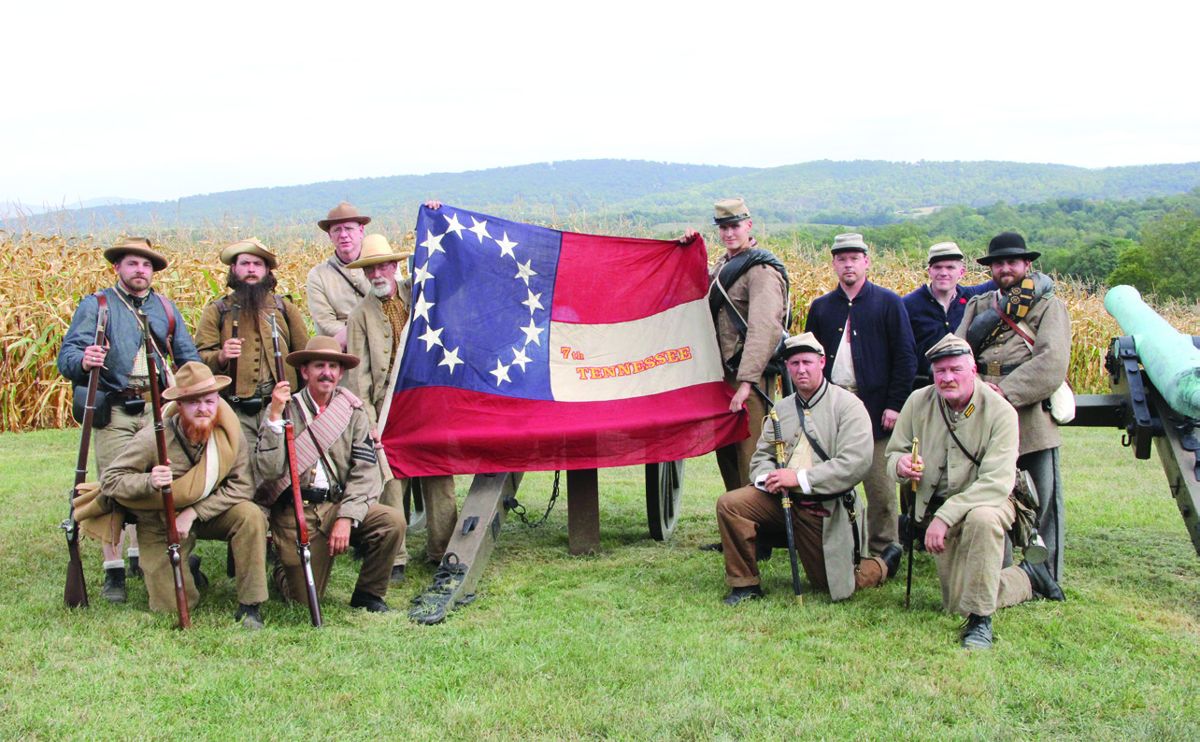
Dunker Church kept a silent vigil as the reenactors who were going to reenact the march of A. P. Hill’s Light Division from Harpers Ferry to Sharpsburg awoke in the pre-dawn chill of September 17, 1862. It was exactly 154 years after the stirring events associated with the Battle of Sharpsburg, or Antietam occurred. The reenactors were shuttled to Harpers Ferry for the beginning of the march by the “unsung heroes” of the march - the people who gave up a day of their life and many gallons of gas for their vehicle to make the march possible. In no time at all we arrived at Harpers Ferry and quickly organized ourselves (I had the honor of acting as First Sergeant of the Company so I was tasked here with “forming the company”) and off we went on the march. Starting the march is always exciting…it’s still dark out, you’re going through the history heavy town of Harpers Ferry, you’re passing John Brown’s Fort…yeah, like that :) Soon we’re out of town and onto the railroad right of way. This is a tough section. Walking on stone fill, in the dark, with slick soled brogans is like an accident waiting to happen. Fortunately, we had an almost full moon lighting up a fairly clear sky to help us see the path. When the sun came up a little later the sky began clouding up a bit, which was extremely fortuitous timing. Thanks, Mother Nature! Anyway, we got through this stretch without anyone turning an ankle, so it was all good. It was amusing to march past the people camping along the river at this point. You have to wonder what their initial thought was when they woke up suddenly and saw a line of soldiers in Confederate gray marching by in the early dawn. We set at least one dog alarm off, but no one said a word to us. Maybe that’s a good thing :) We took a short break at this point and then headed up the nearby Bakerton Road. Bakerton Road was when the marchers made our first acquaintance with the hilly nature of most of the march route. Those hills tire you out. We took a short break somewhere along the way in this first part of the march because it was getting to be a long time from our last break and it looked to be a while before getting to Moler Cemetery, where we take a longer break. It was a kind of spooky place to take a break because it was right under a dead tree that was filled with resting vultures! It sure didn’t make you want to take a snooze there! Anyway, the short break gave everyone a chance to catch up and so we were able to arrive at Moler Cemetery together. We had an excellent break there and many of us used some of the time to check on our feet. It’s always wise to catch those “hot spots” before they turn into blisters! We also took advantage of the opportunity to top off our canteens and we were also treated to some excellent food, courtesy of Capt. Eney, whose recent surgery confined him to a “wagon” (one of the chase cars) but who nevertheless had a lot to do with keeping the men in good spirits. We stacked arms at all of our longer breaks. It is the military thing to do and it makes forming up a lot easier, which is probably one of the reasons stacking arms was done back in the day. Well, after resting for a while at the cemetery, we formed back up and headed out. It’s amazing how much even a short rest will do towards reviving your spirits on the march. We were also encouraged by the excellent progress we were making on the march. It is not that far from Moler’s Cemetery to Moler’s Crossroads, but most of the distance consists of a very long hill that must be climbed. And so it was with great relief that the open cornfields heralded the closeness of the Crossroads. Seeing that church, and knowing that it means that a long break, and food, are in the offing, is enough to pick up a man’s spirits. Speaking of spirits, I here will relate something that happened to me that was pretty mysterious. When our lunch had been consumed and the sweat that covered us had a chance to dry (a bit) I suited up and walked around the corner of the church to where we had stacked arms. When I turned that corner, though, I stopped in my tracks because the view that greeted me took my breath away. Across the cornfield on the other side of the road was a farmhouse that looked like it hadn’t changed a bit since 1862. Beyond that rose the beautiful chain of mountains in the distance. Above that, the sky was beginning to break out of the clouds and a beautiful blue was appearing. I said (out loud, but to myself since no one was near me at that moment), “What a beautiful vista!” and heard someone behind me say something, or make some noise, in agreement. I turned to see who it was and there was no one behind me. Just turning the corner of the church was Lt. Bill Imes. So did I really hear anything? I can’t prove I did, but no one will ever convince me that I didn’t. So, if I did hear someone, who was it? Again, no one will ever know, but I can’t help but feel that a spirit of one of General
Hill’s soldiers was nearby. At Moler’s Crossroads the march route leaves Bakerton Road and turns to the right down Knott Road. This trends downward until River Road appears on the left. River Road, although not level, is not nearly as brutally hilly as Bakerton Road. Also, it is quite a bit shadier so, all in all, the march is easier at this point. Which is just as well, since the Bakerton Road leg of the march leaves the soldiers feeling mighty tired! Speaking of which, we once again took a short break at a convenient spot along the road where another road enters into it and the junction creates two hilly swales on which the marchers can rest. Which we did. After our final rest on River Road, we set off for the crossing of the Potomac River. The march has always gone over Botelor’s Ford (except when high water forced a detour through Shepherdstown) but we decided to try and cross at the original crossing at Pack Horse Ford (at least we believe that A.P. Hill’s Division crossed there). We wanted to do this because it would shave off one to two miles of the march. Our scouts were asked to test the ford and they bravely did so. We watched their progress with great interest. It appeared that they were walking on top of the old cement dam because they looked like they were walking a tightrope. That was the first thing that alarmed me, because I was wondering how deep the river was on either side of the “dam”. What really concerned me, however, was when two men in a rowboat shouted up to us that the river was chest high near the opposite bank and that the river was only ankle high about 50 yards upstream. Lt. Imes and I consulted. It was a tough decision, because the men were ready and eager to cross at this ford. We made the decision to look for the shallower spot, though, and off we went. 50 yards soon turned into 100, and then half a mile, and then we realized that we were approaching Botelor’s Ford. We tried crossing below it near a spot where a small island seemed to provide easy access to the ford, but we couldn’t get access to the island and ended up crossing at Botelor’s Ford. I felt bad, because marcher Sean O’Malley’s friend, Joan Keith, had planned to film our crossing and because of the change of plans was not able to do so. Also, the men were none to pleased about not crossing at Pack Horse Ford because they knew that it would have been a shorter route. That’s what made the decision so tough. Was it the correct decision? There is no way of knowing because we don’t know what would have happened if we had tried to cross at Pack
Horse Ford. The two scouts who got across are active duty military men in prime shape. Most of the rest of us are not in such great shape. So, that was the thinking that went into the decision. We crossed the Potomac River at Botelor’s Ford. There was a giant tree that had been thrown by a storm right across the path of the ford, about midstream. With our options rapidly diminishing, we nonetheless set off for the other side. Our scouts had already crossed, so we were led by the intrepid Corporal O’Malley. It turned out that getting over the giant tree trunk was no problem. After crossing, we reformed on the old towpath of the Chesapeake & Ohio Canal. It was a relief to be marching on something other than asphalt! We marched down the path about a mile or so and then crossed over to the terminus of the infamous Sawmill Road. It was at this point that our spirits were lifted by a trio of musicians who played “The Bonnie Blue Flag” and “Dixie”. It’s amazing how music can actually make marching easier. Our intrepid scouts and teamsters were waiting for us there so the whole company was once again reformed.
We rested there a while and then it was time to tackle the final challenge of the march! Up and up goes the hill. Every time you get to the top, you find out it’s not the top! The men were in fine fettle, though, at one point even shrugging off Lt. Imes’ suggestion to take a breather. So on we marched, up and up. Just when you think that you’ve had it and can’t take another step, you see the real top of the hill - the ridge that has the Harpers Ferry Road running along it! Our scouts provided road security and we marched across the road to the battlefield! There are few things in life as exhilarating as knowing that you have completed a 17-mile march, wearing a Civil War-style uniform and Civil War-style brogans. We can never (fortunately) experience what the Civil War soldiers went through in combat, but we can approximate their marching experience. It is humbling to realize that the long march you have completed was just another “day in the office” for the Civil War soldiers on campaign. They truly were an amazing group of soldiers. I suppose you could call them the “Greatest Generation” of the 19th century.