
President Carter Defied Fake History
By Philip Leigh · Originally published February 2017 · pp. 14–15
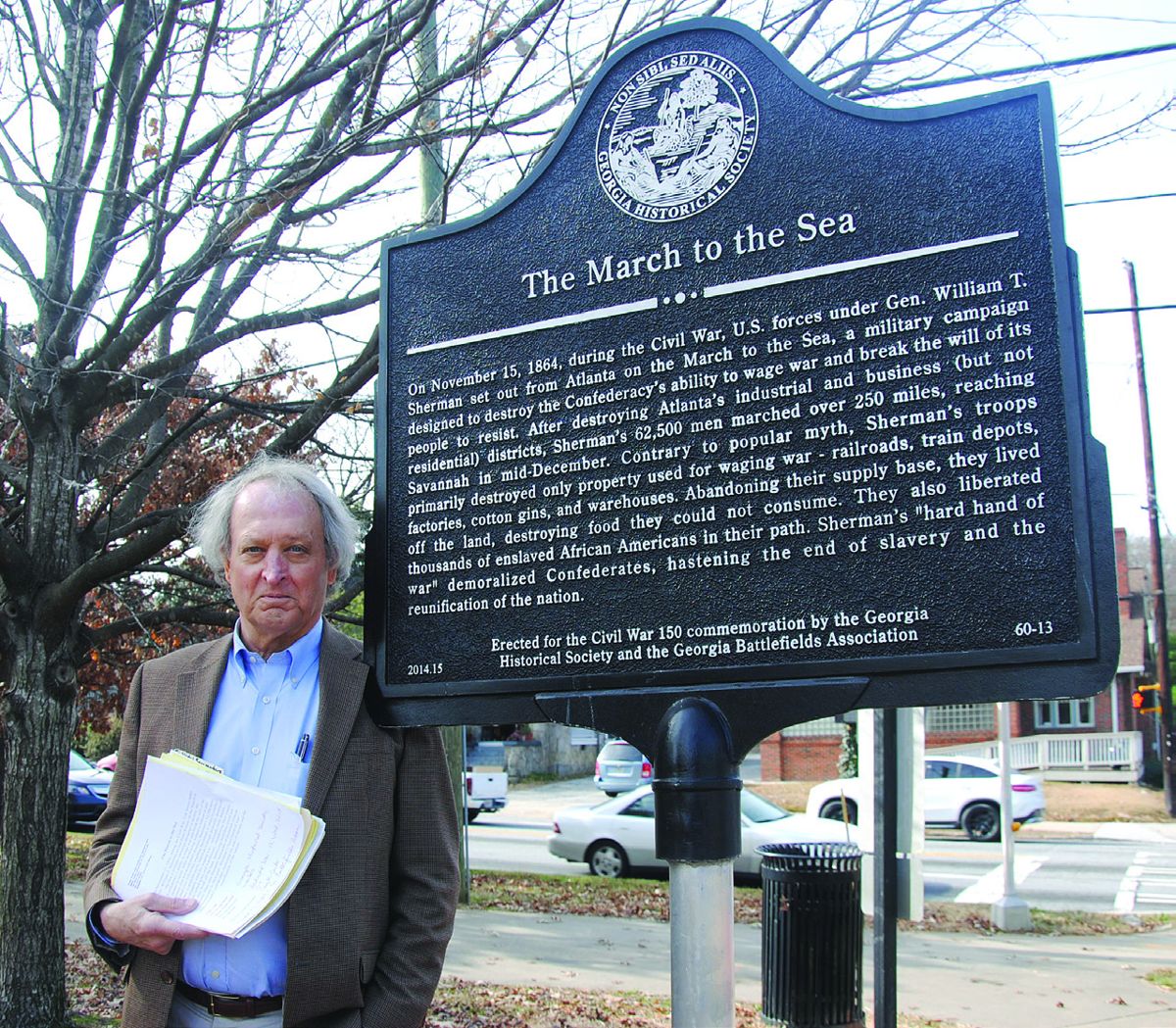
Editor’s note: in our January issue we published a short article on the installation in Atlanta of a new historical marker, “The March to the Sea.” One of our contributing writers, Philip Leigh of Tampa, has provided background on the marker and its recent placement.
By Philip Leigh In November 2014 the Georgia Historical Society (GHS) placed an historical marker on the Carter Center grounds in Atlanta falsely stating that the Union army under Major-General William T. Sherman’s did not destroy many—or perhaps any—residential dwellings when it left on its Marchto-the-Sea in November 1864. The exact wording was, “After destroying Atlanta’s industrial and business (but not residential) districts, Sherman’s 62,500 men marched over 250 miles, reaching Savannah in mid-December.” Perhaps because he is old enough to have met survivors or family members of the conflagration, former President Carter knew fake history when he saw it. As Yale professor Carlos Eire, who escaped Castro’s Cuba in 1962 as an 11-year-old, observed in his National Book Award memoir, Waiting for Snow in Havana,
“Show me history untouched by memories and you show me lies. Show me lies not based on memories and you show me the worst lies of all.” Consequently, Carter asked the Historical Society to either correct the marker or remove it. Months later they removed it. The tale of Carter’s intervention began shortly after The New York Times Disunion Blog published my “Who Burned Atlanta?” article on Nov. 13, 2014. It explained that many city residential dwellings were, in fact, demolished. The day after my article was released, a second newspaper story detailed the historical marker’s dedication and mentioned its erroneous claim that Atlanta residences were not affected. Accordingly, I sent a postal letter to the GHS’s Executive Director, Todd Groce, providing sources documenting that many Atlanta homes were undeniably burned just prior to the Marchto-the-Sea. It also asked that he reveal his sources to the contrary. I copied the Society’s Board Chairman with a “cc.” notation. Among the sources I cited was What the Yankees Did To Us by Steve Davis, a columnist and the Book Review Editor at Civil War News.
Since neither Groce nor the GHS Board Chairman replied, I sent similar letters to several other Board Members informing them of the marker’s error. The only reply was a token one from Cocoa-Cola’s Public Relations Department on behalf of a Board Member who was also a Coca-Cola executive. As a last resort, in early December 2014 I wrote President Carter who didn’t know me from Charlie Chan. Two months later I was pleasantly surprised by his postal reply, “I agree with you and was shocked when I saw the marker. Whom should I write?” In February 2015, I sent Carter the Groce contact information. Carter answered, “I’ve already written the Ga. Historical Society. No answer yet. I asked them to remove or correct the marker.” Months later I wrote the former President a third time to learn how the Society had responded to his request. He answered, “The marker was removed.” To be clear, the wholesale destruction of Atlanta was not Sherman’s official intention. He had officers prepare a plan to destroy military targets, which included a detailed map marking the structures. No private residences were among them. Sherman selected Captain Orlando Poe to execute the scheme because the general assumed engineers would be less reliant upon explosives and fire. Still, there was little doubt about the ultimate result; six days earlier, when Poe first learned that Sherman wanted a demolition proposal, he wrote his superior engineering officer in Washington explaining that by the time his letter arrived, “Atlanta will have ceased to exist.” At seven o’clock on the morning of Nov. 16, 1864, when Sherman was with his army three miles down the road to Savannah, he stopped to look back. “Behind us lay Atlanta smoldering and in ruins, the black smoke rising high in the air and hanging like a pall over the ruined city,” he recalled. Presently a nearby infantry band struck up John Brown’s body. “Never…have I heard the chorus of ‘Glory! Glory! Hallelujah!’
done with more spirit.” The men were proud of what they had done. Estimates of the physical damage Sherman left behind vary. Since only a few Confederate troops were, at best, sporadically nearby and few civilians were permitted to remain in the city to bear witness, most available accounts reflect the Union viewpoint from official war records, diaries and letters of Federal soldiers and Northern reporters’ newspaper accounts.
Such records might naturally have been prone to reflect favorably upon the conduct of Union soldiers and omit outrages that might have been seen otherwise by an opposing Rebel army or Southern civilians. Consequently, when Davis wrote What the Yankees Did to Us, he consulted many diverse contemporary sources from both Northern and
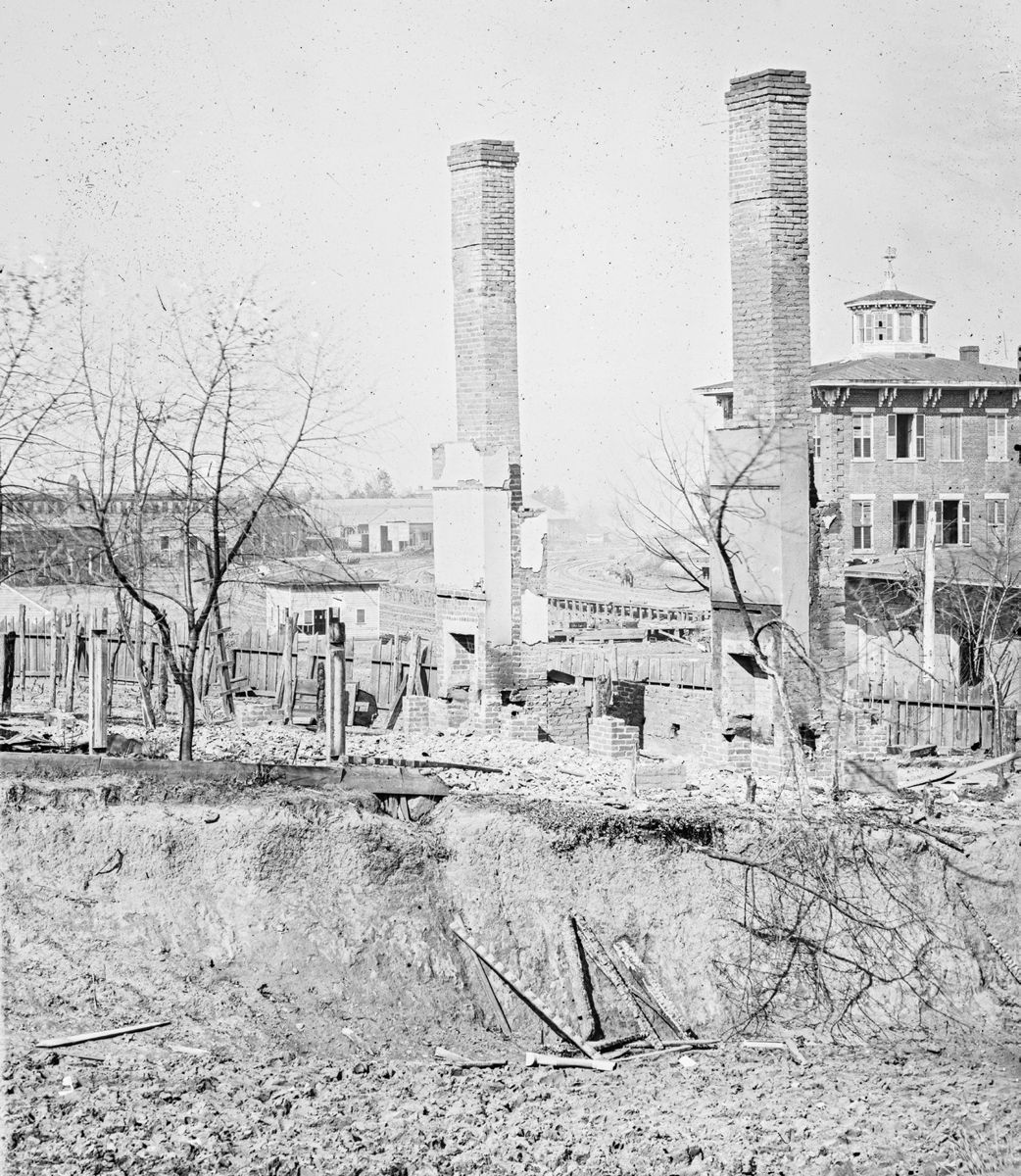
Southern viewpoints. Captain Poe later estimated that 37% of the city had been demolished. An Indiana soldier’s diary entry simply stated, “We have utterly destroyed Atlanta.” After Sherman left, Georgia’s governor sent a militia officer to prepare an assessment. The inspector spent four days systematically mapping every house left standing. He concluded that only 400 homes remained of 3,600 originally within a half-mile radius of the town center. Although it is impossible to know the full extent of damage to residential districts, many contemporary sources indicate that it was significant. One Michigan sergeant conceded getting swept up in the inflammatory madness, even though he knew it was unauthorized: “As I was about to fire one place a little girl about ten years old came to me and said, ‘Mr. Soldier you would not burn our house would you? If you did where would we live?’ She looked at me with such a pleading look that…I dropped the torch and walked away.” On November 13—three days before leaving Atlanta for the coast— an Ill. captain’s diary recorded that when his unit entered the city from the North, “The smoke almost blinded us.”
By Nov. 15 the city seemed to be on fire everywhere. By 3 p.m. officers distributing supplies at the commissary instructed soldiers to simply take whatever they needed, because the outof-control fires would inevitably consume the facility. A Michigan engineer’s Nov. 15 diary stated that when he marched into town “large fires [were] Raging all over the City.” An Ill. military physician got to Atlanta the same day and wrote, “Many houses had been burned and all day long the fires kept increasing in number.” An Ohio captain who also came in that day added, “We arrived in the suburbs of Atlanta at 2:00 P.M.; no sooner did we arrive than the boys commenced burning every house in [the northwestern] part of the town. The wind was blowing hard at the time and soon that part of the city was gone.” For several days prior to the Nov. 16 departure for Savannah, the components of Sherman’s army north of Atlanta converged on the city, destroying railroad tracks and communities along the way. By the time they got to the city, demolition had become habitual. Sherman ordered that miles of track be destroyed after the last train left Atlanta for the North on Nov. 12. The next day a staff officer, Major Henry
Hitchcock, joined the general as the two witnessed soldiers destroy the rail town of Marietta slightly north of Atlanta. After the fire spread to homes and shops, Hitchcock commented to Sherman: “[The town will] burn down, sir.” “Yes,” Sherman said. “Can’t be stopped.” “Was that your intention?” The general answered obliquely. “Can’t save it…There are men who do this,” pointing to a group of nearby soldiers. “Set as many guards as you please, they will slip in and set fire.” From Sherman on down, many Northerners later justified Atlanta’s burning as a military necessity. Major Hitchcock overhead Sherman remark on the night of the Nov. 15 that the city deserved to be demolished because of its military manufacturing capacity. That same night an Indiana sergeant penned, “The entire city was destroyed [but] for a few occupied houses. It reminds me of the destruction of Babylon… because of the wickedness of her people.” Other Union partisans falsely minimized the damage. Sherman speciously claimed thirteen years later in his memoirs that “the fire did not reach…the great mass of dwelling houses.” But he contradicted that belated appraisal only a month after leaving Atlanta in a congratulatory order to his troops following their entrance into Savannah: “We quietly and deliberately destroyed Atlanta.” Although Sherman never ordered a wholesale burning of the city, he did little to stop many of his increasingly undisciplined soldiers from escalating targeted destruction into a riot of arson. It is difficult to avoid concluding that the politically cagey general arranged matters so that he could deny responsibility if Atlanta’s destruction became morally condemned, but accept credit if it were celebrated. Like fake news, however, fake history can be persistent. Last November the erroneous historical marker was installed on grounds outside the Carter Center. Unfortunately experts sometimes discard valid conclusions merely because they contradict what the specialists were taught. The sinking of the Titanic is one example. Although many eyewitnesses said the ship broke apart on the surface, contemporary authorities overwhelmingly rejected the claim. An article in Marine Review itemized the evidence that showed “conclusively that the immense hull held together without shearing her riveted longitudinal connections.” Similarly, International Marine Engineering wrote that “modern ship design” was calculated to withstand longitudinal stress more extreme “than that in which the Titanic was placed.” The list goes on and on. Such opinions were taken as Gospel truth for seventy-three years until the wreck was discovered in 1985. I know. I remember. Sources: William T. Sherman, Memoirs: Volume I; Russell Bonds, War Like a Thunderbolt; Theodore Upson, With Sherman to the Sea; Stephen Davis, What the Yankees Did to Us; Michael Wortman, The Bonfire; Official Records of the Union and Confederate Armies, Series 1, Vol. 17, Part 1; John Walters, Merchant of Terror; Frances Elizabeth Gains, “We Begged to Hearts of Stone,” Northwest Georgia Historical and Genealogical Quarterly (Winter 1988); Sergeant Allen Campbell to father, Dec. 21, 1864, quoted in Mark Hoffman, My Brave Mechanics; Walter Lord, A Night to Remember; Kent Layton, Bill Wormstedt, and Tad Fitch, On a Sea of Glass: Appendix N. Phil Leigh was born in Little Rock, Arkansas and has mostly worked as a computer industry stock analyst. He holds a Bachelor of Science in Electrical Engineering from Florida Institute of Technology and an MBA from Northwestern University. He can be reached at Phil_Leigh@ me.com or 813-368-0764. Editor’s Note: The relocated “March to the Sea” marker stands today at Moreland and North Avenues in Atlanta’s Freedom Park.