
Black Powder, White Smoke
Multiple Musket Loads Revisited
By Joe Bilby · Originally published February 2017 · p. 4
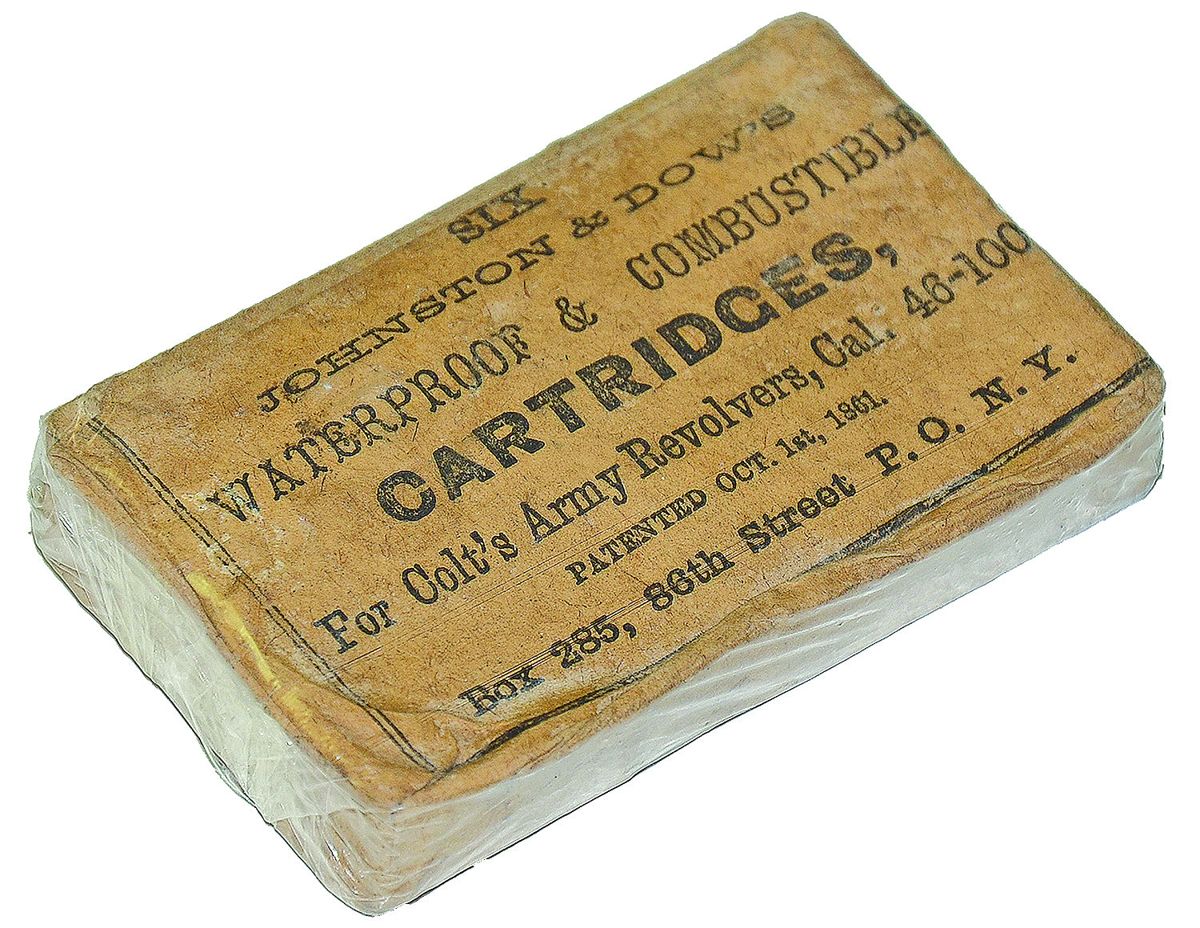
Regular readers no doubt recall that Craig Barry and I, in our respective columns, were speculating on the origins of the famous report on the muskets recovered at Gettysburg with multiple loads. Craig found an account in a 19th century West Point manual and I recalled a Jan. 1864 order to the Army of the Potomac to have individual soldiers load and fire their muskets in the presence of an officer prior to the year’s campaign season. The order noted the necessity of such training was predicated on the fact that muskets had been found on the battlefield “loaded to the muzzle” with cartridges. The only significant battlefield the Army of the Potomac held after fighting the previous year was—Gettysburg. Thanks to researcher and reader Charles Pate, however, I think we can conclude that the original source has been found and the case is closed. Pate’s letter on the subject was printed in this paper last month. In case you missed it, he cited and quoted correspondence in the National Archives between Master Armorer J. Dudley and a Captain Benton at Washington Arsenal. In short, it was the source we were looking for, and provided far more detail than the secondary references I had previously seen. According to Dudley, he and his staff, who handled those 24,000 arms recovered from Gettysburg, found many with multiple loads, including untorn paper cartridges, projectiles with and without powder charges and one smoothbore musket barrel packed with “twenty-two balls and twenty-six buckshot with a corresponding amount of powder all mixed up together.” Interestingly, a number of muskets were found loaded with several Johnson & Dow cartridges, many jammed halfway down the barrel of Enfield rifle muskets. There is much more, and you should check out Mr. Pate’s letter if interested.
Johnston and Dow Cartridge I was interested to learn that the Johnston & Dow cartridge, innovative for its time, was still in relatively wide service by Gettysburg, although it was only issued to Army of the Potomac units in the spring of 1862. The Johnston & Dow, made for handguns as well as rifled long arms, was a skin covered combustible round designed to be loaded whole, with no necessity to bite or rip cartridge paper before loading. At the battle of Gaines’ Mill, the First New Jersey Brigade used Johnston & Dow ammunition. John P. Beach of the 4th N.J. Inf. recalled that his regiment’s fire was “rapid and incessant,” because “we were armed with the new Springfield rifle with patent cartridge (no biting of cartridges).” According to one account the Jerseymen didn’t even bother to ram their “patent inflammable cartridges” down the barrels of their rifle muskets. One soldier recalled that “after the pieces had become warm it was only necessary to insert the cartridge, give the piece a slight shock, and it was home, thus greatly facilitating the rapidity of loading.” Lieutenant E. Burd Grubb believed that the combustible ammunition, “in which the powder and ball were included together in the inflammable paper, it not being necessary to bite the cartridge, but merely to put it in the rifle and ram down” was the same as that issued for reloading steel cases in the “Union Volley” or “Coffee Mill,” a manually operated protomachine gun in service with the brigade. Why the Johnston and Dow cartridge was not more widely adopted remains a mystery. Except for one officer dismayed by what we would call today a “cookoff,” or explosion of a cartridge being loaded, the reviews of the ammunition in the 1st N.J. Brigade’s companies were complimentary. Ordnance chief Brigadier General James W. Ripley considered the ammunition “novel and expensive,” however, and replied to petitioners at one point that he was not interested in buying more Johnston & Dow cartridges because the army had “a large supply of good small arms ammunition on hand.” Although I believe that General Ripley often gets a bad rap on matters of innovation, in this case I fail to see his rationale for stonewalling. Johnston & Dow ammunition, according to most testimonials, including those of reliable officers like Colonel Theodore B. Gates of the 20th N.Y. State Militia, was accurate, easy loading, clean shooting, waterproof and sturdy. Even the Rebels were impressed by combustible rifle musket ammunition and used it when they captured it. Colonel Samuel McGowan, commanding the 14th S.C. Inf. at Frazier’s Farm, reported that, “The regiment [14th] was halted at the edge of the cleared ground and volley after volley thrown into the ranks of the enemy, who returned upon us a very hot and fatal fire. In this musketry fight some of my men, having obtained patent cartridges, shot seventy times.” The South Carolinians had previously fought at Gaines’ Mill and may well have been firing Johnston & Dow ammunition captured from the 1st N.J. Brigade. For more on the Johnston & Dow, as well as other Civil War “patent” ammunition, I heartily recommend Dean S. Thomas’ book, Round Ball to Rimfire: A History of Civil War Small Arms
Ammunition. (Gettysburg: Thomas Publications, 1997). It is the best available source for Civil War ammunition research. Actually Dean’s entire series of books on Civil War ammunition is a must have for any Civil War historian or buff interested in tactical level or ordnance supply studies. So what happened at Gettysburg? The answer appears to be in the weapons used—Enfield rifle muskets. Most British made guns, from a variety of contractors, had a slightly smaller bore diameter than the Springfield rifle musket, although some were made with a larger bore for the American export market. At Gettysburg the men of the 20th Maine Inf. had trouble loading conventional musket ammunition in their Enfields after the first few rounds, once fouling had built up in the bore. The initial bullet diameter established for Minie balls used in the United States Springfield pattern rifle muskets was .5775, and the Johnston & Dow rounds probably adhered to this standard. Subsequent ammunition was produced in .574 diameter, which could be used in either arm. Joseph G. Bilby received his BA and MA degrees in history from Seton Hall University and served as a lieutenant in the 1st Infantry Division in 1966-1967. He is Assistant Curator of the New Jersey National Guard and Militia Museum, a freelance writer and historical consultant and author or editor of 20 books and over 400 articles on NJ and military history and firearms, and as publications editor for the NJ Civil War 150 Committee edited the award winning New Jersey Goes to War. He has received an award for contributions to Monmouth County (NJ) history and an Award of Merit from the NJ Historical Commission for contributions to the state’s military history.