
How Effective Was The Hospital Transport System?
By Richard Blumberg · Originally published February 2017 · pp. 16–18
![THE INTERIOR OF A HOSPITAL CAR.—[SKETCHED BY MR. THEODORE R. DAVIS.] Engraving from Harper’s Weekly,](/article-images/cwn-2017-february/cwn-2017-february-how-effective-was-the-hospital-transport-02.jpg)
“I was wounded Saturday p.m. I laid [sic] on the battlefield for 48 hours and then rode in a government wagon for 48 hours more. Last night at one o’clock my wound was dressed for the first time.” Private Richard Ackerman related this story in an undated letter to his parents after the second Battle of Bull Run. Unfortunately, his fate was not unique. When the Civil War started, neither side had efficient medical evacuation systems. Out of necessity, the hospital transport system evolved. Three types of hospital transports were: 1) A wounded soldier making his own way back; 2) comrades using stretchers; and 3) donkeys, horses, wagons, carts, ambulances or anything else that could be used to transport sick and wounded to the rear. During the war, transport methods evolved into a coordinated network bringing wounded or sick soldiers to ports or rail hubs. Boats or trains then evacuated soldiers to treatment facilities further in the rear. However, these same boats and rail lines were also required for other logistical operations. While speed and quality care in transit increased a soldier’s survival chances and might lead to a full recovery, this had to be tempered with the field armies’ logistical needs. At the start of the Civil War, transportation assets were controlled by the Quartermaster Department. This department, responsible for many other activities, could not assist medical staffs in managing the transport of sick or wounded soldiers. As the war progressed, military and political pressures forced the Quartermaster and Medical Departments to work together and coordinate their efforts. Although most large-scale transport system improvements occurred in the Union forces, the Confederacy capitalized on the new innovations, as well. The United States Sanitary Commission (USSC) created the Hospital Transport Project to oversee evacuations. During the battle of Fort Donelson, Feb. 11-16, 1862, the USSC gained valuable information on how western waterways could transport large quantities of soldiers and supplies. Although not one of the larger battles, Fort Donelson provided a good description of typical obstacles. After the fort’s surrender, the Cincinnati Branch of the USSC procured a steamer and loaded it with supplies, doctors and agents. Upon their arrival at Fort Donelson, Sanitary Agents and doctors found affairs in a “most deplorable condition.” Two vessels, the City of Memphis and the Fanny Bullit, were called into action as hospital boats, but they were really only shells of a shelter. The sick and wounded soldiers loaded aboard these steamboats far exceeded their intended capacity. After Shiloh, USSC personnel knew what supplies, facilities and personnel were needed. This information improved the treatment of wounded and sick soldiers. Dr. Newberry, a USSC inspector and doctor, related the following in his report to the Commission, “For the space of a mile or more the bank of the river was lined with steamers, closely packed together and loaded with troops, stores and munitions of the war.” Each was discharging its cargo, living or inanimate, upon the steep and muddy bank. “The reinforcements and supplies of the great army poured on to the shore in a noisy, turbulent, chaotic flood.” Experience gained from these early battles, showed transporting vast numbers of wounded soldiers by boat was efficient and cost effective. Therefore, many local relief agencies and state governments began supporting the water transport system. However there was no coordinated effort in their support. April 18, 1862, one week before William Alexander Hammond’s appointment as Union Surgeon General, the USCC received approval to transport sick and wounded soldiers by steamers. This allowed the Army of the Potomac the ability to transport soldiers they felt should be sent to hospitals for extended care. Shortly after this, the Union Secretary of War directed the steamer, Daniel Webster, transferred from the Quartermaster Department to the USSC. Although some progress was made, Frederick Law Olmstead, Executive Secretary of the USSC, voiced concerns about the lack of visibility hospital transport systems received during the Mar.-Aug. 1862 Peninsular Campaign. These notes are documented in his memoirs. Harold Elk Straubing also discussed these notes in his book, In Hospital and Camp. The system was officially established by late 1862, and continued to evolve. During the Peninsular Campaign, both Union and Confederate Medical Staffs better understood their needs and effectively identified how to handle transporting supplies and wounded soldiers. Union Army of the Potomac Surgeon, Charles S. Tripler stated the requirements identified at that time. “The hospital train for a large army should consist of two fourwheeled ambulances, four horse litters, and one ordinary baggage wagon for medicines, stores, tents and cooking apparatus to each regiment.” As the war progressed, requirements changed. Many obstacles the USCC and other relief agencies encountered delayed but did not deter their efforts to make this system work. Weather made roads impassable. Flooded waterways made river navigation impossible. This meant wounded soldiers and supplies could be helplessly trapped in one location for days. Despite these obstacles, soldiers, medical staffs and the public saw wounded soldiers were receiving good care and they continued supporting innovations that further developed the evacuation and transport systems. Despite the hardships faced on board ships, many women worked on them. Some of the best-qualified Union nurses worked with the USCC’s Hospital Transport Branch. Three of the more famous women serving on these ships were: Mrs. Eliza Howland, her sister, Georgeanna Woolsey, and an English lady named Katherine Prescott Wormeley. Much is known about their services, because memoirs are available. Unfortunately, the Confederacy had no counterpart to the USSC. I don’t think the author intended to imply that Confederate women worked on Union ships, especially after the foregoing sentence. The good work done by these women created a snowball effect. Field Surgeons released more soldiers to hospital ships, knowing the soldiers would receive good care. As more patients arrived, the women gained more experience, ultimately leading to continued improvements in the care administered. Although both sides used hospital ships, the Union had more boats and used them more extensively. When Vicksburg fell in July 1863, Union forces gained control of the Mississippi River and many internal waterways. Union soldiers who became sick or wounded crowded the docks, so officers commandeered a steamer. This allowed them to evacuate thousands to hospitals in Baton Rouge and New Orleans over a several month period. This shuttle worked well until the ship met its demise, running aground and sinking in 1864. With diminished waterways, Confederate dependence on rail became more extensive after Vicksburg fell. However, rail transport was subject to many obstacles. Weather impeded or shut down rail traffic altogether. Railroads were vulnerable to sabotage activities from both sides. Union and Confederate forces realized the strategic importance of railroads early in the war. Strategically, they offered a practical and cheap way to transport large amounts of troops and supplies over long distances. Tactically, they were lucrative targets, because their location near logistical bases and economic commerce centers could logistically impact military forces. The Confederacy also used rail networks when determining where to move or establish new hospitals. Glenna Schroeder-Lein’s Confederate Hospitals on the Move: Samuel H. Stout and the Army of Tennessee provides an excellent discussion of how hospital locations and the creation of the modern Mobile Army Surgical Hospitals (MASH) were influenced by the proximity of railroads. Rail transport was more challenging than ship transport. In August 1861, the first federally organized hospital train left Rolla, Missouri, bound for Saint Louis. The train carried wounded soldiers from the Wilson’s Creek battlefield to nearby hospitals. This crude hospital train crowded many soldiers on the bottoms of flat cars. Despite the horrors of this first trip, the idea of swiftly removing wounded soldiers from combat areas to base hospitals was very appealing. Boxcars were plentiful, because of their frequent use to bring supplies forward. Wounded soldiers from the Peninsular Campaign were transported on the floors of boxcars covered with straw, which shocked Dr. Elisha Harris, one of the USSC’s founders. Harris created many innovations improving the medical care soldiers received. Some innovations involved equipping boxcars with stretchers, operating tables and quarters for doctors and nurses. He carefully examined boxcars for possible modifications that might allow transporting casualties to the rear once their supplies were delivered. One innovation was boxcars in which litters were suspended and supported by rubber cords. The “Harris Car” was more comfortable than the straw lined floors of boxcars or flat cars. However, bumpy rides caused the “Harris Car” rubber loops to vibrate out of the litter holders, or break. This resulted in patients falling and possibly sustaining further injuries. As the war progressed, both Union and Confederate forces learned how to load litters more securely, minimizing the possibility of further injuries. Although boat and rail transport methods worked independently, synergies emerged when used together. These synergies afforded sick and wounded soldiers quicker and safer ways to be transported to medical facilities located in the rear. Combining these systems also reduced traveling distances. Using both transport systems saved many lives. The strongest validation of this came from medical staffs and commanders who had first-hand knowledge of how these systems impacted a soldier’s treatment. Early in the war, many commanders feared if they released soldiers to hospitals, the sick or wounded would never return to their units. Later in the war, these same commanders saw their soldiers not only recuperated, but returned to duty under this system. Union sentiment regarding the combined hospital transport system is described in the “Union Authorities” correspondence of Volume Five of The War of the Rebellion: A Compilation of the Official Records of the Union and Confederate Armies on page 523. Extracts of this correspondence are included in quotation marks in the paragraphs below. “The ample provision for sick and wounded existing at the date of the last annual report increased during the ensuing months until a maximum of 204 general hospitals, with a capacity of 136,894 beds was reached. Upon the termination of active military
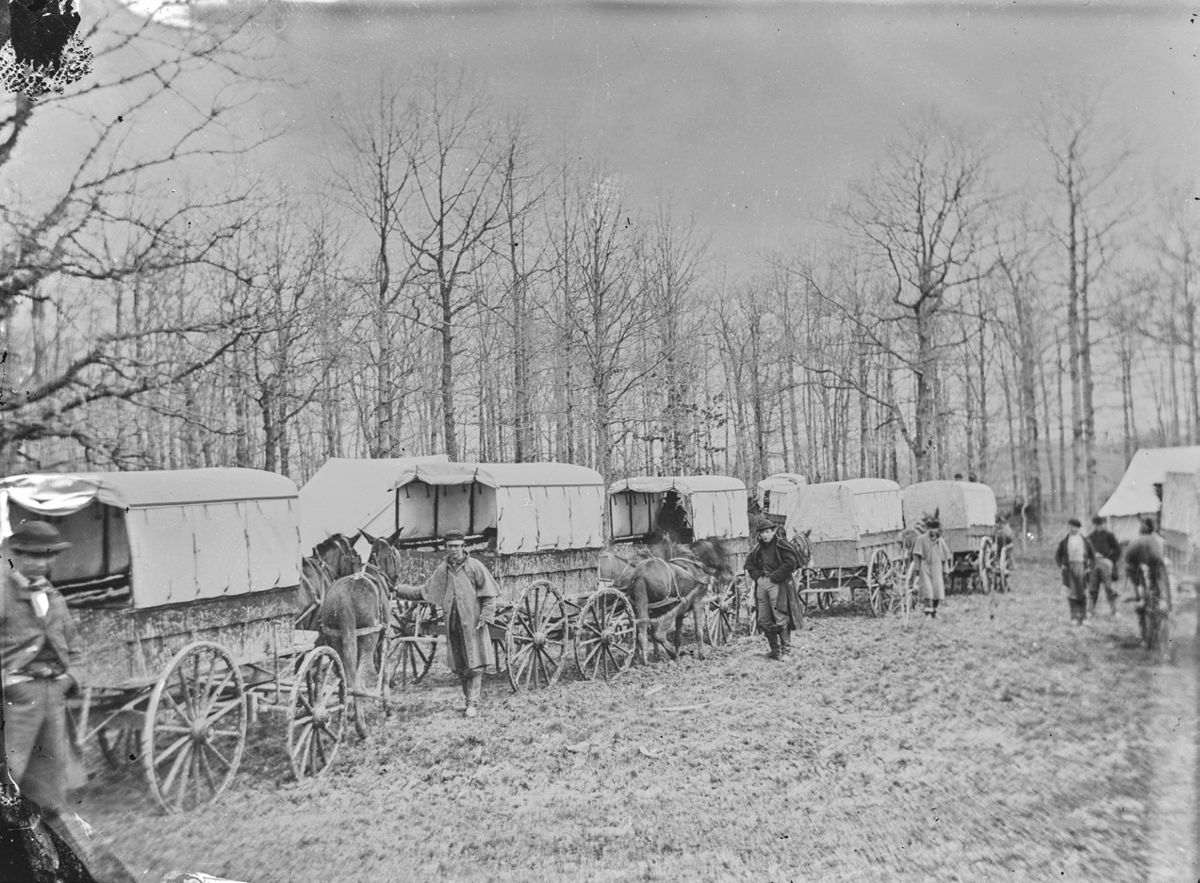
Wagon ambulance train. Washington, District of Columbia. Ambulance train at Harewood Hospital. Miller. (v.7, p. 313 Ambulance train at City Point, Va.) (Library of Congress) movements, immediate measures were taken to reduce the expenses of the Medical Department. Of the 201 general hospitals open on January 1, 1865, 171 have been discontinued.” This summary, written in the summer of 1865, indicated that 85% of the general hospitals closed down. The closures occurred, because the hospitals were no longer needed. The diminished need resulted from better medical care, and the highly developed transport systems. The movement of sick and wounded soldiers to base hospitals allowed immediate care to be given to their wounds, resulting in greater chances for recovery. “Three of the sea-going hospital transports have been discharged; the fourth is now constantly engaged in transfer of sick and wounded from Southern ports to the general hospitals in New York Harbor. All of the river hospital boats have been turned over to the Quartermaster’s Department, and but a single hospital train is retained in the Southwest.” “The returns of sick and wounded show that of white troops 1,057,423 cases were treated in general hospitals alone from 1861 to July 1, 1865, of which the rate of mortality was 8 percent. In nearly all sections of the country the health of the troops has been fully equal to that of preceding years, though military movements of unprecedented magnitude have been pushed to successful termination without regard to seasons.” The references above, from the Official Records, show the government, Union medical staff and the Northern public all felt the hospital transport system worked. By the end of the war, it worked both efficiently and effectively. Efficiently, because it performed its intended functions. Effectively, because they were performed consistently in ways that met or exceeded prescribed standards. In December 1862, four months after writing his letter, Private Ackerman died of complications from his wounds. Although we cannot be sure, he might have survived had the hospital transport system been in place at that time. Medical care and the evacuation of soldiers from the battlefield is one of the biggest reasons the Civil War was a watershed event in American History. Soldiers, medical staffs and the governments of the North and the South made many improvements still used in battlefield medicine today. The long footmarches, inclement weather and governmental bureaucracy wreaked havoc on the medical care system. Poor road networks and an uneven distribution of resources also compounded the problem. These obstacles simply made transporting wounded soldiers on foot or by comrades, wagons or animals unfeasible over long distances. Each transport method played an important role in moving wounded to locations where more efficient transport was available. Boats became “floating hospitals.” Boxcars and flatcars were converted and used to transport wounded soldiers. Logistical traffic was carefully monitored to push logistical material forward to the front of the battlefield. Simultaneous with the delivery of supplies, hospitals and transportation assets were coordinated to use these same routes and equipment to move wounded soldiers back from battle areas to zones where hospitals were located. The USSC’s Hospital Transport Project stressed speed, volume transport, and quality care. These tenets are still paramount to successful medical care on modern battlefields. Unfortunately, Doctors Olmstead and Harris cannot see how their pioneering efforts influenced today’s battlefield medicine. Along with these doctors were countless women and medical staffs who provided the best quality medical care possible against overwhelming odds that would daunt medical staffs of today. Endnotes: 1. James I. Robertson, Jr., Tenting Tonight: The Soldier’s Life. Publication of Time-Life Books, Inc., Chief Researcher Philip Brandt George, (Alexandria: TimeLife Books, 1984), 101. 2. New York Public Library, United States Sanitary Commission: Hospital Transports. Original manuscript is in Box 641 of the United States Sanitary Commission. On-line internet document at www. netwalk.com/~jpr/hospitaltrans.htm, 1. 3. Ibid. 4. Ibid., 2. 5. Ibid., 2. 6. Ibid., 3. 7. Ibid. 8. The War of the Rebellion: A Compilation of the Official Records of the Union and Confederate Armies, Volume XI, Chapter XXIII, (Washington, D.C.: Government Printing Office, 1880-1901), 196. 9. Mary Elizabeth Massey, Women in the Civil War. (Lin-
Greg Ton coln: University of Nebraska Press and Bison Books, 1994), 50. 10. Robertson, Jr. “Tenting Tonight,” 105. 11. George Edgar Turner, Victory Rode the Rails: The Strategic Place of the Railroads in the Civil War. (Lincoln: University of Nebraska Press, 1992), 299. 12. Ibid. 13. Ibid., 297. 14. Donald Dale Jackson, Twenty Million Yankees: The Northern Homefront, Publication of Time-Life Books, Inc., Chief Researcher Philip Brandt George, (Alexandria: Time-Life Books, 1985), 184.
•
•
•
•
Selected Bibliography
•
Primary Sources: • The United States Sanitary Commission. Papers and original manuscripts at the New York Public Library. On-line internet document located at www.netwalk.com/~jpr/hospitaltrans.htm. • The War of the Rebellion: A Compilation of the Official Records of the Union and Confederate Armies, Washington, D.C., 1880-1901. • Secondary Sources: • Jackson, Donald Dale and
•
•
•
editors of Time-Life Books. Twenty Million Yankee: The Northern Home Front. Alexandria: Time-Life Books, Inc., 1985. Massey, Mary Elizabeth. Women in the Civil War. Lincoln: University of Nebraska Press and Bison Books, 1994. Nevin, David and editors of Time-Life Books. The Road to Shiloh: Early Battles in the West. Alexandria: Time-Life Books, Inc., 1983. Oates, Stephen B. A Woman of Valor: Clara Barton and the Civil War. New York: The Free Press, 1994. Robertson, James I. and editors of Time-Life Books. Tenting Tonight: The Soldier’s Life. Alexandria: Time-Life Books, Inc., 1984. Schroeder-Lein, Glenna R. Confederate Hospitals on the Move: Samuel H. Stout and the Army of Tennessee. Columbia: University of South Carolina Press, 1994. Straubing, Harold Elk. In Hospital and Camp: The Civil War Through the Eyes of its Doctors and Nurses. Harrisburg: Stackpole Books, 1993. Turner, George E. Victory Rode the Rails: The Strategic Place of the Railroads in the Civil War. Lincoln: University of Nebraska Press, 1992.