
Through The Lens
118 Days
By Stephanie Hagiwara · Originally published February 2017 · p. 5
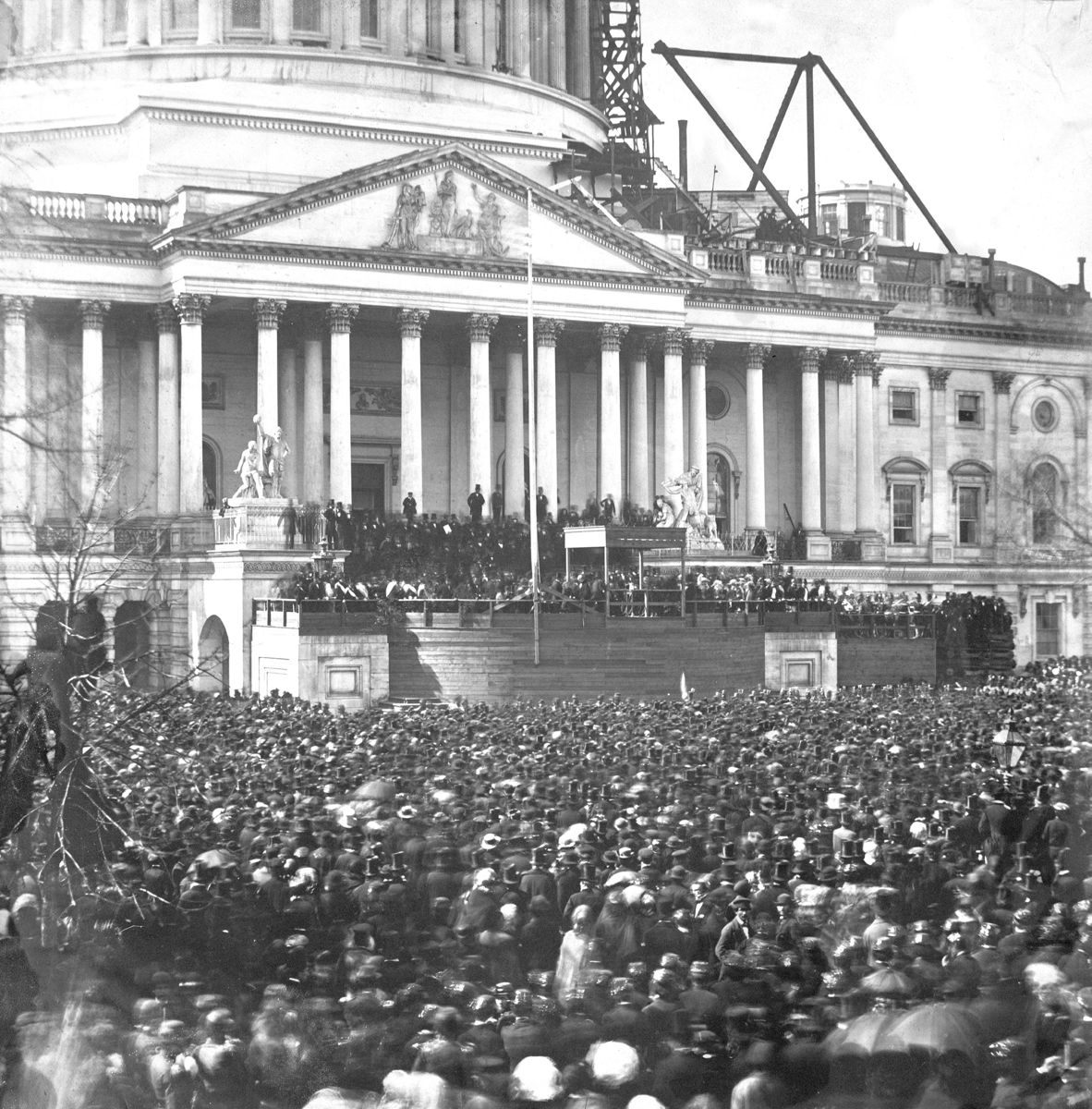
“If I live till the 4th of March I will ride to the Capitol with Old Abe whether I am assassinated or not.” President James Buchanan In November 1860, Abraham Lincoln was elected President of the United States. As promised, in Dec., South Carolina seceded from the Union. Six days later, U.S. Major Robert Anderson moved his troops from Fort Moultrie, S.C., to the more defendable Fort Sumter. In response, South Carolina seized the custom house, the arsenal and other forts. Soon after six more states seceded, seizing federal assets. It was becoming debatable during the 118 days between Lincoln’s election and inauguration if there would still be a country to govern. One Washington insider talking to another said that if Maryland and Virginia leave the Union they would be taking Federal assets in the Capitol with them. “The public buildings and the navy-yard here,’’ he said, “belong to Virginia and Maryland just as much as the public buildings and the forts at Charleston belong to South Carolina.” Not wanting to lose a lucrative customer base, New York City Mayor Fernando Wood proposed a solution. On Jan. 6, 1861, he acknowledged to the City Council that, “It would seem that a dissolution of the federal Union is inevitable.” To maintain New York’s trade relationship with “our aggrieved brethren of the Slave States,” he suggested turning the City into an independent, duty-free port. “… Instead of supporting by her contributions in revenue two-thirds of the expenses of the United States, become also equally independent? As a free city, with but a nominal duty on imports, her local government could be supported without taxation upon her people….” When asked about the Wood’s scheme, Lincoln responded, “… as to the free city business - well, I reckon it will be some time before the front door sets up housekeeping on its own account.” Abolitionist Senator Charles Sumner was willing to let the South leave if it came to War or “a corrupt conspiracy to preserve the Union. …As for the slaveholding States, let them take their curse with them if they were judicially blinded so to do.”
Horace Greeley, New York Tribune founder and editor, found the idea of a separate Northern Confederacy appealing. Not only did Greeley support freeing the slaves, he considered it possible that he could be elected President. Lord Lyons, the British ambassador, began inquiring how Lincoln would “dispose of the actual occupation, unlawfully, or by force, of United States premises in these seceded States.’’ He also warned “that, while England could not possibly have anything to gain by a real rupture of the Union, the case was clearly different with France, under her present policy and engagements on this side of the water”. South Carolina may have been the first state to secede but her governor, Francis Pickens, had just served as the Minister to Russia. When asked if Pickens, “is really in sympathy with the secession movement. He [James Orr] smiled, and asked me if I knew Mrs. Pickens. ‘Mrs. Pickens, you may be sure,’ he said, ‘would not be well pleased to represent a petty republic abroad. But I suppose you know,’ he went on, ‘that Pickens is the man who was born insensible to fear. I don’t think he is likely to oppose any reasonable settlement, but he will never originate one.’” Politicians from both North and South did act to hold the country together. Future Confederate Vice President Alexander Stephens addressed the Georgia Secession Convention in January 1861, stating that the “election of no man, constitutionally chosen to that high office, is sufficient cause to justify any State to separate from the Union.” He urged his listeners to, “Let the fanatics of the North break the Constitution, if such is their fell purpose. Let the responsibility be upon them. I shall speak presently more of their acts; but let not the South, let us not be the ones to commit the aggression.” As part of one president at a time, former presidents never even visited Washington after leaving office. Getting involved in national affairs was simply not done. But if asked … At a New York dinner party, the topic of what kind of man was Lincoln came up. In response, former President Martin Van Buren related the tale of another dinner party in Rochester, Ill., on June 16, 1842, during a campaign tour. He had swapped stories of Alexander Hamilton and Aaron Burr with a lawyer from the opposing party—Lincoln. Lincoln had “a constant supply” of entertaining stories, “each more irresistible than its predecessor.” Van Buren was “so forcibly struck by the intelligence and high toned sentiments of the man, his rare and pleasing conversational powers, that he often wondered, when he afterwards mentally reviewed his western tour, what had become of this man whom he remembered as one of the most remarkable he ever met.” Former President John Tyler not only welcomed the opportunity to “see the vast improvements that have been made since the close of his administration” in Washington, but he and his second wife, Julia, enjoyed being back on the national stage. In January, he traveled to the White House to confer with Buchanan. He returned to serve in the Peace Conference. Tyler called it, “a miserable, rickety affair” that did nothing for the South. Furthermore, “that every hour’s delay was perilous, and that nothing remained but to act promptly and boldly in the exercise of state sovereignty.” Tyler went from working to keep the Union together, to working to break it apart during the Va. secession convention. The Lincoln - Douglas Debates had thrust Lincoln onto the National Stage. Stephen Douglas may have won the Ill. Senate race but he realized that he was losing the Presidential race to Lincoln. To hold the Union together, Douglas campaigned in the South, encouraging acceptance of the election results. Determined that Lincoln would survive his inauguration, Gen. Winfield Scott arranged for every armed soldier available to line the streets and stand on every corner. For their protection, Lincoln and Buchanan would walk through a temporary tunnel to the capitol building. Despite the possible threat, Douglas was resolved to visibly show his support for Lincoln and the Union. At the time, it was the custom for the President-elect to deliver his speech before being sworn in. With difficulty, he weaved his way through the crowd to stand “directly beside Mr. Lincoln, when he prepared to read the address. A miserable little rickety table had been provided for the President, on which he could hardly find room for his hat, and Senator Douglas, reaching forward, took it with a smile and held it during the delivery of the address. It was a trifling act, but a symbolical one, and not to be forgotten.”
Stephanie Hagiwara provides the trivia and photo info for the 2017 Civil War in Color War calendar. She also writes a weekly column for History in Full Color. com that covers stories of photographs of historical interest from the 1850’s to the present. Her articles can be found on Facebook, Tumblr and Pinterest. Sources: • The Presidents’ War: Six American Presidents and the Civil War That Divided Them by Chris DeRose • The Diary Of A Public Man: An Intimate View Of The National Administration, December 28, 1860 to March 15, 1861 • Political History of New York State During the Period of the Civil War by Sidney David Brummer, pp. 123-124. • The Confederate Records of the State of Georgia, pp. 183-205