
Unholy War: For God and Country!
By Joseph F. Wilson · Originally published December 2017 · p. 22
Soldiers going into battle carried a musket, a bayonet, and 60 rounds of lead balls designed for maximum damage. For one company of men from central Pennsylvania, a powerful shield was packed alongside their government compliment of weapons. An ever present pocket sized bible bolstered their veil of defense and odds of survival. To march into battle without their bible meant facing the enemy stripped of their armor. The good book was standard issue in Co. C of the 125th Penn. Regt. Known as the “Bible Company,” the 130 soldiers of Co. C signed up for nine months in 1862 after Lincoln’s call for 300,000 more volunteers. Along with Theodore Flood, a divinity student, Capt. William Wallace recruited a unique company of men in the name of the Lord Almighty. Most boys hailed from Huntington County, Penn. Wallace was a saintly Scottish Presbyterian whose strong faith carried over in guiding his raw recruits in the ungodly art of warfare. The gospel, according to the adamant captain, demanded a prayer meeting follow every morning roll call. After only a short six weeks under arms with little training, the citizen soldiers of Co. C marched toward Antietam Creek flowing beside the hamlet of Sharpsburg, Md. An unholy bloodbath awaited them. Looming ahead was a not so spiritual encounter with a determined horde of veteran soldiers belonging to Robert E. Lee’s Army of Northern Virginia. If indeed a heavenly cloak of protection shielded the boys of the Bible Company, it would be needed on the terrifying morning of Sept. 17 when mayhem followed their morning devotions. At least for a day, “Thou Shalt Not Kill” fell by the wayside. At the Battle of Antietam, the green enlistees descended into the vortex of hell for a baptism of another kind. To be thrust into the bloodiest single day of the war as an introduction to combat was certainly not sanctioned from above, but seemed more a downright punishment. Any blessings crowning the group went AWOL for a day. Making matters worse for the “Bible Boys,” Co. C was assigned to carry the regimental flag into battle. Considered an honor by many, the lone soldier holding the colors aloft also drew the heaviest fire from the enemy. On Sept. 17, 1862, the 125th pushed beyond the Hagerstown Pike and into the West Woods well beyond any supporting troops. Wallace led his company into their first battle with his own unique battle cry. Holding his sword high he marched his young bible toting charges at the double quick into a storm of shot and shell while screaming, “In God We Trust,” for all to hear. After imploring the company to echo his shouts, his 130 spirited disciples shouted the peculiar cry while silently placing their fate in a higher power. Hoping their cries for divine intervention would rise above the din of battle; they gripped their loaded muskets and followed Wallace straight into the chaos swirling in the West Wood and around the Dunker Church. In the ensuing fight, four Confederate charges failed to dislodge the boys in blue. Bravely standing his ground, the color bearer of Co. C, Sgt. George Simpson, took a lead ball to the brain and fell dead with his blood oozing onto the flag. Under intense rebel musket fire, a rush of men dashed for the sullied flag. Several fell wounded attempting to save the flag before Sergeant W.W. Greenland snatched up the banner and passed the rescued flag to Capt. William Wallace. The defiant Wallace waved the bloodstained flag high in the air while rallying his men to continue firing on the enemy. A fifth desperate charge of determined rebels pushed the outnumbered regiment to the breaking point. An unrelenting tide of Confederate reinforcements swarming the woods convinced the regimental commander, Union Colonel Jacob Higgins, the fight was in vain. Fearing the loss of his total command, Higgins ordered the regiment back to the safety of a Rhode Island battery 200 yards away. The race was on as the boys of Co. C, along with the rest of the 125th Penn. Regt., fled the West Woods with shrieking rebels in hot pursuit. Once behind the menacing line of artillery, the reformed regiment watched the advancing Confederates abruptly reverse course as deadly Union cannon spewed hot iron into their ranks. Faith in God is a powerful ally. A righteous cannon barking fire is another. The Sons of Pennsylvania fought valiantly in their advanced position until overwhelmed by the crushing Confederate counterattack. In 20 minutes, the 125th Penn. lost 54 killed and 91 wounded in the West Woods. Col. Jacob Higgins later remarked, “On looking around and finding no support in sight, I was compelled to retire. Had I remained in my position two minutes longer, I would have lost my whole command.” Many regiments suffered terribly in the morning bloodbath around the Dunker Church, the West Woods, and Miller’s cornfield.
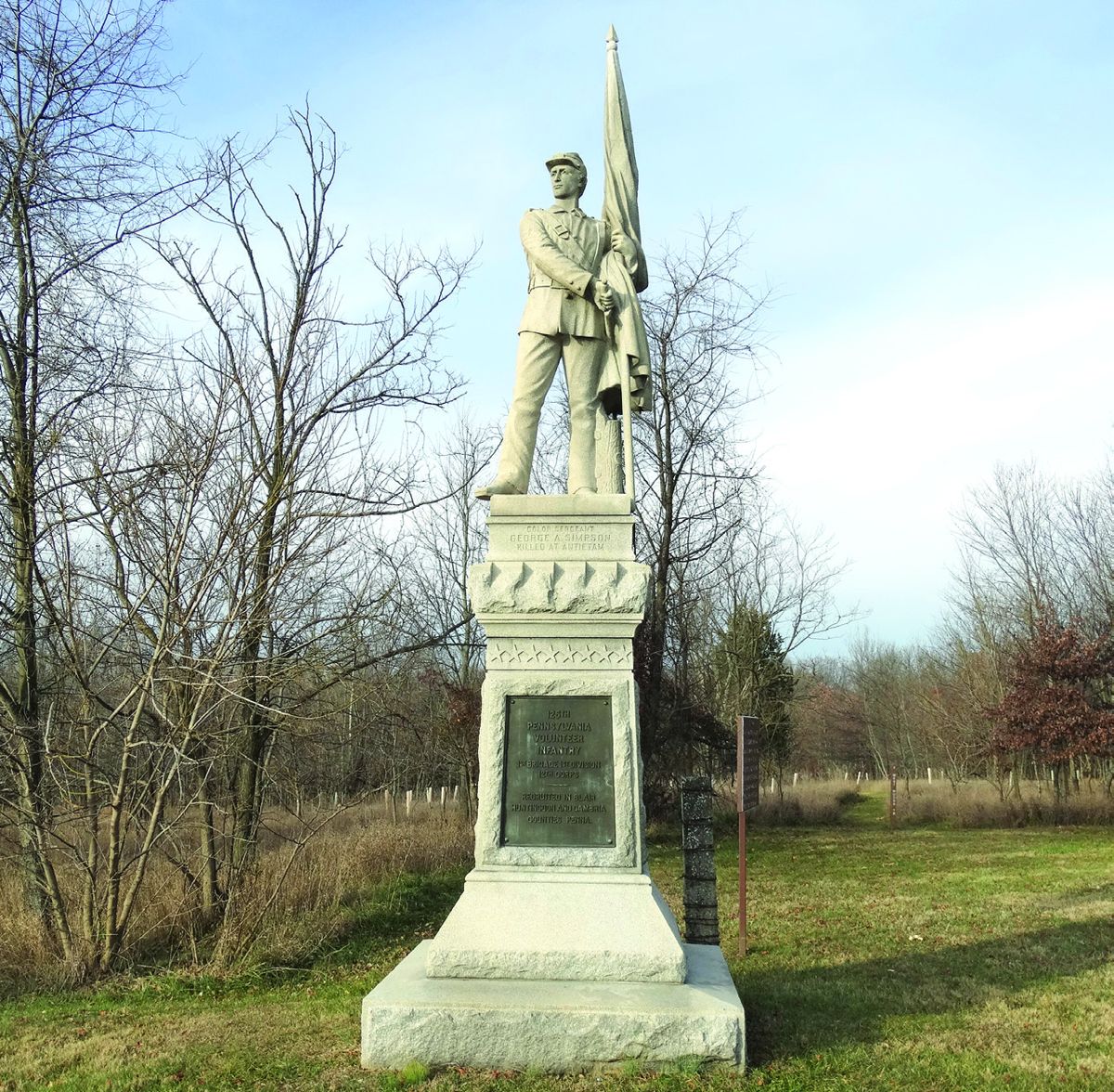
The nine-month citizen soldiers of the 125th Penn. fought their only other battle in May of 1863 at Chancellorsville. Not being swept up in Stonewall Jackson’s flank attack, their casualties were few. In the two battles that Captain Wallace and his pious soldiers of Co. C participated, they lost 14 men killed in battle and 13 wounded from a total of 130 soldiers. Almost all these casualties came on Sept. 17 at Antietam. When compared to other companies caught in the slaughter in the West Woods, the group was fortunate. Over 100 of Wallace’s faithful boys escaped the debacle totally unscathed. A celestial shroud of protection seemed to envelop the believers. Maybe the good Lord was watching over them after all. Behind the Dunker Church on the present day battlefield, an impressive monument marks the spot where the 125th Pennsylvania stubbornly held their ground. All members of the regiment agreed that Sgt. George Simpson of Co. C be immortalized forever atop the monument for his actions at Antietam. In a tribute to their courageous color bearer, the likeness of Sergeant Simpson crowns the monument still faithfully clutching his flag. The granite Simpson stands firm and unyielding just as he did in 1862. Miss Annie Simpson, George’s sister, unveiled the monument in 1904 to the 60 surviving members of the regiment. The regimental flag, still stained with the blood of the brave Sergeant, was unpacked for the ceremony. George is buried in Antietam National Cemetery in the Pennsylvania section along with 53 other comrades of the 125th Pennsylvania Regiment who also fought and died at Antietam. They rest in peace beside the 2,100 other Union defenders who gave their all in turning back Robert E. Lee’s threatened invasion of the North. Company C mustered out in May 1863, along with the rest of the regiment after serving their nine month enlistment. A majority joined other units to keep on fighting. One year after the bible troop disbanded, Captain Wallace’s famed battle cry, “In God We Trust,” graced the face of American coins. Many historians believe the Huntington Bible Company’s slogan inspired the iconic saying that still appears on American currency. Almost a hundred years after the Civil War, the 84th Congress passed a resolution making “In God We Trust” the official motto of the United States of America. President Dwight D. Eisenhower signed the piece into law on July 30, 1956.
Captain William Wallace and his collection of devout holy warriors would be proud. Joseph F. Wilson is the writer and producer of the new documentary films, “Civil War Prisons – An American Tragedy,” and “Remarkable Tales of the Civil War.” He also lectures on the Civil War and offers authentic Civil War artifact displays. Contact: [email protected] or 856 627-5401