
Stonewall Jackson’s Headquarters Evokes Winchester’s Civil War Heritage
By Bob Ruegsegger · Originally published December 2017 · pp. 4–5
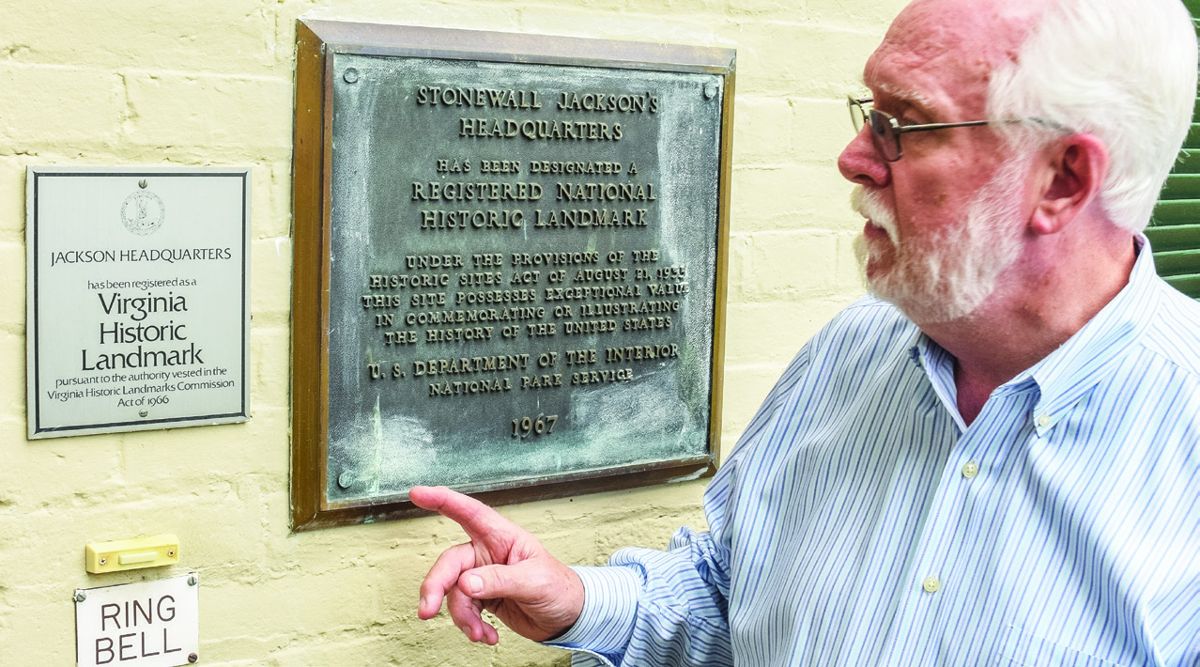
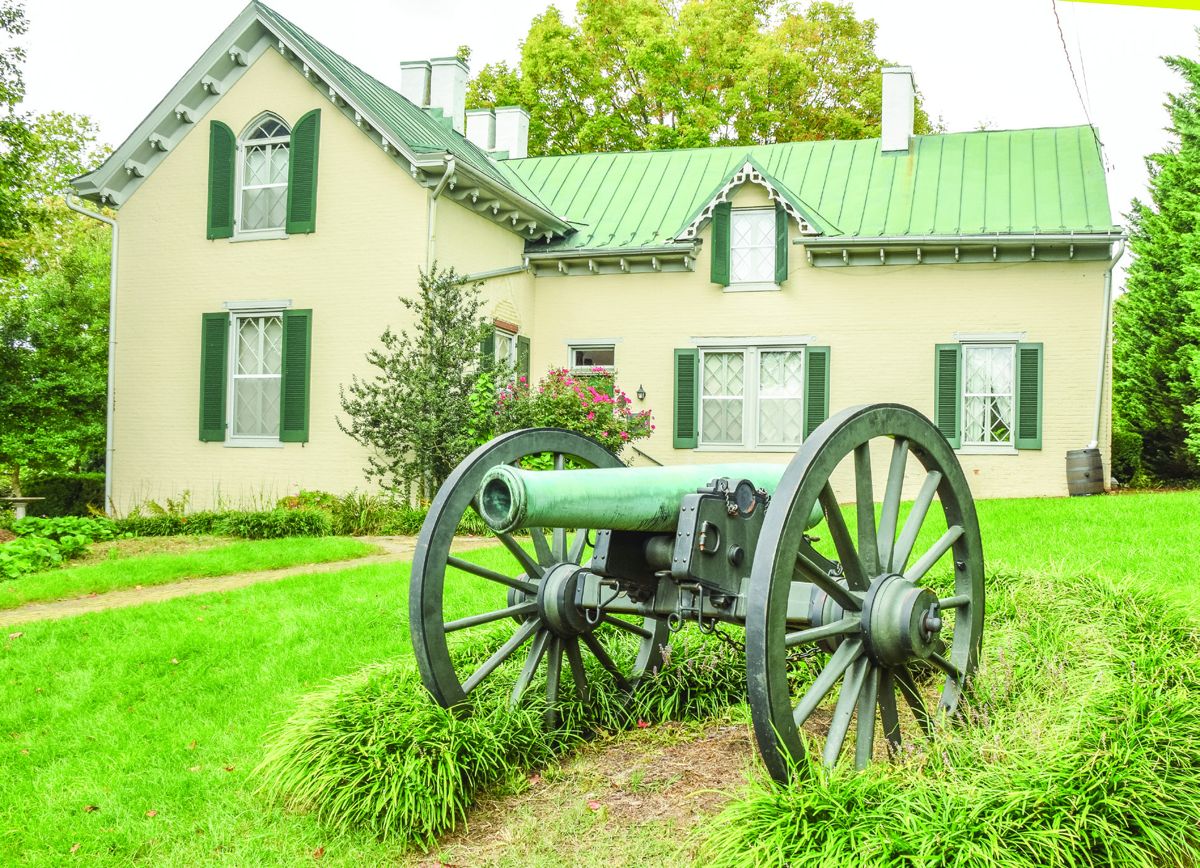
From the Shenandoah Valley Civil War Museum to the Stonewall Confederate Cemetery, Winchester, Va., warmly embraces its Civil War legacy. Local folks tell visitors, with modest pride, that Winchester changed hands 72 times during the Civil War. Nothing in Winchester, with the exception of the Museum of the Shenandoah Valley, attracts more visitors to the area than Stonewall Jackson’s Headquarters Museum on Braddock Street. The museum averages 15,000 visitors annually. Last year, Jackson’s Headquarters received visitors from all 50 states and 32 foreign countries. There were 48 visitors from England alone. When the residence served as Jackson’s headquarters, Colonel Lewis Tilghman Moore, who commanded the Stonewall Brigade’s 4th Virginia Volunteer Infantry, owned the property. He loaned his home to Major General Jackson during his stay in Winchester. As commander of the Valley District, Gen. Jackson initially found quarters in the Taylor Hotel until Col. Moore offered Jackson his home “Alta Vista,” a Hudson River Gothic Revival cottage. Jackson and Moore had an acquaintanceship that dated back to abolitionist John Brown’s 1859 execution in Charlestown.
We carry a very large inventory of Colt and Civil War firearms including muskets, carbines, rifles and accoutrements. Our inventory of historic antiques and firearms begin at the early collectors level and range all the way up to the advanced collector and investors level.
Historic Antiques
Moore’s cottage, actually a two-story, eight-room house, was four blocks from downtown Winchester on a densely wooded lot on the town’s outskirts. General “Stonewall” Jackson, who had been a bit of a celebrity since Manassas, found a sense of security at the private residence. Jackson was in Winchester from November 1861 until midMarch 1862. “Jackson was here because it was advantageous. It was densely wooded. It was outside the town,” said Brian Daly, a docent and amateur historian at Jackson’s Headquarters Museum. “He was not going to be, as he would say, ‘bothered’ by the people in town.” General Jackson had become the most famous and easily recognizable person in the Confederacy. The original owner built the house at this elevation because he wanted to enjoy a line of sight into downtown Winchester from the second-floor balcony. Enough trees had been removed from the property so the owner was able to see into the town. “We strive to give people a firsthand account of Jackson’s time here,” said Daly. “It was valuable personal time. He spent three to four months in Winchester with his wife in company,” noted Daly. “They will conceive a child here. Jackson will begin planning some of the Valley Campaign.”
Vin Caponi
It was in Winchester, that Jackson as commander of the Valley District resigned his commission in the Confederate service, and where he held his first and last council of war with his staff officers. Here Jackson was a celebrity. He had received a share of the credit for the Confederate victory at Bull Run [Manassas]. “Jackson would freely admit that he has gotten much more credit than he deserved,” said Daly. “Nonetheless, he eventually rode out that journey of fame and fortune.” The antique furnishings in Stonewall Jackson’s
Joanne Roulette Happ stands before a portrait of Gen. Stonewall Jackson in the parlor that served as Jackson’s office from November 1861 until March 1862. The gilded wallpaper was a gift to the museum from actress Mary Tyler Moore. It was replicated from fragments of the original wallpaper.
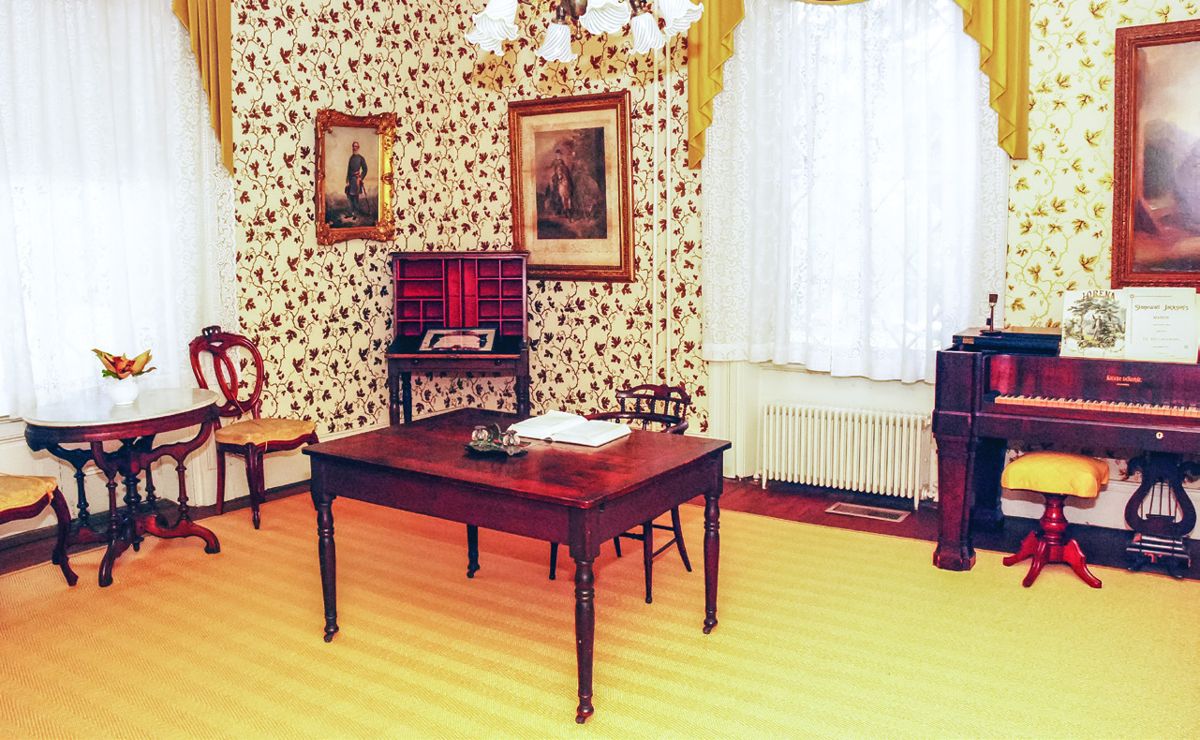
(Photos by Bob Ruegsegger) Headquarters today reflect those that existed in Colonel Moore’s home while it served as the general’s headquarters. “All the furnishings in the house are authentic to the time,” said Daly. “None of the furniture that you see here is a reproduction.” The eightfoot-long Victorian dining room suite, a double dropleaf table and four chairs, is the original table that was here when Jackson was in residence. Stonewall Jackson, his wife, and staff members dined at the table. The dinner service exhibited on the table top belonged to Col. Moore as did the coffee service in the room. It was used during Jackson’s time in the house. Jackson’s prayer book and prayer table, from his Lexington home, and the campaign chair he used in the field are among the artifacts in the museum’s galleries. “We have the original desk that Jackson used in the field and during his travels,” said Daly.
“More importantly, we have the desk that was purchased for him by his staff. It’s the centerpiece of the general’s office.” General Jackson’s office in the first-floor parlor is among the highlights of the house. The desk given to Jackson by his staff is positioned in the center of the room on a reed mat. His campaign chair rests against the wall. Elegant gilded wallpaper decorates the parlor walls and reflects light entering the room from the windows. The room is much as it was when it served as Jackson’s office. Iconic portraits of Stonewall Jackson throughout the parlor offer visitors a visual review of Jackson as he is generally remembered and imagined throughout the War Between the States. Colonel Lewis T. Moore raised six children in the “cottage” that served as Jackson’s headquarters. Actress Mary Tyler Moore was his great granddaughter. She toured the house with her father, husband, and family members soon after she lost her mother in 1992.“It was a big to do when she was here. When she was leaving, she asked if there was anything that she could do,” said Brian Daly. “The staff that day asked her if she could have our wallpaper reproduced,” he said. “This is gold reflective wallpaper. It has stood the test of time. It still reflects light.” The actress paid to have the wallpaper designed, reproduced, and installed in 1993. Every year since then, Jackson’s Headquarters has received a stipend to maintain Mary Tyler Moore’s gift. Jackson had developed affection for Winchester. He regarded the town as more “cosmopolitan” than Lexington where he had lived during the years before the Civil War. “Mrs. Jackson wrote that this [their time in Winchester] was the most romantic time their entire married life,” said Daly. “She looked back on it quite fondly. She visited Winchester often in the years after Jackson’s death.” After the Romney Campaign, Jackson returned to Colonel Moore’s house in Winchester. He resigned from Confederate service because he felt that officials in Richmond had interfered with his command. Jackson was met by Colonel Boteler, a representative of the Governor of Virginia. Boteler’s assignment was to persuade Jackson to withdraw his resignation. In the museum’s gift shop, a limited-edition lithograph— Stonewall’s Return—by Texas artist John Paul Strain depicts Jackson’s return to his headquarters where he is met by Colonel Boteler on Feb. 4, 1862. Strain’s artwork [see johnpaulstrain.com/art-gallery.com] depicts a cold moon-lit night with inches of snow on the ground. Jackson stands beside his unsaddled horse holding Little Sorrel by the bridle. His saddle and prayer book rest in the snow while Jackson’s staff tend to their duties. Colonel Moore’s home
“under a waning moon” provides the backdrop. “We’ve been told his saddle would never have been put down in the snow. Due to Jackson’s position, someone would have held it,” said Joanne Roulette Happ, house manager. “We think that it was John Paul Strain’s way of emphasizing General Jackson’s religion,” she said. “When you turn the light out and have a little bit of extra light coming in the window, it has a 3D effect. It’s absolutely magnificent.” Major General Thomas J. Jackson, fortunately for the Confederacy, reconsidered his resignation. In mid-March, Jackson reluctantly abandoned Winchester to the Yankee invaders, much to the anguish of its frantic civilian population. That same month Jackson began his famous Valley Campaign. Stonewall Jackson’s highly successful campaign in the Shenandoah Valley quickly raised his military prominence. He became the Confederacy’s most widely celebrated general. Stonewall Jackson’s Headquarters Museum offers visitors a tantalizing glimpse of General Jackson before he rode full speed into the valley of immortality. For more information regarding Stonewall Jackson’s Headquarters and upcoming special programs see www.visitwinchesterva.com or call 540-667-5505.