
The Graphic War
“Oh, I’m a Good Old Rebel”
By Salvatore Cilella · Originally published December 2017 · p. 27
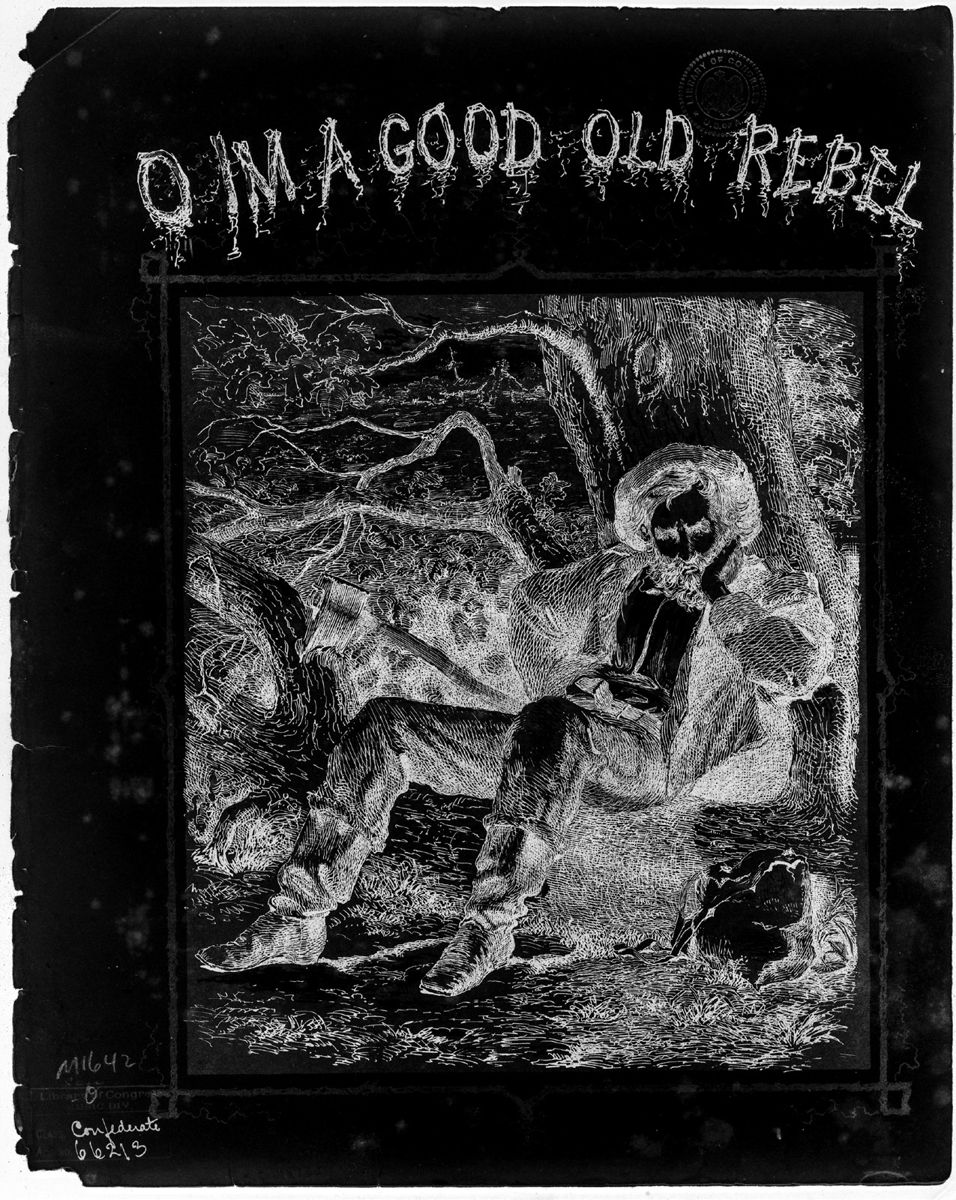
This occasional column will highlight prints from the Civil War. It will discuss their meaning and most importantly, what the print maker or artist was trying to achieve. For many reasons, some obvious, some not, prints in southern homes were uncommon. The rural, agrarian economy was radically removed from the capital and industrial advantages the north experienced. Print selling and marketing was no different than any other commodity; supply and demand ruled. Few southern urban areas such as Richmond, Atlanta, and New Orleans, had the capacity to produce the number and quality of prints put out by such northern companies as Currier and Ives in New York and the Kelloggs in Connecticut. Additionally, most southern households were preoccupied with holding the family together during the war. Artwork for the walls of the house was the last priority.
Home Sweet Home (Old Time American String Band)
Band members are: Elaine Winters – fiddle Daniel Rothwell – banjo Rob Pearcy – guitar and dulcimer connections. He attended Hobart College in Geneva, N.Y., and graduated from the State and National Law School of Poughkeepsie. During the war, Randolph served, first as an Executive Officer in the Provisional Army of Virginia, and then “on topographical duty, loosely associated with [the] staff of” Maj. Gen. R.S. Ewell, May 25–July 2, 1862. “He may have been with the army at Gettysburg” and was definitely at Richmond as an Executive Officer from June 1864 until war’s end.3 Unfortunately, we do not know who did the artwork on the cover of the song sheet or which printer published the forlorn rebel soldier sitting on a log. He appears disconsolate. An axe splits the log to his right and his haversack is on the ground to his left. The song’s sentiment blames the war on the north and specifically rejects reconciliation. His anger at reconstruction and the Freedman’s Bureau is paramount and equated with his loss of freedom. The narrative bolsters the Lost Cause and, in one writer’s opinion, Randolph focused “on what has been lost by being controlled by the Union, instead of what is lost from losing the war and former Southern Glory.”4 In 1961, the Library of Congress held a Centennial Exhibition of Civil War Art encompassing prints, photographs, and of course, song sheet covers. The library called Randolph’s work a “comic song, which expressed in backwoods dialect the justified resentment of many southerners of the reconstruction being forced on them.” Randolph or his publisher deliberately dedicated the song to Pennsylvania’s rabid abolitionist the Honorable Thaddeus Stevens.5 Sometime after the war, as the apocryphal tale goes, the Prince of Wales heard the Duchess of Manchester perform the uncensored rendition of the song and “insisted on a repeat performance of ‘that fine American song with the cuss words in it’.” According to one historian, “no song had the defiant venom and unconquerable bitterness of ‘Good Old Rebel’.”6
In fact most “southern” prints were eventually produced by northern printers after the war, not during it.1 Finding contemporary Southern war prints is almost impossible. Even song sheets were primarily produced in the north. The most famous is “O I’m a Good Old Rebel” written sometime between 1866 and 1868 by Major James Innes Randolph. According to one source, he wrote the piece “during the war at a meeting of the Mosaic Club, Richmond” and published it in the Augusta, Georgia Constitution July 4, 1867.2 Randolph was born in Winchester, Va., and died in Baltimore where he spent most of his post war years as an editorial writer. It was in Richmond where he initially settled as writer for the Examiner. There he wrote poetry and “Old Rebel.” Although a trained lawyer, he preferred writing and especially poetry. Virulently anti-Northern, the song betrayed Randolph’s northern
(Library of Congress) Salvatore Cilella is retired after 43 years in the museum field. His last position was President and CEO of the Atlanta History Center. He is the author of several articles and books. His most recent books are Upton’s Regulars: A History of the 121st New York Volunteers in the Civil War (U. Press Kansas, 2009) and he edited The Correspondence of General Emory Upton, 1856-1881 (University of Tennessee Press, 2017).
Endnotes: 1. Mark Neely, Harold Holzer and Gabor S. Boritt, The Confederate Image: Prints of the Lost Cause. Chapel Hill: University of North Carolina Press, 1987, xiii. Hereafter, Neely, Image. 2. Curtis Carroll Davis, “James Innes Randolph, Jr. (1837-1887),” in Robert Bain, Joseph M. Flora & Louis D. Rubin, Jr. (eds.), Southern Writers: A Biographical
Dictionary, 368-369 (Baton Rouge: Louisiana State University Press, 1979) as cited on website http://myweb.wvnet.edu/~jelkins/lp-2001/randolph.html. Last accessed 10/10/2017. Randolph went on to write poems “Twilight at Hollywood” and “Ode to John Marshall.” Edwin Anderson Alderman & Joel Chandler Harris (eds.), Library of Southern Literature, 349 (New Orleans: Martin & Hoyt Co., 1910) (1907). See also Davis, Curtis Carroll, “Elegant Old Rebel: Innes Randolph of Virginia and Baltimore,” 8 (1) Virginia Cavalcade 42 (Summer 1958). List of Staff Officers of the Confederate States Army, 1861-1865. Washington: GPO, 1891, 135. Robert E. L. Krick, Staff Officers in Gray: A Biographical Register of Staff Officers in the Army of Northern Virginia. Chapel Hill: University of North Carolina Press, 2003, 249. Edwards, Paul J. “Memory of the Civil War in Popular Song,” Thesis, Wesleyan University, Middletown, Ct., 2009. pp.31-33. The American Civil War: A Centennial Exhibition. Washington, Library of Congress, 1961, 67. Irwin Silber and Jerry Silverman, Songs of the Civil War. New York: Bonanza Books, 1960, 350.