
Black Powder, White Smoke
Late War Sharpshooters & A Centennial Saga
By Joe Bilby · Originally published December 2017 · p. 6
Sharpshooters in Name After a conversation with some friends about Spencer rifles and/ or carbines issued to infantry “sharpshooters” in the last year of the Civil War, I recalled that the First New Jersey Brigade had been issued Spencer rifles to arm a sharpshooters detachment in the fall of 1864. I decided to track the issue down by regiment, and since I have the ordnance reports of all the brigade’s units during the campaign of 1864, it was relatively easy. The Jersey Brigade, 1st Brig., 1st Div., of the Army of the Potomac’s VI Army Corps, began the campaign of 1864 composed of the 1st, 2nd, 3rd, 4th, 10th and 15th New Jersey infantry regiments. During the summer the initial three-year enlistments of the first four regiments ran out, and only the 4th reenlisted enough men to maintain its initial organization. The 1st, 2nd, and 3rd regiments’ reenlisted men were formed into additional companies assigned to the 15th N.J. Inf. Adjutant Edmund Halsey of the 15th N.J. noted in his diary that a brigade sharpshooter detachment was established on Aug. 30, 1864, and that the initial issue was sixteen Spencer rifles. The 4th quarter ordnance report for the 2nd N.J. Inf. lists one Spencer rifle, the 3rd reports two Spencer rifles, the 4th two Spencers, the 10th three, and the 15th two, for a brigade total of ten remaining in service at the end of the year. There is no direct provenance, but I believe the Jerseymen’s Spencer rifles were the ones turned in by the 5th and 6th Michigan Cavalry regiments in exchange for Spencer carbines. Were these sharpshooters trained in range estimation and sight adjustments? My guess is, most likely, not. The adjutant probably asked some noncommissioned officers “who do you guys think is a good shot,” and they said something like “I think Willie is. He knocked a tin can off a fence post with his old man’s shotgun before the war, and I seen him do it.” Then the adjutant said “OK Sarge, give Willie, a Spencer.”
Civil War Catalog Featuring a large assortment of Civil War and Indian War autographs, accoutrements, memorabilia, medals, insignia, buttons, GAR, documents, photos, & books.
Please visit our fully illustrated online catalog at www.mikebrackin.com Free copy mail catalog
The First Oregon Sets Out Across the Country They called it a “Salute to America.” “It” was a six-month long trip to Gettysburg, although some accounts had the ultimate destination as Washington D.C.,
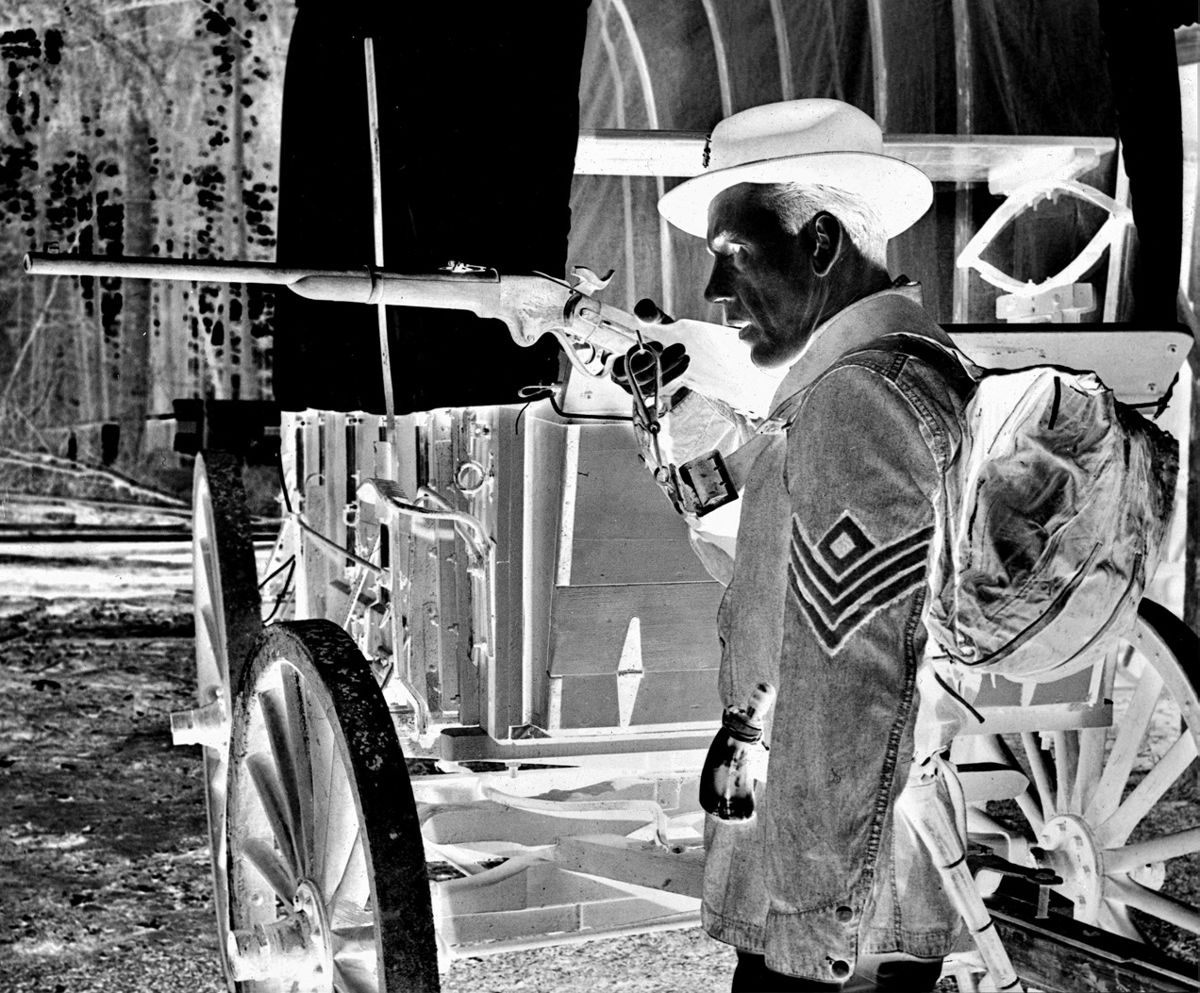
U.S. Model 1860 Spencer rifle. The Spencer rifle was one of the arms issued to the sharpshooters. (Jack Melton) this photo. Astute reenactors and living history presenters will no doubt see more interesting things in the image. Johnson also claimed, inaccurately, that “Civil War artillerymen carried carbines dangling from sling, enabling them to raise a gun and fire it quickly with one hand or two.” Field artillerymen were actually issued a small number of revolvers per battery, for non-commissioned officers and drivers who would use them chiefly to dispatch wounded horses. Despite that, Johnson is pictured with a very nice original Spencer carbine. He also has a powder horn stuck in his belt, no doubt to prime the artillery, a practice long abandoned by the time of the Civil War, when friction fuses were the ignition system of choice. The Beaver State gunners never arrived in Gettysburg. By mid-July they were back where they started in Banks. Major Marek blamed “too many automobiles and not enough money” for the failure, declaring further that “horses are not for modern highways.” Rudy Marek made the Oregon papers off and on for years
Phone: (814) 765-5918 Email: [email protected] Shop: www.FireArtCorp.com afterward. He was apparently a local polymath, variously described as a police officer, gunsmith, gun and cremation urn engraver, knife maker, Volkswagen collector, old truck restorer, and aquarium owner, as well as the author of North to Alaska: A Studebaker Story, but he gained his initial fame as “Major” Marek, commander of the cross-country jaunt that didn’t quite make it. Joseph G. Bilby received his BA and MA degrees in history from Seton Hall University and served as a lieutenant in the 1st Infantry Division in 1966-1967. He is Assistant Curator of the New Jersey National Guard and Militia Museum, a freelance writer and historical consultant and author or editor of 21 books and over 400 articles on NJ and military history and firearms, and as publications editor for the NJ Civil War 150 Committee edited the award winning New Jersey Goes to War. His latest book, New Jersey: A Military History, was published by Westholme Publishing in 2017. He has received an award for contributions to Monmouth County (NJ) history and an Award of Merit from the NJ Historical Commission for contributions to the state’s military history. He can be contacted by email at [email protected]