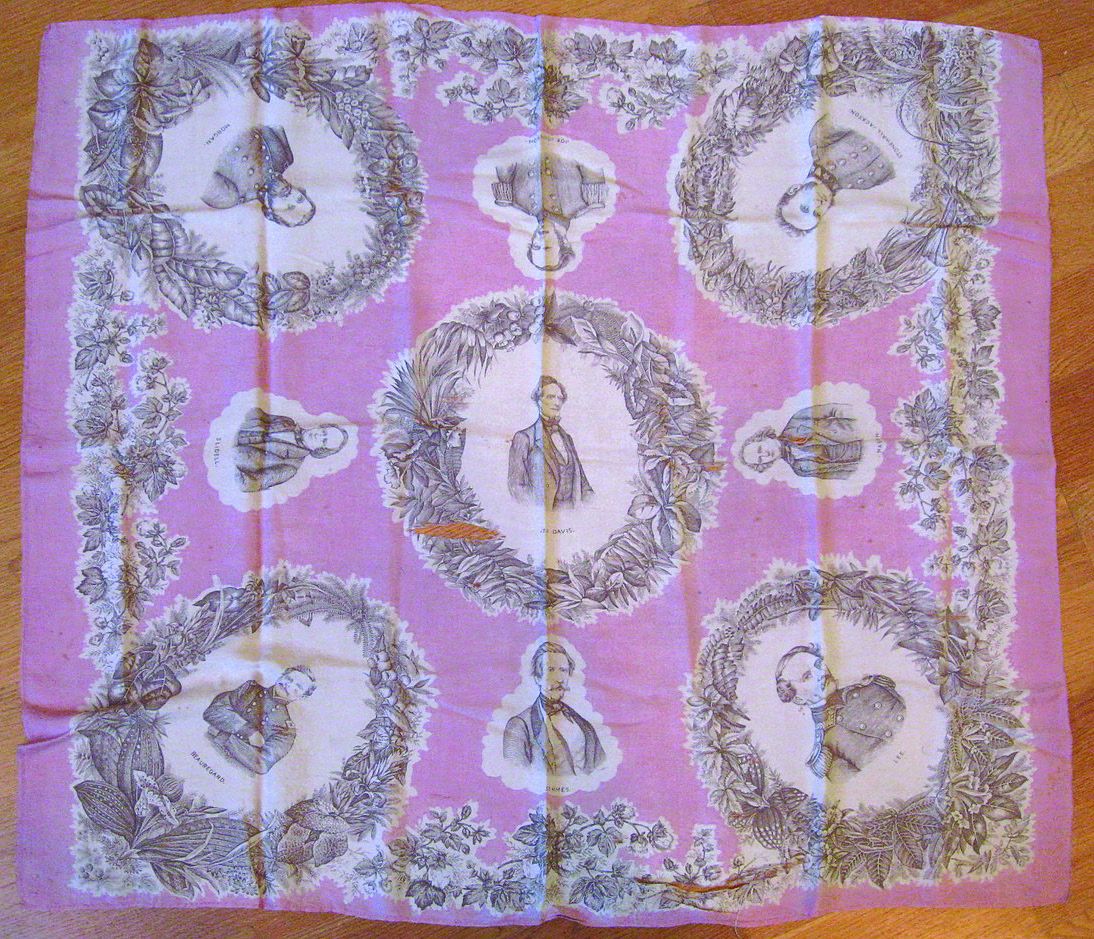
Confederate Scarf
By John Sexton · Originally published December 2017 · p. 21
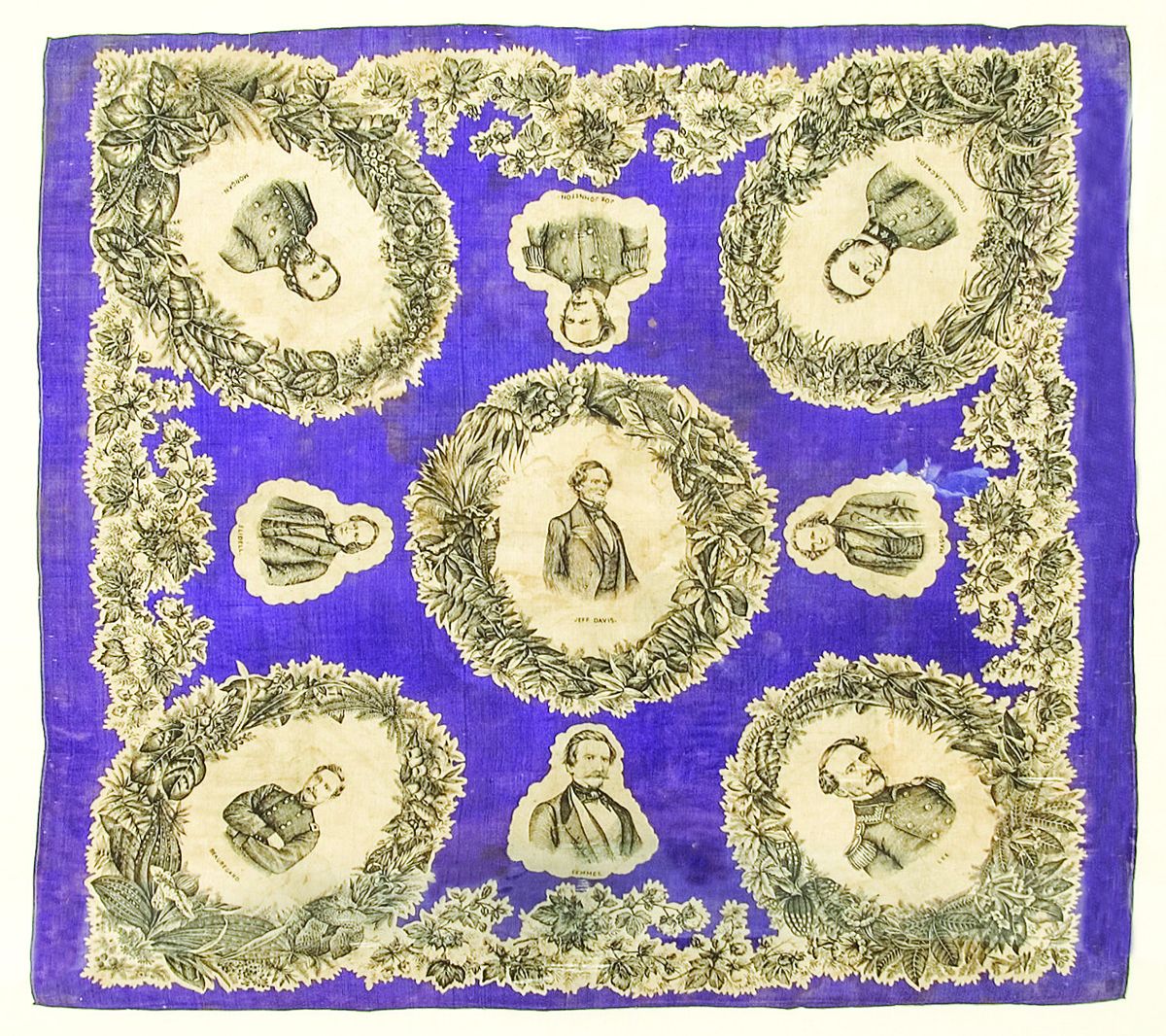
Dear John: My mother-in-law had this Confederate Civil War scarf and when she died, it was sent to me. She was English and none of her children have any idea how it got to England and how she obtained it. I have unable to find anything like it on the internet. I have no idea if it has any value and it has a number of tears. The images are: Jeff Davis, Lee, Semmes, Beauregard, Slidell, Morgan, Joe Johnston, Stonewall Jackson, and Mason. I would appreciate any information you can tell me about the scarf and if it has any value. If it has sufficient value for restoration, can you suggest a fabric restorer? Dean Eayre Dear Dean: American political kerchiefs dating back to 18th Century with patriotic examples of George Washington and other figures are well-known and published in various reference books. The best text on this subject is “Threads of History, Americana Recorded on Cloth – 1775-Present,” written by Herbert Collins and published by the Smithsonian Institution in 1979. Many surviving kerchiefs are unique and few examples are known of others. These items were, in some cases, mass produced but survival of utilitarian souvenir textiles is often quite low. There are examples noted in contemporary literature of the period that no examples have been seen. It seems that every few years a new example comes to light. Collins shows an identical silk example printed on a purple background on page 166 of his text. The Smithsonian has three copies in their collection, one with a blue background, a golden border example is also known. Yours has a pink background, which may be a new color variation or just faded purple. Collins goes into much detail in his description as follows: Medallions stamped in black with wreaths of southern leaves and border of ferns and cotton plants on a white ground. Portrait of Jefferson Davis in the center, from a photo by Brady, engraved by H.B. Hall, and published by E. Anthony, N.Y. Other portraits are of Confederate Generals Semmes, Slidell, Mason, Joe Johnston, Beauregard, Lee, Stonewall Jackson, and Morgan. Portrait of Lee is from an original photo by Bendann Brothers and engraved by an unknown artist.* *There are many misconceptions concerning this particular bandanna. An account in the Richmond Times Dispatch, Nov. 6, 1960, illustrates one such handkerchief as one of twelve made in England and rescued from the Alabama when it was sunk June 19, 1964. A clipping of unknown origin, dated 1894, stated the handkerchiefs were ordered from England by Confederate Secretary of War Judah P. Benjamin. Many of the bandannas have been brought to the author’s attention which would tend to refute this claim. The Smithsonian Institution has three examples in its collections. Another purple example was exhibited at the 2014, 150th Civil War Anniversary, New York Historical Society traveling exhibition, “Homefront and Battlefield: Quilts and Context in the Civil War.” The exhibition was documented in text and extremely well-researched. Though Collins could not attribute this handkerchief in his earlier text, an example in this exhibition had an imprinted mark “registered by W.H. Tucker Kayess, London for 1863, 1864, 1865.” This example is noted as being owned by the Museum of the Confederacy, Richmond, Va. The photograph shown inside the Maryland Confederate Line Soldier’s Home in 1905 shows an identical handkerchief among their mementos. I could not find an auction record of this particular textile, but a leading dealer of American textiles, especially American flags, Jeff R. Bridgman of York County, Penn., does offer a near pristine example, archivally framed for $32,500, currently on his website. After speaking with Mr. Bridgman, he stated that he had only owned one previously and thought that only about four to six were known in private hands. There are numerous rare political textiles offered in auction and the prices range from under $1,000 to well over $100,000. This is a very thin market and the top prices are generally paid for the truly pristine examples, damaged and less aesthetically pleasing examples can bring fractions of prices realized for the best. Unfortunately, your textile does have some damage and probable “light fading” from sun exposure, but is indeed worthy of being conserved. John is an certified appraiser with International Society of Appraisers specializing in Civil War memorabilia. He authenticates and evaluates other rare and valuable historic items as well. His website is www.civilwardealer.com. He is coauthor of the book Confederate Bowie Knives (2012) by Jack Melton, Josh Phillips and John Sexton, that was published by Mowbray Publishing Inc. Send “Ask The Appraiser” questions and photographs to [email protected].