
Through The Lens
Chasing Lee
By Stephanie Hagiwara · Originally published December 2017 · p. 8
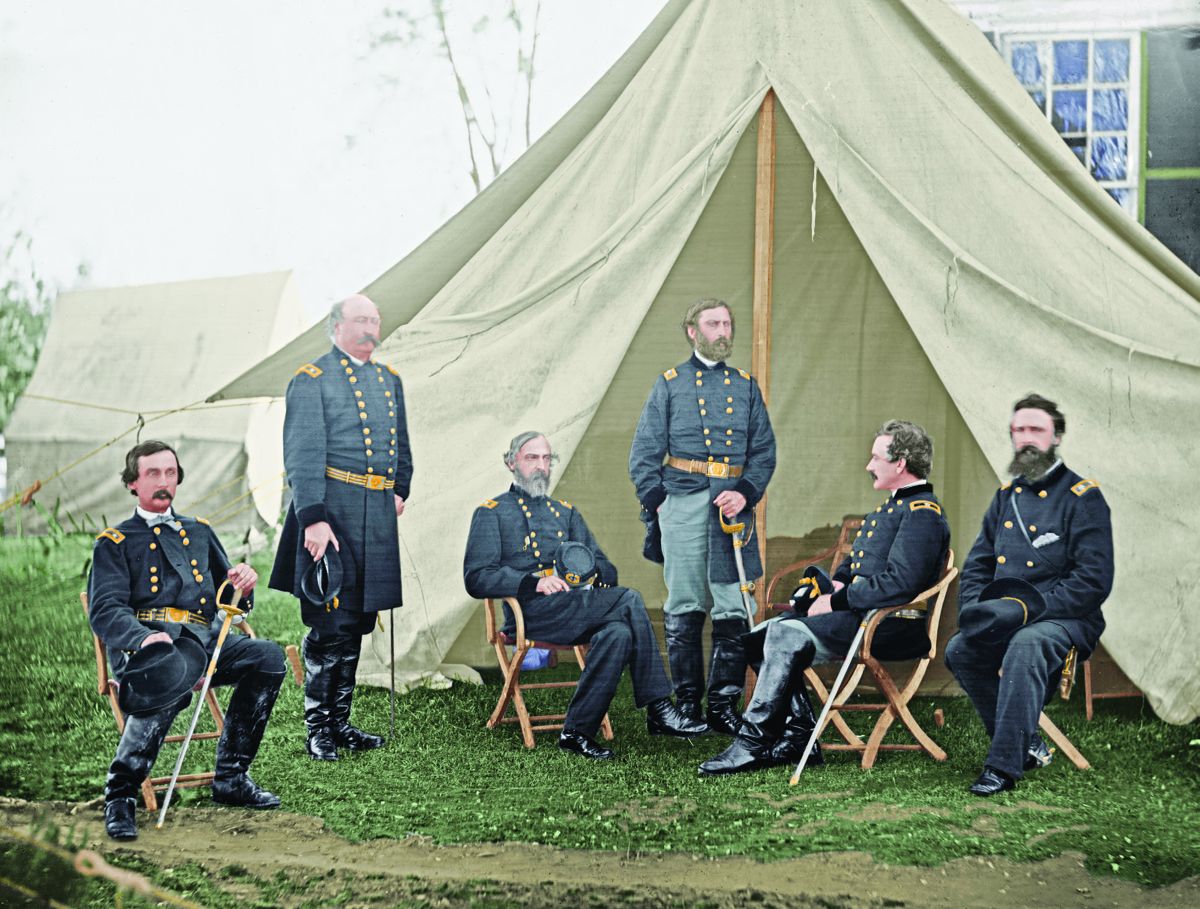
“I would sooner sacrifice my commission than my men” – U.S. Gen. Gouverneur K. Warren On Nov. 25, 1863, on the eve of the first nationally recognized Thanksgiving, U.S. Gen. George Meade ordered that his men be issued 10 days of rations and prepare for battle. Meade had received intelligence that C.S. Gen. Robert E. Lee’s army was almost half of his 81,000. Wanting to squeeze in one more battle before departing for winter quarters, Meade decided to cross the Rapidan River to attack Lee’s flank at Mine Run creek. A similar strategy had resulted in defeats at Second Manassas, Fredericksburg, and Chancellorsville. Meade believed between numbers and surprise, his attack would be victorious. Meade did not factor U.S. Gen. William French into his plan. Promoted above his ability, career solider French was given command of the III Corps after Gen. Daniel Sickles lost his leg at the Battle of Gettysburg. Known as “the old gin barrel,” “a perfect ignoramus and bloat,” and “an imbecile,” French was detested by his men. During a previous battle, “… a bullet passed through French’s hat. ‘It would have added much to our peace of mind,” stated a private, ‘if said bullet had gone two inches lower.’” The weather was also against Meade. Between the rain creating ankle deep mud and crossing the secondary growth of timber the locals referred to as the “Wilderness,” the troops began taking circuitous routes. French, late to depart and heading off in the wrong direction, became a day late. Lee, aware the Federals were on the move, was “anxious to give those people what I think they deserve if Providence will only smile upon us.” Highly regarded C.S. Gen. Edward “Old
Allegany” Johnson became a key factor. West Point graduate Johnson was a first cousin once removed from Thomas Jefferson, its founder. Breveted twice during the Mexican War, it left him partially deaf and gave him an eye twitch. Eccentric, Johnson was known for his profanity, and “when he got mad could work his ears like a mule.” He was “a close quarter commander,” leading his men waving a hickory cane or club and a “firm believer in the bayonet.” At the Battle of McDowell, Va., Federal troops spotting Johnson “being separated a little from his command, some of them hallooed out, ‘There’s old Johnson; let’s flank him!’ Johnson heard them, and, waving his club in the air, exclaimed: ‘Yes, d___n you, flank me if you can.’” His troops swooped in, preventing capture. On Nov. 27, Gen. Gouverneur K. Warren’s troops had made it past a clearing in the Wilderness known as Locust Grove. C.S. Gens. Jubal Early, John Gordon, and Johnson were debating their options when news came to Johnson that an unknown force had fired on the division ambulance train at the junction of two roads. Johnson galloped to the rear; passing his three brigades swung to meet the enemy, his fourth brigade was “briskly engaged” in a confusing forest fight. To the surprise of all, a wall of blue infantry was “drawn up in order of battle.” On the narrow Raccoon Ford Road everyone scrambled to counter French’s men. Skirmish lines were formed and ordered forward. It was “the promptest movement I saw during the war,” claimed a man from the 21st Va. Inf. On the extreme left, Col. Williams, 37th Va. Inf., hoping to fool the enemy “that I was supported by the line of battle,” had his entire regiment act as skirmishers.
Johnson issuing orders, waving his club, realized that the Federal’s firing was alternating intensity. It was decision time - retreat or take the initiative. Johnson aligned his men. As the Federals pushed forward, the Confederates, unknowingly outnumbered three to one, vigorously charged on Johnson’s order. “We gave them all the lead we had and the bayonet,” recalled a 10th Va. Inf. solider. Into the woods, underbrush, and clouds of gun smoke both sides blindly fired. On the embattled Confederate left flank, it felt as if the enemy were “throwing minie-balls upon us by the bucket-full.” Still, the men fought through dense thickets, ravines, and a swampy area, leaving one or both shoes stuck in the mud, emerging into Madison Payne’s open farm fields. U.S. Gen. William Morris’s almost entirely green troops, a.k.a. “Gen. French’s Pets,” were ordered to charge and disperse the enemy. “It was truly a baptism of fire, while it was a deluge of lead and iron, that swept over us. The musketry was not in the least of a jerky or intermittent sort, but one continuous roll.” The battle surged back and forth as the Federals poured more men into the fight and the Confederates valiantly struggled to coordinate their counterattacks in the dense trees and “murderous fire”. Gen. “Stonewall Jim” Walker “seized the colors, leaped his horse over a fence into an open field in front of his command, and waved his men on, while the lines of the enemy, 80 yards distant, directed a fearful converging fire upon him.” Pvt. Alexander Tedford Barclay, who had resolved to be “distinguished or extinguished,” planted his regiment’s colors well in advance of the line, surviving the “thousands of shots [that] were fired at that lone hero.” Capt. John C. Johnson of the 50th Va. Inf. became a human breastwork, as his offer to put himself “broadside to the enemy” was accepted. “Several soldiers actually took up position behind his stout form ‘resting their guns on him, [and] firing steadily from the position until the fight was over,’ remembered an eyewitness.” Darkness ended the Battle of Payne’s Farm. During the night, Lee’s men fell back to fortified lines and dug in. In the morning, Meade’s men moved forward, finding “a very ugly looking line of hills, rendered more repulsive in aspect by fallen trees and lines of freshly dug earth.” For two days Meade searched for a spot to attack Lee’s lines as the temperature dropped. Water froze in canteens. At night, pickets were relieved every half hour. “… Each soldier knew that to sleep uncovered in that bitter air would be the sleep of death.” On Nov. 30, Union Gen. John Sedgewick’s men opened fire on Lee’s line. Gen. Gouverneur Warren’s troops did not join them as planned. He had called off the attack, describing it as suicidal. Warren had noticed his men preparing for death by writing their names on slips of paper to enable identification of their bodies. He checked out the enemy’s line. Lee’s men had been busy during the night.
Meade too had a look before choosing between losing his command or the lives of his men unnecessarily. Meade abandoned the offensive. His grateful army, taking advantage of the frozen ground, were able to return swiftly to their camps. On the other side, Lee got tired of waiting. Every other Federal general had attacked against great odds. Now Lee ordered an attack, but Meade had disappeared. “I am too old to command this army. We should never have permitted those people to get away,” was Lee’s reaction to the news. In the end, the Army of the Potomac survived to fight another day; however, its forward momentum had been deterred. Sources: Clemmer, Gregg S., Old Alleghany: The Life and Wars of General Ed Johnson • Wert, Jeffery D., The sword of Lincoln: The Army of the Potomac • Haynes, Edwin Mortimer, A History of the Tenth Regiment, Vermont Volunteers: With Biographical Sketches • Time Life Books, The Killing Ground • Foote, Shelby, Fredericksburg to Meridian •
Stephanie Hagiwara is the editor for Civil War in Color.com and Civil War in 3D.com. She also writes a weekly column for History in Full Color.com that covers stories of photographs of historical interest from the 1850’s to the present. Her articles can be found on Facebook, Tumblr and Pinterest.