
Book Reviews
Book Reviews — December 2017
Originally published December 2017 · pp. 30–37
The Definitive History of Civil War Battlefield Preservation Altogether Fitting and Proper: Civil War Battlefield Preservation in History, Memory, and Policy, 1861-2015. By Timothy B. Smith. Photos, notes, index, 328 pp., 2017, University of Tennessee Press. www.utpress.org. $39.95 hardcover. Reviewed by A. Wilson Greene
Let me get right to the point: I loved this book. Timothy B. Smith’s topic naturally appeals to someone who has spent his entire career preserving, managing, and interpreting Civil War battlefields. But a reader need not be a professional in the field to devour the fruit of Smith’s extensive research into scores of Civil War sites, from Picacho Peak in Arizona to Gettysburg. Professor Smith is widely recognized as the authority on the history of our nation’s Civil War parks. His earlier books chronicled the establishment of Shiloh National Military Park, Chickamauga and Chattanooga National Military Park, and the entire “Golden Age” of battlefield preservation in the 1890s. With Altogether Fitting and Proper, Smith contributes the capstone to his previous work in a comprehensive review of the way our Civil War battlefields have developed from Reconstruction to the present. Smith divides his narrative into seven distinct “eras” of battlefield preservation, not including the erection of monuments and the creation of military cemeteries during the war itself. In the course of this journey, he addresses various legislative endeavors that created policies and laws influencing the way governments and the private sector have gone about protecting our Civil War heritage. Smith reveals the origins of federal, state, and privately managed battlefields and the political and economic imperatives that influenced their existence. He carefully places the evolution of battlefield preservation in its proper historical context, documented by a plethora of sources that will lead interested readers to learn more about their favorite parks. Certain themes emerge from Smith’s chronological approach, the most obvious of which is, in the author’s opinion, the failure of the federal government to play a more instrumental role in creating and executing a national policy of battlefield protection. Although states—and to some extent local governments—tried to fill the void, it was not until the “Renaissance” period beginning in 1990 that private organizations assumed preeminence in the preservation field, doing “more than all levels of government combined” and picking up “where the government on all levels failed the American people in terms of battlefield preservation.” Chief among these non-profit groups is the Civil War Trust, led by James Lighthizer, for whom Smith has effusive praise. Some readers might find negotiating the legislative labyrinth involved in creating and administering the parks a bit tedious, but Smith does the best he could with an inherently ponderous topic. He adopts an organizational construct, popular in much academic writing, of summarizing the points of each chapter at the outset and then re-summarizing those points in a concluding section. This redundancy detracts a bit from the narrative flow. Still, Smith’s prose is lucid and free of jargon, making Altogether Fitting and Proper highly accessible to a broad audience. I only detected two editorial slips (Petersburg’s Fort Hell is identified as Fort Hill (p. 57) and the anniversary celebrations of the 1980s are ascribed to the war’s 135th anniversary (p.192), which speaks to the skillful production values embraced by the University of Tennessee Press. Two sections of photographs enhance the text. Smith’s scope is as impressive as his command of the relevant sources. The research that informs this book is stunning and Smith’s reach extends into practically every preserved battlefield in the country. Although he neglected to address the contributions in the Centennial period of the Lee-Jackson Foundation in the Shenandoah Valley, Smith otherwise untangles the entire universe of initiatives behind the erection of monuments, the construction of visitor amenities, and—most importantly— the preservation of the battlefields themselves throughout the country. Smith relates a number of interesting anecdotes, such as the origin of the myth of Independence Day celebrations in Vicksburg and a stillborn scheme to build a commemorative highway from Washington to Gettysburg. He also tackles the changes in battlefield interpretation over the decades, from the reconciliationists of the 1890s to the current emphasis on the contributions of African Americans and the centrality of slavery and emancipation in the memory of the war. Everyone who visits Civil War battlefields or supports battlefield preservation should read this superb book. It stands as the definitive treatment of its topic. A. Wilson Greene was the first executive director of the Association for the Preservation of Civil War Sites. His book on the Petersburg campaign in June and July 1864 will be published by the University of North Carolina Press in 2018.
Reviews of Civil War Books Civil War News book reviews provide our readers with timely analysis of the latest and most significant Civil War research and scholarship. Stephen Davis, Civil War News Book Review Editor. Email: [email protected]
An Unsteady Research Guide The Army of Tennessee: Organization, Strength, Casualties, 1862-1865. By Darrell L. Collins. Notes, index, 266 pp., 2017. McFarland, www.mcfarlandpub.com. $49.95 paper. Reviewed by Stephen Davis
Darrell Collins, a Coloradan, has compiled reference works on the Army of the Potomac (2013) and Army of Northern Virginia (2016), assembling information from the Official Records in ready-to-use compendia. Here he does the same for the Army of Tennessee. “This is meant to be a basic foundational reference,” he announces in his Introduction. In essence, Collins intends to spare us a trip to the OR bookshelf when we want to check on the Confederacy’s chief western army as to its organization, strength, and casualties for major battles. These are the three sections of his book. The Army of Tennessee was not officially so named until late November 1862 by Gen. Braxton Bragg, but it had a couple of earlier names. Thus Collins begins his Section I, “Organization Reports,” with Maj. Gen. William J. Hardee’s Central Army of Kentucky in January 1862. For curiosity’s sake I went to the OR (vol. VII) to doublecheck Collins’ transcription and, alas, found that it is not without error. He lists divisions, brigades, and regiments to be found on VII, 852, but inexplicably omits those printed on page 853 (Buckner’s 3rd Brigade, et al.) Section I has 39 reports from Jan. 31, 1862 to Apr. 9, 1865. Corps, division, brigade and regimental commanders are all named. A subsection, “Timelines,” lists all of these units with their leaders, “whereby one may see at a glance who commanded what unit and when at any given time,” Collins explains. Section II offers “Present for Duty Reports,” 1862-1865. Here, more than a hundred reports provide the army’s strength at various times during two and a half years. Once more I selected at random Collins’ tabulation for the army’s strength as of April 30, 1864, checking it with the OR (vol. XXXII, pt. 3, 865-66). First thing I noticed is that he has changed the names of the all-important categories. Most students know the difference in Confederate reports between “Present for duty” and “Effective total present.” For his guide, though, Collins has changed “present” to “effective”—very different categories entirely— then added “Effect off.” and “Effect Men” for a total he terms “Effect Total.” But his numbers don’t correspond to the OR’s “Effective total present,” so he changes the OR total and substitutes his. If all this sounds confusing… well….You get my point: how dependable is a reference work with this kind of confusion? I’ve put Collins’ The Army of Tennessee on my bookshelf. I suspect that’s where it’ll stay. P.S. Why does he give Lt. Gen. James Longstreet the middle initial of “P.” on page 21? Steve Davis of Atlanta has written about the Confederate Army of Tennessee for a few years.
The Hearing Impaired New Book Ably and Entertainingly Fought in the War, Too Chronicles Watershed Election of 1856 Fighting in the Shadows: Untold Stories of Deaf People in the Civil War. By Harry G. Lang. Photographs, index, 272 pp., 2017, Gallaudet University Press, gupress.gallaudet.edu, $39.95 hardcover. Reviewed by Bruce Stewart
The vast majority of current literature dedicated to the Civil War is military in nature, and understandably so. A much smaller portion examines the trials and hardships suffered by civilians, but there is even less which deals specifically with disabilities, whether they are seen on the field of battle or among those still at home. With copious research and in clear detail, Harry Lang has managed to explain many of the difficulties experienced among those on both sides of the conflict who had to confront the handicaps associated with their loss of hearing. Deaf himself, Lang has uncovered diaries, letters, poems, and photographs which bring to life a group of society often scorned by some and misunderstood by others. It is not intended to be a military work, but simply to tell the stories of common men and women who had to overcome their inability to hear the spoken word. While the causes of deafness are many, he carefully breaks the end result into three categories: those individuals who are deaf from birth, others who contract the condition later in life, and people who we would classify today as, in some form, hard of hearing. In order to provide some background, the author begins with conditions across the nation during the antebellum period. This offers insight into the troubles experienced by the African American community as well. Pioneers in education began the process of addressing a need which had as yet gone unfulfilled. Lang then makes a smooth transition into the economic life of a civilian with a serious affliction. His liberal use of period photographs connects the reader with the story, and the attempt is made to dispel any preconceived notions held by the healthy populace against those less fortunate. The chapters are concise, thoughtful and well presented, finally closing with twentieth century legislation relevant to the disease. Fighting in the Shadows has great value in the exploration of a field of study which has received minimal attention. It does however, contain one flaw, and it is not with the book itself, but with its preface and introduction. While this is described as the only book of its kind, both the text and the footnotes continue to cite other material by different authors. The reader is also led to believe that deaf soldiers appeared on the front lines in large numbers, a statement which is later clarified. Lang determined that no two deaf men enlisted in the same company or even the same regiment. Many applicants served as cooks, teamsters, artists, or nurses. In addition, as the author explains, it is not possible to quantify how many men managed to pass cursory medical examinations for enlistment, only to be quickly discharged by their officers upon arrival. Lang points out that despite thorough investigation, recorded observations were not plentiful from deaf soldiers. It seems that they would be better described as hard of hearing, as there are many examples of men who attained a rank above that of a private. While a soldier could move with his unit, he would certainly be unable to give field commands under fire to even the smallest of contingents. Fighting in the Shadows should be viewed as a very successful work which will enlighten the general public and give new insight into a subject which has not received the exposure which it deserves. Bruce Stewart is a former president of the Civil War Round Table of Atlanta, with particular interest in the Western Theater. His book, Invisible Hero: Patrick R. Cleburne, was published by Mercer University Press in 2009.
Lincoln’s Pathfinder – John C. Fremont and the Violent Election of 1856. By John Bicknell. Bibliography, endnotes, illustrations, 358 pp., 2017, Chicago Review Press, www.chicagoreviewpress.com, $26.99 hardcover. Reviewed by John Foskett
Few American presidential elections have taken place in a more volatile climate than that of 1856. Veteran journalist John Bicknell chronicles this event with a reporter’s flair for entertainingly written political history. Two issues were at the core of this volatility. First, of course, was the deepening sectional crisis, fueled by the Democratic administration of Franklin Pierce and by the party’s congressional leader, Stephen A. Douglas. They had attempted to quell the slavery controversy with the Kansas-Nebraska Bill, which would undo the Compromise of 1850 by committing the fate of slavery in the western territories to popular vote. In fact, their effort would only fan the flames. The second factor was the dramatic destabilization of the political party system. As the Whigs imploded, in part along sectional lines, new parties filled the void. Growing anti-slavery sentiment in the North fueled the nascent Republican Party, while hostility to the recent wave of immigrants, primarily from Ireland, and to the Catholic Church drove the new American Party, popularly known as the “Know Nothings.” Bicknell plunges into this toxic mixture with page-turning skill. The debate over popular sovereignty surfaced in escalating violence, large and small. The former took place primarily in “Bleeding Kansas,” where both sides undertook murderous violence, including killings by the unhinged abolitionist John Brown. Isolated incidents also occurred—notably the attack by caning on the Senate floor of Senator Charles Sumner from Massachusetts by Congressman Preston Brooks of South Carolina. Bicknell deftly covers the political process which evolved in this environment. He describes the machinations which led to the Democrats’ rejection of the incumbent Pierce with, ultimately, the “safe” venerable operative from Pennsylvania, James Buchanan. He does the same for the Republicans, who were new to the national political scene. Bicknell shows how luminaries such as William Seward, Salmon P. Chase, and Sumner withdrew, probably in part because it was too soon to assume a reasonable chance at winning. Instead, the legendary western explorer, California insurrectionist and largely apolitical John C. Fremont was named to carry the party’s banner against popular sovereignty. Last, the Americans nominated former President Millard Fillmore to represent their anti-immigrant-Church platform, despite Fillmore’s own lack of “know nothing” history. The author does not ignore other events which helped make the climate for this election unique. He delves into the Dred Scott case which was percolating in the Supreme Court (and which would inflame the country when it was decided in March, 1857). Bicknell also covers the migration by Mormon immigrants from Europe across the Great Plains to Salt Lake City, pushing handcarts on foot and encountering great perils while also exacerbating the prevalent anti-Mormon sentiment. Attention is given, as well, to a committee of vigilantes which used its own brand of justice to impose law and order in San Francisco. The author’s description of the campaign casts significant light on the role of Fremont’s wife, Jessie Benton Fremont. Daughter of long-time Jacksonian Democrat and Missouri Senator Thomas Hart Benton (who would oppose his son-in-law’s candidacy) and earnest promoter of her husband’s exploits, Jessie took a surprisingly influential part in the campaign. She inspired other women to do so, as well, even though women would not be enfranchised to vote for president for another sixty-four years. Bicknell also ably writes about the Republicans’ efforts to fight a two-front war against the Democrats and the Americans, notably against the formers’ use of a false assertion initiated by the latter that Fremont was a Catholic. Ultimately, as Bicknell shows, the Republicans and the Americans combined to outpoll the Democrats, but Buchanan prevailed in the electoral college and became president. The author’s premise, however, is that the 1856 campaign showed the Republicans how to organize on the local level in the North and that a northern anti-slavery strategy could propel them to victory in 1860. His title may suggest more influence on the development of this strategy than the politically passive Fremont actually had, but there can be little doubt that party leaders gleaned a useful roadmap from their defeat. This is popular history rather than an academic or scholarly study. While Bicknell has not accessed archival collections, he has employed published primary sources and authoritative secondary works. Fittingly for a book about an era in which newspapers flourished and unabashedly involved themselves in politics, Bicknell has relied on a number of contemporary newspapers. My only criticism is that some sort of glossary regarding the political parties would be helpful to the reader. Disaffected Whigs headed in various directions (including an Illinois Whig named Lincoln who joined the Republicans fairly late in the process) and a splinter group of anti-slavery Americans ended up nominating Fremont, as well. A reader might well want to reach for a roster card at times to keep affiliations straight. This is an entertaining book which explores the vortex in which America elected a president in 1856. Ironically, the election outcome reflected an urge for stability but merely helped facilitate the country’s greatest crisis. Bicknell’s book is well worth buying. John Foskett, longtime reviewer for CWN, is a practicing attorney in Boston with a life-long interest in the Civil War. He is descended from Isaac Foskett, who served for three years in the Engineer Battalion with the Army of the Potomac.
Meade Frets While Lee Escapes Again Interesting Account of Union Meade and Lee After Gettysburg: The Forgotten Final Stage of the Gettysburg Campaign, from Falling Waters to Culpeper Court House, July 14-31, 1863. By Jeffrey Wm Hunt. Maps, bibliography, notes, index, 291 pp., 2017, Savas Beatie, http://www.savasbeatie.com/, $29.95 hardcover. Reviewed by Thomas J. Ryan
Maj. Gen. George G. Meade and his Army of the Potomac were unable to exploit the prospect of further damaging the Army of Northern Virginia near Williamsport, Md., following Gen. Robert E. Lee’s defeat at Gettysburg on July 1 to 3, 1863. Other opportunities, however, presented themselves during a 17-day retrograde movement south toward the Rappahannock River. Jeffrey Wm Hunt addresses events that took place beginning July 14, after Lee’s forces crossed the Potomac, until July 31 when both armies arrived back at the point from which the campaign began. The author examines the strategic and tactical maneuvering for advantage on the part of Meade and Lee in this groundbreaking study of a segment of the Gettysburg campaign that has not received the attention it deserves. Hunt relates that another major battle could have been in the offing, if Meade had orchestrated his forces and operated in a timely manner. Yet, in a reprise of the Gettysburg aftermath, Meade fretted about what Lee would do and the potential consequences, essentially relinquishing the initiative to his opponent. Meade’s hesitancy to make decisions in crucial situations demonstrated the difficulty of his leap from corps to army command, and how clarity of vision dims and self-motivation dissipates as responsibility increases. The odds of success lessened further for Meade given his audacious and more experienced opponent. Meade placed himself in a deeper hole from a command point of view after Gettysburg by choosing three generals with limited credentials to replace the hard-charging Maj. Gens. John Reynolds, Winfield Scott Hancock, and Daniel Sickles —all three casualties at Gettysburg. In particular, selection of Maj. Gen. William French for Third Corps command would prove to be costly. Hunt summarizes Lee’s expedition into the North beginning in early June, his defeat at Gettysburg, and the aftermath of the battle in which Lee’s army escaped damaged but still intact. The author describes how Meade’s delay in crossing the Potomac in pursuit allowed Lee time to rest his fatigued troops before marching in the direction of safer ground on the south side of the Rappahannock River. Although not specifically addressed, Meade’s indecision about employing pontoon bridges to cross the Potomac was a factor in the delay. The author explains that, as happened after Gettysburg, the Union cavalry engaged in combat with the enemy, while the infantry played catch-up given Lee’s head start. Brig. Gen. David Gregg’s cavalry division initially carried the heaviest load, and suffered substantial casualties. Although Brig. Gen. Benjamin Kelley forded the Potomac above Williamsport on July 15 with nearly 6,000 infantry and cavalry of his West Virginia command intending to inflict damage on the Rebels, his efforts came to naught and his troops narrowly avoided capture or annihilation thanks to timely information provided by a local citizen. This segment of the campaign focused on gaining control of the gaps in the Blue Ridge Mountains separating the two armies. The Rebels managed to maintain control of Chester Gap, allowing Lt. Gen. James Longstreet’s
Publishers: Please send your book(s) for review to:
CWN Book Review Editor, Stephen Davis 3670 Falling Leaf Lane, Cumming, GA 30041-2087
corps to move through toward the Rappahannock River. A potential confrontation at Manassas Gap or Front Royal occurred when Meade directed French’s Third Corps to intercept and attack Lee’s forces that were making their way south up the Shenandoah Valley. Mirroring his commander’s approach, “a very much confused French” hesitated and mismanaged his assignment leading to frustration and failure. Yet the ultimate responsibility for the lack of success of the Union army during this period was Meade’s, for inherent caution and defensive-mindedness in dealing with combat situations. Mimicking Generals Joseph Hooker and George B. McClellan, his predecessors, Meade attributed to Lee and his army a strength that was non-existent. In contrast, Lee was determined to accomplish specific objectives, and outmaneuvered his opponent. The Confederate army desired to avoid a confrontation and find refuge south of Fredericksburg, while Meade maintained the unrealistic concern that Lee may go back on the offensive. Having done extensive research, Jeffrey Wm Hunt describes this battle of wits between Meade and Lee with assurance. Included are maps, a bibliography and an index. Missing, however, are eight reports that the Army of the Potomac’s intelligence staff under Col. George H. Sharpe prepared for chief of staff Maj. Gen. Andrew A. Humphreys from July 19 through July 29. Inclusion of these reports and another intelligence-related document (available at the National Archives) would have enhanced the narrative. Meade and Lee After Gettysburg is a welcome study that demonstrates the final encounters of the Gettysburg campaign occurred at the end of July 1863, rather than the commonly accepted date of July 14th. During this time, Lee achieved the goal of preserving his army to fight another day, while Meade experienced disappointment similar to the immediate post-Gettysburg period when caution became the watchword of his command style and performance. Thomas J. Ryan is the author of Spies, Scouts, and Secrets in the Gettysburg Campaign. His latest book, with co-author Richard R. Schaus, is Eleven Fateful Days in July 1863: Meade Tracks Lee’s Army after Gettysburg (due out in 2018). He writes a weekly “Civil War Profiles” column for the Coastal Point, an Ocean View, Delaware newspaper.
Service in the Far South Western Frontier During the Civil War Ordered West: The Civil War Exploits of Charles A. Curtis. Edited by Alan D. Gaff and Donald H. Gaff. Photos, maps, footnotes, bibliography, index, 575 pp., 2017, University of North Texas Press, www.untpress.unt.edu, $39.95 hardcover. Reviewed by Robert L. Durham
Charles Curtis began his service in the Civil War at the Battle of First Bull Run, where he received a crippling wound in the knee. Unable to march, instead of returning to Maine and spending the remainder of the war comfortably at home, he enlisted in the 5th United States Infantry. The 5th U.S. was stationed on the American frontier, in the territories of New Mexico and Arizona. Through the pages of Curtis’ journal, we can experience his trip by stagecoach over the Santa Fe Trail to reach his duty station at Fort Craig, N.M.. The journey was not uneventful and neither were the rest of Curtis’ exploits. During his service, Charles Curtis commanded several forts and constructed Fort Whipple, Ariz. He led many expeditions against l the Navajo and Apache, in one of which, while attempting to escape from an Apache ambush, he was wounded in the side by an arrow. Curtis imparts much information on Indian tribes that he encountered. Charles had a good relationship with most of his fellow officers and with the regular infantrymen under his command. Everyone serving there had to endure inevitable practical jokes and Curtis was as often a target of these pranks as he was the perpetrator. His friends often took advantage of his fear of snakes, which were abundant. There is also much detail on the towns he passed through. Of a naturally curious bent, Charles explored every town and Indian village he encountered, chronicling tales of the people and their customs, some of them a little curious to modern readers. Curtis’ memoirs present many harrowing and amusing accounts of his life on the frontier. He met many noteworthy frontier characters, Mexican ranchers and mountain men (Kit Carson among others). The two Gaffs do a great job in the footnotes; I found it hard to believe the details they found on so many individuals and locations. There are very few people mentioned in the journal on which they were not able to find information. While not a Civil War book per se this would be an interesting volume to add to your bookshelf. I enjoyed it thoroughly and am sure most readers would appreciate Curtis’ frontier encounters. Robert L. Durham of Centerville, Ohio, is a longtime contributor to CWN. His articles on the battles of Richmond, Ky. and Raymond, Ms. appeared in our June-July issues.
The Travail of Gen. Gouverneur Warren
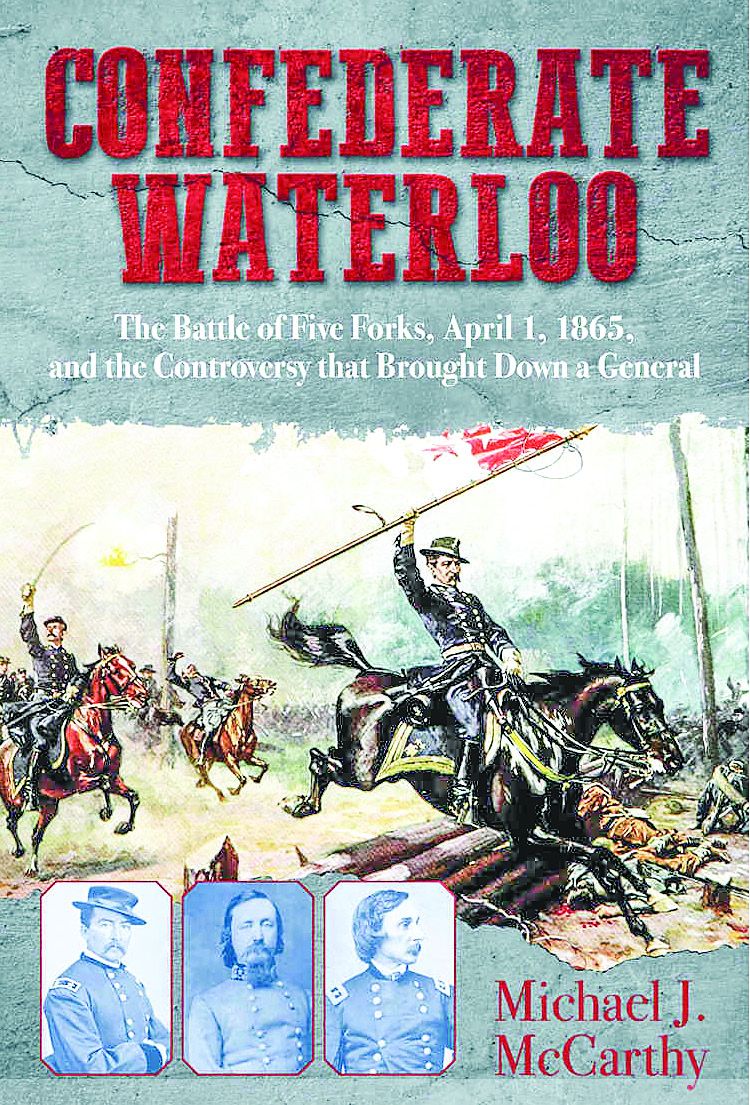
Confederate Waterloo: The Battle of Five Forks, April 1, 1865, and the Controversy that Brought Down a General. By Michael J. McCarthy. Maps, photos, notes, appendices, index, 336 pp., 2017, Savas Beatie, www.savasbeatie.com, $32.95 hardcover.
By the latter part of March, 1865, the Union armies in Virginia under Lt. Gen. Ulysses S. Grant were poised to strike a final blow against Gen. Robert E. Lee and the Army of Northern Virginia. Since the previous June, Grant and Lee had been locked in a siege around Richmond and Petersburg. The Federal target was Lee’s last supply line, the Southside Railroad. Emboldened by the return of the Maj. Gen. Philip Sheridan and his cavalry of the Army of the Shenandoah, Grant planned a final offensive. Late in the month, Grant dispatched Sheridan west in an effort to capture the rail line. Sheridan was to cooperate with the commander of the V Corps, Maj. Gen. Gouverneur Warren. Aware of the threat, Lee sent Maj. Gen. George Pickett to confront Sheridan. The Confederates struck on March 31 and drove Sheridan back to Dinwiddie Court House. After some initial success, Sheridan brought up reinforcements and Pickett withdrew to a crossroads known as Five Forks. The following day, in coordination with Warren, Sheridan launched an attack that shattered Pickett’s position. In the aftermath of the victory, Sheridan relieved Warren from command. Devastated, Warren set out to convene a court of inquiry. Stonewalled throughout the Grant administration, Warren was finally granted his request by President Rutherford B. Hayes. Convening at Governor’s Island in December 1879, the court met for nearly two years. Among the witnesses who testified were Grant and Sheridan. Unfortunately, Warren passed away before the court’s findings were released. Five Forks and Warren’s removal became and remains one of the most controversial episodes of the American Civil War. Michael J. McCarthy has successfully recounted the closing days of the war and Warren’s subsequent fight to clear his name. Utilizing a variety of primary sources, he focuses on Warren’s actions leading up to Five Forks and the V Corps’ role in the engagement. He chronicles Warren’s efforts after the war and follows him through the court of inquiry and its aftermath. The text is supplemented by outstanding maps by cartographer George Skoch. McCarthy’s writing is quick paced and easy to read. The chapters on the court are outstanding. He takes a very complicated subject for a reader, court testimony, and synthesizes it into a very clear narrative. Additionally, the book has appeal for a variety of audiences. Students of the war in Virginia, the life of Gouverneur Warren and the army’s judicial process will find McCarthy’s work to be fascinating and engaging. It is highly recommended. Daniel T. Davis is the co-author of six books in the Emerging Civil War Series published by Savas Beatie, LLC. He is a Managing Editor of the Emerging Civil War blog and resides in Fredericksburg, Va.
Miller’s Millinery Lynnette R. Miller, proprietress www.bonnets.com Bonnets, Caps & Accessories Constructed with period techniques Serving Living Historians since 1990
Dirt-Eye View of the Overland and Petersburg Campaigns
The Army of the Potomac in the Overland and Petersburg Campaigns: Union Soldiers and Trench Warfare, 1864-1865. By Steven E. Sodergren. Maps, tables, photos, notes, bibliography, index, 400 pp., 2017. Louisiana State University Press, www.lsupress.com. $47.95 hardbound.
Reviewed by Tim Talbott
Just as tactical fighting methods evolved during the Civil War, so did the ways soldiers perceived their military service. Changes in soldier sentiment developed from many factors; from styles of command, to political fluctuations, to a proper flow of supplies and medical care, among many others. The Overland Campaign of May and June 1864 brought a rather new high-intensity and sustained style of combat that wore on the physical and mental capacities of those on the front lines. While relentless pressure on the Army of Northern Virginia by the Army of the Potomac from the Wilderness to Cold Harbor resulted in significant territorial gains, it also produced an enormous list of killed, wounded, captured, and missing soldiers. It is not difficult to see how such sustained fighting and losses could sap the soldiers’ bodies and minds. Steven E. Sodergren has produced a noteworthy book that uses a soldier-eye-view approach to describe the effect the last year of fighting had on the soldiers of the Army of the Potomac, and how they adapted to various changes. Sodergren tellingly covers how, after the meat-grinder fighting of the Overland Campaign, the majority of the army found an opportunity (relatively speaking) to rest and refit during the more static (at least as far as geographical movement was concerned) Petersburg Campaign. Although certainly not devoid of combat, the fighting around Petersburg allowed for breaks between engagements, time the Union army used to relocate their motivation to finish the war, which many soldiers had seemingly lost by the end of Overland Campaign. Sodergren’s book helps fill a scholarly void that J. Tracy Power’s Lee’s Miserables: Life in the Army of Northern Virginia from the Wilderness to Appomattox partially filled. Power gave us the Confederate soldiers’ experience, and now, with this volume, we have the Union side as well. The strength of Sodergren’s book is his use of rich primary sources as evidence to support his thesis. He perhaps could have widened the pool of soldiers included for source information, as he often uses the same men to comment on multiple issues; however, those he utilizes provide solid depth. It would also have been a bonus to get a firmer grasp of whether African American soldiers experienced the Petersburg trenches differently than their white comrades. We get some comment from white field officers of USCT units, but sparingly little from the black enlisted men themselves. However, a practical lack of readily available USCT sources likely contributed to this shortage of coverage. The Army of the Potomac in the Overland and Petersburg Campaigns adds considerably to our understanding of these campaigns by supplementing previous works such as Earl J. Hess’s two fine volumes (Trench Warfare Under Grant and Lee: Field Fortifications in the Overland Campaign [2007] and In the Trenches at Petersburg: Field Fortification and Confederate Defeat [2009]) by giving the reader a better idea of the day-to-day experiences of the common Union soldier who filled the trench systems that Hess so aptly describes. Similarly, Sodergren’s focus on the soldiers’ experiences complements well the recent and thorough more tactical-based publications on different Union offensives of the Petersburg Campaign, such as The Battle of Petersburg, June 15-18, 1864, by Sean Michael Chick, and Richmond Must Fall: The Richmond-Petersburg Campaign, October 1864, by Hampton Newsome. Finally, with the publication of The Army of the Potomac in the Overland and Petersburg Campaigns, we get a better idea of how support services usually taken for granted—such as regular mail service, more consistent and higher quality food rations, adequate opportunities for rest, improved facilities to treat sick and wounded men, and a reliable transportation system (the United States Military Railroad)—can make an enormous difference to the fighting men. It was a combination of all of these amenities that solidified an ebbing morale among the soldiers and ultimately helped pave the path to Union victory and an end to the war. Tim Talbott is the Associate Director of Education, Interpretation, Visitor Services, and Collections at Pamplin Historical Park and the National Museum of the Civil War Soldier in Petersburg, Va. He has most recently been researching the Park’s Wiley Sword Collection for soldiers’ experiences during the Petersburg Campaign for a monthly column in Petersburg’s The Progress Index newspaper.
Reconstruction: A History of Corruption, Control and Capitalism Southern Reconstruction. By Philip Leigh. Illustrations, notes, bibliography, index. 288 pp. Westholme Publishing. www.westholmepublishing.com. $29.95 hardcover. Reviewed by Wayne L. Wolf
Reconstruction did not end in 1877 as is commonly taught. This book utilizes factual analysis to extend the work of such pioneers as Kenneth Stampp (The Era of Reconstruction [1965]) and C. Vann Woodward (Origins of the New South [1951]) to show how previous emphasis on racial equality misses the South’s economic descent to become merely the doormat for Northern capitalism. High tariffs, discriminatory banking laws, injurious monetary policies, excessive taxes, crippling railroad subsidies, gouging by Northern trusts and most importantly political exploitation kept the South in poverty, illiteracy and economic peonage for a century after the Civil War. Racial equality, long the mantra of Radical Republicans, took a back seat to greed, political dominance and punishment. The South was to be nothing more than a subjugated province whose resources were mined for the benefit of the North and the dominance of Radical Republicanism. The author forecasts how this exploitation led to the South’s myth of the Lost Cause where the dignity of its past, the valor of its soldiers, and the uplifting of sectional pride was all it had left. This is still a battle being fought today over the preservation of the Confederate past and the fight for a fair share of federal largesse to make up for decades of exploitation. Radical Reconstruction was thus characterized by incompetence and corruption where newly freed slaves, carpetbaggers and scalawags engaged in an orgy of theft, mismanagement and political skullduggery. The result was a South unable to restart its economy after the war and burdened with increased debt, higher taxes, educational deficiency and the migration of the best and brightest to the North. Ultimately this led to increased racial animosity, a fracturing of the Republican Party, the rise of the solid Democratic South and decades of subsistence living and endemic poverty. World Wars I and II serve as excellent examples of the impact of different reconstruction policies. The crushing debt imposed on Germany after WWI led to a decimated economy (much like the South). The result was the rise of Hitler. Conversely, after WWII Americans assisted Germany and Japan in rebuilding and incubated vibrant economies and political allies. How different the South may have developed if Reconstruction would have followed benevolent Lincolnian policy. Perhaps white and black would have coalesced to the benefit of both and the lingering effects of slavery consigned to history. The only criticism of the data is the author’s use of vague descriptors, e.g., a Confederate general or an attorney general, where naming these individuals would clarify the text. Likewise, black elected leaders like P.B.S. Pinchback are either omitted or again referenced only by position. Regardless, this book would be a welcome addition for researchers of Southern Reconstruction, the rise of the Klu Klux Klan or Southern Democratic politics after the war. Wayne L. Wolf is Professor Emeritus at South Suburban College of Illinois and Past President of the Lincoln-Davis Civil War Roundtable. He is currently researching newly discovered letters of Bvt. Brig. Gen. Clark Edwards of the 5th Maine Regiment.
Memorializing a Massacre: The Crater Remembering the Battle of the Crater: War as Murder. By Kevin M. Levin. Notes, bibliography, 184 pp., 2017, University Press of Kentucky, www.kentuckypress.com, $24.95 paperback. Reviewed by Joseph Truglio
My first impression was, this is going to be just another Crater book! However, just a few pages in I realized this was not the case. Over the past decade there have been several excellent tellings of this story. Most are micro-managed accounts of the activities leading up to, descriptions of the action and its tragic aftermath. Most are highly opinionated accounts and virtually all leave out certain aspects of the affair, including participation of African Americans and responsibility for events that happened. That is not the case here. In just 139 pages of text Mr. Levin describes the planning, battle and aftermath in succinct fashion. It is well annotated and has a very pertinent list of references. However, it is not about the battle. There are many other good sources for that; Remembering the Battle of the Crater is about how this event was and is perceived in history. We are given detailed information on the influence of “The Lost Cause” on the memory of the battle, on how difficult it has been over the years to acknowledge AfricanAmerican participation, and on the surprisingly little assistance the Federal government afforded in the creation of a battlefield park that included African Americans. Each chapter deals with a different aspect of “historical memory,” but perhaps the most important one is the last chapter. It is here that Mr. Levin brings all aspects of the story to fruition. In this age of political correctness and controversy over “memorials,” I am sure this book will add fuel to the fire. Yet, in spite of this, I applaud the author on his courage to deal head-on with the issues presented here. His straightforward, non-opinionated style is refreshing. Overall, it is a well written book. I thoroughly enjoyed it. My disappointments were few. I would have liked to have seen a bit more on the Union leadership’s failure to use the USCT as originally planned, but I guess that is for another book. That aside, I highly recommend this book for its unique content and welcome its divergent opinion. It is a bit pricy for a short paperback, but worth the cost. Joseph Truglio is a lifelong student of the American Civil War. He is currently President of the Phil Kearny Civil War Round Table in Wayne, N.J., and is researching the life of John M. Chivington.